Short answer
In 2026, publishing more SEO content is not automatically a growth strategy. For many sites, especially B2B, SaaS, ecommerce, and service businesses with years of blog archives, the better move is to publish fewer new pages and make the existing topic system easier for Google, AI Overviews, ChatGPT-style answer engines, and buyers to understand.
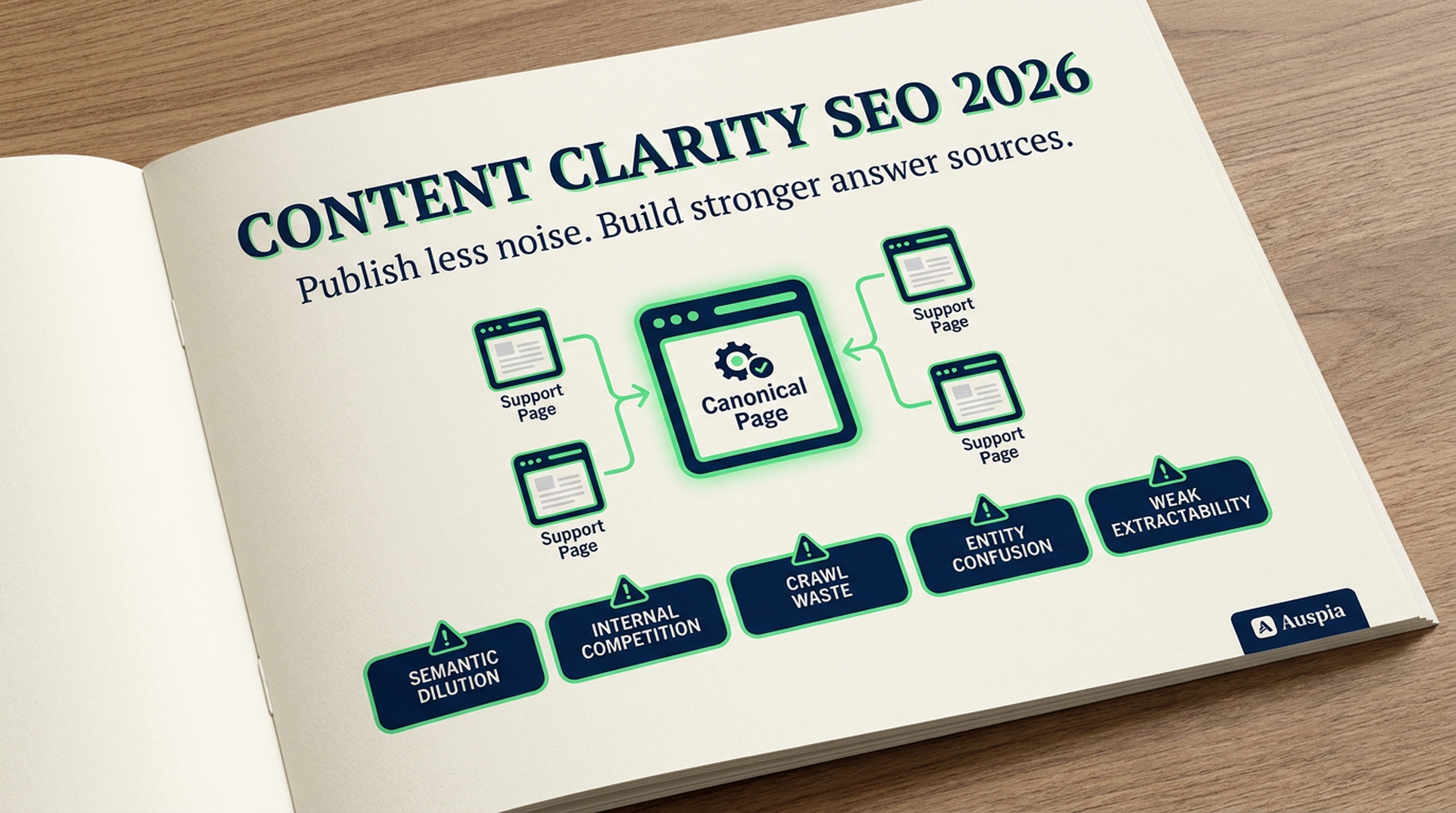
The problem is not content volume by itself. The problem is unclear volume: near-duplicate guides, overlapping comparison pages, weak location pages, thin FAQ articles, and old posts that all answer the same question in slightly different ways. Those pages split semantic signals, waste crawl attention, confuse internal links, and make it harder for AI systems to identify the best answer to cite.
Auspia's view is simple: 2026 SEO is becoming a clarity game. Before adding another article, decide which page should be the canonical answer, which pages support it, and which pages should be merged, redirected, or retired.
Why this matters in 2026
A lot of content programs still run on an old assumption: more pages mean more chances to rank.
That was often true when search visibility came mostly from document-level ranking. If a team published enough posts around enough long-tail phrases, some of them would pick up impressions, links, or conversions. Even average pages could work if the site had enough authority and the keyword set was broad enough.
Search no longer behaves that neatly.
Google still crawls and ranks pages, but users now meet search results through AI summaries, answer boxes, shopping modules, forum snippets, video results, and assistants that retrieve pieces of pages instead of treating every URL as a full destination. AI answer systems are not looking for "another article on the same topic." They are looking for the cleanest source of a fact, explanation, comparison, or procedure.
That changes the content job. Your site has to help machines and humans answer three questions quickly:
- What is this brand or author actually authoritative about?
- Which URL is the best source for this specific answer?
- Can the answer be extracted without reading around a mess of repetitive pages?
If the site cannot answer those questions, publishing more may make the system noisier.
The hidden cost of "just publish more"
Content bloat rarely looks dangerous at first. It usually starts with reasonable requests:
- "Let's make a blog post for every keyword variation."
- "Let's create a separate page for every city."
- "Let's refresh this guide by publishing a new version instead of updating the old one."
- "Let's have AI generate supporting posts for the cluster."
Each decision seems harmless. The damage shows up later, when the site has 12 pages that all explain the same buying criteria, 30 posts that repeat the same definition, and internal links that point everywhere except the page that should matter most.
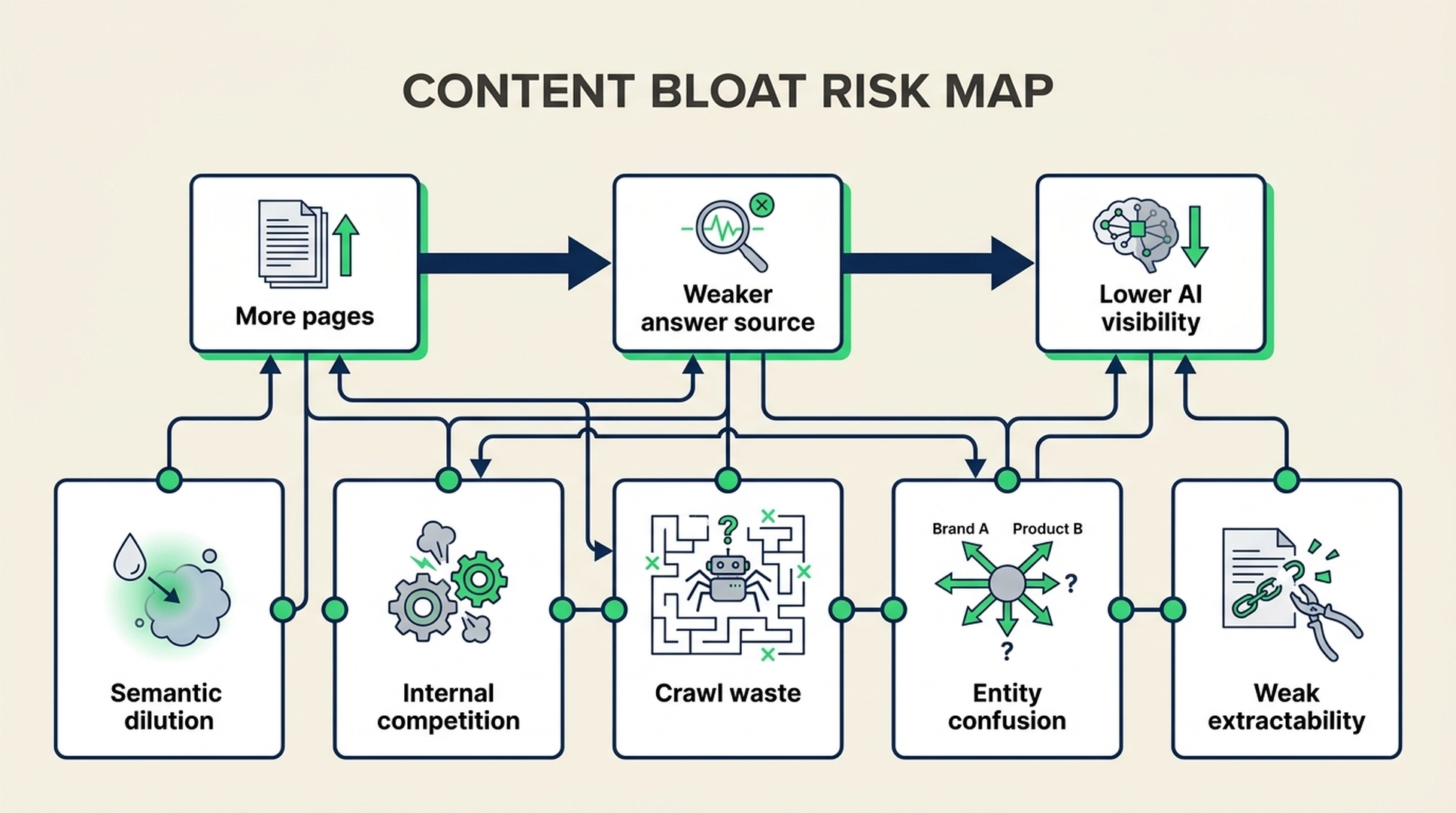
Here is the practical risk map.
Risk | What it looks like | Why it hurts SEO and AI visibility |
|---|---|---|
Semantic dilution | Many URLs answer the same question with minor wording differences | Search and AI systems get weaker signals about the canonical answer |
Internal competition | Similar pages rank, drop, or swap positions for the same query family | Authority, links, and engagement are split across URLs |
Crawl waste | Crawlers spend time on thin, old, filtered, or repetitive pages | Important pages may be discovered, refreshed, or evaluated less efficiently |
Entity confusion | The site publishes across too many loosely related topics | The brand looks less clearly associated with a topic or expertise area |
Weak extractability | Long intros, vague headings, and buried answers | AI systems have a harder time pulling concise passages for answers |
This is why a site can publish more and still lose visibility. The content program is active, but the information architecture is getting worse.
Semantic dilution is the new content cannibalization
Old-school keyword cannibalization was easy to explain: two pages target the same keyword, so they compete with each other.
In 2026, the issue is wider. Pages compete at the semantic and retrieval level too. A page may not use the same primary keyword, but it can still cover the same intent, same entities, same examples, and same answer blocks.
For example, a SaaS company might have these pages:
- "What is AI search optimization?"
- "How to optimize for AI search"
- "AI search optimization checklist"
- "GEO vs AI SEO"
- "How brands appear in ChatGPT answers"
- "2026 guide to AI answer visibility"
Those could be a strong cluster if each page has a clear job. But if every page repeats the same definition, the same benefits, and the same generic checklist, the cluster is not stronger. It is blurrier.
A better structure would assign one primary role to each URL:
Page type | Job | What to avoid |
|---|---|---|
Pillar page | Explain the main concept and own the broad definition | Rewriting the same overview into five posts |
Checklist page | Give an operational audit sequence | Repeating the pillar intro for half the article |
Comparison page | Help users choose between two approaches | Turning into another generic guide |
Tool page | Let users run a check or generate an output | Hiding the tool behind long marketing copy |
Case or experiment | Show evidence, constraints, and lessons | Pretending illustrative examples are real results |
The question is not "Can we create another page?" The question is "What unique job does this URL do that no existing URL does better?"
How AI search changes the content standard
AI search raises the bar for structure, not just quality.
A human reader can tolerate a little wandering. A retrieval system is less patient. It needs headings, paragraphs, entities, tables, and answer blocks that make the page easy to chunk and quote. If your strongest insight is buried under a 500-word introduction, the page may still be useful to a loyal reader, but it is a poor answer source.
For AI search visibility, a strong page usually has these traits:
- The direct answer appears near the top.
- Headings describe the question being answered.
- Important entities are named consistently.
- Definitions, steps, and comparisons are separated cleanly.
- Tables summarize choices, criteria, or tradeoffs.
- FAQs answer real follow-up questions without padding.
- Internal links make the site hierarchy obvious.
This is where content pruning and content design meet. You are not only deleting weak pages. You are building a cleaner retrieval surface.
If you want a quick diagnostic, run important URLs through an AI Search Visibility Checker and compare which pages are easy to summarize, cite, or extract. Then look at the pages that compete with them. Often the issue is not one bad page. It is a messy cluster.
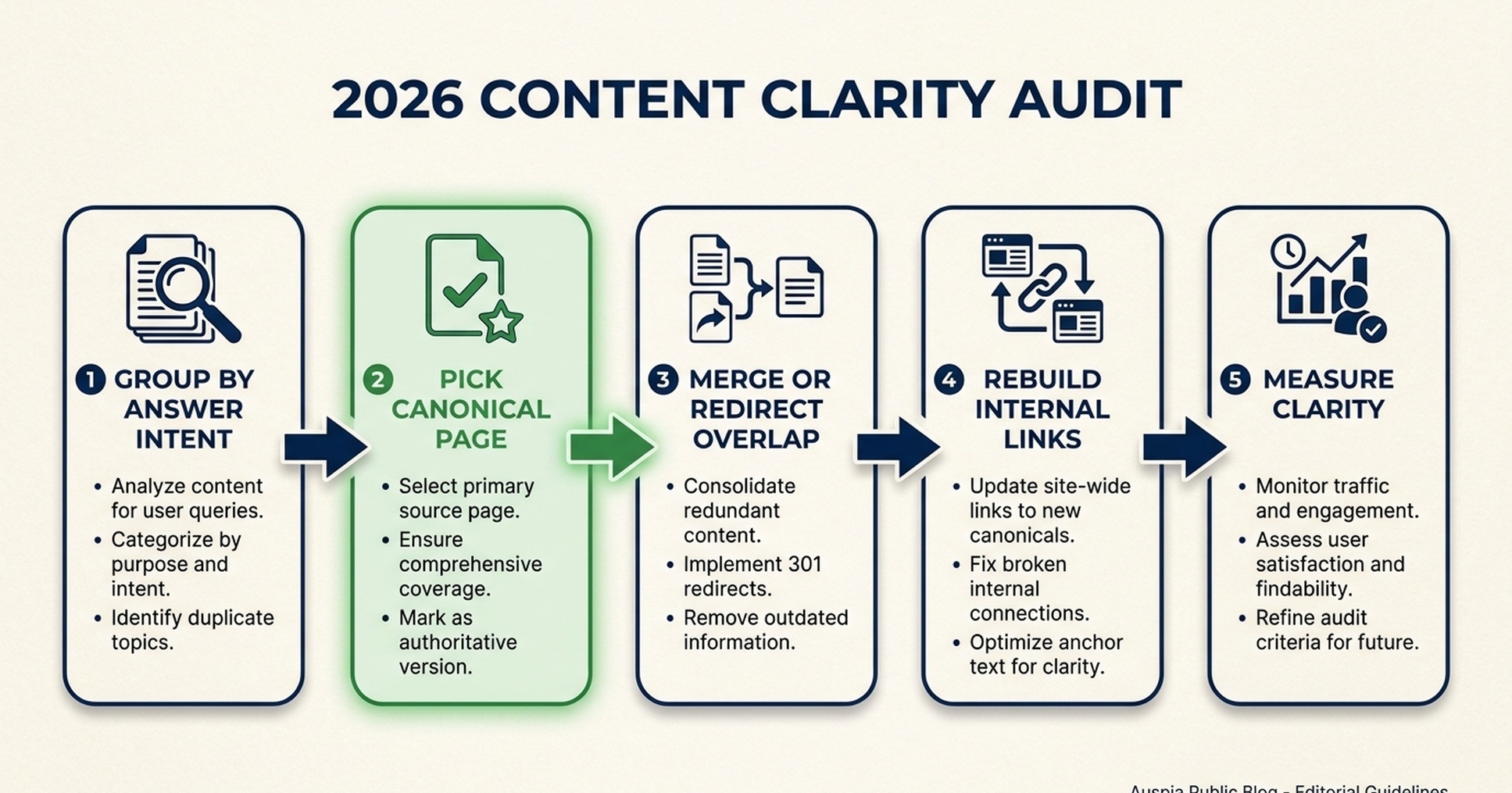
A 2026 audit workflow before you publish again
Before assigning the next batch of articles, audit the existing topic set. This workflow works for SEO teams, founders, content leads, and agencies.
Step 1: group URLs by answer intent
Do not start with keywords. Start with the question each page answers.
Create a spreadsheet with these fields:
Field | Example |
|---|---|
URL | /blog/ai-search-optimization-guide |
Primary answer | How should a brand optimize for AI search? |
Page role | Pillar, checklist, comparison, case, tool, FAQ, category |
Target user | Founder, marketer, developer, agency, buyer |
Main entities | AI search, GEO, Google AI Overviews, ChatGPT, citations |
Conversion path | Audit, tool, demo, newsletter, product signup |
Keep / merge / redirect / update | Update |
This forces the team to see overlap. If five URLs have the same primary answer, at least four of them need a clearer role.
Step 2: choose the canonical answer page
For each topic group, pick the URL that should become the main answer source. Usually it is the page with the best backlinks, conversions, freshness, or structure. Sometimes it is not the page currently ranking.
Then decide what happens to the rest:
- Merge useful sections into the canonical page.
- Redirect outdated duplicates if there is no unique value left.
- Keep a support page only if it owns a distinct sub-intent.
- Rewrite pages that have a valid role but weak structure.
- Noindex low-value utility pages that should exist for users but not search.
Do not merge mechanically. If two pages serve different buyer stages, keep them separate and clarify the links between them.
Step 3: rebuild internal links around hierarchy
Internal links should show which page is the hub and which pages are supporting evidence.
A common mistake is linking every related phrase to every related article. That feels comprehensive, but it gives no priority signal. Instead, use a hub-and-support pattern:
- Support pages link up to the pillar page with descriptive anchor text.
- The pillar page links down to the most useful support pages.
- Tool pages are linked where a reader has a real action to take.
- Old posts stop pointing to outdated versions of the same answer.
For large sites, this one change can clarify the topic map quickly.
Step 4: make the canonical page extractable
Once a page is chosen as the main answer, make it easy to quote. Add a short answer near the top. Rewrite vague headings. Turn long comparison paragraphs into a table. Add a concise FAQ. Use direct sentences.
A good test: if someone copied only the first 120 words under each H2, would the argument still make sense?
Step 5: change the KPI
If the team is measured only on publishing volume, the bloat will return.
Replace "number of posts published" with a healthier mix:
Old KPI | Better 2026 KPI |
|---|---|
Blog posts per month | Topic groups clarified per month |
Keywords targeted | Search intents owned |
Word count shipped | Pages updated, merged, or improved |
Organic sessions only | Organic sessions, assisted conversions, AI visibility, citations |
Content velocity | Useful answer coverage |
Publishing still matters. It just cannot be the only visible output of the content team.
When more content still makes sense
This is not an argument for freezing your blog.
More content is useful when it adds a new answer, a new audience, a new format, or new evidence. A product-led company may need new comparison pages as competitors change. A local service business may need new pages when it enters a new market. A research-heavy team may publish experiments that deserve separate URLs.
The standard is simple: new content should increase clarity, not just coverage.
Publish a new URL when at least one of these is true:
- The user intent is meaningfully different from existing pages.
- The page targets a different stage of the buying journey.
- The content contains new data, examples, or evidence.
- The format is different enough to serve a different use case, such as a calculator, template, or checklist.
- The page supports a strategic entity you want the brand to be associated with.
If none of those are true, update an existing page instead.
Auspia take: content strategy now needs an editor and an architect
The strongest 2026 SEO teams will not be the teams that publish the most. They will be the teams that know what each URL is supposed to do.
That requires two roles, even if one person holds both.
The editor protects usefulness: Is the page saying something specific? Is it current? Is it worth a reader's time?
The architect protects meaning: Where does this page sit in the topic map? Which URL is the main answer? What should be merged? Which internal links tell search systems what matters?
AI makes content production cheaper. That is exactly why editorial architecture matters more. When anyone can generate 100 articles, the advantage moves to the team that knows which 20 should exist and how they should connect.
A practical starting point is to audit one topic cluster, not the whole site. Pick a revenue-relevant theme, export every related URL, and decide what each page should do. If the cluster gets clearer, repeat the process.
For a broader diagnostic, use Auspia's Website SEO Score Checker to find structural issues, then pair it with a manual content overlap review. Tools can surface the symptoms. A person still has to decide the page's job.
2026 content clarity checklist
Use this before creating a new article brief:
- Can we name the one question this page should answer?
- Does another URL already answer it well enough?
- If this is a support page, does it link clearly to the hub?
- If this is the hub, do support pages link back to it?
- Is the direct answer visible in the first section?
- Are entities, product names, and category terms used consistently?
- Can a table, checklist, or FAQ make the page easier to extract?
- Should old pages be merged or redirected before this new page goes live?
- Does the page support a business goal, not just a keyword target?
- Will publishing this make the topic map clearer?
If the last answer is no, do not publish yet.
FAQ
Is publishing more content bad for SEO in 2026?
No. Publishing more content is bad when the new pages repeat existing answers, split authority, or make the site harder to understand. New content still helps when it covers a distinct intent, adds evidence, or supports a clear topic architecture.
What is semantic dilution in SEO?
Semantic dilution happens when a site spreads the same topic across too many similar URLs. Instead of one strong answer source, search and AI systems find many weaker candidates. That can reduce ranking stability and make AI citation less likely.
Should I delete old blog posts?
Sometimes, but deletion is not the first move. Start by grouping posts by intent. Keep pages with unique value, merge useful material from overlapping pages, redirect duplicates where appropriate, and update pages that should remain canonical.
How many blog posts should a company publish each month?
There is no universal number. A small team with a tight topic map may get more value from updating five important pages than publishing 20 thin posts. The better question is how many search intents the team can cover well without creating overlap.
How does this affect AI search optimization?
AI search systems retrieve passages, compare sources, and generate answers. Clear pages with direct answers, consistent entities, useful tables, and strong internal hierarchy are easier to retrieve and cite than clusters of repetitive content.