Quick answer
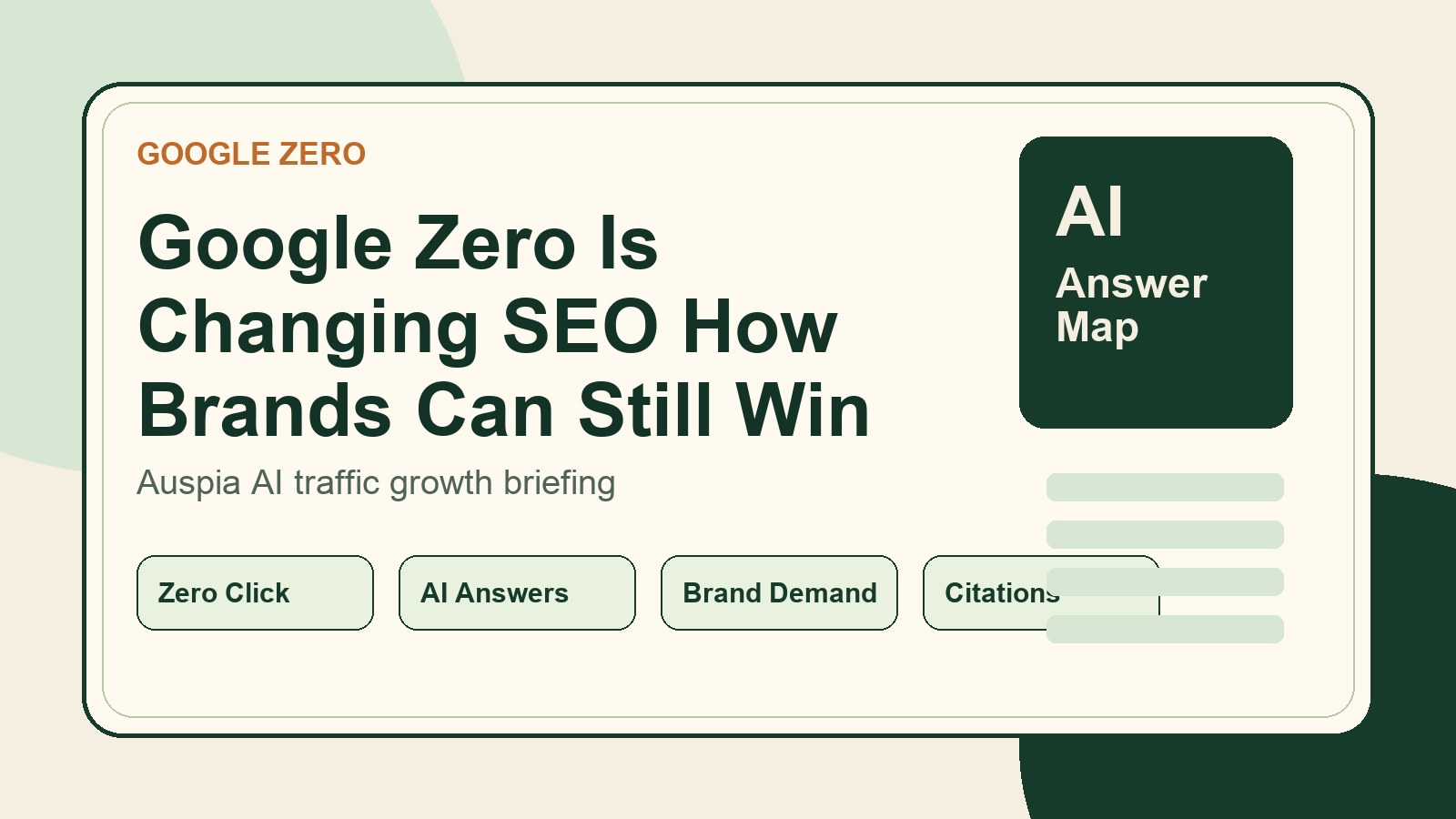
Google Zero does not mean SEO is dead. It means the job has moved from winning only blue-link clicks to becoming the source, entity, and answer that AI systems trust enough to summarize.
For growth teams, the practical question is not whether the keyword is trending. The question is whether the query can teach you how people ask, how AI systems summarize, and what kind of source earns trust. Auspia treats these topics as search-behavior signals, then turns the useful ones into durable SEO, GEO, or AEO assets.
Signal | What to check | Why it matters |
|---|---|---|
Intent | What does the user need now? | Prevents traffic chasing |
Source standard | Who would AI trust? | Shapes citation strategy |
Freshness | How fast does the answer change? | Defines update cadence |
Business fit | Can this support a buyer journey? | Keeps content useful |
What Google Zero really changes
The old model was simple enough: rank, earn the click, convert on the site. AI answer surfaces change the sequence. A user may get the definition, shortlist, comparison, and next step before visiting any page. That hurts pages built only for shallow information capture, but it can help brands with clear entities, original evidence, and decision-ready pages. The question is no longer only "can we rank?" It is also "can an answer system understand and reuse our information accurately?"
The new visibility stack
Teams need to track four layers: classic rankings, AI answer mentions, citations, and downstream branded demand. A page can lose clicks but still influence a buyer if the brand appears inside an answer. That influence is hard to see in analytics unless you build prompt tracking and compare branded search, direct visits, assisted conversions, and sales notes.
Content decision | Recommended action |
|---|---|
If the query changes daily | Use a dated brief or live page |
If the query is evergreen | Build a durable guide or glossary page |
If trust is the issue | Add sources, evidence, and entity facts |
If AI misdescribes the brand | Rewrite the core entity page first |
What to change first
Start with pages that define the brand and its category. Rewrite vague hero copy, add answer-first summaries, connect claims to proof, and make comparison pages honest enough for AI to reuse. If the site has original data, put it in crawlable text and tables. If the brand has strong customer examples, make the context and limitation visible.
Auspia workflow
Use a small prompt library: definition prompts, comparison prompts, recommendation prompts, risk prompts, and pricing prompts. Run them monthly across Google AI Overviews, ChatGPT, Perplexity, and Gemini. Record whether your brand appears, how it is described, and which source URL supports the answer.
Checklist
A Google Zero-ready page should answer the query in the first screen, name the entity clearly, include a concise table or list, cite its own evidence, link to a deeper page, and give the user a next step that still matters after the AI summary.
What Auspia would do next
Auspia would not start by publishing ten disconnected posts. We would build a prompt set, map it to pages, check current AI answers, then decide which page type has the best chance to improve visibility. For many teams, the first useful action is a small visibility audit with the AI Search Visibility Checker, followed by a page rewrite and a repeat check two to four weeks later.
FAQ
Is this topic mainly SEO or GEO?
It is both. SEO helps the page become crawlable, indexable, and competitive in search. GEO adds the answer-readiness layer: clear entities, extractable claims, trustworthy evidence, and measurement across AI answer surfaces.
How should a small team start?
Start with one high-intent query group, rewrite the page that should answer it, add a concise table or checklist, and test the page against five AI prompts before expanding the project.
What should we measure?
Track rankings, impressions, AI mentions, citation URLs, description accuracy, branded search lift, assisted conversions, and sales notes. One metric will not explain the full impact.
Author: Owen Hartwell, Google AI Overview Tracker Across 40+ Verticals at Auspia. Owen writes about Google AI Overviews, search AI features, and the practical changes teams need to make when search pages become answer pages.