The useful version of the argument
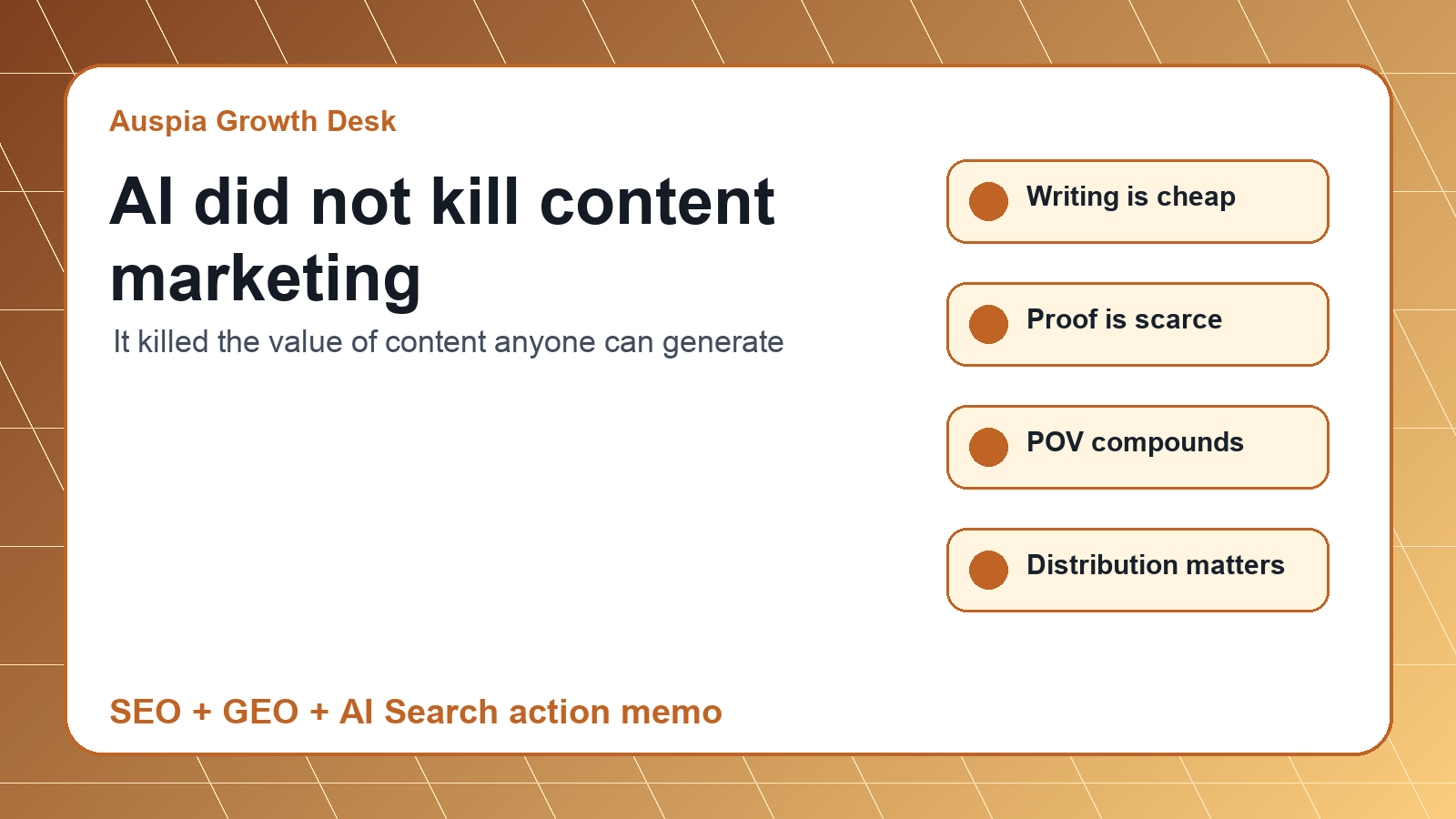
AI did not kill content marketing. It killed the idea that "we can write" is a competitive advantage.
A SaaS SEO practitioner framed it well on X: when everyone can generate 100 articles a month, writing capacity stops being the scarce asset. The scarce asset becomes judgment. What should exist? What should not be published? Which claim can the company actually defend? Which page deserves promotion, links, expert review, or product proof?
That is the part many AI content programs skip.
The old moat is gone
For years, small teams could win by being more consistent than larger competitors. Publish helpful pages, cover the long tail, answer questions clearly, and let compounding do the work.
That still matters. But AI changed the cost curve.
A small company can now produce a large topic map. A large company can refresh thousands of pages. A solo operator can create comparison pages, product guides, glossaries, and email sequences in a week. The old production advantage has been flattened.
The bad response is to publish more mediocre content. The better response is to move up the stack.
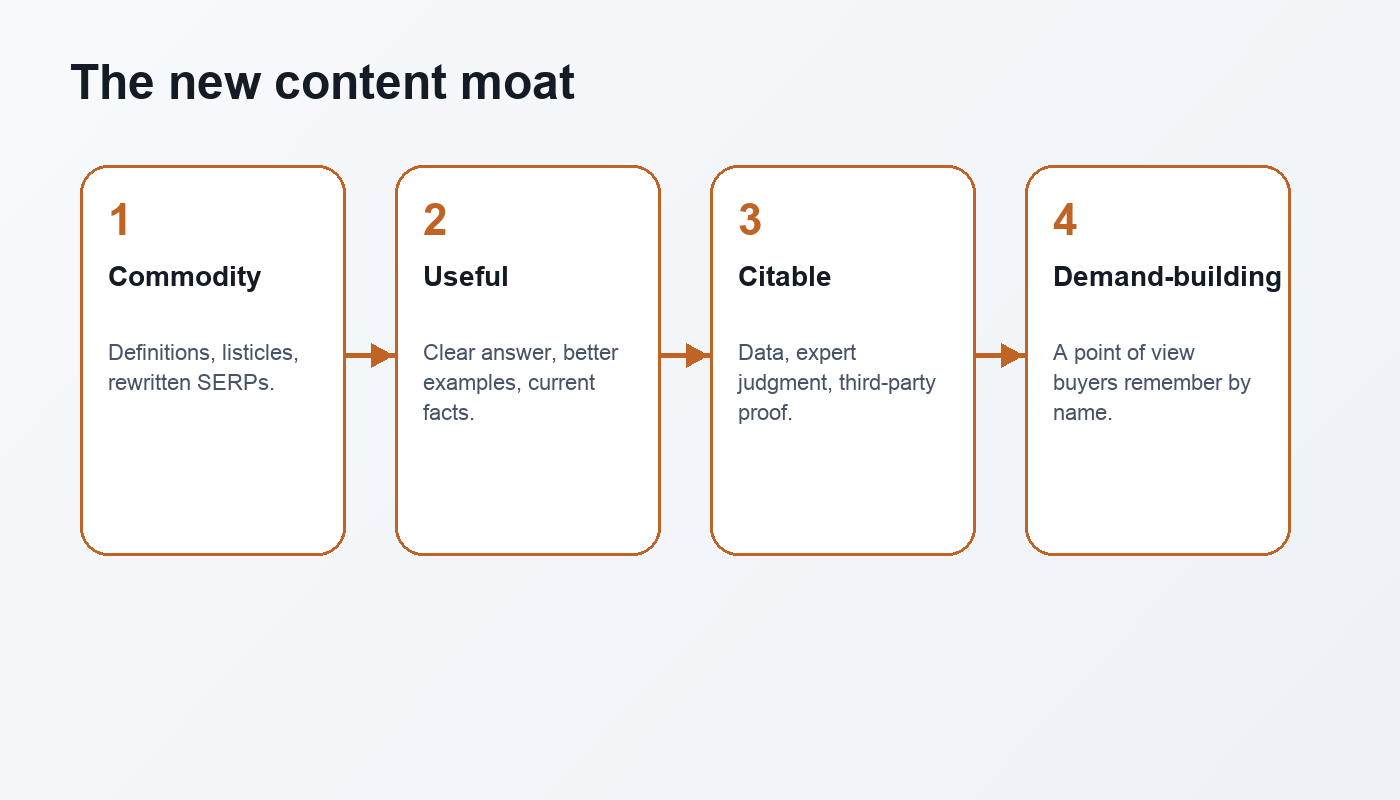
Layer | What it looks like | Can AI produce it alone? | Search value |
|---|---|---|---|
Commodity content | Generic definitions and rewritten SERPs | Usually yes | Weak and fragile |
Useful content | Clear answers with examples and structure | Partly | Moderate |
Citable content | Data, sources, expert review, screenshots, and proof | Not alone | Stronger for AI search |
Demand-building content | Original POV, category language, and brand memory | No | Harder to copy |
What content marketing becomes
Content marketing becomes an operating system, not a writing queue.
The best teams will still use AI heavily. They will use it for clustering, briefs, outlines, summaries, refresh candidates, internal-link suggestions, and draft variations. But they will add human judgment in the places that change the outcome:
- Pick topics based on business value, not keyword volume alone.
- Decide which pages deserve original research or product examples.
- Kill pages that exist only because a tool suggested them.
- Add brand-specific language instead of neutral encyclopedia copy.
- Build distribution before the article is published.
This sounds slower. It is often faster, because the team stops maintaining content nobody needed.
The new content moat
A content moat now has four parts.
First, SEO foundations. Pages still need crawlability, speed, internal links, schema, clean titles, and intent alignment. AI does not rescue a weak site architecture.
Second, GEO strategy. If AI answer systems summarize your category, your pages need to be easy to quote, compare, and cite. That means direct answers, evidence blocks, source notes, and a visible brand entity.
Third, brand signals. Search engines and AI systems look beyond your site. Mentions, profiles, reviews, communities, and social presence all help systems decide whether your brand is real enough to surface.
Fourth, editorial taste. This is the part nobody wants to put in a spreadsheet. The page needs a point of view. It should sound like someone chose the angle, not like a model filled the outline.
A simple filter before publishing
Before publishing any AI-assisted article, ask five questions:
- Would this page still be useful if the reader never clicked another result?
- Does it include an example, data point, screenshot, table, or decision rule that is not copied from the SERP?
- Can a buyer understand why our brand has the right to talk about this?
- Would an AI answer system have a clear reason to cite this page?
- Do we have a distribution path beyond waiting for Google?
If the answer is no three times, the article is probably content debt.
Where Auspia fits
Auspia's view is not "write less with AI." It is "stop treating AI output as the asset."
The asset is the system around the output: technical SEO checks, query mapping, AI visibility testing, content refresh rules, entity cleanup, and measurement. AI can make that system faster. It cannot replace the system.
For small teams, the first win is usually not a 100-post content sprint. It is a 20-page repair sprint on pages that already have impressions, leads, or sales value.
FAQ
Is AI content bad for SEO?
No. Low-value content is bad for SEO. AI can help create useful content, but it also makes it easier to publish pages with no evidence, no point of view, and no reason to exist.
What should replace content volume as the main goal?
Use business impact, search intent coverage, citation readiness, and conversion path quality. Volume is only useful when each page has a job.
Can small teams still compete?
Yes, but not by copying enterprise content calendars. Small teams should focus on sharper positioning, faster refresh loops, better examples, and pages that answer specific buyer questions.
What is the first audit to run?
Start with your existing content. Find pages with impressions but weak clicks, pages that rank but do not convert, and pages that have no extractable answer for AI systems.
Sources
- Chris Tweten's X discussion on AI and content marketing: https://x.com/ctwtn
- Related industry discussion on AI repricing commodity content: https://timpeter.com/blog/ai-made-content-free-made-priceless-digital-reset-episode-492/
Author: Clara Bennett, 10-Year Content Strategy Practitioner at Auspia. Clara writes about editorial systems, topic maps, and practical content operations for small growth teams.