Executive summary
A useful GEO question to ask your team is blunt: when people ask AI systems about your category, do you show up at all?
That question feels uncomfortable because many brands still judge content by traditional SEO dashboards. A page can rank in Google and still be almost invisible inside AI answers. The reason is simple. AI search products do not all use the same source mix, retrieval logic, or citation habits.
GEO in 2026 is less about stuffing more keywords into pages and more about making your content good source material for retrieval-augmented generation, or RAG. That means clear answers, structured sections, trustworthy evidence, readable multimedia, and platform-aware distribution.
The practical takeaway: stop publishing one generic asset and expecting every AI engine to treat it the same way. Build a source system that can be retrieved from several places.
Why RAG changed the GEO game
RAG is the reason GEO feels different from old SEO.
A basic RAG workflow works like this:
- A user asks a question.
- The system retrieves relevant material from an index, database, web search layer, knowledge base, or connected source.
- The model combines the user question with the retrieved material.
- The model writes an answer, often with citations or source references.
This is not the same as a search result page. In classic search, your page competes for a click. In RAG search, your content competes to become part of the material the model uses before the user ever clicks.
That changes the content job.
A vague article can still rank if the domain is strong. But a vague article is weak RAG material. AI systems need chunks they can retrieve and use: definitions, steps, tables, parameters, examples, citations, transcripts, alt text, product facts, and clean summaries.
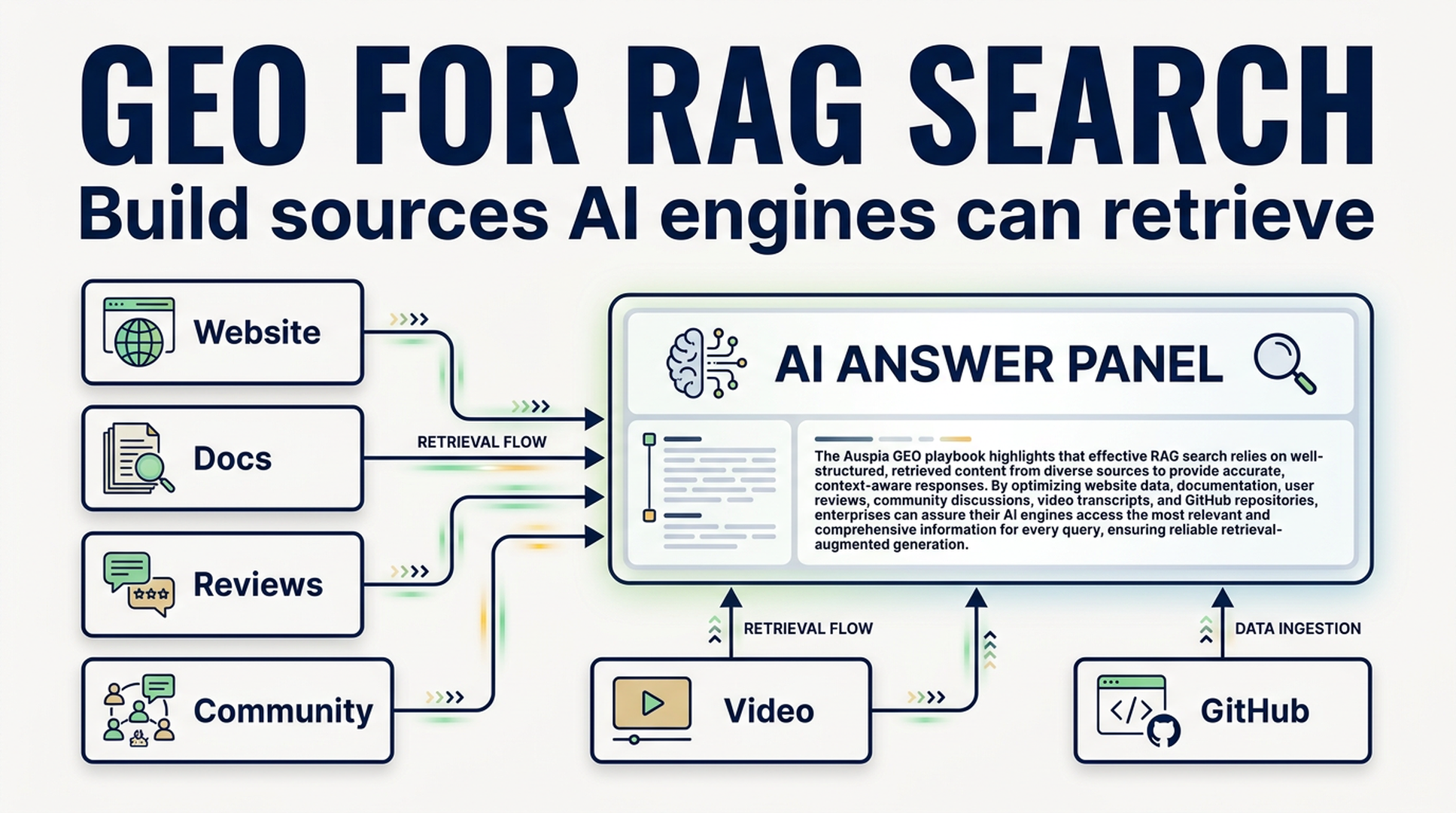
Here is the hard part: each AI search surface has its own source habits. Google AI Overviews, ChatGPT Search, Perplexity, Copilot, Gemini, YouTube search, Reddit discussions, GitHub, Stack Overflow, review platforms, and documentation sites do not behave like one giant neutral machine.
So the old one-size-fits-all content plan is no longer enough.
The platform problem: AI engines have different source diets
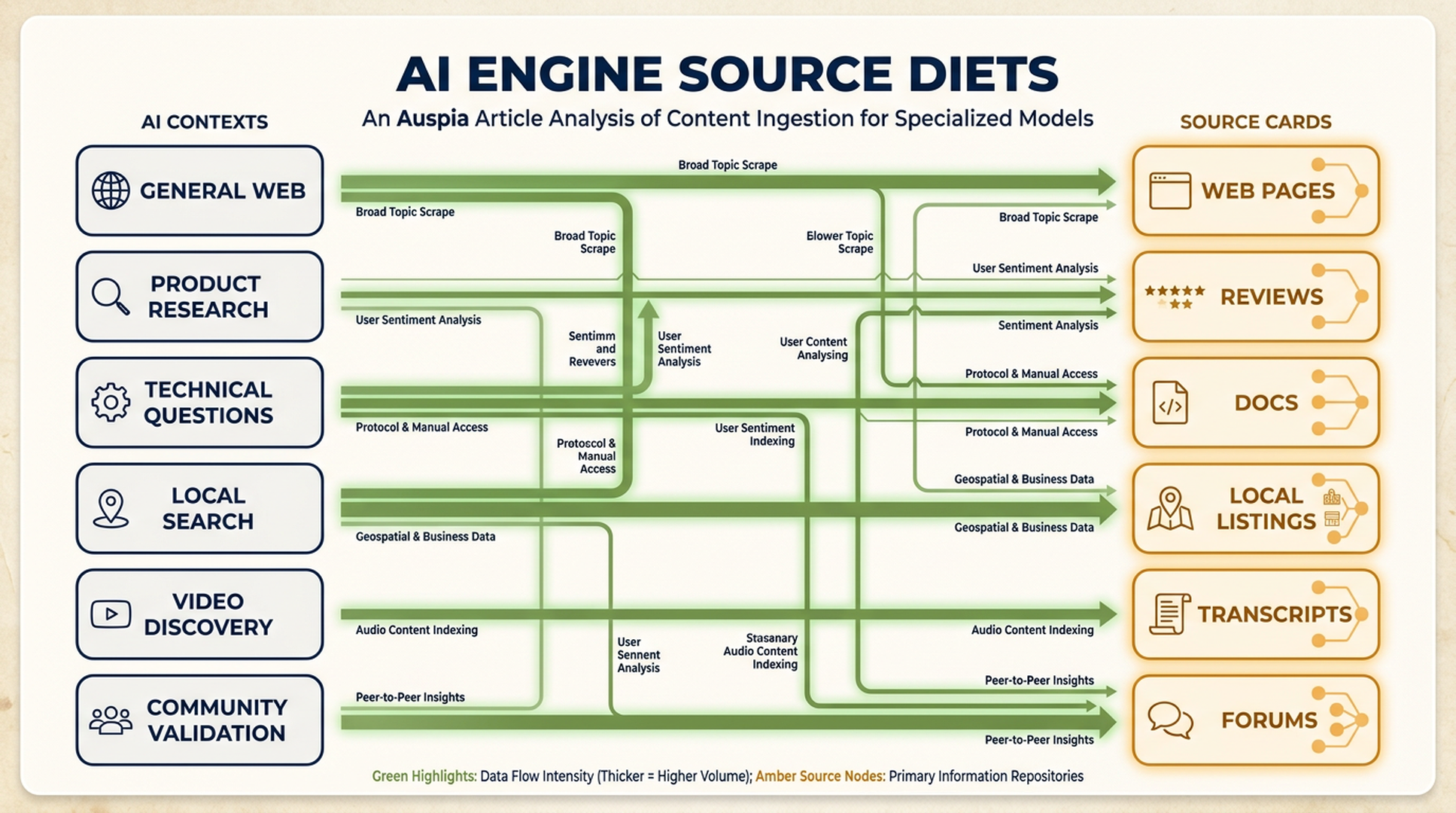
Every AI search product has a source diet. Some lean heavily on web pages. Some surface community discussions. Some cite official docs. Some are strong at news. Some use shopping data, videos, local listings, or structured product feeds.
You do not need to reverse-engineer every model. You do need to know where your category is likely to be retrieved from.
AI search context | Sources that often matter | What to prepare |
|---|---|---|
General web answers | Crawlable pages, news articles, trusted explainers, comparison pages | Clear definitions, citations, current facts, author signals |
Product or software research | Review platforms, docs, marketplace listings, comparison pages, community threads | Feature accuracy, pricing context, integrations, limitations |
Technical questions | Official docs, GitHub, Stack Overflow, API references, changelogs | Code examples, version notes, markdown docs, issue references |
Local or service queries | Local pages, maps, directories, reviews, service-area content | Location facts, services, hours, reviews, proof, schema |
Video-led discovery | YouTube, TikTok, webinars, transcripts, captions, chapters | SRT captions, summaries, timestamps, clear spoken answers |
Community validation | Reddit, Quora, forums, Slack/Discord archives where public, niche communities | Real answers, non-promotional participation, problem-specific advice |
The point is not to post everywhere. The point is to stop acting as if your company blog is the only source AI systems may use.
For GEO, your source footprint is the product.
A practical source map for global teams
Use a source map before you write another article.
Start with one buyer question, such as:
"Which AI search visibility tool should a small SaaS team use?"
Then map the places an AI system might look for evidence:
Source layer | Example assets | GEO role |
|---|---|---|
Owned website | Product page, use-case page, FAQ, pricing page | Canonical facts and conversion path |
Help and docs | Setup guide, integration docs, changelog | Implementation evidence |
Third-party proof | G2, Capterra, Product Hunt, partner pages, analyst mentions | Trust and category validation |
Community answers | Reddit, Quora, relevant forums, LinkedIn comments | Real user language and objections |
Technical proof | GitHub, API docs, schema, sample reports | Verifiability for technical buyers |
Multimedia | YouTube demos, webinar clips, transcripts, diagrams | Discoverability for video and multimodal retrieval |
This exercise usually exposes the real problem. The brand may have a blog post, but no docs. Or it may have reviews, but the category label is wrong. Or it has a great webinar, but no transcript, chapters, or summary page. Or the product page says one thing while the marketplace listing says another.
Those gaps are GEO gaps.
Make text content work like AI source material
Text still matters most, but the format has to change.
A good GEO page should feel a bit like a strong briefing note. It answers the question early, gives the reader enough context, and makes the useful parts easy to lift.
Use this structure for important pages:
- Direct answer in the first 100 words.
- Definition or decision frame.
- Short sections with descriptive headings.
- Comparison table where buyers need tradeoffs.
- Evidence close to the claim.
- FAQ based on real sales or support questions.
- Clear next step.
Avoid the usual mistake: writing a polished thought piece that never says the answer plainly.
For example, a page titled "How to choose an AI SEO platform" should include a sentence like:
Choose an AI SEO platform by checking four things: whether it measures AI answer visibility, whether it audits crawl access, whether it maps missing source pages, and whether it separates traditional SEO issues from GEO issues.
That sentence is useful to a buyer. It is also useful to a retrieval system.
Make video and audio readable by AI
Video is often wasted from a GEO perspective.
A founder records a strong demo. A marketer uploads it. The title is vague, the description is thin, the captions are auto-generated, and the best explanation is buried at minute 17. Humans may still watch it. AI systems have a harder time extracting the answer.
Fix that.
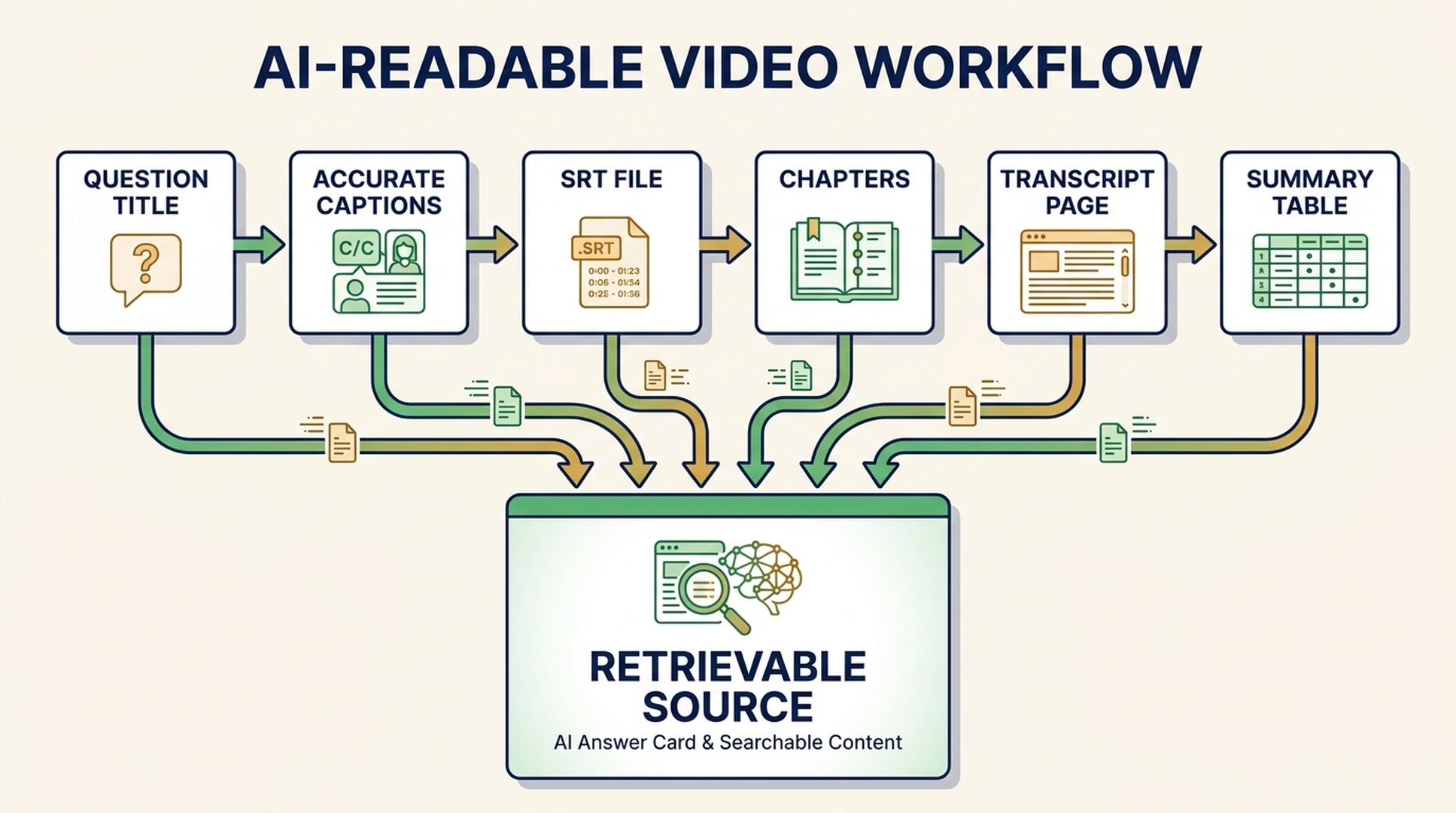
For important videos, prepare:
- A title framed around the question the video answers.
- A 2-3 paragraph description with the core answer near the top.
- Accurate captions or an SRT file.
- Chapters with descriptive labels.
- A transcript page on your website.
- A short summary table with claims, examples, and links.
- Alt text and labels for diagrams used in the video.
Do not treat captions as an afterthought. Captions are source text.
A practical format for a product demo:
Video element | Weak version | Better GEO version |
|---|---|---|
Title | "New dashboard walkthrough" | "How to audit AI search visibility in 10 minutes" |
Description | "Watch our demo" | "This demo shows how to find missing AI citations, blocked crawlers, and weak source pages." |
Chapters | "Intro / Feature / Outro" | "0:00 What the audit checks / 2:10 AI citation gaps / 5:40 Robots and crawler access" |
Transcript | None | Clean transcript with headings and links |
AI cannot use what it cannot parse.
Build channel-specific source assets
Different platforms reward different formats. This does not mean you need separate strategies for every tool. It means each core idea should have a few source versions.
Take one important topic, then produce these four assets:
Asset | Best home | Purpose |
|---|---|---|
Canonical guide | Your website or blog | Own the complete answer |
Short answer | Community or Q&A platform | Match question-based discovery |
Technical proof | Docs, GitHub, API reference, changelog | Support verifiability |
Visual explainer | YouTube, LinkedIn, webinar, image article | Help multimodal discovery |
Keep the facts consistent. Change the tone and format, not the truth.
A good example: if your company offers an AI search visibility audit, the website guide might explain the methodology, the community answer might explain when an audit is worth doing, the docs might show sample reports and crawler checks, and the video might walk through one audit in a realistic scenario.
That is not duplicate content. It is a source network.
The "AI-friendly article" pattern
The source article's strongest idea is worth keeping: structured writing matters. The global version is simple.
A GEO-friendly article usually has this pattern:
- State the problem in the opening paragraph.
- Give the answer before the background.
- Use sections that match user questions.
- Put parameters, examples, and criteria in tables.
- Mention limitations instead of hiding them.
- End with a checklist or FAQ.
This is not fancy. It is closer to a good memo than a brand campaign.
For a comparison article, use:
Section | What it should answer |
|---|---|
Short conclusion | Which option fits which user? |
Selection criteria | What should buyers compare? |
Evidence | What sources or examples support the comparison? |
Limitations | When is the recommendation wrong? |
FAQ | What would a skeptical buyer ask next? |
This structure gives both humans and AI systems something to work with.
Do not ignore entity authority
Keyword density matters less than entity clarity.
AI systems need to understand that your company, product, people, categories, and proof sources refer to the same entity. That is harder than it sounds.
Check the basics:
- Company name and product name are consistent.
- The category label is stable across your website and third-party profiles.
- The founder, location, contact, and legal details are accurate where relevant.
- Product capabilities match the docs, pricing page, and marketplace listings.
Organization,Product,FAQPage, andArticleschema are used where they actually fit.- SameAs links point to real official profiles.
- Old claims are removed from directories and partner pages.
If your entity footprint is messy, AI systems may still mention you, but they may mention you incorrectly. That is not a win.
A 7-day GEO cleanup sprint
You can make progress in a week without launching a giant project.
Day | Task | Output |
|---|---|---|
1 | Ask five AI tools the same buyer question | List of missing, wrong, or competitor-heavy answers |
2 | Map sources AI could use | Website, docs, reviews, community, video, technical proof |
3 | Rewrite one priority page | Direct answer, table, FAQ, evidence |
4 | Clean third-party profiles | Category, description, screenshots, links |
5 | Add transcript and chapters to one video | AI-readable multimedia asset |
6 | Publish one community-style answer | Non-promotional answer to a real buyer question |
7 | Re-test and document changes | Baseline for future GEO monitoring |
If you want a starting diagnostic, run your domain through an AI search visibility checker, then compare the findings with your own manual prompts.
Auspia takeaway
GEO is not one trick. It is a source design problem.
The brands that adapt fastest will not be the brands shouting the loudest. They will be the brands whose content is easy to retrieve, easy to parse, and easy to trust across the places AI systems already look.
Auspia's view is practical: build one strong canonical answer, then create the supporting source assets around it. Website page. Documentation. Third-party proof. Community answer. Video transcript. Structured data. Keep the facts consistent.
That is slower than spraying content across every channel. It also gives AI systems and buyers a cleaner version of the truth.
FAQ
What is RAG in AI search?
RAG stands for retrieval-augmented generation. The system retrieves relevant information from sources such as web pages, documents, databases, or indexes, then uses that material to generate an answer.
Why does RAG matter for GEO?
RAG means your content may be used as source material inside an AI answer, not just shown as a link. Pages need clear answers, evidence, structure, and crawlable text so retrieval systems can use them.
Should every brand optimize for every AI platform?
No. Start with the platforms and source types that matter in your category. A developer tool may need GitHub and docs. A local service may need maps, reviews, and location pages. A SaaS product may need product pages, review profiles, comparison pages, and demos.
Is video useful for GEO?
Yes, if it is readable. Add accurate captions, transcripts, chapters, summaries, and question-based titles. A good video with no transcript is harder for AI systems to use.
What is the fastest GEO improvement for existing content?
Rewrite the opening section of one priority page so it directly answers a buyer question. Then add a comparison table, proof near the main claim, and an FAQ based on real objections.