Short answer
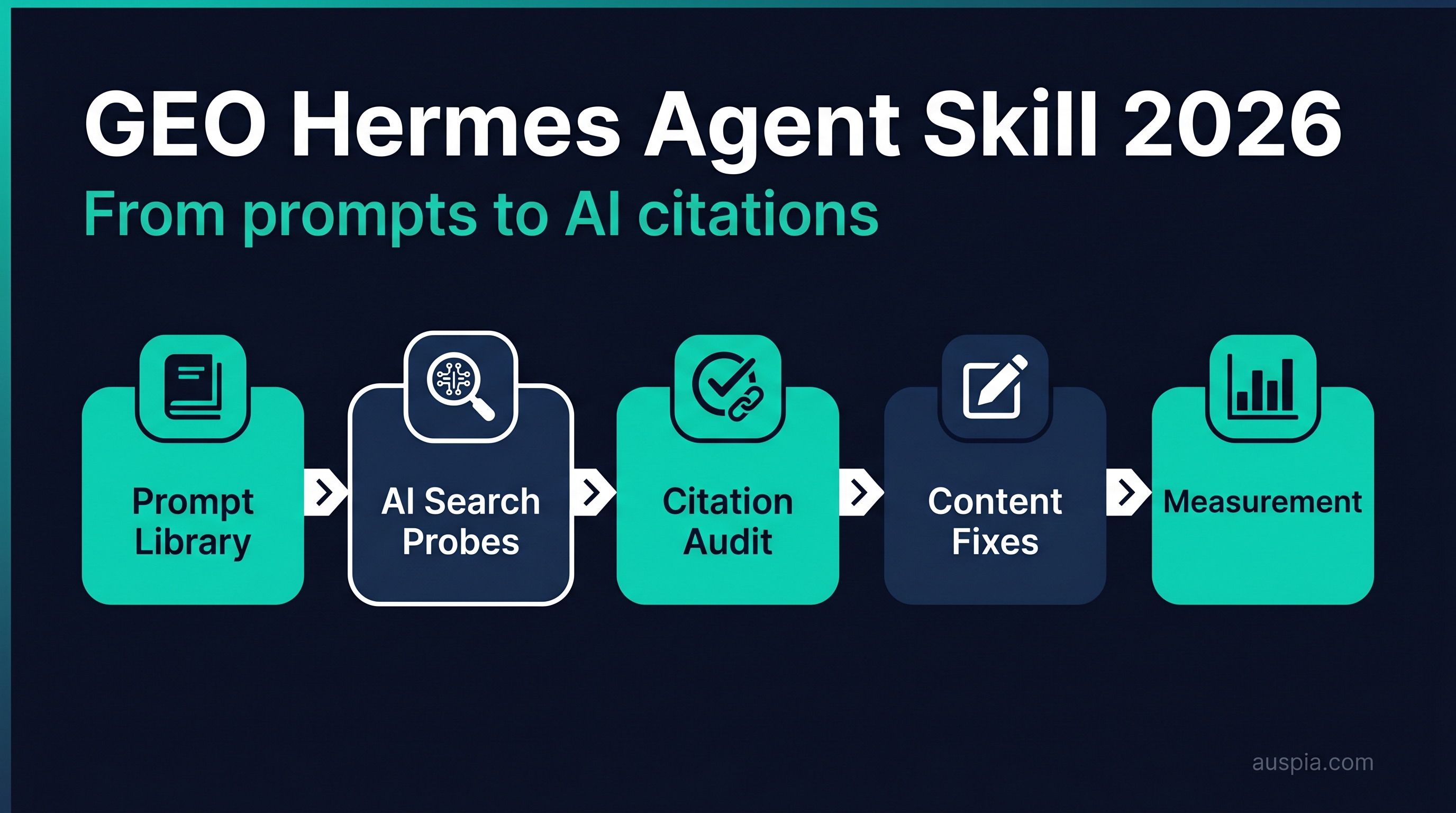
The best GEO Hermes Agent Skill for 2026 is not a single magic prompt. It is a reusable operating skill that makes an agent do five jobs every week: build prompt libraries, test AI answers, audit citations, rewrite pages for extractability, and report what changed.
That matters because GEO is moving from "write better content" to "run a repeatable visibility system." Hermes-style skills are useful here because they can preserve the workflow as a file, improve it after repeated use, and make the next audit less dependent on one senior SEO operator remembering every step.
If you only install one GEO skill for a Hermes Agent setup in 2026, choose one that combines AI search visibility measurement, citation diagnosis, entity cleanup, and content fix briefs. A skill that only writes GEO copy is too narrow.
What is a GEO Hermes Agent Skill?
A GEO Hermes Agent Skill is a reusable instruction pack for an AI agent that handles generative engine optimization work. In plain English: it tells the agent how to check whether a brand appears in AI answers, why it does or does not get cited, and which content changes are most likely to improve visibility.
Hermes Agent is often discussed as a self-improving agent framework with a skill system. The useful idea for marketers is simple. Instead of asking an AI assistant to "do GEO" from scratch every time, you give it a stored playbook:
Layer | What the skill should do | Output |
|---|---|---|
Prompt research | Generate buyer, comparison, problem, and alternative prompts | Prompt library |
AI answer checks | Query answer engines or approved search APIs | Visibility sample |
Citation audit | Record which sources are cited and why | Citation map |
Page diagnosis | Check entity facts, structure, schema, evidence, and crawl access | Fix brief |
Measurement | Compare this run with earlier runs | GEO report |
That is the difference between a prompt and a skill. A prompt gives one answer. A skill gives the agent a working habit.
Why 2026 makes this skill more useful
GEO used to sound like an experimental add-on to SEO. By 2026, it is closer to a visibility layer that sits beside technical SEO, content strategy, and brand authority.
The reason is not mysterious. Buyers are asking ChatGPT, Perplexity, Gemini, Claude, Google AI Overviews, and other AI answer surfaces for recommendations before they click a traditional result. Those systems do not simply rank ten blue links. They synthesize, quote, compare, and sometimes cite. A brand can have decent SEO and still disappear from the answer.
Search research also shows a pattern growth teams should take seriously: AI systems often fan out a single user prompt into many hidden subqueries. A user may ask, "What is the best analytics platform for early-stage SaaS?" The model may then look for startup analytics tools, pricing comparisons, implementation guides, reviews, alternatives, and integration docs. A normal keyword list misses much of that behavior.
This is where a Hermes-style agent skill helps. It can keep testing the same prompt families, record what changed, and turn the result into a backlog instead of a one-off report.
The best GEO Hermes Agent Skill: the five-part version
A strong 2026 GEO Hermes Agent Skill should have five modules. If a skill does not cover these, it is probably a content-writing helper, not a full GEO workflow.
1. Prompt library builder
The skill should start by building prompts from real buyer intent, not from vanity keywords.
Useful prompt groups include:
Prompt group | Example | Why it matters |
|---|---|---|
Category prompts | "Best GEO tools for B2B SaaS" | Tests whether the brand is visible in buying research |
Comparison prompts | "Auspia vs other AI search visibility tools" | Reveals competitor positioning |
Problem prompts | "How do I know if ChatGPT cites my website?" | Finds pain-led answer opportunities |
Alternative prompts | "Alternatives to Semrush AI visibility tracking" | Captures switching intent |
Implementation prompts | "How to prepare a site for AI citations" | Surfaces content and technical gaps |
The prompt library should include market, persona, buying stage, product category, and expected answer type. Without those fields, the results become hard to compare over time.
A useful agent should also flag prompt bias. Some prompts are brand-neutral, some are category-led, and some already imply a preferred vendor or platform. Mixing them without labels can make the visibility report look better or worse than reality.
2. AI answer and citation tracker
The skill should capture the actual AI answers and the sources mentioned or cited. At minimum, it should record:
Field | Why it matters |
|---|---|
Prompt | The exact wording tested |
Platform | ChatGPT, Perplexity, Gemini, Google AI Overviews, Claude, or another surface |
Brand mentioned? | Basic visibility |
Brand position | Whether the brand appears early, late, or only in passing |
Citation URL | Which pages the system trusts |
Competitors cited | Who owns the answer |
Sentiment | Whether the mention is positive, neutral, or risky |
Missing evidence | What the cited pages have that yours lacks |
This is the part many teams skip. They read an AI answer, take a screenshot, and move on. That is not measurement. A Hermes skill should turn the answer into structured data that can be compared next week.
3. Entity and evidence audit
AI answer systems tend to favor sources that are easy to understand, easy to verify, and easy to cite. A GEO skill should therefore inspect the page like a machine would.
The audit should check:
- Does the page clearly state who the brand is, what it does, who it serves, and what problem it solves?
- Are product names, company names, category terms, and locations consistent across the website?
- Does the page contain original evidence, examples, benchmarks, screenshots, or named methodology?
- Are claims backed by sources, dates, and concrete data?
- Can a crawler access the page, or are AI-related bots blocked in robots.txt?
- Does the page use schema where it helps, such as Organization, SoftwareApplication, FAQPage, Product, Review, or Article?
Auspia's view is that this is where GEO and SEO still overlap. If a page is vague, uncrawlable, thin, or full of unsupported claims, it will usually struggle in both Google and AI answer engines. GEO does not replace SEO basics. It punishes weak SEO basics faster.
4. Content fix brief
A good skill should not stop at diagnosis. It should produce a page-level fix brief a writer, SEO manager, or developer can actually use.
A practical brief includes:
Fix type | Example instruction |
|---|---|
Answer-first summary | Add a 70-word direct answer near the top |
Citation hooks | Add one original comparison table and one dated benchmark |
Entity cleanup | Standardize the product category as "AI search visibility checker" |
Schema | Add FAQPage schema for five buyer questions |
Internal links | Link from the GEO guide to the visibility checker and score checker |
Technical access | Confirm GPTBot, PerplexityBot, ClaudeBot, and Googlebot are not blocked |
The brief should separate writer tasks from developer tasks. Otherwise, GEO recommendations pile up in one messy document and nobody ships them.
5. Measurement loop
The final module is the one that makes the skill worth keeping. The agent should compare runs.
A simple weekly report can track:
Metric | What to watch |
|---|---|
Prompt coverage | How many priority prompts were tested |
Mention rate | Share of prompts where the brand appears |
Citation rate | Share of prompts where the site is cited |
Top cited pages | Which URLs AI systems trust |
Competitor share | Which competitors dominate answers |
Fix shipped | Which recommendations were implemented |
Visibility delta | What changed after fixes |
Do not overread small samples. AI answers vary by model, geography, account state, prompt wording, and retrieval path. The point is not false precision. The point is direction: are you becoming easier to cite, or are competitors becoming the default source?
How it compares with normal SEO tools
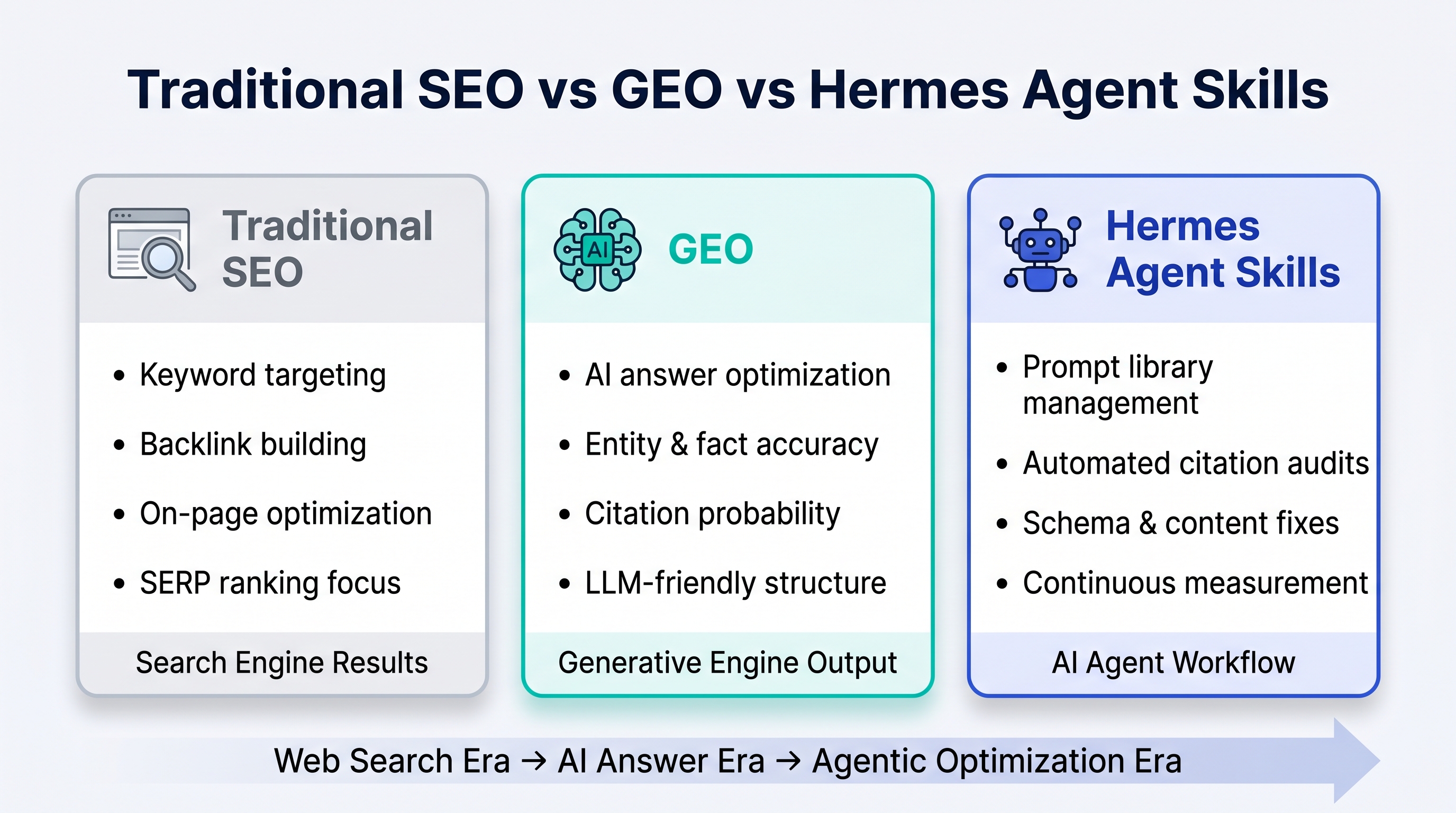
Traditional SEO tools still matter. You need crawl diagnostics, keyword research, backlinks, search intent analysis, technical SEO, and content quality checks. But a GEO Hermes skill has a different job.
Workflow | Traditional SEO tool | GEO visibility platform | Hermes GEO skill |
|---|---|---|---|
Main question | "Can we rank?" | "Are we visible in AI answers?" | "What should the agent test and fix next?" |
Core input | Keywords and URLs | Prompts and AI answers | Repeatable playbook |
Core output | Rankings, audits, traffic estimates | Mentions, citations, sentiment | Fix briefs and operating cadence |
Best user | SEO team | Growth/brand team | Operator who wants automation |
Weakness | May miss AI answer behavior | Can become reporting-only | Needs careful guardrails |
The best setup is not either-or. Use SEO tools for site health and demand research. Use AI visibility tools for monitoring. Use the Hermes skill to connect the two into action.
For teams starting from scratch, Auspia's AI Search Visibility Checker is a practical first step before building a custom agent workflow.
What to look for before installing or writing the skill
Before you call something the best GEO Hermes Agent Skill, test it against this checklist.
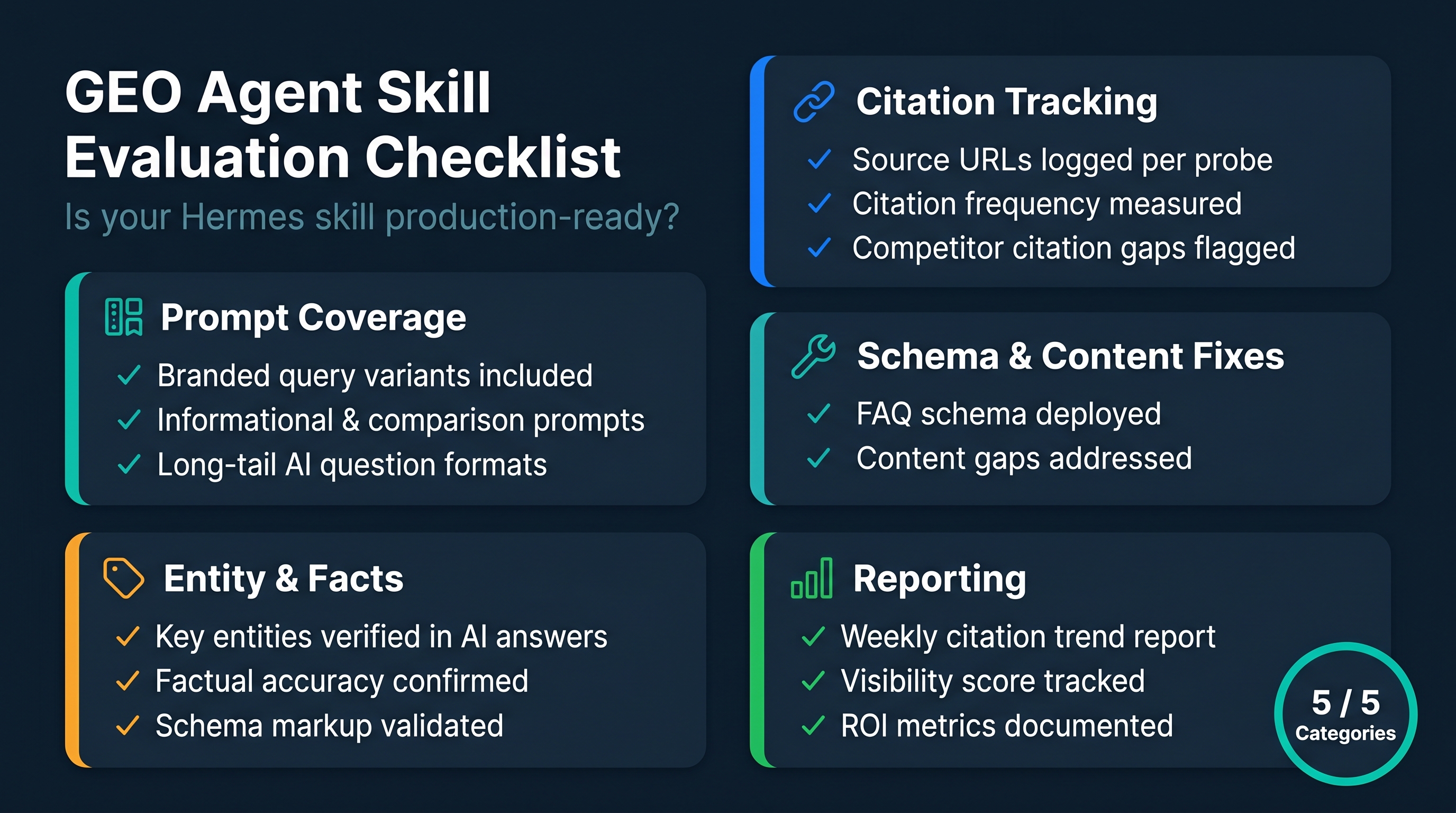
Requirement | Pass/fail question |
|---|---|
Prompt coverage | Can it generate and label prompt families by intent? |
Multi-platform checks | Can it test more than one AI answer surface or search API? |
Citation extraction | Does it capture cited URLs, not just brand mentions? |
Entity audit | Does it check brand facts, category language, and source consistency? |
Technical checks | Does it inspect robots.txt, schema, indexability, and page structure? |
Fix briefs | Does it produce writer and developer tasks separately? |
Measurement | Can it compare runs over time? |
Human review | Does it require approval before publishing or changing pages? |
If the skill cannot pass at least six of these eight tests, do not use it as your main GEO system. Use it as a helper.
A practical Hermes GEO skill template
Here is a condensed operating template you can adapt for a Hermes-style skill file.
Role: GEO visibility operator

Goal:
Measure and improve brand visibility across AI answer engines by building prompt libraries, auditing citations, diagnosing source gaps, and producing page-level fix briefs.

Inputs:
- Brand name
- Website URL
- Product category
- Target markets
- Competitors
- Priority pages
- Approved AI/search tools

Workflow:
1. Build 30-100 prompts across category, comparison, problem, alternative, and implementation intent.
2. Label each prompt by persona, funnel stage, market, and prompt bias.
3. Run approved checks across selected AI answer surfaces or search APIs.
4. Record brand mentions, cited URLs, competitor mentions, sentiment, and answer position.
5. Audit cited competitor pages for structure, evidence, schema, and entity clarity.
6. Audit the brand's target pages for crawl access, extractability, evidence, and schema.
7. Produce prioritized fixes split into writer tasks, developer tasks, and strategy tasks.
8. Save results to a dated report and compare against prior runs.
9. Require human approval before publishing, editing production pages, or changing robots.txt.

Outputs:
- Prompt library
- Citation map
- Competitor citation gap table
- Page fix brief
- Weekly GEO visibility report
The guardrail in step 9 is not optional. Agents can move fast, and GEO work touches public content, schema, internal links, and sometimes crawl rules. A bad automated fix can create real search problems.
Where teams usually get this wrong
Most weak GEO agent setups fail for one of five reasons.
First, they test too few prompts. Three prompts do not tell you anything reliable. You need enough prompt diversity to see patterns.
Second, they confuse mentions with citations. A brand mention is nice. A citation is stronger because it means the system found a source worth using.
Third, they write generic "AI-friendly" content. AI systems do not need more fluffy explainers. They need pages with clear facts, comparisons, definitions, evidence, and structure.
Fourth, they ignore technical access. If crawlers cannot reach your content, the best GEO copy will not help much.
Fifth, they never close the loop. A report without shipped fixes is just research theater.
Recommended workflow for a 30-day pilot
If you want to test a GEO Hermes Agent Skill without overbuilding, run a 30-day pilot.
Week | Work | Output |
|---|---|---|
Week 1 | Build prompt library and choose competitors | Baseline prompt set |
Week 2 | Run AI answer checks and citation audit | Visibility baseline |
Week 3 | Fix 3-5 priority pages | Content and technical changes |
Week 4 | Re-run the same prompts and compare | Delta report |
Keep the pilot narrow. Choose one product category, one market, and five priority pages. If the agent finds useful citation gaps and the team ships fixes faster, expand the workflow.
Auspia's GEO Checker can support the audit layer when you need a quick read on page readiness before building a full agent loop.
Research notes and source signals
This article is based on a fresh June 22, 2026 scan of public material around Hermes Agent skills, AI search visibility, and GEO tools. Useful reference points include Nous Research's Hermes skills catalog, Composio's discussion of SEO plus GEO skills for Hermes workflows, Indexable AI's GEO Agent positioning around prompt and citation tracking, Google Search documentation for generative AI features, and current GEO tool roundups from vendors such as Profound. Treat vendor rankings as market signals, not neutral proof.
FAQ
Is a GEO Hermes Agent Skill the same as an AI SEO tool?
No. An AI SEO tool usually provides analysis, tracking, or content assistance. A Hermes-style skill is a reusable operating procedure for an agent. It can use tools, but the value is in the repeatable workflow.
Can a Hermes Agent Skill guarantee AI citations?
No. No GEO tool can guarantee citations across ChatGPT, Perplexity, Gemini, Google AI Overviews, or Claude. The realistic goal is to make your pages easier to discover, understand, verify, and cite.
What is the minimum version of this workflow for a small team?
Start with 30 prompts, 5 competitors, 5 priority pages, and one weekly report. Track mentions, citations, cited URLs, and shipped fixes. That is enough to find early patterns.
Should the skill write content automatically?
It can draft recommendations and page sections, but publishing should require human review. GEO content often includes claims, comparisons, schema, and source references. Those need editorial control.
Which tags fit this article?
For Auspia publishing, this article fits GEO as the primary category, with ai-search-visibility, ai-seo-tools, and playbook as tags.
Conclusion
The best GEO Hermes Agent Skill for 2026 is a measurement-and-action loop, not a prettier prompt. It should help a team discover how AI systems describe the brand, identify why competitors are cited, and ship specific fixes to pages that matter.
Use it for the work agents are good at: repeated checks, structured extraction, comparison tables, and weekly reporting. Keep humans in charge of claims, strategy, and publishing. That balance is where agentic GEO becomes useful instead of noisy.