Executive Summary: GEO In 2026 Is Not A Trick. It Is Evidence Packaging.
In 2026, more buyers are asking AI systems for recommendations before they open a classic search results page. They ask questions like "Which compliance tool should a small fintech team use?", "What are the best boutique hotels near Lisbon for remote work?", or "Which automatic litter box is safest for large cats?" If your brand is not visible in that answer, you may never enter the buyer's shortlist.
The practical answer is not to "hack" ChatGPT, Perplexity, Gemini, or Google AI answers. The real work is simpler and less glamorous: make your product easy to find, easy to understand, and easy to trust across the public web.
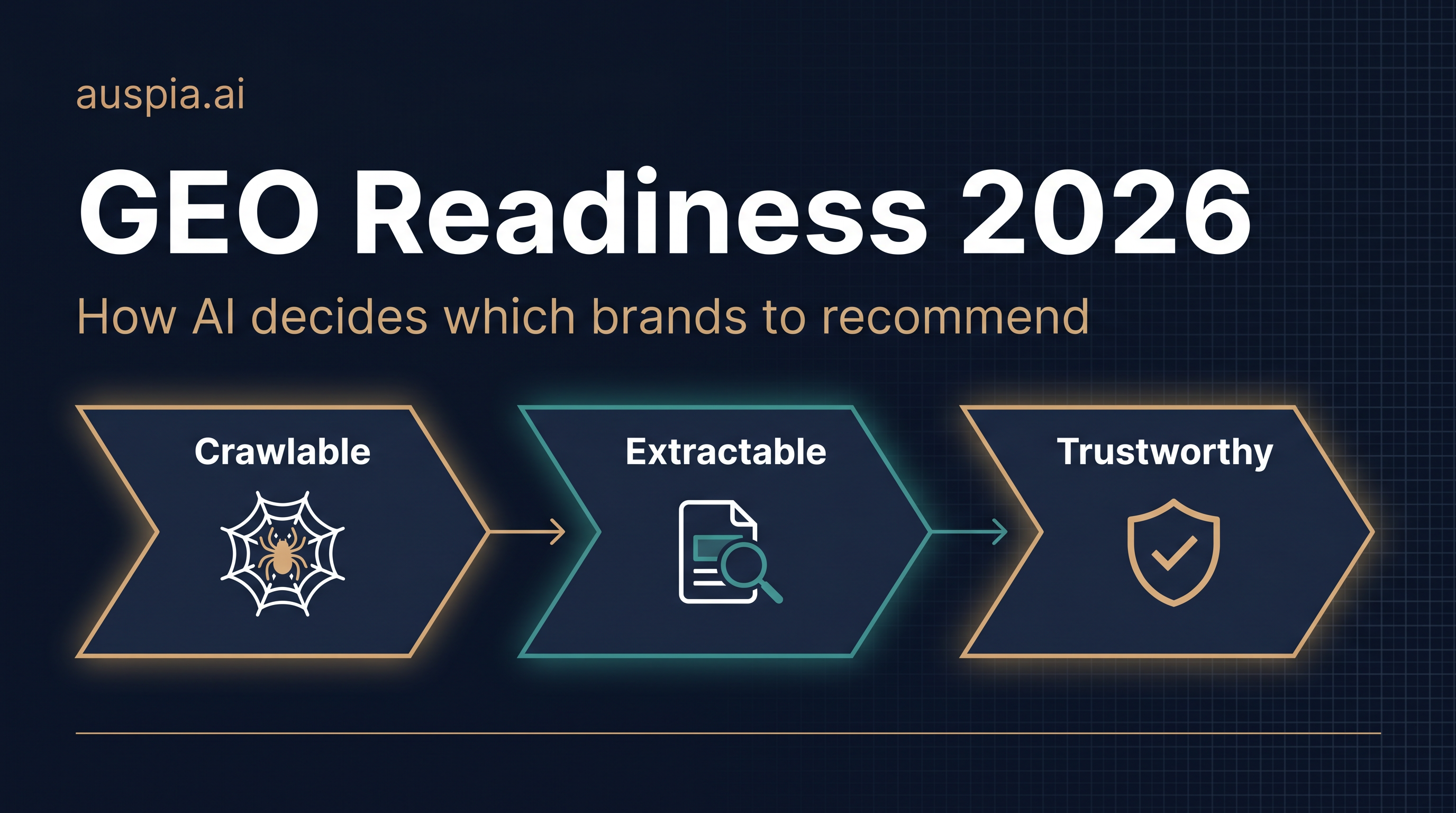
For most teams, GEO has three gates:
Gate | What AI needs | What your team should improve |
|---|---|---|
Crawlable | Can the system access your pages and evidence? | Robots.txt, rendering, page speed, sitemap, important URLs |
Extractable | Can the system summarize your product clearly? | Answer-first copy, product facts, comparison tables, FAQs, schema |
Trustworthy | Can the system verify your claims elsewhere? | Reviews, credible mentions, third-party comparisons, consistent facts |
This article gives you a 2026-ready playbook for deciding whether GEO is worth doing, building AI-readable content, checking your technical foundation, measuring whether AI is recommending you, and avoiding bad GEO vendors.
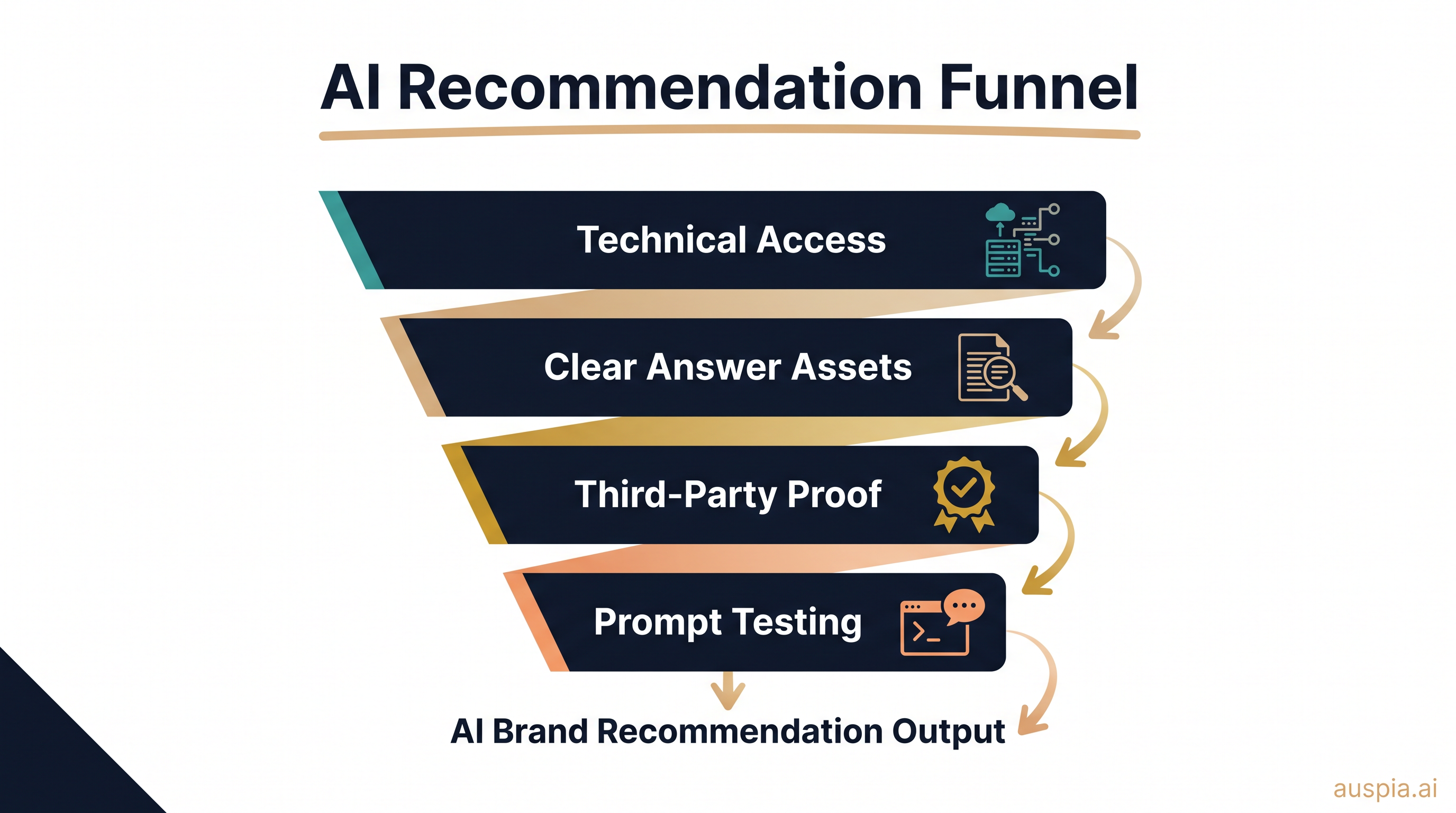
Caption: A practical GEO system moves from access to extraction, trust, and repeated prompt testing.
Why AI Recommendations Matter More In 2026
Classic SEO is still important. Buyers still use Google, and pages still need search demand, links, crawlability, and intent fit. But AI recommendation surfaces have changed the first step of many decisions.
A buyer no longer needs to search ten pages, open seven tabs, and build a shortlist by hand. They can ask an AI assistant for a shortlist, a comparison, a recommendation for their budget, or a vendor that fits a specific constraint.
That means your product can lose before the buyer ever sees your website.
The brands that appear in AI answers usually have four advantages:
- Their official pages clearly explain what the product is and who it is for.
- Their claims are repeated consistently across the web.
- Their comparison pages, reviews, documentation, or case content answer real buyer questions.
- Their site is technically accessible to search and AI crawlers.
That is the core of GEO: not manipulating a model, but making your public evidence easier for retrieval systems to use.
How AI Decides Whether To Recommend A Brand
When an AI system recommends a product, it usually has to do two jobs.
First, it retrieves information. Depending on the platform and query, that information may come from search indexes, crawled pages, partner data, user-provided context, or internal retrieval systems.
Second, it generates an answer. The model turns the retrieved material into a short recommendation, often with pros, cons, caveats, and alternatives.
Your brand can fail at either stage.
If the system cannot find your pages, you are invisible. If it finds your pages but the content is vague, it has little to quote. If it finds clear content but cannot verify the claims anywhere else, it may choose a better-documented competitor.
A useful way to think about GEO is this:
Write, publish, and structure information in the same way an AI answer system needs to retrieve, compare, and summarize it.
That does not mean writing for machines only. The best GEO pages are also better for humans because they remove fluff, make tradeoffs explicit, and answer buying questions quickly.
Should Your Product Or Store Invest In GEO?
Not every business needs a serious GEO program right now. The first question is not "How do we get AI to mention us?" It is "Do buyers ask AI before they buy?"
GEO tends to matter more when the purchase has one or more of these traits:
Business type | GEO fit | Why it works |
|---|---|---|
B2B software | High | Buyers compare features, security, integrations, pricing, and alternatives |
Professional services | High | Buyers need trust signals before speaking to a provider |
Healthcare, legal, finance, education | High but sensitive | Decisions require careful evidence and compliance-aware content |
Travel, hospitality, local experiences | Medium to high | Users ask for recommendations by location, budget, and occasion |
Ecommerce products with tradeoffs | Medium to high | AI can compare safety, durability, materials, fit, price, and use case |
Low-cost impulse products | Low | Buyers rarely ask AI before buying |
Pure foot-traffic businesses | Low to medium | Local AI visibility may help, but location and availability often matter more |
A simple test: write down ten questions a real buyer might ask before spending money. If those questions sound natural in ChatGPT, Perplexity, Gemini, Google AI Mode, or another assistant, GEO is probably worth testing.
If you cannot think of natural questions, start with classic SEO, local search, marketplace optimization, or conversion improvements instead.
The 2026 GEO Readiness Checklist
Before paying for a GEO campaign, check whether your brand has the basic evidence AI systems need.
1. A One-Sentence Positioning Line
AI systems need a clean summary. If your product takes six paragraphs to explain, it is harder to recommend.
Use this format:
[Product] is a [category] for [audience] that helps with [main problem], especially when [specific differentiator].
Example:
DockPilot is a cloud deployment monitoring tool for small DevOps teams that need release alerts, rollback visibility, and incident timelines without adopting a full enterprise observability suite.
That sentence gives an AI answer system the category, audience, use case, and differentiation in one place.
2. Buyer Questions Mapped To Pages
Most teams write from the brand's point of view. GEO works better when pages are built around buyer questions.
Examples:
Buyer question | Content asset to create |
|---|---|
What is this product? | Definition section on homepage and product page |
Is it safe? | Safety, security, compliance, or quality page |
Is it better than alternatives? | Comparison page with clear tradeoffs |
Who is it best for? | Use-case pages by segment |
What does it cost? | Pricing page or transparent buying guide |
What are the drawbacks? | Honest FAQ, limitations section, implementation notes |
Do not hide the tradeoffs. AI answers often include caveats. If your own site explains when your product is and is not a fit, the model has better material to summarize.
3. Answer-First Page Structure
For GEO, the conclusion should come early. A human can enjoy a slow intro. An AI retrieval system needs the answer quickly.
A strong product or comparison page often follows this structure:
- Direct answer in the first 80 to 120 words.
- Short bullet list of who it is best for.
- Feature or capability table.
- Evidence section: reviews, benchmarks, screenshots, case examples, or documentation.
- FAQ written in natural buyer language.
- Schema markup where appropriate.
You can check whether your site is ready with Auspia's AI Search Visibility Checker and then prioritize the pages most likely to influence buyer prompts.
4. Consistent Facts Across The Web
AI systems are sensitive to conflicting facts. If your website says one price, a marketplace says another, an old PDF lists outdated features, and a review site uses a previous product name, the system has to choose what to trust.
Create a source-of-truth sheet for your brand facts:
Fact type | Example |
|---|---|
Product name | Official spelling and capitalization |
Category | The category you want to be grouped with |
Audience | Primary buyer, user, company size, or use case |
Core differentiator | One or two defensible claims |
Pricing | Public pricing or pricing explanation |
Availability | Countries, languages, platforms, integrations |
Proof | Reviews, testimonials, benchmarks, certifications, docs |
Then update your homepage, product page, docs, app stores, marketplaces, profiles, comparison listings, and high-value third-party pages where you can legitimately edit information.
The Content Formats AI Can Reuse Most Easily
Some content is easier for AI systems to extract than other content. The goal is not to make every paragraph robotic. The goal is to create reusable answer blocks inside a useful page.
Definition Blocks
Use a clean definition when you want to own the "what is" answer.
Template:
[Brand/Product] is a [category] for [audience] that [main benefit]. It is best suited for [specific use case] because [differentiator].
Numbered Advantage Lists
Use lists when buyers ask "What are the benefits?" or "Why choose it?"
Template:
The three main advantages are: 1) [advantage], 2) [advantage], and 3) [advantage].
Keep the claims specific. "Fast, powerful, easy" is weak. "Connects to Salesforce in under 15 minutes, monitors failed syncs, and sends Slack alerts to revenue ops" is stronger.
Comparison Tables
AI systems often rely on tables for "best for" and "A vs B" answers. Tables force you to state tradeoffs clearly.
Criterion | Your product | Alternative A | Alternative B |
|---|---|---|---|
Best for | Small teams needing simple setup | Enterprise teams | Budget-sensitive buyers |
Strength | Fast deployment | Deep controls | Low price |
Limitation | Fewer custom workflows | Longer setup | Limited support |
Proof to cite | Docs, reviews, benchmark | Analyst listing | Marketplace reviews |
Do not fake comparisons. If you do not have evidence, write the limitation plainly.
Conclusion Sentences
AI answers need a recommendation anchor. End major sections with a sentence that states the decision logic.
Example:
Therefore, this product is a better fit for teams that care more about fast setup and alert clarity than deep enterprise customization.
That sentence is not hype. It is a useful recommendation rule.
Technical Foundations: What To Ask Your Developer Or Codex Agent To Check
GEO is not only content. If your site blocks crawlers, renders important text only after a fragile script runs, or lacks structured data, your content may not be usable.
Here is a practical technical checklist for 2026.
Robots.txt And AI Crawler Access
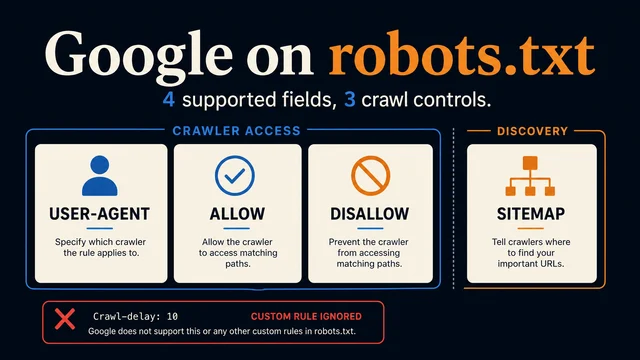
Review robots.txt and confirm that you are not accidentally blocking the crawlers and search systems you want to access your content. Policies change, and crawler names vary by platform, so use the latest official documentation for each crawler before editing.
A good prompt for your developer or coding agent:
Audit robots.txt and crawler directives. Identify whether important product, documentation, comparison, and FAQ pages are accessible to major search crawlers and AI-related crawlers. Do not open private, account, checkout, admin, or staging paths. Show the proposed diff before making changes.
LLMs.txt
llms.txt is not a magic ranking file, but it can act as a clean orientation page for AI agents and retrieval systems that choose to read it. Treat it like a curated map of your most important public content.
A useful llms.txt should include:
- A short brand description.
- Links to the homepage, product pages, pricing, docs, FAQ, comparisons, and policy pages.
- One-line descriptions of why each page matters.
- No private URLs or inflated claims.
Schema Markup
Structured data helps machines identify the type of content on a page. Depending on the page, useful schema may include Organization, Product, SoftwareApplication, Article, FAQPage, Review, BreadcrumbList, or LocalBusiness.
Ask for a page-by-page schema audit, not a generic schema plugin install.
Review our homepage, product pages, pricing page, blog articles, comparison pages, and FAQs. Recommend JSON-LD schema types for each page. Add only factual fields we can verify. Show validation results and the final diff.
Page Rendering And Important Text
Make sure your core product facts, pricing explanations, comparison tables, and FAQs are present in crawlable HTML. If critical content only appears after user interaction or inside an image, it may be harder to retrieve.
How To Measure Whether AI Is Recommending You
GEO measurement is messy because AI answers vary by user, location, history, date, and prompt wording. Still, you can build a useful measurement loop.
Start with a prompt library of 30 to 100 natural buyer questions.
Group them by intent:
Intent | Example prompt |
|---|---|
Brand lookup | What is [brand]? |
Category recommendation | What are the best [category] tools for [audience]? |
Use-case recommendation | Which [category] tool is best for [specific constraint]? |
Comparison | [Brand] vs [competitor]: which is better for [use case]? |
Risk check | What are the limitations of [brand]? |
Local or vertical query | Best [service] near [location] for [need] |
Then test across the answer surfaces that matter to your audience. Track:
- Whether your brand is mentioned.
- Whether it appears in the top few recommendations.
- What reasons the AI gives.
- Which sources or citations appear, if the platform shows them.
- Whether the answer contains wrong or outdated facts.
- Which competitors are repeatedly recommended instead.
Use Auspia's GEO Score Checker as a starting point, then add your own prompt library for the terms your buyers actually use.
The most valuable insight is often not "we are invisible." It is "the AI recommends competitor X because it finds clearer comparison evidence, stronger third-party reviews, or better documentation for that use case."
What To Do If AI Recommends Competitors Instead
Do not panic. Competitor mentions are a map of what the retrieval system currently trusts.
Take three steps:
- Inspect the sources behind the competitor recommendation when available.
- Identify the specific reason the competitor is being recommended.
- Build a better evidence asset around that reason.
If a competitor wins because it has better comparison content, publish a fair comparison page. If it wins because users mention it in reviews, build a review collection program. If it wins because it owns a narrow use case, create a page for that use case with examples, screenshots, and limitations.
The quickest GEO wins often come from long-tail prompts. Instead of trying to win "best CRM," aim for "best CRM for boutique consulting firms that need simple proposal follow-up." Smaller pools are easier to become relevant in.
GEO Vendor Red Flags In 2026
GEO services are growing quickly, and the market has a predictable problem: some vendors sell mystery instead of work.
Be cautious if a vendor says any of the following:
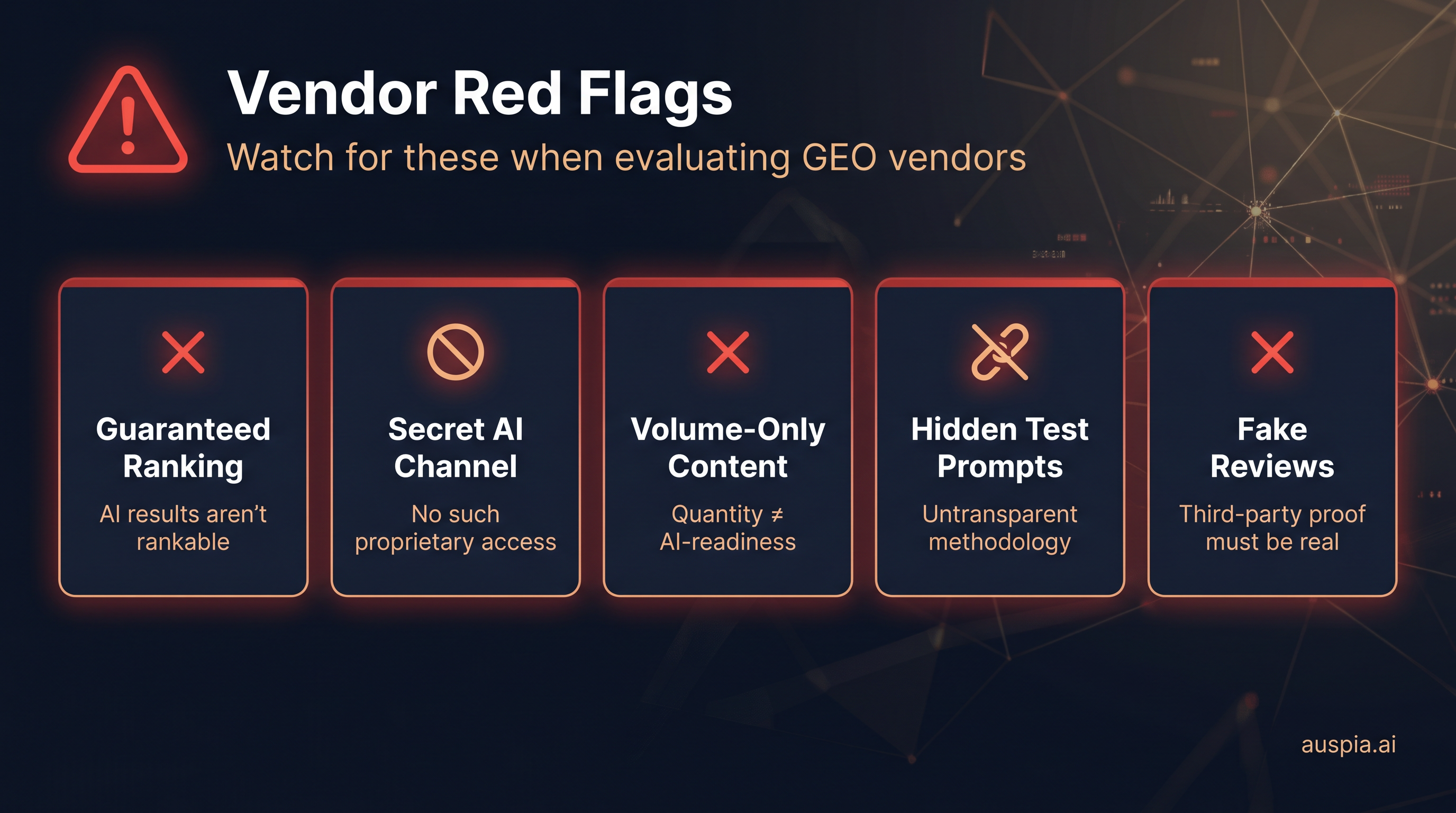
Caption: The worst GEO vendors sell certainty where the channel is still probabilistic.
Vendor claim | Why it is risky | Better question to ask |
|---|---|---|
"We guarantee top AI recommendations" | AI answers are variable and platform-controlled | What prompts, dates, locations, and tools will you measure? |
"We have a secret channel into AI models" | Public recommendation systems are not controlled that way | Which public evidence assets will you improve? |
"We charge by number of articles" | Volume alone can create low-quality noise | How will each page map to a buyer prompt? |
"You do not need to see the test prompts" | Hidden prompts can inflate reports | Can we provide our own natural prompt set? |
"We will create reviews for you" | Fake reviews create legal, platform, and trust risk | How do you collect legitimate customer evidence? |
"We can fix this without touching your site" | Technical and content foundations usually matter | What site changes are required? |
A responsible vendor should be able to show the work: prompt set, baseline visibility, content plan, technical audit, evidence gaps, publication schedule, and retest method.
The Safe 30-Day GEO Starter Plan
If you are a small team, do not start with a huge retainer. Start with a controlled 30-day sprint.
Week 1: Baseline
- Choose 30 natural buyer prompts.
- Test your brand across 3 to 5 AI answer surfaces.
- Record competitor mentions and cited sources.
- Audit your top product, pricing, comparison, and FAQ pages.
Week 2: Fix The Source Of Truth
- Rewrite your one-sentence positioning line.
- Update your homepage and product page with clearer answer blocks.
- Add or clean up comparison tables and FAQs.
- Remove conflicting outdated facts from public profiles where possible.
Week 3: Build Evidence Assets
- Publish one buyer guide.
- Publish one fair comparison page.
- Publish one use-case page for a narrow high-intent segment.
- Ask real customers for reviews or testimonials through compliant channels.
Week 4: Technical And Measurement Loop
- Check robots.txt, sitemap, schema, rendering, and internal links.
- Add or update
llms.txtif it fits your site. - Retest the original prompt library.
- Document which prompts improved, stayed flat, or produced incorrect answers.
At the end of 30 days, decide whether GEO deserves ongoing investment. If the answer is yes, expand from a sprint into a quarterly operating loop.
Common Mistakes
Mistake 1: Publishing Thin AI Content At Scale
More pages do not automatically mean more AI visibility. If the content repeats generic claims, lacks evidence, or creates conflicting facts, it can reduce trust instead of improving it.
Mistake 2: Optimizing Only The Official Website
Your website is the foundation, but AI systems often rely on third-party confirmation. Reviews, credible mentions, documentation, community discussions, and comparison pages all matter.
Mistake 3: Treating GEO As Separate From SEO
GEO and SEO overlap. Crawlability, content quality, internal linking, topical authority, structured data, and brand demand still matter. GEO adds a stronger focus on answer extraction, prompt measurement, and third-party evidence.
Mistake 4: Using Only Branded Prompts For Reporting
If you only ask "What is our brand?", you will miss the real buying journey. The harder question is whether you appear when the buyer does not already know your name.
Mistake 5: Making Claims AI Cannot Verify
Do not invent awards, numbers, user counts, market share, or benchmarks. AI systems cross-check information, and users do too. Unverifiable claims create long-term reputation risk.
FAQ
What is GEO in 2026?
GEO, or Generative Engine Optimization, is the practice of making a brand's public information easier for AI answer systems to find, understand, verify, and recommend. It combines SEO, answer-first content, structured data, third-party evidence, and prompt-based measurement.
Can GEO guarantee that ChatGPT or Perplexity will recommend my product?
No. AI answers vary by platform, prompt, date, location, and retrieval source. A credible GEO program can improve the evidence that AI systems may use, but it cannot guarantee a fixed ranking in every answer.
Is GEO only for SaaS companies?
No. GEO can matter for software, professional services, local businesses, ecommerce products, travel, education, healthcare, finance, and any category where buyers ask questions before purchasing. It is less useful for low-cost impulse purchases.
How soon can GEO results appear?
Some changes can show up within days if pages are crawled and cited quickly. More often, teams should measure over several weeks or months because third-party evidence, indexing, and answer behavior take time to shift.
What is the difference between SEO and GEO?
SEO focuses on search visibility in search engines. GEO focuses on visibility inside AI-generated answers and recommendations. The foundations overlap, but GEO places more emphasis on answer extraction, source consistency, prompt testing, and evidence that AI systems can trust.
Final Takeaway
The best way to make AI recommend your product is not to trick the model. It is to make your real strengths easier to discover, compare, and verify.
In 2026, that means clear positioning, answer-first pages, technical accessibility, consistent facts, third-party evidence, and honest measurement. If your product is good but the web cannot explain why, AI systems will struggle to recommend it. If your evidence is clear, crawlable, and credible, you give both people and machines a better reason to include you.
Author: Maya Ellison, 12-Year GEO Strategy Researcher at Auspia. Maya writes about AI search visibility, brand entity clarity, and practical GEO operating systems for growth teams.