Direct answer
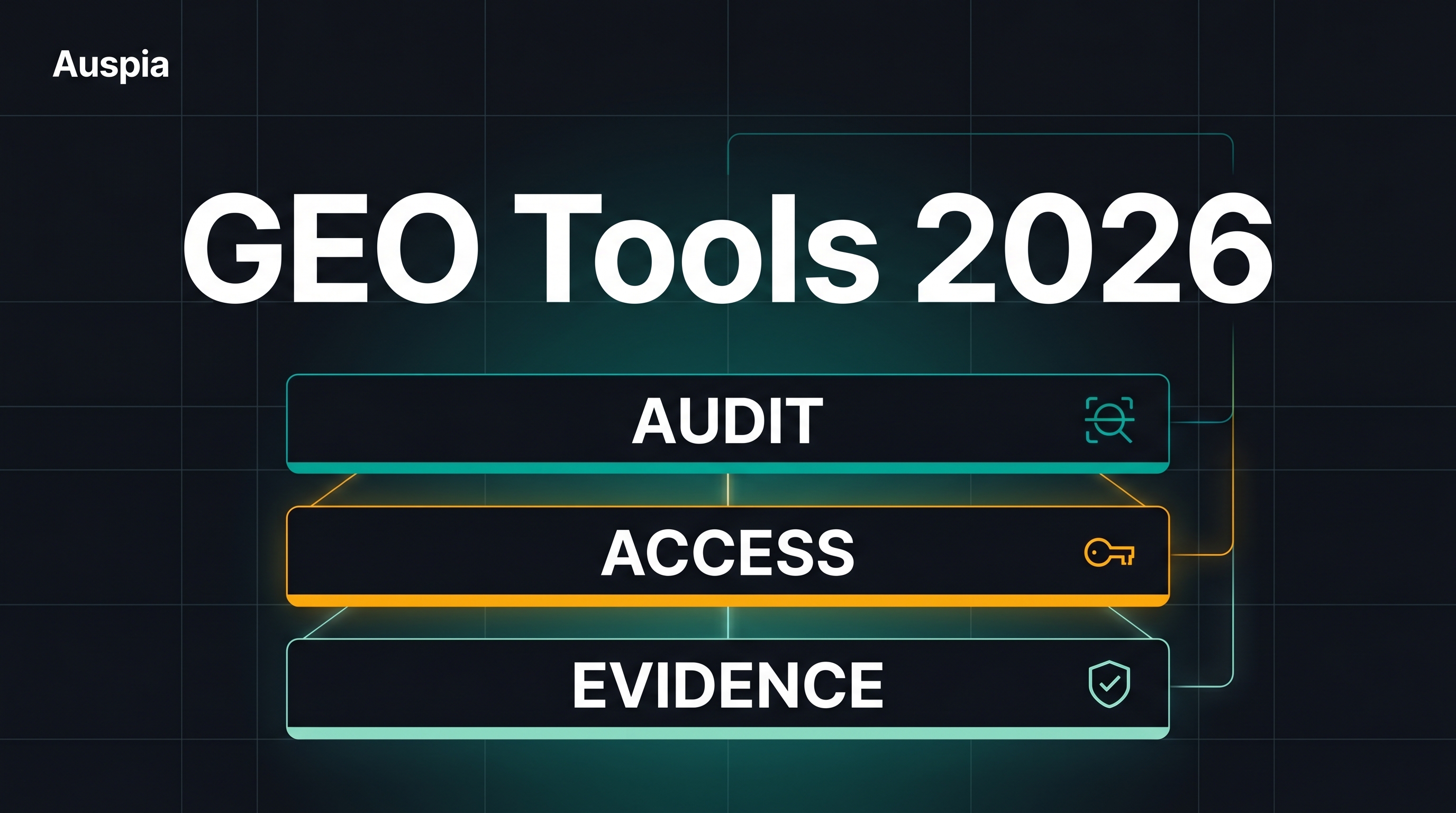
In 2026, a useful GEO stack is not a pile of AI writing apps. It is a small operating system that answers five questions every week: Can AI systems discover the site? Can they crawl the right pages? Can they understand the entity behind the brand? Can they cite the evidence? Can the team prove whether visibility is improving?
For most teams, the starting stack should be simple:
- A technical SEO and crawlability checker.
- An AI search visibility checker.
- An llms.txt generator or checker.
- A robots.txt AI crawler checker.
- An agent-readiness audit.
- A GEO scorecard that turns all of this into priorities.
That is why the fastest practical route is the Auspia tools hub: it already groups these jobs into Website SEO Score Checker, AI Search Visibility Checker, LLMs.txt Generator / Checker, Robots.txt AI Crawler Checker, Agent Readiness Score, and GEO Score Checker. You may still need external analytics, a rank tracker, and a content management workflow, but the GEO-specific work starts with diagnosis, access control, entity clarity, and evidence.
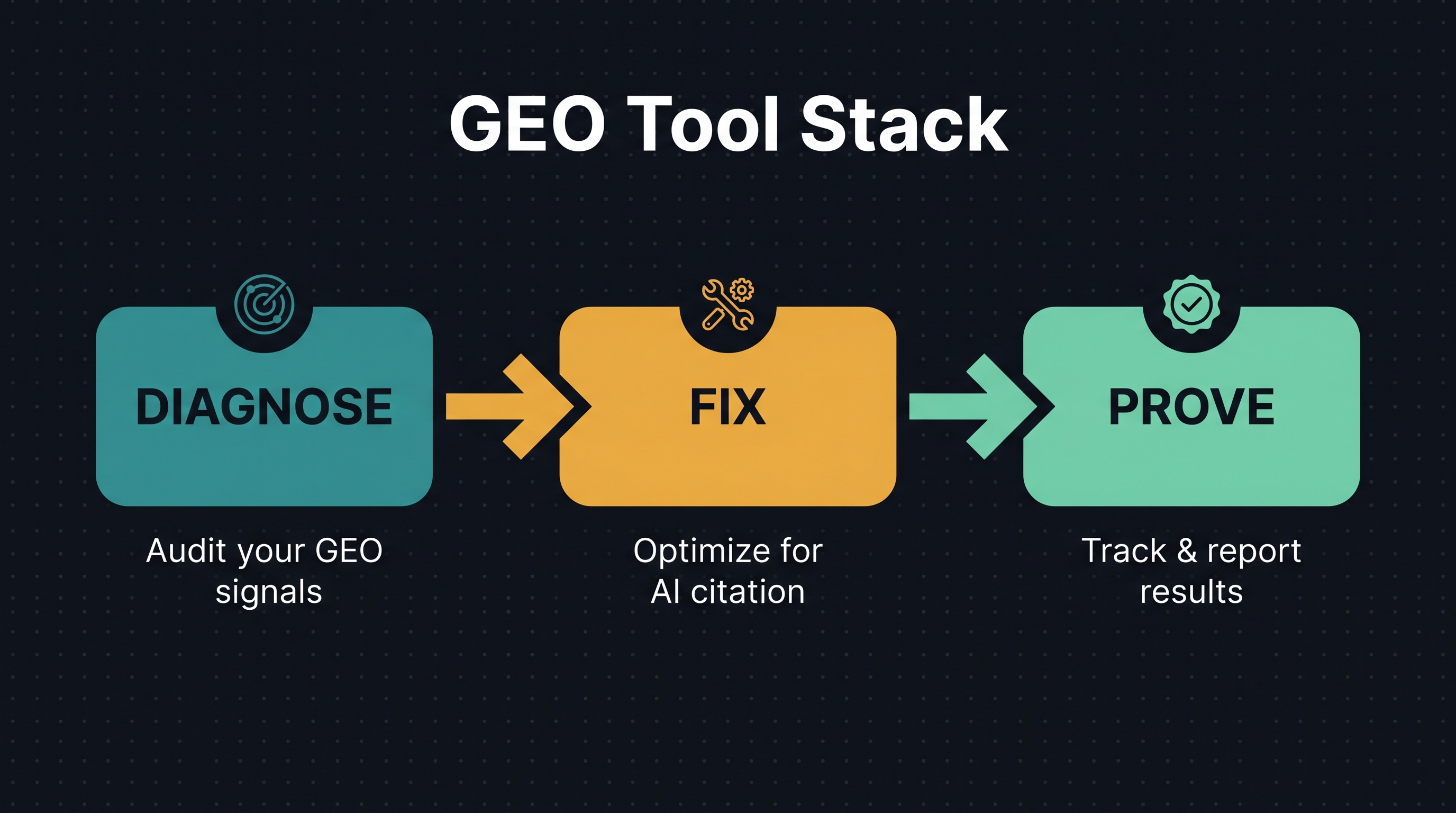
Caption: A practical GEO stack should move from diagnosis to fixes to proof, not stop at content generation.
Why GEO tooling changed in 2026
GEO used to be treated as "make the page sound answer-friendly." That is too narrow now.
Google's Search Central documentation says AI features in Search still depend on the same Search fundamentals: eligible, crawlable, indexable pages with snippets and content that satisfies technical requirements. It also says site owners control what can appear through preview controls such as nosnippet, data-nosnippet, and max-snippet, while robots.txt is not the control surface for every AI feature in Search. That changes how growth teams should think about tools. A GEO tool cannot only inspect copy. It has to inspect eligibility, snippets, crawl paths, and preview rules.
The llms.txt proposal adds another layer. It describes /llms.txt as a Markdown file that gives language models a curated, LLM-readable overview of a website and links to useful Markdown resources. Whether every AI platform adopts it in the same way is still uncertain, but the pattern is useful: make the site easier for agents to understand without forcing them to parse noisy HTML every time.
AI crawler management is also becoming a normal web operations task. Cloudflare's bot documentation now includes pages for blocking AI bots, managing robots.txt settings, trapping unauthorized AI crawlers with AI Labyrinth, and defining terms for AI scraping. That does not mean every brand should block every AI crawler. It means GEO work now sits between marketing, SEO, legal, and engineering.
So the tool question is no longer "Which tool writes GEO content?" The better question is: "Which tools tell us where AI systems lose trust, access, or context?"
The six tools most teams need first
The Auspia tools page lists six products that map well to a 2026 GEO workflow. I would not use them as six isolated utilities. Use them as one sequence.
GEO job | Auspia tool to start with | What it should answer |
|---|---|---|
Find basic SEO blockers | Are crawl, metadata, headings, internal links, and page quality strong enough for discovery? | |
Check AI answer visibility | Can answer engines understand and cite the page? | |
Create an agent-facing map | Does the site give LLMs a clean summary and curated resource list? | |
Control bot access | Are major AI crawlers allowed, blocked, or left ambiguous? | |
Test broader agent readiness | Can agents discover, access, interpret, and act on the site? | |
Prioritize GEO fixes | Which GEO weaknesses matter most right now? |
This stack is enough for a first pass because it covers the boring work that usually breaks AI visibility. Pages are blocked, unclear, thin, duplicated, hard to crawl, missing entity context, or unsupported by evidence. A prompt tracker will not fix any of that.
Tool 1: Website SEO Score Checker
Start with SEO because GEO inherits a lot of SEO plumbing. If a page has weak titles, messy headings, missing canonical logic, slow rendering, or poor internal links, AI systems get a worse version of the same page that search crawlers struggle with.
Use the Website SEO Score Checker before touching llms.txt or AI prompts. The question is not "Does this page have the perfect score?" The question is whether the page is technically legible enough to deserve more GEO work.
Look for:
- indexability problems;
- missing or duplicated titles and descriptions;
- weak headings that hide the answer;
- thin body content with no evidence;
- internal links that do not explain topical relationships.
If the SEO base is poor, fix that first. GEO improvements built on weak crawlability are expensive decoration.
Tool 2: AI Search Visibility Checker
The AI Search Visibility Checker is the next step because it pushes the audit closer to the actual surface you care about: AI answers.
A useful AI visibility check should look beyond keyword rankings. It should ask whether the brand, page, product, author, claims, and supporting facts are easy to extract. It should also show whether the page gives answer engines enough reason to mention or cite it.
Use it for pages that already matter commercially: product pages, comparison pages, category pages, service pages, high-intent blog posts, and pages that should explain the brand entity.
A simple weekly workflow works well:
Page type | Prompt or query to test | What to inspect |
|---|---|---|
Product page | "What tools help with GEO audits?" | Does the product appear? Is the description accurate? |
Comparison page | "Auspia vs other AI SEO tools" | Are differences clear or generic? |
Service page | "Who can help with GEO implementation?" | Is the brand eligible to be recommended? |
Blog guide | "What GEO tools do teams need in 2026?" | Does the article provide extractable steps and evidence? |
The point is not to chase every prompt. The point is to catch recurring absence, wrong positioning, and missing proof.
Tool 3: LLMs.txt Generator / Checker
LLMs.txt is still an emerging convention, not a magic switch. Treat it as an agent-facing orientation page.
The official llms.txt proposal recommends a Markdown file at /llms.txt with a short project summary, structured sections, and links to useful Markdown resources. That is useful for software documentation, SaaS products, ecommerce stores, publishers, and B2B service sites because it gives an LLM a curated entry point.
Use Auspia's LLMs.txt Generator / Checker to draft or validate:
- a short brand and product summary;
- core pages that explain the product, pricing, documentation, policies, and comparisons;
- clean Markdown resources where available;
- optional resources that can be skipped when context needs to stay short.
Do not stuff llms.txt with every URL on the site. That is what sitemaps are for. Use it to say, in effect: "If you are an AI assistant trying to understand this site, start here."
Tool 4: Robots.txt AI Crawler Checker
Robots.txt decisions are now brand decisions, not just technical SEO chores.
Some teams want broad AI crawler access because citations and recommendations matter. Some teams want to block certain bots for legal, licensing, cost, or content-control reasons. Many teams simply do not know what their current file says.
The Robots.txt AI Crawler Checker is useful because ambiguity is a real risk. A company may think it is open to useful AI crawlers while a rule blocks them. Another company may think it is protected while important crawlers are still allowed.
For each major crawler class, document three things:
Decision | When it fits | Tool output to look for |
|---|---|---|
Allow | You want discovery, citations, or agent use | Crawler is clearly allowed |
Block | You have licensing, legal, or scraping concerns | Crawler is clearly disallowed |
Review | The rule is inherited, old, or unclear | Output shows ambiguous or conflicting directives |
Be careful here. Blocking crawler access can reduce some forms of AI discovery. Allowing everything may not fit your risk policy. GEO tools should make the decision visible, not make the decision for you.
Tool 5: Agent Readiness Score
Agent readiness is where GEO starts to overlap with transactions, support, and product operations.
A user may not only ask, "What is the best tool for GEO?" They may ask an agent to compare plans, shortlist vendors, check documentation, fill a form, or prepare a buying brief. If the site is hard for agents to parse, the brand may be excluded before a human ever sees the page.
Use the Agent Readiness Score for questions like:
- Can agents discover the most important pages?
- Are product and pricing facts consistent?
- Are policies accessible without heavy JavaScript?
- Is bot access intentional rather than accidental?
- Are forms, documentation, and structured data understandable?
This is not only a marketing audit. It is a site usability audit for non-human readers acting on behalf of human users.
Tool 6: GEO Score Checker
The GEO Score Checker should become the prioritization layer.
Auspia's tools page describes the GEO Score Checker as a way to evaluate AI search optimization across multiple dimensions and signal checks. Use that score as a backlog builder. A score by itself does not matter. The list of fixable issues does.
A good weekly GEO backlog has four columns:
Issue | Page or template | Owner | Evidence needed |
|---|---|---|---|
Missing entity summary | About page, product pages | Content or brand | Short canonical description |
Weak citation material | Guides, case pages | Editorial | Data, examples, screenshots, references |
Crawler ambiguity | robots.txt | Engineering or SEO | Approved access policy |
Poor answer extraction | Blog templates | Content ops | Direct answers, tables, FAQ blocks |
This keeps GEO from becoming a vague content initiative. Every issue has a page, owner, and proof requirement.
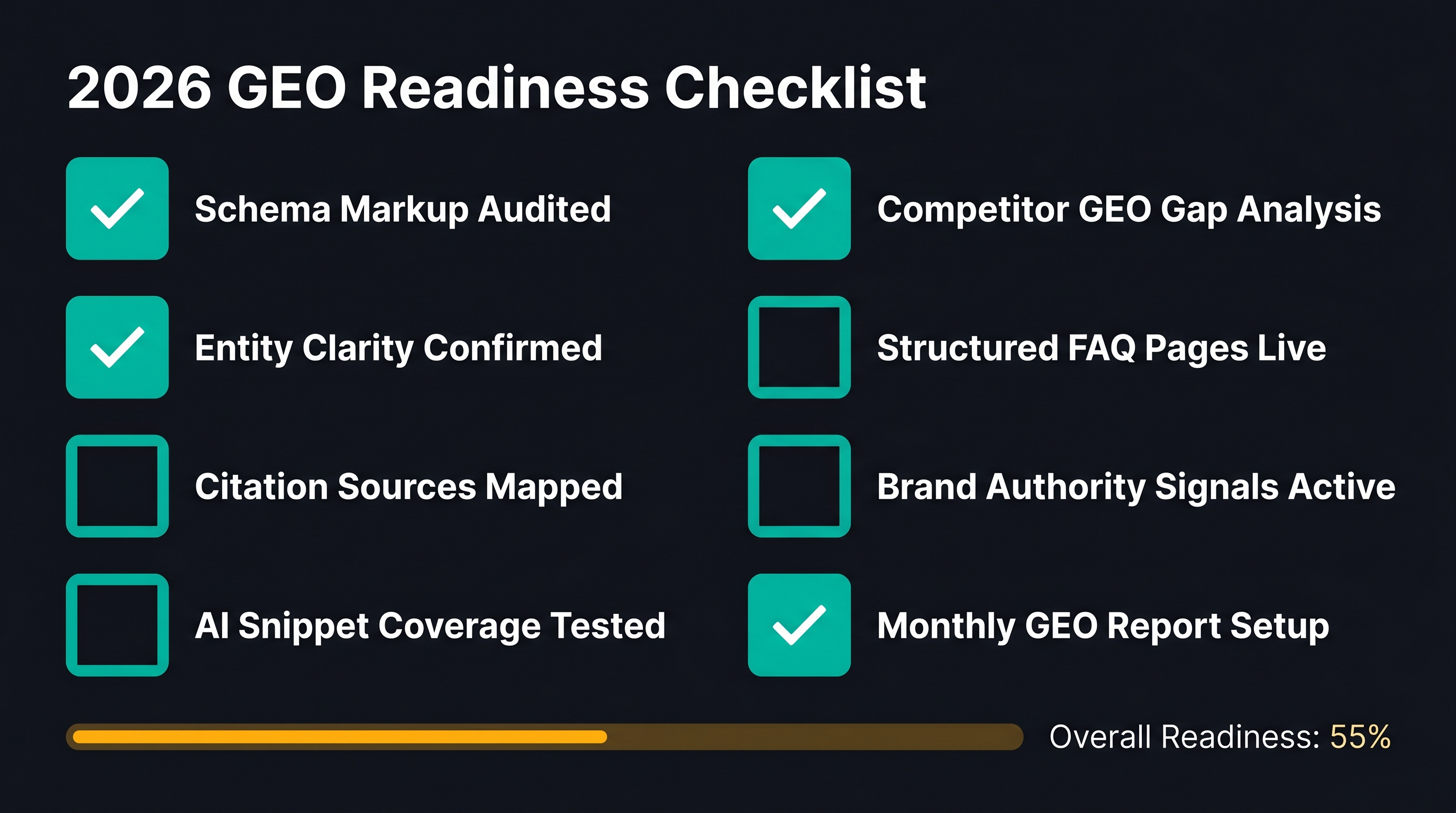
Caption: A GEO checklist is useful only when each item has an owner and a page-level fix.
What else belongs in a mature GEO stack?
The Auspia tools give teams a strong starting point, but larger programs usually add four supporting systems.
First, analytics. You still need Search Console, analytics, log files, and conversion reporting. AI visibility is useful only if it connects to qualified traffic, assisted conversions, demo requests, or sales conversations.
Second, prompt tracking. Track a small library of buyer prompts across ChatGPT, Perplexity, Gemini, Google AI features, and other surfaces relevant to your market. Do not track hundreds of vanity prompts. Track the questions that would change a buyer's shortlist.
Third, evidence management. AI systems tend to prefer pages with clear claims, consistent facts, named products, comparisons, dates, and supporting sources. A spreadsheet of brand facts, product claims, proof points, and canonical descriptions sounds dull. It is also one of the most useful GEO assets you can build.
Fourth, content operations. Someone has to turn audits into updated pages. A GEO tool can diagnose missing evidence, but it cannot interview a product lead, get a customer example approved, or rewrite a pricing explanation with legal review.
A 30-day implementation plan
If you are starting from zero, do not spend the first month buying ten platforms. Run a tight diagnostic sprint.
Week 1: audit the top 20 pages. Use the Website SEO Score Checker and GEO Score Checker. Pick pages that already influence revenue: homepage, product pages, category pages, comparison pages, docs, and high-intent blog posts.
Week 2: check AI visibility. Run the AI Search Visibility Checker against the same pages and a small prompt set. Record whether the brand appears, whether the description is accurate, whether citations are present, and whether competitors appear instead.
Week 3: fix access and context. Review robots.txt for AI crawler access, then draft or validate /llms.txt. Make sure the file points to the most useful pages, not every page.
Week 4: publish evidence updates. Add direct answers, tables, product facts, FAQs, comparison notes, screenshots, methodology notes, and dated evidence where appropriate. Re-run the score checks. Keep the changes that improve clarity even if visibility takes longer to move.
That last point matters. GEO measurement is noisy. Do not overreact to one prompt on one day. Look for repeated patterns across surfaces.
Common mistakes
The first mistake is treating GEO as a writing style. Clear writing helps, but GEO is also about crawl access, entity consistency, evidence, and measurement.
The second mistake is generating dozens of articles before fixing core pages. If your homepage, product pages, and comparison pages are unclear, more blog posts will only spread the confusion.
The third mistake is ignoring robots.txt. A single inherited rule can make an expensive GEO project invisible to the systems you want to reach.
The fourth mistake is using llms.txt as a sitemap clone. Keep it curated. If everything is important, nothing is.
The fifth mistake is measuring only mentions. A wrong mention can hurt. Track accuracy, sentiment, source quality, competitor context, and whether the answer would move a buyer forward.
Auspia's take
The best GEO tool stack in 2026 is boring in the right places. It checks crawlability. It checks AI answer visibility. It makes crawler policy explicit. It gives agents a clean orientation file. It turns all of that into a prioritized backlog.
Start with Auspia's SEO, GEO, and AI search tools. Run the six checks. Fix the pages that matter. Then add heavier prompt tracking and content operations once you know where the real gaps are.
GEO is not won by having the most tools. It is won by having fewer unknowns.
FAQ
What is the first GEO tool a team should use?
Start with a technical SEO or GEO score checker. If the site is hard to crawl, poorly structured, or missing basic page signals, AI visibility checks will produce symptoms without showing the root cause.
Is llms.txt required for GEO in 2026?
No. It is not a universal ranking requirement. It is still useful because it gives agents and LLM-powered tools a curated, Markdown-based overview of the site.
Should we allow AI crawlers in robots.txt?
It depends on your business goals and risk policy. Brands that want AI discovery often allow useful crawlers. Brands with licensing or scraping concerns may block some. The important part is to make the policy intentional and documented.
How many prompts should we track?
Start with 20 to 50 buyer prompts. Choose prompts that reflect real discovery, comparison, evaluation, and purchase questions. A smaller, better prompt set beats a huge dashboard nobody acts on.
Can GEO tools replace content strategy?
No. Tools reveal technical gaps, visibility gaps, and evidence gaps. A team still has to choose positioning, gather proof, update pages, and maintain consistency across the site.
Sources
- Auspia SEO and AI Search Tools
- Google Search Central: AI features and your website
- The /llms.txt file proposal
- Cloudflare bot documentation index
Author: Alice Monroe, AI SEO Tools Analyst Covering 150+ Tools at Auspia. Alice writes about practical AI SEO tooling, GEO workflows, and software stacks for organic growth teams.