Quick Answer
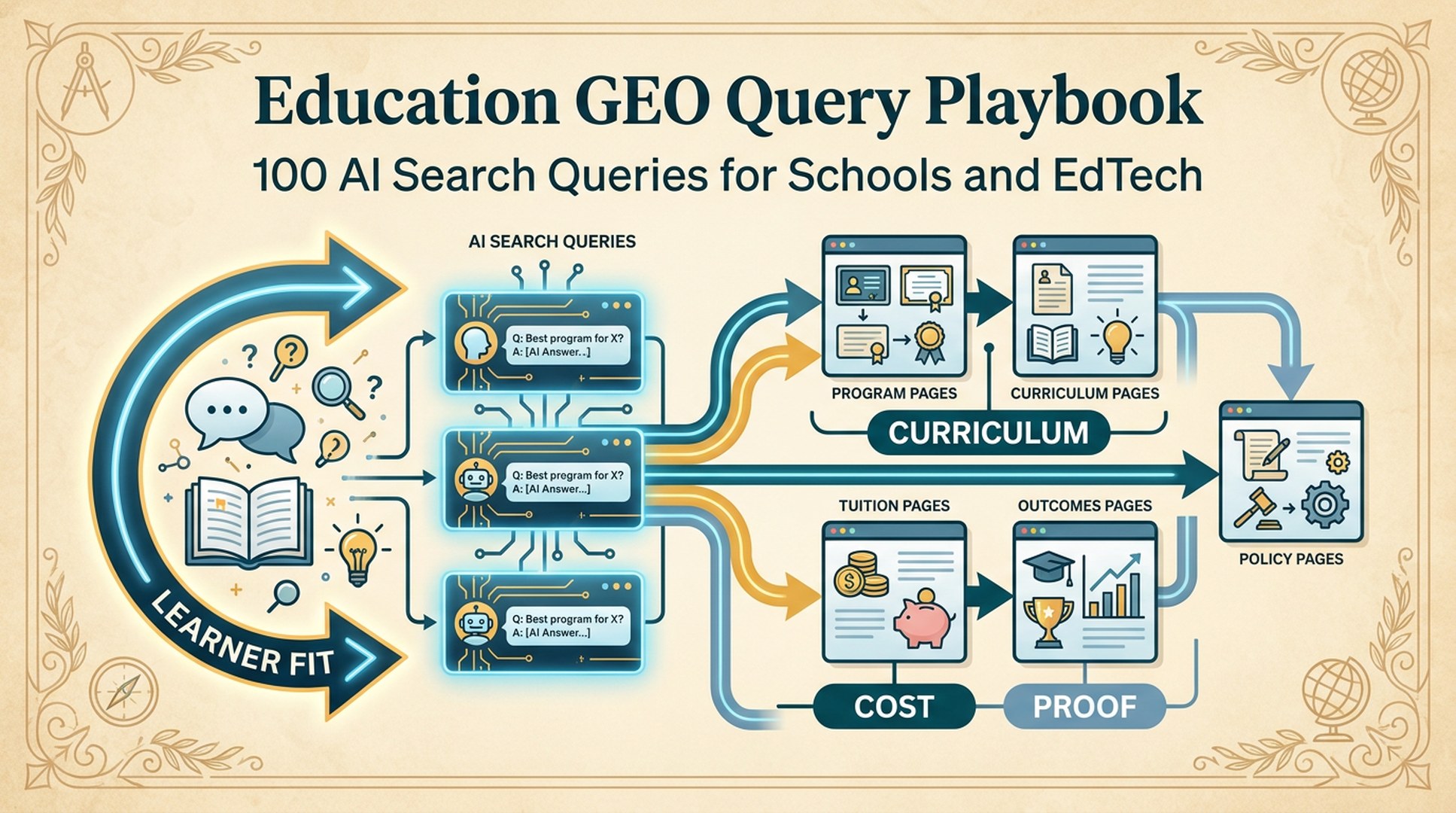
Education GEO is the work of making programs, courses, schools, bootcamps, tutoring services, and EdTech products easier for AI answer systems to understand, compare, and cite when learners or parents ask decision questions.
Education buyers rarely search in neat keyword phrases. A parent may ask, Which online math tutoring option is better for a 7th grader who is behind? A working adult may ask, Is a data analytics certificate worth it if I do not have a college degree? A school administrator may ask, What should we compare before buying an AI writing tool for students?
Those are not just blog topics. They are enrollment, trust, and product-fit prompts.
For education brands, the strongest GEO assets are program pages, admission pages, curriculum pages, tuition pages, outcomes pages, accreditation pages, parent guides, student support pages, comparison pages, and honest FAQ sections. The goal is not to publish 100 thin articles. The goal is to map 100 real AI Search queries to 10-20 pages that can answer with clarity, evidence, and context.
This playbook gives schools, universities, tutoring companies, online course platforms, bootcamps, and EdTech teams 100 AI Search queries to track, a learner-decision framework, a query-to-page map, and a 30-day execution plan.
The Education Decision Loop
Education GEO is different from SaaS, ecommerce, or insurance because the buyer and learner are often not the same person. A parent may choose for a child. A student may research for themselves but need family approval. An employee may evaluate a course because an employer might reimburse it. A teacher may test a tool, while a district administrator approves the purchase.
That creates a loop rather than a simple funnel:
Stage | What The User Needs | Example Query | Page That Should Answer |
|---|---|---|---|
Goal | Define the learning or career outcome |
| Goal-based guide |
Fit | Match level, age, schedule, or learning style |
| Fit / audience page |
Proof | Verify outcomes, reviews, accreditation, or teacher quality |
| Outcomes / accreditation page |
Cost | Understand tuition, fees, refund terms, and aid |
| Tuition / pricing page |
Experience | Understand curriculum, support, workload, and format |
| Curriculum / student experience page |
Risk | Check transferability, recognition, safety, privacy, or completion risk |
| Risk / policy FAQ |
Next Step | Apply, book a trial, request information, or compare options |
| Admissions / demo / trial page |
A useful first step is to check where the brand already appears, where competitors are mentioned, and which pages AI systems cite using an AI Search Visibility Checker. Then build a prompt library around the gaps.
Why Education GEO Starts With Learner Questions, Not Course Keywords
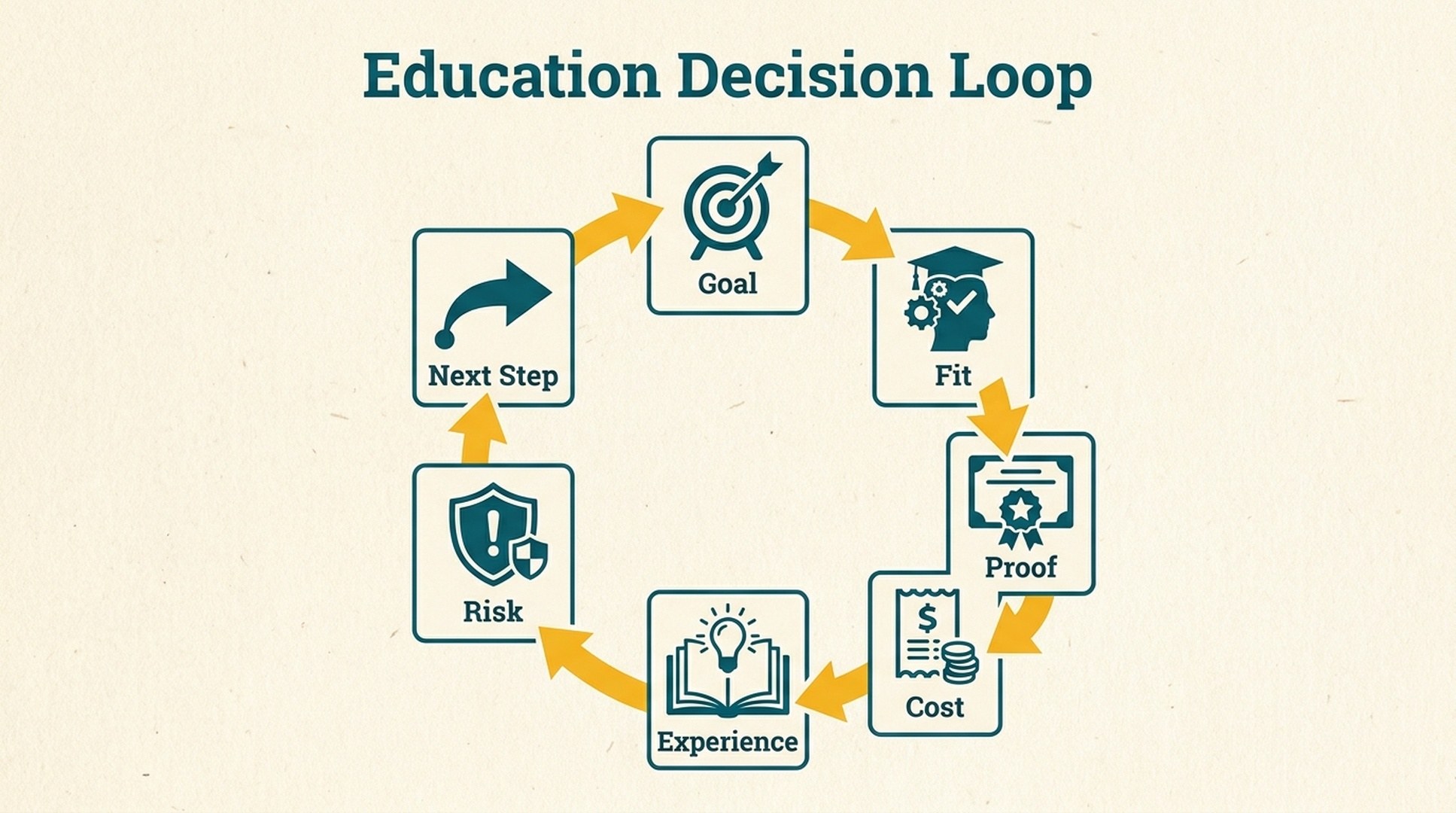
Education decisions move through goal, fit, proof, cost, experience, risk, and next step. GEO pages should support each stage with clear evidence.
Traditional education SEO often starts with keywords such as MBA program, online coding course, math tutor, or learning management system. GEO starts one level deeper.
AI Search users ask questions that combine outcome, context, constraints, and risk:
What is the best online MBA for someone working full time?How do I compare tutoring companies for a child with test anxiety?Is a cybersecurity bootcamp enough to get an entry-level job?What questions should a school ask before buying an EdTech platform?What should parents check before choosing a private school?
These questions require pages that explain who the offer is for, what it includes, what it does not promise, what evidence supports it, and what the next step should be.
Education pages also need careful language. Do not promise guaranteed grades, admissions, jobs, salaries, or learning outcomes unless the claim is factual, documented, and qualified. Strong education GEO is specific without being misleading.
The 10 Query Types Education Teams Should Map
Classify prompts before creating pages. This keeps the content system from turning into a pile of repetitive best course and top school posts.
Query Type | What The User Wants | Best Content Asset |
|---|---|---|
Goal / Outcome | Understand which path supports a learning, admissions, or career goal | Goal-based guide, program page |
Audience Fit | Match a program to age, level, schedule, role, or learning style | Audience page, student profile page |
Program / Curriculum | Understand what is taught, in what order, and at what depth | Curriculum page, syllabus page |
Cost / Aid | Understand tuition, fees, payment plans, aid, refund rules, or ROI assumptions | Tuition page, financial aid FAQ |
Comparison | Compare schools, courses, certificates, tools, or learning formats | Comparison page |
Credibility / Proof | Verify accreditation, outcomes, teacher credentials, reviews, or recognition | Outcomes page, accreditation page |
Process | Understand admission, enrollment, trial, assessment, onboarding, or graduation steps | Admissions / process page |
Risk / Limitations | Understand transfer credits, job claims, privacy, safety, completion risk, or policy limits | Policy FAQ, risk page |
Local / Scenario | Match a geography, grade level, exam, job goal, or school environment | Local page, scenario guide |
Tool / Implementation | Evaluate EdTech tools, LMS platforms, AI policy, integrations, and school rollout | Buyer guide, implementation page |
Every major cluster needs one owner page. If tuition is explained on a blog post, a landing page, and an FAQ with different wording, AI systems may summarize the wrong version.
How To Prioritize Education GEO Queries
Use a learner and enrollment scoring model:
Priority = Enrollment Intent + Learner Fit + Decision Impact + Evidence Strength + AI Answer Probability - Policy Risk - Competition Difficulty
Factor | How To Evaluate It |
|---|---|
Enrollment Intent | Is the user close to applying, booking a trial, requesting info, or choosing a tool? |
Learner Fit | Can the answer clearly explain who the program, school, tutor, or tool is for? |
Decision Impact | Could the answer change which institution, course, tutor, or platform the user chooses? |
Evidence Strength | Do you have curriculum details, accreditation, teacher credentials, outcomes data, reviews, policies, or demos? |
AI Answer Probability | Is the query likely to trigger a summarized recommendation, comparison, or checklist? |
Policy Risk | Could the answer imply guaranteed grades, admissions, jobs, salaries, safety, or student outcomes? |
Competition Difficulty | Are universities, directories, review sites, government pages, or large platforms already dominating? |
Start with prompts where the brand has proof and the user has a real decision to make. Avoid vague best school content unless you can explain the methodology, audience, evidence, and limitations.
100 Education GEO Query Examples
Use these prompts as a starting library. Adapt them by education level, geography, subject, learner age, credential type, privacy requirements, and internal policy review.
Goal / Outcome Queries
- What online course should a beginner take to learn data analytics?
- What degree should I consider if I want to work in healthcare administration?
- What coding class should a high school student take first?
- What certificate helps people move into digital marketing?
- What should adults study if they want to change careers?
- What math support helps students who are behind grade level?
- What English course helps international students prepare for university?
- What program helps teachers learn AI classroom skills?
- What business course is useful for first-time founders?
- What should students study before applying to design school?
Audience Fit Queries
- Is online tutoring good for middle school students?
- Is a coding bootcamp suitable for complete beginners?
- Is an online MBA manageable while working full time?
- Is self-paced learning good for students who need structure?
- Is private tutoring worth it for students with test anxiety?
- Is an online certificate useful for career changers?
- Is homeschool curriculum a good fit for working parents?
- Is a language app enough for business English practice?
- Is a small private school better for shy students?
- Is an AI learning platform appropriate for elementary students?
Program / Curriculum Queries
- What should a good data analytics curriculum include?
- What topics should a beginner coding course cover?
- What should parents look for in a reading intervention program?
- What does an online MBA curriculum usually include?
- What does a UX design bootcamp teach?
- What should a cybersecurity certificate cover?
- What skills should a digital marketing course teach?
- What should a college prep program include?
- What does a strong ESL program include?
- What should a teacher AI training course cover?
Cost / Aid Queries
- How much does online tutoring usually cost?
- How much does a coding bootcamp cost?
- What affects private school tuition?
- What fees should students check before enrolling in an online program?
- What financial aid options exist for adult learners?
- What refund policy should an online course have?
- How do payment plans for bootcamps work?
- What is the total cost of an online degree?
- What should parents ask about tutoring package pricing?
- What does employer tuition reimbursement usually require?
Comparison Queries
- Online tutoring vs in-person tutoring: which is better?
- Bootcamp vs university degree for software development
- Online MBA vs part-time MBA for working professionals
- Certificate vs degree for career change
- Private school vs charter school: what should parents compare?
- Group tutoring vs one-on-one tutoring
- Self-paced course vs live online class
- LMS vs learning experience platform for schools
- Language app vs online language tutor
- Community college vs online certificate for adult learners
Credibility / Proof Queries
- How do I know if an online course is credible?
- How do I check if a school is accredited?
- What outcomes should a bootcamp publish?
- What credentials should tutors have?
- How should schools report student outcomes?
- Are online certificates recognized by employers?
- What reviews should parents read before choosing a tutoring company?
- What makes an EdTech platform trustworthy?
- How do I verify a teacher training provider?
- What proof should a college prep service provide?
Process Queries
- How does online tutoring enrollment work?
- What happens during a tutoring assessment?
- What documents are needed to apply for an online degree?
- How does bootcamp admissions work?
- What happens after requesting information from a university?
- How do students switch from one online course to another?
- How does private school admissions work?
- How do schools onboard a new EdTech platform?
- How does a free trial for a learning app work?
- What should students expect during course orientation?
Risk / Limitations Queries
- Are online certificates enough to get a job?
- Can a bootcamp guarantee employment?
- What are the risks of choosing an unaccredited program?
- Can online tutoring guarantee better grades?
- What student data should an EdTech platform collect?
- What privacy questions should schools ask before using AI tools?
- What happens if a student does not finish an online course?
- Will credits from an online program transfer?
- What should parents know before using AI homework tools?
- What should students check before paying for a course upfront?
Local / Scenario Queries
- Best tutoring option for high school math students near me
- Best online course for working parents
- Best coding class for teenagers
- Best college prep support for international students
- Best English course for healthcare workers
- Best data analytics certificate for non-technical beginners
- Best private school for students who need small classes
- Best homeschool curriculum for middle school science
- Best test prep option for students with limited time
- Best online teaching certification for busy teachers
Tool / Implementation Queries
- What should schools compare before buying an LMS?
- What should districts ask before approving an AI writing tool?
- How do schools evaluate student data privacy in EdTech tools?
- What integrations should an education platform support?
- What features matter in a math learning app?
- What should teachers look for in an AI lesson planning tool?
- How should schools pilot a new EdTech platform?
- What makes an online learning platform accessible?
- How should universities evaluate AI tutoring tools?
- What should education teams measure after launching a learning platform?
How To Turn Education Queries Into Citation-Ready Pages
A GEO query library should become an enrollment and trust architecture. The most useful pages are often not blog posts. They are pages that already sit close to enrollment, application, parent approval, school procurement, or course purchase.
Query Cluster | Owner Page | Page Type | Required Proof |
|---|---|---|---|
Goal prompts | Goal-based guide | Educational guide | Audience, outcome, prerequisite, next step |
Audience-fit prompts | Student fit page | Segment page | Age, level, schedule, support model, limits |
Curriculum prompts | Curriculum page | Program page | Syllabus, modules, workload, learning objectives |
Cost prompts | Tuition / pricing page | Cost guide | Tuition, fees, payment options, refund policy |
Comparison prompts | Comparison page | Decision guide | Methodology, tradeoffs, who each option fits |
Credibility prompts | Outcomes / accreditation page | Trust page | Accreditation, credentials, outcomes, reviews, caveats |
Process prompts | Admissions / onboarding page | Process guide | Steps, documents, timeline, contact path |
Risk prompts | Policy FAQ | Risk / policy page | Transfer limits, privacy policy, no-guarantee language |
Local prompts | Location / scenario page | Local or use-case page | Location details, learner segment, service scope |
Tool prompts | EdTech buyer guide | B2B evaluation page | Integrations, privacy, accessibility, support, evidence |
A citation-ready education page should answer the question directly, then support the answer with curriculum facts, admissions requirements, pricing details, outcome evidence, student support details, and policy limits.
For technical readiness, make sure program pages, course pages, tuition pages, faculty pages, and admissions pages are crawlable and indexable. A quick Website SEO Score Checker can help find basic crawl, metadata, and page quality problems before the content team rewrites high-value pages.
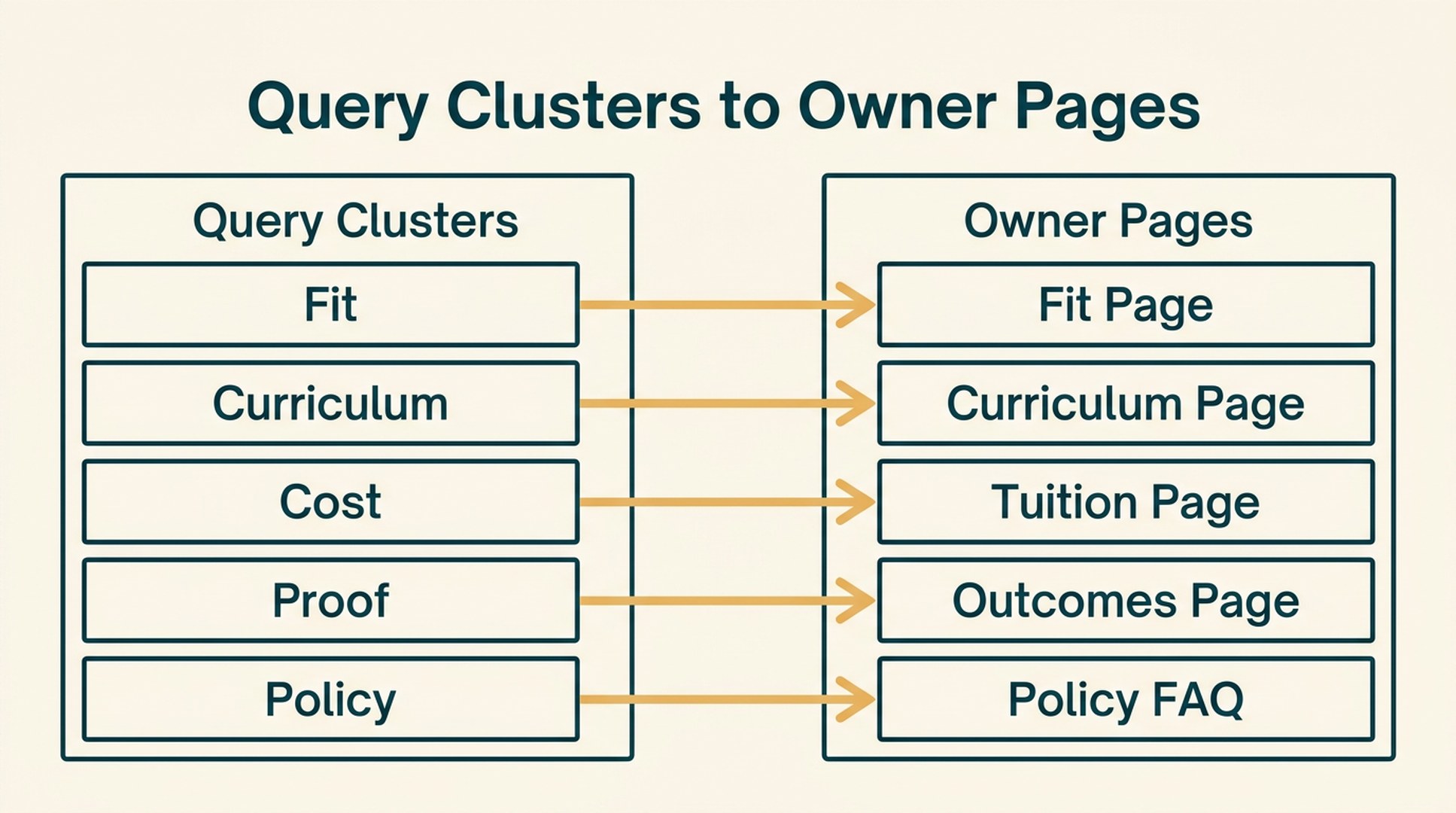
Fit, curriculum, cost, proof, and policy queries should map to dedicated owner pages instead of scattered blog mentions.
The First 20 Queries To Prioritize
If an education brand is starting from scratch, these 20 prompts usually create a strong first backlog.
Priority | Query | Why It Matters | Likely Owner Page |
|---|---|---|---|
1 | What online course should a beginner take to learn data analytics? | Clear goal and enrollment intent | Goal-based program guide |
2 | Is a coding bootcamp suitable for complete beginners? | Fit question before application | Audience fit page |
3 | What should a good data analytics curriculum include? | Curriculum evaluation | Curriculum page |
4 | How much does a coding bootcamp cost? | High purchase friction | Tuition page |
5 | Online tutoring vs in-person tutoring: which is better? | Format comparison | Tutoring comparison page |
6 | Certificate vs degree for career change | High decision impact | Credential comparison page |
7 | How do I know if an online course is credible? | Trust validation | Credibility page |
8 | How do I check if a school is accredited? | Critical proof query | Accreditation page |
9 | What outcomes should a bootcamp publish? | Evidence and transparency | Outcomes page |
10 | How does online tutoring enrollment work? | Process and conversion | Enrollment process page |
11 | What happens during a tutoring assessment? | Trial readiness | Assessment guide |
12 | Are online certificates enough to get a job? | Risk-sensitive expectation setting | Career outcomes FAQ |
13 | Can online tutoring guarantee better grades? | Policy and trust risk | Tutoring limitations FAQ |
14 | What student data should an EdTech platform collect? | B2B privacy decision | Privacy guide |
15 | Will credits from an online program transfer? | High-risk enrollment question | Credit transfer page |
16 | Best coding class for teenagers | Segment-specific discovery | Teen coding page |
17 | Best online course for working parents | Schedule and format fit | Working adult guide |
18 | What should schools compare before buying an LMS? | B2B buyer intent | LMS buyer guide |
19 | How should schools pilot a new EdTech platform? | Implementation intent | Pilot plan page |
20 | What makes an online learning platform accessible? | Trust and compliance signal | Accessibility page |
These prompts are useful because they can be answered with owned facts rather than vague claims. They also create a balanced first sprint: goal, fit, curriculum, cost, proof, process, risk, and implementation.
30-Day Execution Plan
Timeframe | Action | Output |
|---|---|---|
Days 1-3 | Build the education AI Search query library and classify by learner type, program, buyer, and page owner | 100-query prompt library |
Days 4-7 | Score prompts by enrollment intent, learner fit, decision impact, evidence, AI answer probability, policy risk, and competition | First 20 prompt backlog |
Days 8-14 | Map prompts to program pages, curriculum pages, tuition pages, comparison pages, outcomes pages, and policy pages | Query-to-page map |
Days 15-21 | Rewrite priority pages with direct answers, prerequisites, curriculum facts, cost details, proof blocks, and policy limits | Updated citation-ready pages |
Days 22-30 | Test prompts across AI answer surfaces and record brand mentions, cited URLs, competitors, and inaccurate claims | Education AI visibility tracker |
A tutoring company can start with five assets: a student-fit guide, a tutoring format comparison page, a pricing FAQ, an assessment process page, and a tutor credentials page. A university or online program should add curriculum pages, tuition pages, accreditation pages, outcomes pages, transfer credit FAQs, and admissions guides. An EdTech company should add privacy, accessibility, integration, implementation, and evidence pages.
Common Mistakes
Education GEO fails when teams publish enrollment content without enough proof, context, or policy boundaries.
Avoid these mistakes:
- Turning 100 prompts into 100 thin posts. Use the list to strengthen owner pages instead.
- Overpromising outcomes. Avoid guaranteed grades, admissions, jobs, salaries, or career changes unless the claim is documented and qualified.
- Hiding tuition details. If pricing is complex, explain ranges, fees, payment plans, and refund terms.
- Treating accreditation as a footnote. Accreditation, recognition, and credential validity should be easy to verify.
- Publishing generic `best course` pages. Explain who the course fits, what it includes, what it does not include, and how the comparison was made.
- Ignoring privacy and accessibility. EdTech and AI education tools need clear student data, accessibility, and implementation information.
- Measuring only rankings. Track AI mentions, cited pages, competitor inclusion, and inaccurate summaries of program details.
FAQ
What is education GEO?
Education GEO is the process of making school, course, tutoring, program, EdTech, admissions, tuition, curriculum, and outcomes pages easier for AI answer systems to understand, summarize, and cite accurately.
Is education GEO the same as education SEO?
No. Education SEO focuses on rankings, technical visibility, content quality, and enrollment traffic. Education GEO builds on that foundation but focuses on how AI systems answer learner, parent, and administrator questions about fit, credibility, cost, curriculum, and next steps.
Should education brands create one page for every AI Search query?
No. The 100-query list should become a page map. Many questions should be answered by stronger program pages, tuition pages, curriculum pages, admissions pages, comparison pages, outcomes pages, and policy FAQs.
Which education queries should teams prioritize first?
Start with questions about learner fit, curriculum, cost, credibility, accreditation, outcomes, admissions process, privacy, accessibility, and comparison. These queries influence enrollment or purchase decisions and can usually be answered with owned evidence.
How can education brands avoid risky GEO content?
Use clear qualification language, avoid guaranteed outcomes, show assumptions, state refund and transfer policies, explain accreditation or recognition accurately, and involve admissions, academic, legal, privacy, or product owners when needed.
How should education teams measure GEO performance?
Track a stable prompt set across AI answer surfaces. Record whether the brand appears, which URLs are cited, which competitors appear, whether facts are accurate, and whether AI answers omit important tuition, accreditation, privacy, or outcome limitations.
Auspia Takeaway
Education GEO is about helping AI systems explain learning decisions responsibly. The best pages do not simply sell a course, school, tutor, or platform. They clarify learner fit, curriculum, cost, credibility, risk, and next steps.
Start with prompts that affect enrollment, parent confidence, student success, or school procurement. Map the first 20 queries to pages that already matter for decisions. Then rewrite those pages so their answers are direct, verifiable, and safe to summarize.
Author: Clara Bennett, 10-Year Content Strategy Practitioner at Auspia. Clara writes about editorial systems, topic maps, repeatable content operations, and SEO/GEO production workflows.