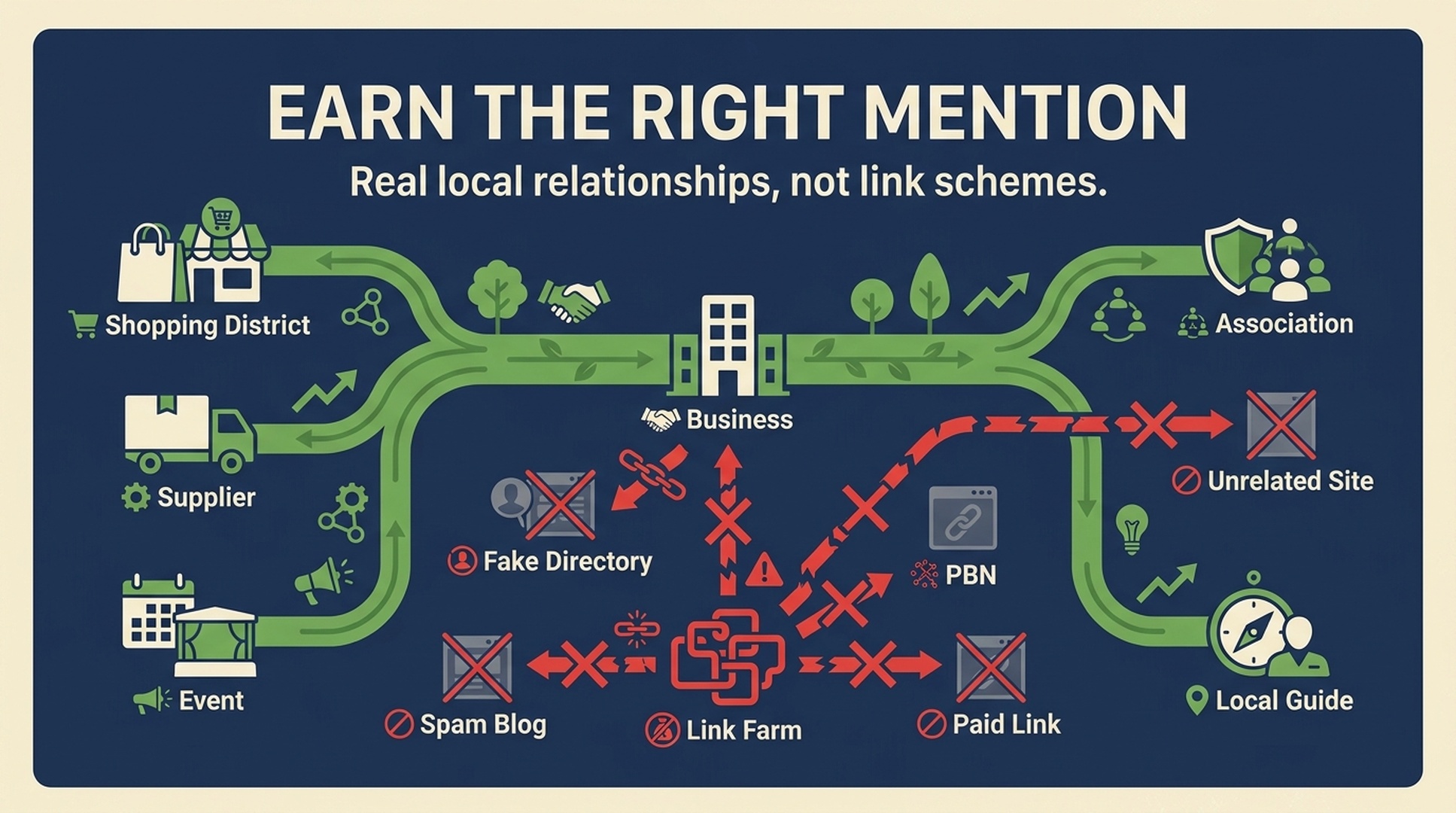
The first question is not "How many links can we buy?"
Ask a harder question: what independent local or industry source could describe this business in a way that helps a customer make a better decision?
If the answer is "none," buying a placement will not create a real reason for that source to mention the business. If the answer is a genuine partnership, credential, project, event, supplier relationship, community resource, local report, or specialist service, the business may have something useful to contribute. A link can follow from that work, but it should not be the only reason the work exists.
Google's local-ranking guidance says local prominence is based in part on how many websites link to a business and how many reviews it has. So links still belong in local search strategy. Google also defines link spam as creating links to or from a site primarily to manipulate rankings. Buying or selling ranking links, excessive reciprocal exchanges, automated link creation, low-quality directory links, and paid articles that pass ranking credit are listed examples.
That gives local businesses a clear operating line:
Build toward | Do not build toward |
|---|---|
A relevant source that can explain why the business is useful to a local or industry audience | A link that exists only because a vendor could sell placement |
A customer-relevant mention, even if the link is qualified or absent | A followed link with no context, referral value, or credible relationship |
A stable page that confirms a real service, credential, event, partnership, or local contribution | A mass-produced guest post, footer link, widget, comment, or reciprocal-link page |
A local or specialist relationship that remains useful after the campaign ends | A report whose only output is a growing count of referring domains |
The practical aim is not "more authority" in the abstract. It is a better public record of why this business belongs in the local decision set.
What links can and cannot do for local visibility
Links can support a business's broader web presence and Google says they feed into local prominence. They can also send a prospective customer to a local service page, validate a relationship, or give an AI answer system a source that describes the business accurately.
They cannot do the following on their own:
- Move a business closer to a searcher.
- Correct an inaccurate Business Profile, wrong primary category, outdated hours, or false service area.
- Turn an unqualified market into a profitable service territory.
- Make thin location pages useful.
- Guarantee a Maps ranking, a Google AI Overview link, or a recommendation in another answer engine.
Google does not publish percentage weights for local ranking signals. Its local-ranking guidance says that links to a business contribute to prominence, while its spam policies prohibit attempts to manipulate rankings with paid or artificial links. Treat links as one part of a broader local trust system alongside accurate business facts, genuine reviews, useful pages, and real-world evidence.
A local link must pass three tests
Before pursuing a placement, score it against the relationship, audience, and evidence tests.
Test | Question | Pass looks like | Warning sign |
|---|---|---|---|
Relationship | Does a real connection exist or can one be built through useful work? | The business can truthfully explain the partner, project, event, credential, or resource | The only connection is a request for a followed link |
Audience | Would the source's readers reasonably care about this business or resource? | The page reaches local buyers, referral partners, or a relevant professional community | The site publishes unrelated topics solely to sell placements |
Evidence | Does the page provide accurate context that a customer could verify? | It names the service, location, role, qualification, or project without exaggerated claims | It uses a keyword-rich anchor and no meaningful explanation |
A prospect that fails two of the three tests should usually be declined. This removes most of the links that create policy risk, wasted budget, and reporting theater.
Seven sources of legitimate local mentions
The right mix differs by category. A clinic, roofing company, restaurant group, law firm, manufacturer, and home-services franchise will not earn the same references. The following sources are useful because they begin with something a real audience can verify.
Source type | What creates a legitimate reason to mention the business | Useful destination page | What to avoid |
|---|---|---|---|
Professional and licensing organizations | Current membership, credential, accreditation, or public directory record | Location, credential, or specialist service page | Claiming credentials that have expired or do not apply to the location |
Suppliers, manufacturers, and distributors | Authorized relationship, trained installer status, a compatible product line, or documented project collaboration | Relevant service or product-support page | Partner pages created solely for a reciprocal link |
Local chambers and business groups | Membership, speaking, practical local resource, or genuine business participation | Local about page, resource, or event page | Paying for a listing upgrade only for an SEO link |
Community organizations, schools, and nonprofits | Sponsorship, volunteer effort, donation, workshop, or useful community project | Project page or local resource page | Token sponsorships with no actual connection or misleading cause claims |
Local media and neighborhood publications | A verifiable business change, local data, expert explanation, event, project, or community contribution | Primary source page with facts, images, or contact details | Press-release syndication designed only to place links |
Referral partners | A real complementary relationship, co-authored customer guide, or clear referral process | Selection guide, service page, or booking path | "Link to us and we will link to you" pages with no customer purpose |
Industry education and local resources | A practical guide, safety resource, accessibility information, cost explainer, or event that fills an audience need | Durable guide with named author, date, and clear limitations | Generic guest articles rewritten for each site |
The destination is part of the work. If a local article names a storm-restoration company, a link to a generic homepage may be less helpful than a page explaining insurance documentation, emergency-response boundaries, and which neighborhoods the business actually serves. The page should substantiate the mention without pretending to be a sales landing page.
Build assets before outreach
Outreach fails when the business asks a source to recommend it without offering a reason. Build a small library of pages or resources that a partner, journalist, association, or customer would be comfortable sharing.
Good local-link assets are grounded in the operating reality of the business:
Asset | When it is useful | Minimum proof needed |
|---|---|---|
Local service guide | Customers need to understand a process, emergency, season, regulation, or common problem | Accurate service boundary, author or reviewer, date, sources, and clear limitations |
Supplier or partner explainer | A real relationship affects product choice, installation, warranty, or process | Partner authorization, accurate scope, and a customer-relevant explanation |
Community project page | The business contributed time, funding, expertise, or a resource | Specific project facts, permission to name parties, and photos or outputs where appropriate |
Original local data note | The business has defensible operational data that helps the community | Methodology, sample limits, date, and no unsupported market claims |
Referral or selection guide | Buyers need help choosing a provider, preparing for a service, or understanding boundaries | Fair criteria, stated limitations, and no deceptive comparison claims |
Accessibility, safety, or preparation resource | The business can provide a useful, non-promotional answer to a recurring local question | Accurate advice, qualified review where needed, and clear emergency or professional-service disclaimers |
Do not manufacture a resource just to obtain a link. A weak "guide" with city names swapped in is thin content plus a thin outreach angle. Start with questions the business already hears from customers, partners, dispatchers, or frontline staff.
Outreach should make a narrow, honest request
The best local outreach is specific enough that a recipient can say yes or no without a call. It explains the real connection, names the resource, and does not ask for a particular anchor text, followed status, or ranking outcome.
Example structure:
Subject: resource for [audience or local need]
>
Hi [Name], [Business] works with [specific customer, partner, or community context]. We put together [resource] because [real problem it solves]. It includes [one or two verifiable details]. If it is useful for your [page, audience, members, or event], you are welcome to reference it here: [URL]. If not, no action needed.
The message does not need to use the word "link." A recipient can choose whether a reference, citation, resource listing, or invitation makes sense. That choice is one reason the mention has more credibility than a placement bought to manipulate ranking.
For paid sponsorships, advertising, and advertorials, be transparent. Google says paid links for advertising or sponsorship are not a violation when they are appropriately qualified with rel="nofollow" or rel="sponsored". A legitimate sponsorship can still create brand awareness and referral value. Do not represent it as a way to buy ranking credit.
What to decline, even when the metric looks attractive
The following offers can look efficient in a spreadsheet and expensive after the fact.
Offer | Why to decline | Better alternative |
|---|---|---|
"Guaranteed DR/DA links" with no source list or editorial context | It treats the metric as the product and hides the relationship | Ask which audience, page, contribution, and disclosure policy make the mention legitimate |
Paid guest post with optimized anchor text | Google lists paid articles passing ranking credit as link spam | Sponsor transparently with qualified links, or create an editorial resource worth citing without payment |
Large reciprocal-link page | Google lists excessive exchanges and partner pages made exclusively for cross-linking as link spam | Build a customer-facing referral page only where an actual partner relationship helps the buyer |
Bulk local directory package | Google lists low-quality directory links as link spam | Correct high-decision sources and real authority records first |
Free product or service in exchange for a link | Google lists exchanging goods or services for ranking links as link spam | Provide a product for an independent review without requiring a link or qualify any compensation properly |
Footer, widget, or template links across many sites | Google lists widely distributed template links as a spam example | Earn individual editorial references tied to a real page and audience |
Link exchange inside an "SEO partnership" | The relationship exists only to pass ranking signals | Work with partners on a customer resource, event, or referral process that stands on its own |
This is not a reason to avoid every paid local marketing opportunity. It is a reason to separate advertising value from ranking manipulation. A sponsored community event may be worth doing because it supports a real organization and reaches local customers. Its search link treatment should be transparent.
A 60-day local mention pipeline
This pipeline is small by design. It gives a local business enough time to build useful proof and relationships rather than sending hundreds of generic emails.
Timeframe | Work | Owner | Output |
|---|---|---|---|
Days 1-7 | Review service areas, customer questions, existing partners, credentials, local projects, and current off-site mentions | Owner, operations, and marketing | Relationship inventory and three evidence gaps |
Days 8-21 | Build or improve two destination assets that answer real customer or partner questions | Subject-matter owner and content lead | Two source-worthy pages with proof, dates, and contact paths |
Days 22-35 | Identify 20 to 30 prospects that pass the relationship, audience, and evidence tests | Marketing lead | Shortlisted sources with connection notes and proposed value |
Days 36-50 | Make narrow outreach requests, participate in real events or partner work, and record responses | Relationship owner | Outreach log, meetings, and approved source opportunities |
Days 51-60 | Verify published facts and links, review referrals and lead quality, and decide what to improve next | Owner and agency | Mention-quality report and next-quarter plan |
The goal is not to close every prospect. The goal is to develop a repeatable way to make the business more useful and easier to verify in the communities that matter.
Measure mention quality before link quantity
Track the link, but do not let it become the only result in the report.
Measure | What it shows |
|---|---|
Source relevance | Whether the source reaches the local or professional audience that matters |
Context accuracy | Whether the mention describes the business, service, and location correctly |
Customer utility | Whether the page gives a reader a genuine reason to consider, contact, or verify the business |
Referral quality | Whether visitors call, book, request a quote, or engage with the relevant local page |
Relationship durability | Whether the source reflects an ongoing credential, partnership, or resource rather than a one-time placement |
Brand and entity consistency | Whether public facts support the canonical business record |
Search contribution | Whether local organic, branded, or relevant referral visibility changes over a reasonable period alongside other work |
Do not attribute a local ranking increase to one new link without evidence. Local visibility changes for many reasons, including profile updates, reviews, competition, customer location, page changes, and Google systems. Report the link as one input in a broader local-trust program.
How links fit into local AI visibility
Links and mentions can give an answer system more places to find and corroborate a business. They do not create an AI-specific shortcut.
Google says there are no special requirements or special optimizations for AI Overviews and AI Mode. Google also says a page shown as a supporting link must be indexed and eligible to appear with a snippet. For other answer engines, pages may be retrieved, summarized, or cited under different conditions. The safe strategy remains the same: publish useful pages, maintain accurate business facts, earn real third-party descriptions, and test the questions customers actually ask.
When reviewing local AI prompts, look beyond whether the brand name appeared:
- Is the business described with the correct service, location, and customer fit?
- Is a third-party source accurate and current?
- Does the answer link or direct the user to a useful page?
- Does the next step produce a qualified call, booking, or inquiry?
A mention that creates the wrong kind of demand is not a win. A clean local reference that gives the business the right context can be more valuable than a high-metric link that sends no relevant customer anywhere.
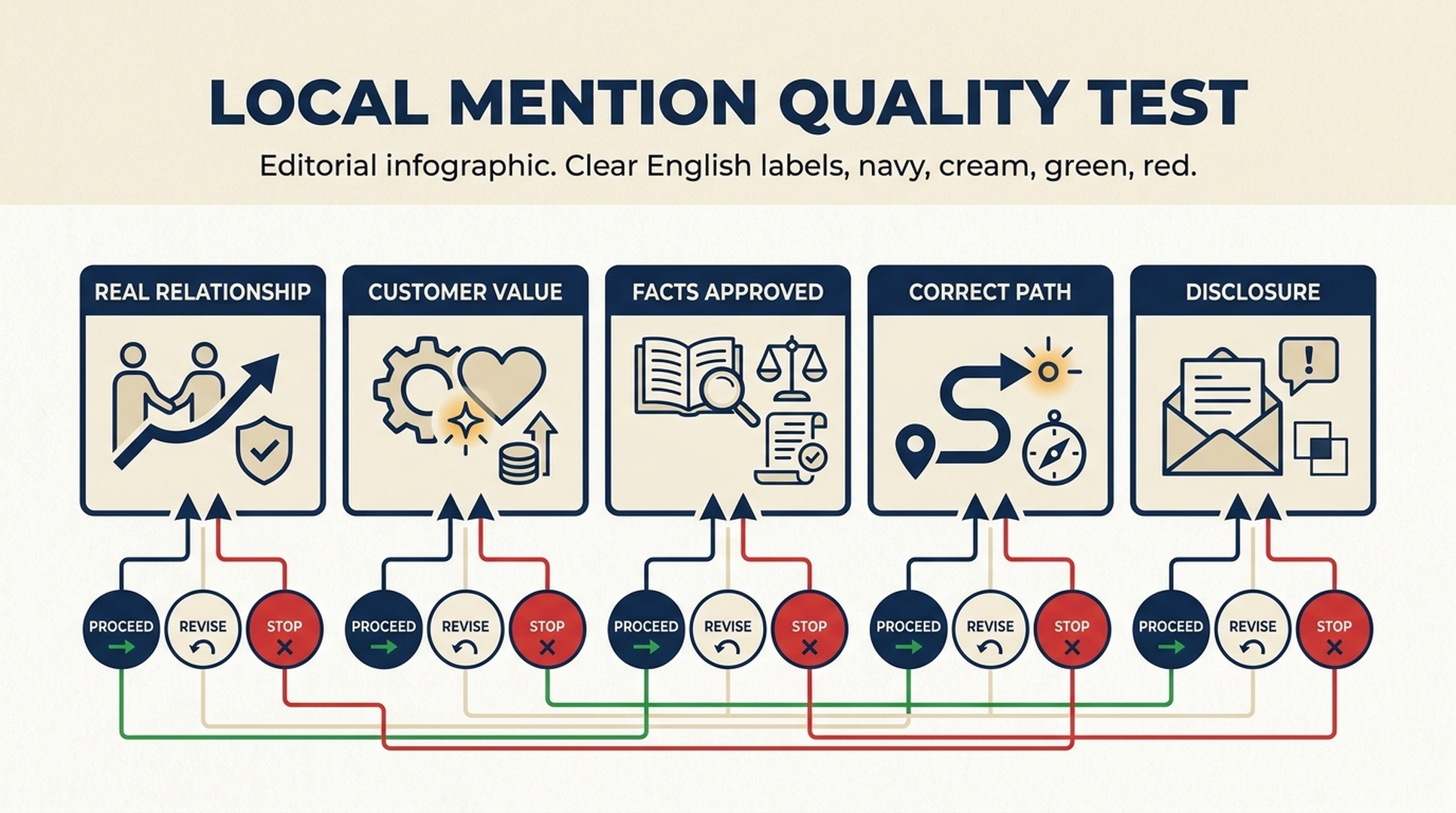
Use this framework to separate operational facts, customer trust, relevant evidence, and answer-quality checks.
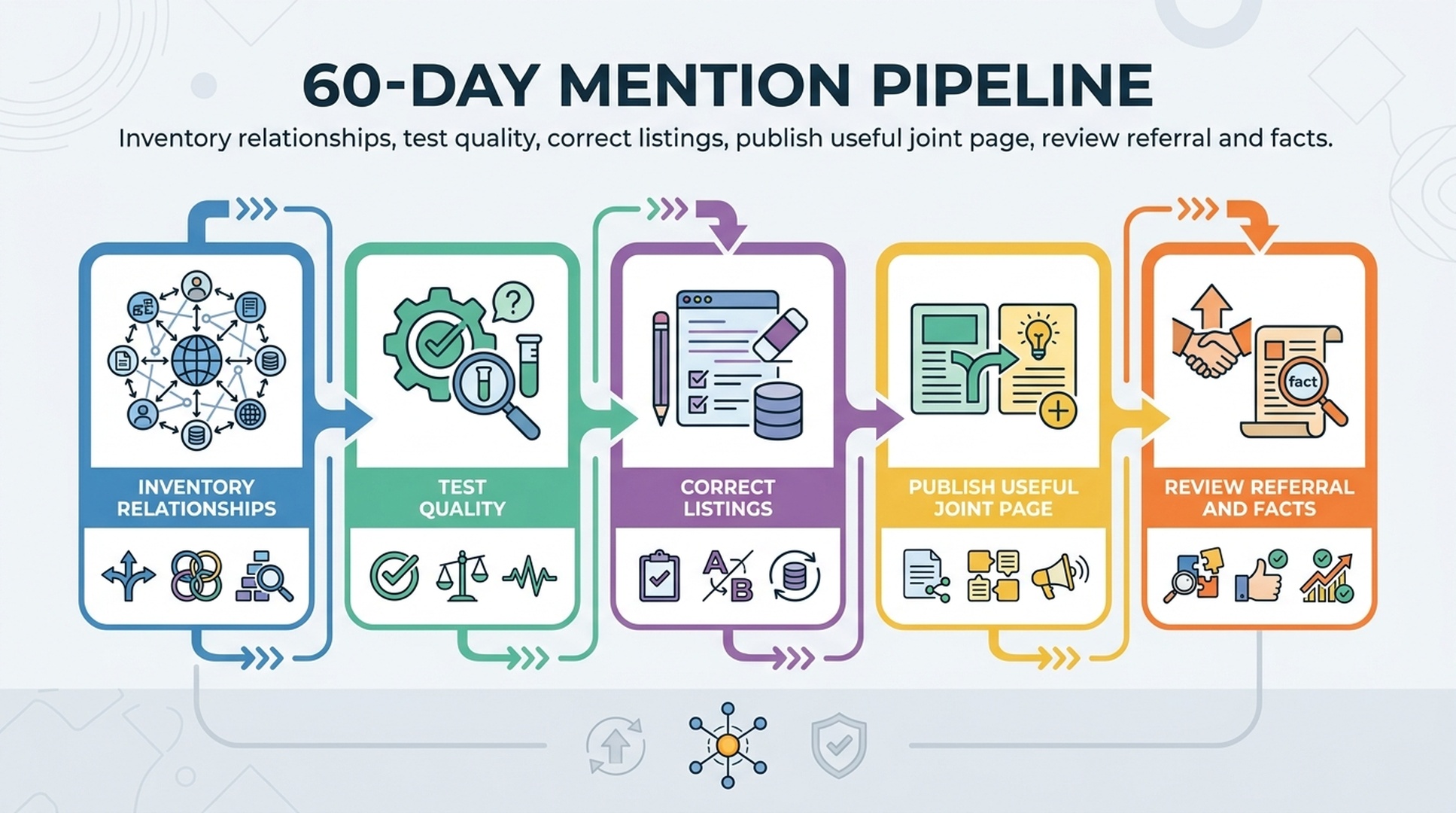
Use the timeline as an operating sequence, not as a ranking guarantee.
FAQ
Are links still important for local SEO in 2026?
Yes. Google says links to a business contribute in part to local prominence. Links are one component of a wider local system that also includes relevance, distance, business information, reviews, useful pages, and customer experience.
Should a local business buy backlinks?
Do not buy links for ranking purposes. Google identifies buying or selling links for ranking, paid articles that pass ranking credit, excessive exchanges, low-quality directories, automated link creation, and certain template links as link-spam examples. Spend on transparent advertising, sponsorship, or useful relationship work when it has independent customer value.
Does a sponsored local event help SEO?
It can be worthwhile for community, referral, and brand reasons. Google says paid advertising and sponsorship links should be appropriately qualified with nofollow or sponsored when relevant. Do not require a followed link as the condition of sponsorship.
What is a good local link prospect?
A good prospect has a real relationship with the business, reaches a relevant customer or professional audience, and can describe a verifiable reason the business or its resource is useful. A local association, supplier, licensing body, community organization, referral partner, or neighborhood publication may qualify when the underlying connection is genuine.
Are directory links bad for local SEO?
No. A relevant, maintained directory that customers use can be useful for business facts and discovery. The risk is treating low-quality directory volume as a ranking tactic. Google lists low-quality directory or bookmark links as a link-spam example.
Can local links guarantee a Maps ranking or AI recommendation?
No. Local results depend on relevance, distance, prominence, and other information Google can verify. AI answers vary by platform, prompt, and source set. Use links and mentions to improve real-world evidence, not to promise a particular outcome.
Continue the local search series
Use these related guides to move from diagnosis to an operating plan:
Sources
- Google Business Profile Help, Tips to improve your local ranking on Google. Source for Google's local-prominence statement that includes links to the business and reviews.
- Google Search Central, Spam policies for Google web search. Source for the link-spam definitions and examples, including paid ranking links, excessive exchanges, low-quality directories, widgets, template links, and qualified paid links.
- Google Search Central, AI features and your website. Source for no special AI Overview/AI Mode requirements and supporting-link eligibility.
Author: Naomi Ellis, Brand Mention Analyst Across 20k+ Visibility Signals at Auspia. Naomi writes about brand mentions, relationship-based evidence, reputation signals, and visibility gaps across local and AI search.