The short answer
AEO in 2026 means making your brand, pages, and facts easy for answer engines to cite. Traditional SEO still matters, but it does not guarantee that an AI answer will mention you when a buyer asks for a recommendation, comparison, definition, or shortlist.
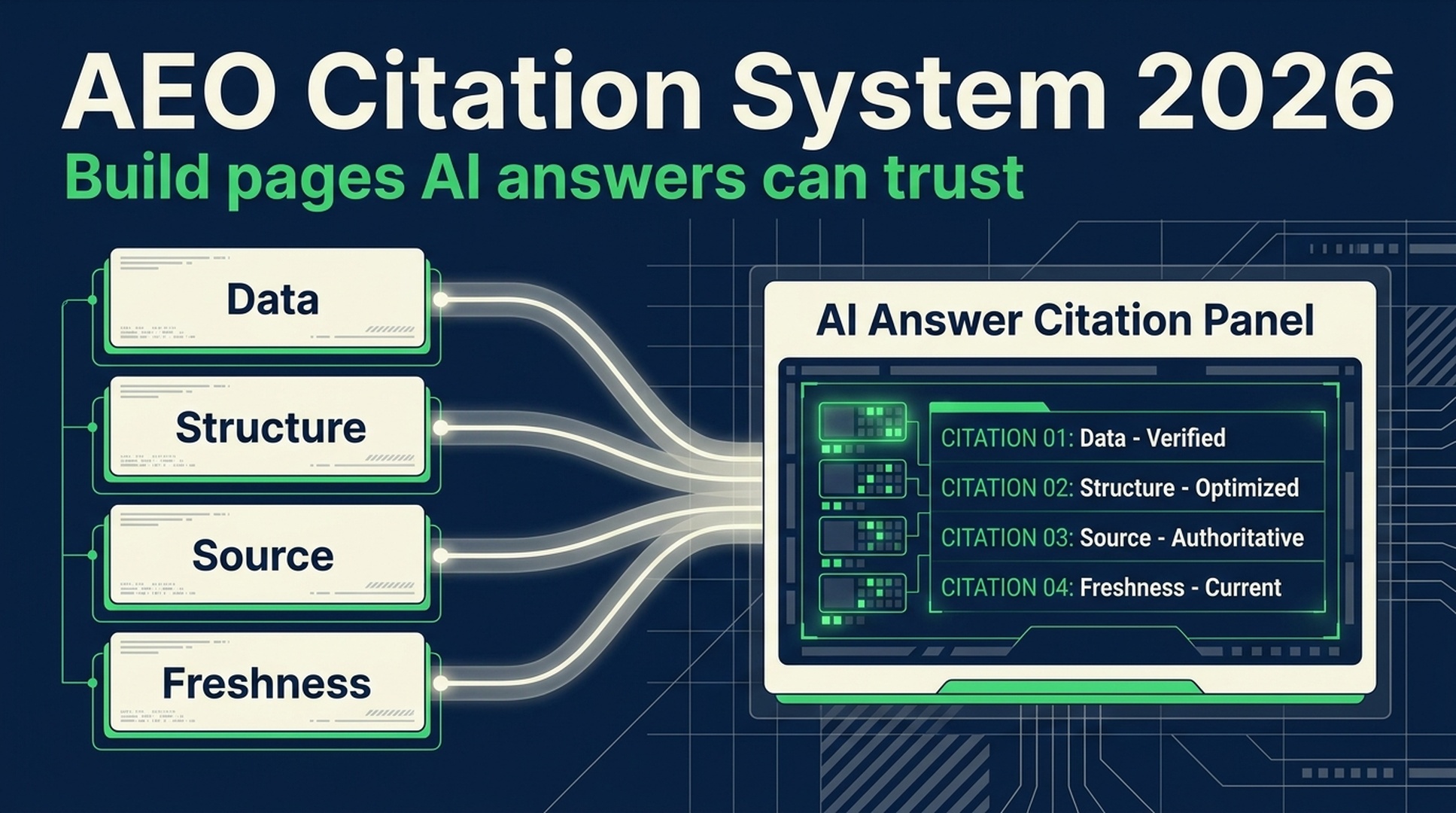
The practical fix is not to publish more generic content. Build a citation system: verified facts, clear page structure, front-loaded answers, schema markup, and a recurring review loop for the prompts that matter to revenue.
That sounds more operational than glamorous. It is. But that is why it works.
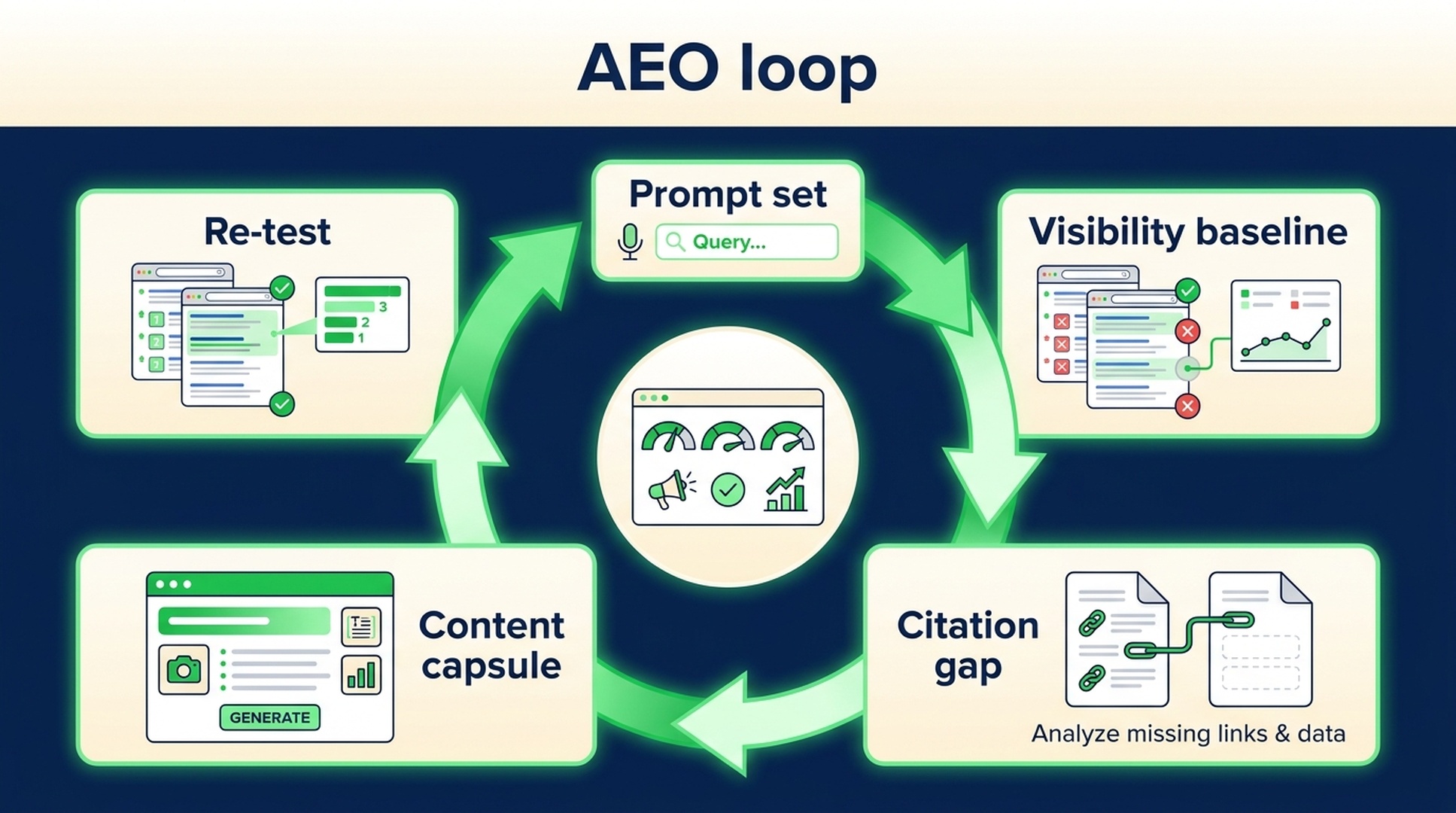
Caption: AEO works best as a recurring loop, not as a one-off rewrite project.
Why AEO matters more in 2026
Search is splitting into two behaviors.
One group of users still searches the old way: query, blue links, comparison tabs, click. Another group asks an answer engine for the conclusion first. "Which CRM is best for a 20-person agency?" "What is the safest payment processor for cross-border SaaS?" "Which AI SEO tools support llms.txt?"
Those queries do not always produce a neat list of ten links. They produce a synthesized answer with a few named sources, a few recommended brands, and a confidence level the user may never question.
That changes the job of content. A page can rank well and still fail at the exact moment the buyer asks an AI system what to choose. In AEO terms, the page was visible to search crawlers but not useful enough for answer extraction.
AEO, or Answer Engine Optimization, is the work of making your content easier for AI systems to retrieve, verify, summarize, and cite in a direct answer.
GEO is broader. It improves how a brand appears across the knowledge layer that AI systems learn from and retrieve against. AEO is narrower and more tactical. It asks: when the model needs one answer, one definition, one comparison, one proof point, or one recommendation, is our source the safest one to use?
If you want to check the current gap, start with a small prompt set in an AI search visibility checker. Do not begin by rewriting the entire site.
Four signals answer engines look for
AI answer systems are not judging your content the way a human editor does. They are trying to reduce the risk of giving a wrong answer. That is why pages with extractable facts often beat pages with better prose.
Research on Generative Engine Optimization from Princeton University, Georgia Tech, the Allen Institute for AI, and IIT Delhi found that tactics such as adding statistics, citing sources, and improving fluency could increase visibility in generative answers. The exact lift varies by query and domain, but the pattern is useful: answer engines favor content they can verify and reuse.
For most teams, four signals matter first.
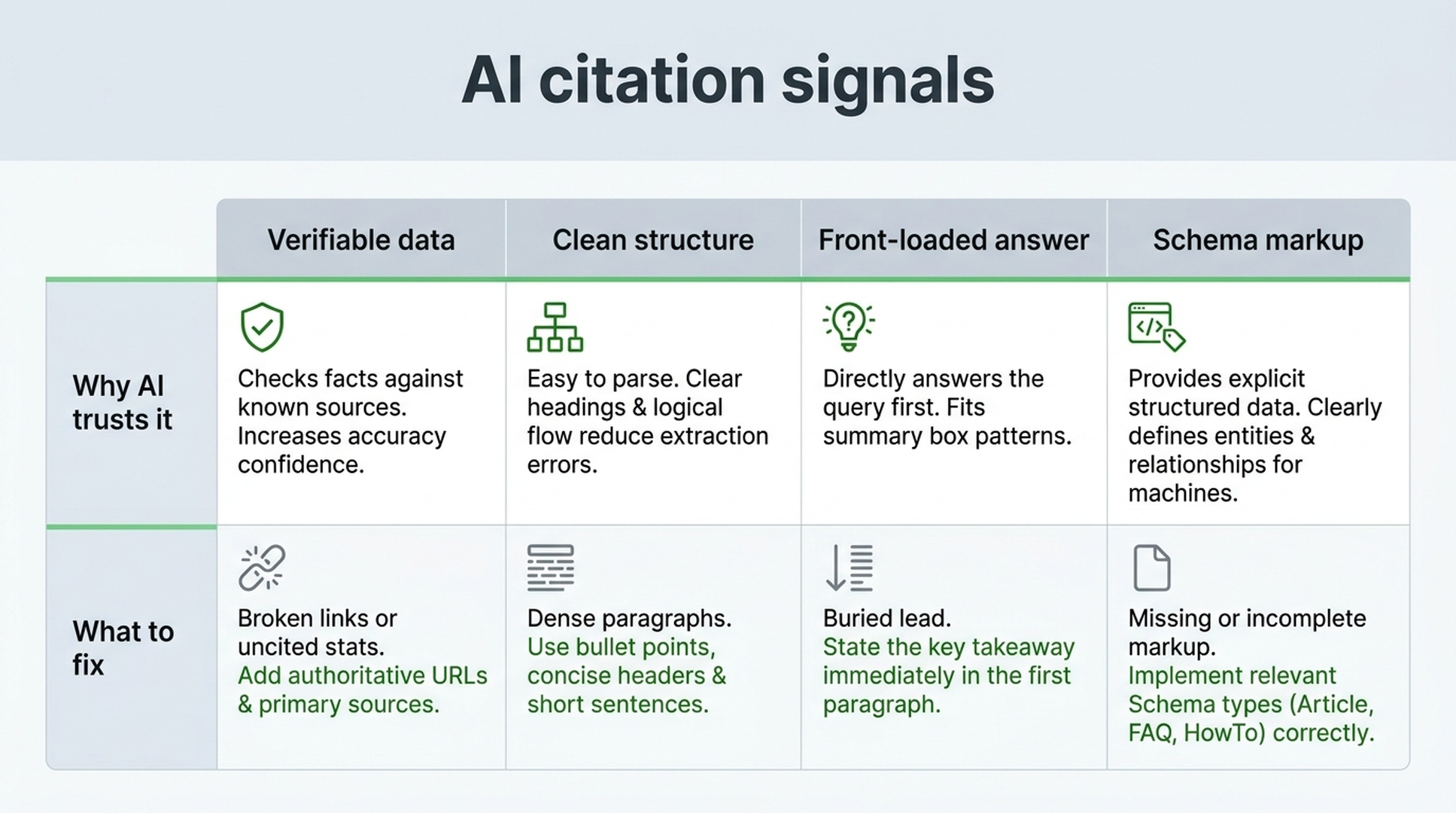
Caption: The strongest AEO pages reduce ambiguity for both crawlers and answer engines.
Signal | What it means | What to fix first |
|---|---|---|
Verifiable data | Claims are supported by named sources, dates, metrics, or original examples. | Replace vague claims with cited numbers, product evidence, or first-party observations. |
Clean structure | The page has logical H2/H3 sections, short paragraphs, tables, and direct definitions. | Break dense sections into answer-sized blocks. |
Front-loaded answer | The first section gives the conclusion before the explanation. | Put the answer, method, or recommendation near the top. |
Schema markup | The page declares entities, FAQs, article data, breadcrumbs, and how-to steps where relevant. | Add structured data only when it matches visible content. |
This is where many teams go wrong. They treat AEO like copywriting. It is closer to evidence architecture.
AEO vs GEO vs SEO
SEO asks: can the page rank and earn clicks from search engines?
GEO asks: does the brand have enough entity clarity, source coverage, and third-party evidence to appear correctly inside generative systems?
AEO asks: can this specific page answer this specific prompt better than the alternatives an AI system might retrieve?
Here is the simple split.
Discipline | Main goal | Common asset | Primary failure mode |
|---|---|---|---|
SEO | Rank and attract organic traffic | Search pages, comparison articles, technical SEO | Good ranking, weak conversion or weak answer extraction |
GEO | Improve brand understanding across AI systems | Entity pages, third-party mentions, source maps | Brand appears inconsistently or competitors own the narrative |
AEO | Win citations in direct AI answers | Answer blocks, data-backed pages, schema, prompt monitoring | Pages rank, but answer engines do not quote or recommend them |
You do not need to choose one. A strong 2026 search program needs all three. The mistake is assuming SEO work automatically creates AEO results.
The 2026 AEO workflow
AEO becomes manageable when you stop thinking in keywords and start thinking in prompt clusters.
1. Build a prompt set
Start with 30 to 80 prompts that represent how buyers actually ask for help. Include comparison prompts, problem prompts, pricing prompts, alternative prompts, and "best tool for" prompts.
For example, a B2B SEO platform might track:
- "best AI SEO tools for a small SaaS team"
- "how to check if my website is visible in ChatGPT"
- "AEO vs GEO for a marketing team"
- "tools that generate llms.txt for websites"
- "how to make product pages citable by AI search"
These are not classic keywords. They are decision moments.
2. Establish a visibility baseline
Run the prompts across ChatGPT, Google AI Overviews where available, Perplexity, Gemini, and any platform that matters to your buyers. Track three things:
- whether your brand appears;
- which sources are cited instead;
- whether the sentiment or description is accurate.
A single platform is not enough. Perplexity may cite editorial sources. ChatGPT may lean on broad web consensus. Google AI Overviews may blend classic search results with AI summaries. The overlap is often smaller than teams expect.
3. Audit the sources AI systems already trust
Do not jump straight into writing. First, inspect the sources that appear again and again.
Are they listicles? Documentation pages? Reddit threads? Review sites? Analyst pages? GitHub repos? You are looking for the shape of trusted evidence in your category.
If AI answers cite third-party review pages, your own blog will not fix the whole problem. You may need partner pages, marketplace profiles, comparison pages, public docs, or clearer product evidence on neutral sites.
4. Create content capsules
A content capsule is a short, self-contained block that answers one question clearly. It should work even if an AI system extracts it without the rest of the page.
A good capsule usually has:
- a direct answer in the first sentence;
- one specific data point, example, or constraint;
- a named entity or product category;
- a natural citation or source reference;
- schema support when the page type allows it.
For example:
AEO is the process of structuring content so answer engines can retrieve and cite it in direct responses. In practice, that means adding verifiable facts, concise answer blocks, clear headings, and schema markup to pages that target comparison, definition, and recommendation prompts.
That block is short. It is not fluffy. It tells the machine what the page is for.
5. Re-test and refresh
AEO decays. Sources change, pages get updated, AI systems test different citations, and competitors improve their evidence.
Set a monthly review rhythm for stable categories and a weekly rhythm for high-intent commercial prompts. When visibility drops, do not rewrite everything. Diagnose the gap:
- Is the page outdated?
- Is a competitor using fresher data?
- Did a third-party source become more trusted?
- Is your answer buried too low on the page?
- Is the schema incomplete or mismatched?
AEO rewards small, precise updates more than large, unfocused rewrites.
Common AEO mistakes
The first mistake is optimizing only for your own website. AI systems often trust distributed evidence: documentation, product pages, review sites, comparison pages, community discussions, and authoritative publications. If the wider web cannot confirm your claim, your own page has to work harder.
The second mistake is treating schema as a magic switch. Schema helps when it clarifies visible content. It does not rescue thin content, exaggerated claims, or pages that fail to answer the prompt.
The third mistake is burying the answer. Many marketing pages spend 600 words setting context before they say anything useful. That may be tolerable for a human reader. It is terrible for answer extraction.
The fourth mistake is tracking brand mentions without tracking accuracy. A citation is not always a win. If an AI answer mentions an old price, an outdated feature, or the wrong use case, it can damage conversion before your sales team ever gets involved.
What Auspia recommends
For 2026, we recommend a three-layer AEO operating model.
First, build an AEO baseline. Choose the prompts that influence discovery, comparison, and purchase intent. Run them across multiple AI answer platforms. Record who gets cited and why.
Second, repair the highest-value pages. Add concise answer blocks, source-backed claims, summary tables, FAQ sections, and appropriate schema. If the page is for a tool or product, make feature names, supported platforms, pricing constraints, and target users explicit.
Third, monitor citation drift. AEO is not a quarterly content project. It is closer to technical SEO monitoring, except the watched object is not only the page. It is the answer that users see.
If you need a starting point, run your top pages through the Website SEO Score Checker, then pair that with AI visibility testing. SEO health tells you whether the page can be crawled and understood. AEO testing tells you whether answer engines actually use it.
A practical AEO checklist for 2026
Use this checklist on any page that should win AI-answer citations.
Check | Pass criteria |
|---|---|
Direct answer | The first 150 words answer the main query clearly. |
Evidence | Important claims include numbers, dates, examples, or sources. |
Structure | H2/H3 headings match the questions users ask. |
Tables | Comparisons, workflows, and definitions are formatted for extraction. |
Schema | Article, FAQ, HowTo, Product, SoftwareApplication, or Breadcrumb schema is used only where appropriate. |
Entity clarity | Brand names, product categories, competitors, and use cases are explicit. |
Freshness | Dates and version-sensitive claims are reviewed on a defined schedule. |
Cross-source support | Key claims can be confirmed outside your own site when needed. |
FAQ
What is AEO?
AEO, or Answer Engine Optimization, is the practice of making content easier for AI answer systems to retrieve, verify, summarize, and cite. It focuses on direct answers, clear structure, evidence, and schema rather than only keyword rankings.
How is AEO different from GEO?
AEO targets specific AI answers and citations. GEO is broader and focuses on how a brand is understood across generative systems, knowledge sources, and third-party evidence. AEO is usually more page-level and prompt-level. GEO is more brand-level and ecosystem-level.
Does AEO replace SEO?
No. SEO still provides crawlability, technical health, authority signals, and search demand capture. AEO builds on that foundation so answer engines can use the page as a trusted source. Weak SEO can make AEO harder, but strong SEO does not guarantee AI citations.
How often should teams review AEO performance in 2026?
Review high-intent prompts weekly or monthly, depending on how competitive the category is. Evergreen informational prompts can be checked less often. The important point is to review prompts repeatedly, because AI answers and citations change over time.
What is the fastest AEO improvement?
The fastest improvement is usually to rewrite the opening section of a high-value page so it gives a direct, evidence-backed answer. Then add a summary table, fix headings, cite stronger sources, and apply schema that matches the visible content.
Final take
AEO in 2026 is not about chasing every new AI platform. It is about making your best facts easy to trust.
If your pages answer clearly, cite evidence, use clean structure, and get reviewed on a real schedule, answer engines have fewer reasons to ignore you. That is the whole game: reduce ambiguity, reduce citation risk, and make your brand the easiest correct source to use.
Sources and further reading: Princeton/Georgia Tech/Allen Institute for AI/IIT Delhi, "GEO: Generative Engine Optimization"; Google updates on AI Overviews and AI Mode; Pew Research Center analysis of Google AI summaries and click behavior; OpenAI usage reporting cited by Reuters.