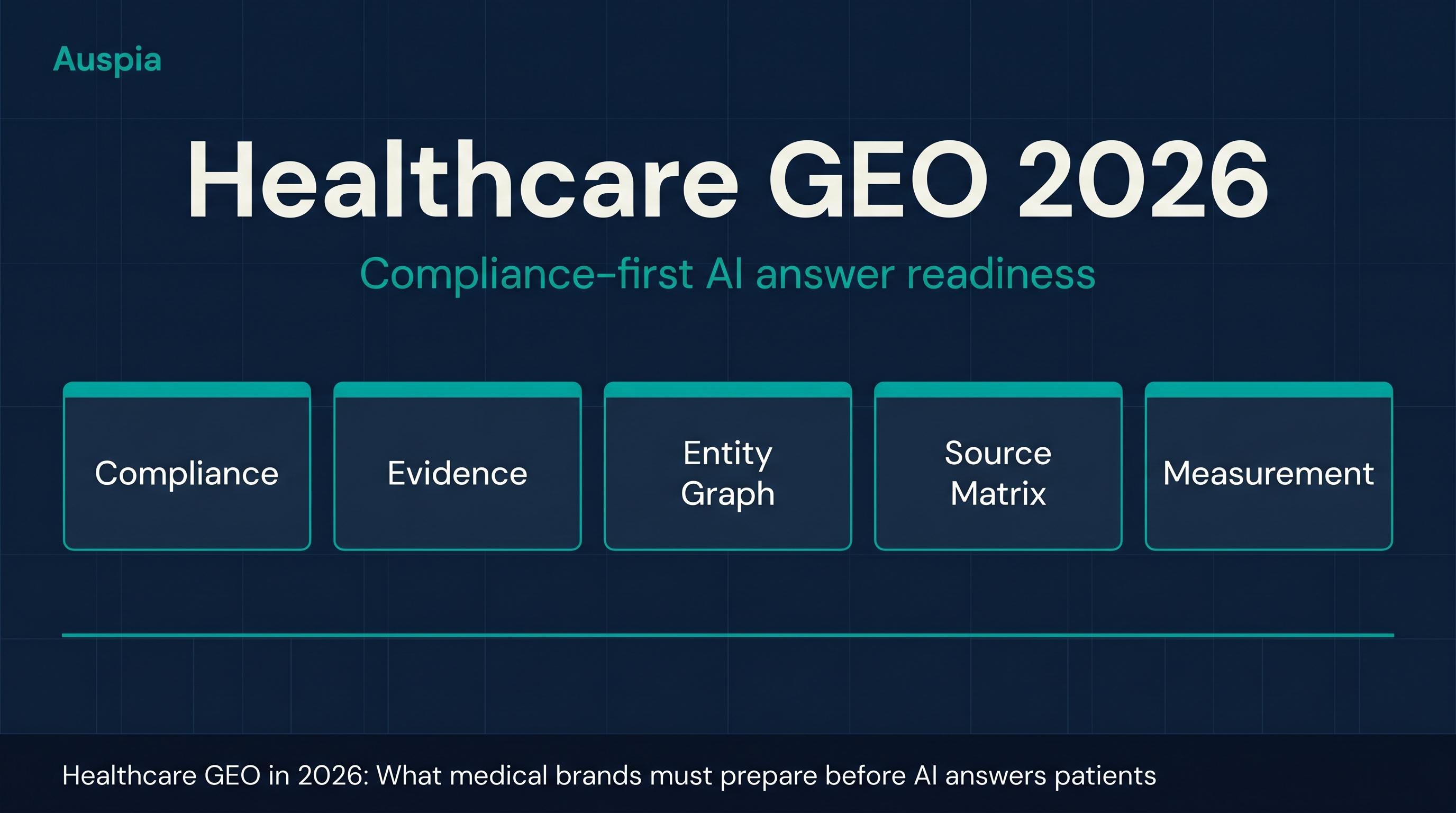
When a patient asks ChatGPT, Gemini, Perplexity, or Google AI Overviews, "Which migraine treatment has fewer side effects?" the answer may shape what they read next, which doctor they trust, and which brand they remember. In healthcare, that answer cannot be treated like a normal marketing impression.
The short version: healthcare GEO in 2026 is not about forcing your brand into more AI answers. It is about making sure AI systems can find, understand, quote, and summarize your approved medical information without turning it into unsafe advice or unsupported claims.
That makes healthcare different from most GEO categories. A SaaS company can test messaging quickly. A hospital group, pharmaceutical brand, medtech company, or digital health platform has to think about compliance, clinical accuracy, review workflows, source traceability, and patient safety before it thinks about share of answer.
This article uses the same operating question many medical marketing teams are now asking: before we invest in GEO, what needs to be ready?
First, what is healthcare GEO really competing for?
GEO, or Generative Engine Optimization, is the practice of making a brand, page, product, expert, or organization easier for AI answer systems to retrieve, understand, and cite. In classic SEO, the fight was often for ranking position. In GEO, the fight is for presence inside the answer itself.
For healthcare, the goal is narrower and more serious.
A medical brand should not aim to be "mentioned everywhere." It should aim to be mentioned correctly, with context, with source support, and within the boundaries of approved claims. If an AI answer summarizes dosage, indications, contraindications, device use, provider qualifications, or treatment outcomes incorrectly, the visibility win can become a risk event.
A useful way to frame the difference:
Traditional SEO question | Healthcare GEO question |
|---|---|
Can patients find this page in search results? | Can AI systems retrieve the correct approved source when patients ask the question? |
Is the page ranking for the target keyword? | Is the brand represented accurately in generated answers? |
Does the snippet earn clicks? | Does the answer cite or reflect a traceable, medically reviewed source? |
Is traffic increasing? | Are visibility, citation quality, and hallucination risk improving together? |
Search still matters. In fact, Google has repeatedly said that creating helpful, reliable, people-first content remains central to Search performance, including in search experiences with AI features. But healthcare teams now need a second layer: AI answer readiness.
Preparation 1: compliance comes before visibility
For healthcare GEO, compliance is the entry ticket. Without it, more visibility can simply create more exposure.
This is where many teams move too fast. They publish condition pages, treatment explainers, physician profiles, and product FAQs, then later ask whether the pages are AI-ready. In regulated categories, the order should be reversed: decide what can be said, who can approve it, how it will be sourced, and how it will be updated before scaling content.
At minimum, teams need four controls.
Confirm which claims are allowed
A healthcare website may include educational content, promotional content, provider information, product labeling, patient support material, clinical evidence summaries, and investor-facing information. AI systems do not always preserve those boundaries when they synthesize answers.
Before starting GEO, map every high-value topic to its approved claim set. For pharma and medical devices, this often means separating patient education from product promotion. For hospitals and clinics, it means separating general health information from individualized medical advice. For digital health companies, it means being clear about what the product supports and what it does not diagnose or treat.
Add medical and legal review to the content workflow
A GEO program needs review discipline, not just writing velocity. Each page that may be used by AI systems should show who wrote it, who reviewed it, what evidence supports it, and when it was last updated.
This is not only good for compliance. It also gives AI systems clearer entity and trust signals. A condition page with a named clinician reviewer, current references, structured sections, and a recent update date is easier to interpret than a generic blog post with no ownership.
Avoid disguised advertising
Healthcare content can become risky when educational pages quietly turn into product claims. A page about hypertension management, for example, should not imply that one drug is broadly "best" unless that claim is approved, sourced, and presented with the required context.
For GEO, this matters because AI systems compress language. A sentence with mild promotional drift can become a stronger claim in an answer. Write defensively. Use precise language, define patient populations, and avoid unqualified superlatives.
Build an audit trail
If an AI answer cites or paraphrases your content incorrectly, the team needs to know what the approved source said at the time. Keep version history, review records, reference lists, and update logs for pages that cover clinical or product-sensitive topics.
This audit trail is not glamorous. It is what lets marketing, medical, and legal teams work together without freezing every GEO initiative.
Preparation 2: build a content system AI can trust
Healthcare GEO is a source-quality contest. AI systems may pull from your site, peer-reviewed literature, government sources, professional associations, review platforms, medical encyclopedias, local directories, and news coverage. Your owned content has to be good enough to stand among those sources.
The content system needs three traits: precision, evidence, and structure.
Use exact medical language where it matters
Vague phrasing is bad for patients and bad for AI retrieval. If a page says a treatment "may help many people feel better," it gives an AI system very little to work with. Better content names the condition, patient group, intervention, evidence type, limitations, and next step.
That does not mean every page should read like a journal article. It means patient-friendly content should still be medically specific.
For example:
Weak wording | Better wording for AI-ready healthcare content |
|---|---|
"This treatment is safe and effective." | "In the patient groups studied, the treatment reduced symptoms compared with placebo. Common side effects included..." |
"Our clinic is a leader in cardiac care." | "The clinic provides cardiology consultations, diagnostic testing, and follow-up care for adults with..." |
"Fast recovery with advanced technology." | "Typical recovery timelines vary by procedure, patient age, comorbidities, and post-operative plan." |
Make sources visible
Every clinically meaningful claim should connect to a source type: prescribing information, clinical guideline, peer-reviewed study, regulatory document, professional society resource, or medically reviewed internal protocol. The source does not need to overwhelm the patient experience, but it should be available.
AI systems are more likely to treat a page as a usable source when the evidence trail is visible and coherent. Humans need the same thing.
Structure pages around real patient questions
AI answers are triggered by questions, not just keywords. Build pages around the way people ask about symptoms, diagnosis, treatment choices, side effects, costs, recovery, provider qualifications, insurance, and next steps.
A strong healthcare page often includes:
- A short direct answer at the top
- A clear medical disclaimer that does not bury the answer
- Definitions for condition, treatment, device, or service entities
- Eligibility and non-eligibility sections
- Benefits and risks in separate blocks
- Evidence and references
- Review and update information
- FAQ written around real patient questions
- Next-step guidance that sends the reader to a qualified professional
If you want a quick starting point, run your critical pages through an AI Search Visibility Checker and compare what AI systems actually say against what your approved content says.
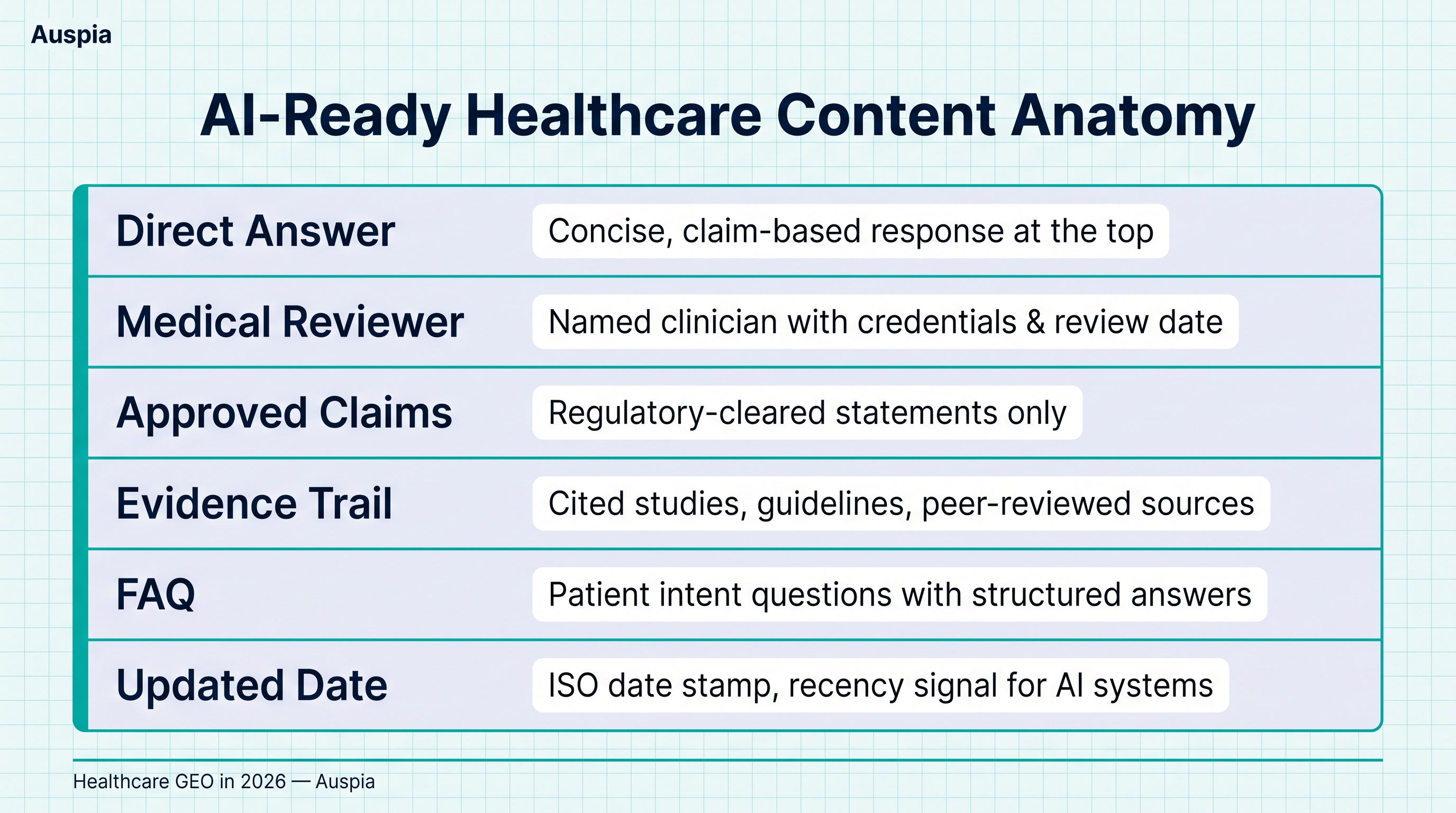
Caption: An AI-ready healthcare page gives answer systems a direct response, reviewer context, approved claims, evidence, patient FAQs, and freshness signals.
Preparation 3: make your medical entity machine-readable
Healthcare GEO is partly content work and partly entity work. AI systems need to understand what your organization is, which clinicians or products are associated with it, which conditions or services it covers, and which facts are stable.
This is where technical SEO and GEO overlap.
Create a healthcare knowledge graph
Start with a simple internal graph before worrying about sophisticated tooling. Map the relationships between entities:
Entity type | Examples | Facts to standardize |
|---|---|---|
Organization | hospital, clinic, pharma company, medtech brand | legal name, location, category, credentials, official profiles |
Person | physician, medical reviewer, researcher | name, role, specialty, profile URL, review responsibility |
Condition | diabetes, migraine, sleep apnea | synonyms, ICD-style naming where appropriate, related treatments |
Treatment or product | procedure, device, drug, care program | approved description, eligibility, risk language, source document |
Evidence | guideline, trial, label, protocol | title, date, publisher, page URL, claim supported |
The point is not to publish a giant database. The point is to prevent entity drift. If your site calls the same service "virtual urgent care," "online urgent care," and "telehealth triage" without explaining the relationship, AI systems may treat those as separate concepts.
Use structured data where it is appropriate
Structured data does not guarantee AI citations. Still, schema helps search systems parse entities and page meaning. For healthcare organizations, relevant schema may include Organization, MedicalOrganization, Physician, Person, FAQPage, Article, Review, and other types where they accurately describe the content.
Be conservative. Do not mark up claims that are not visible on the page. Do not use schema as a place to stuff promotional language. The goal is clarity, not decoration.
Control crawl and retrieval basics
Many healthcare sites accidentally hide the exact pages they want AI systems to understand. Common issues include blocked resources, thin JavaScript-rendered content, duplicate provider pages, conflicting canonical tags, missing XML sitemaps, and PDFs that contain the official answer while HTML pages contain only marketing summaries.
Before scaling GEO, audit whether your important content can be crawled, indexed, and extracted. If your site blocks AI crawlers by policy, make that choice intentionally and document what visibility tradeoff you are accepting. Auspia's Robots.txt AI Crawler Checker can help identify whether major AI crawlers are allowed or blocked.
Preparation 4: build a source matrix beyond your website
Owned content is necessary, but it is rarely enough. AI answer systems often cross-check multiple sources before naming a healthcare brand, product, provider, or treatment category.
A source matrix is the set of places where your approved facts appear consistently. For healthcare, that may include:
Source layer | What to maintain | Why it matters for GEO |
|---|---|---|
Official website | condition pages, product pages, provider profiles, medical review pages | canonical approved facts |
Regulatory and labeling sources | approved labels, safety communications, registrations | high-authority claim boundaries |
Clinical and academic sources | publications, trial pages, conference abstracts | evidence and context |
Professional directories | physician directories, clinic listings, specialty associations | entity verification |
Knowledge platforms | Wikidata, Google Business Profile, trusted medical databases where appropriate | entity disambiguation |
Third-party education | medically reviewed explainers, interviews, podcasts, webinars | broader retrieval surface |
The source matrix should not be used to spray duplicate articles across the web. That creates noise. The goal is consistency across sources that AI systems and patients already trust.
If your brand facts differ across directories, your provider bios use old credentials, and your product descriptions vary by region, AI answers may synthesize the wrong version. Clean the facts before you chase more mentions.
Preparation 5: assign the work to a real cross-functional team
Healthcare GEO cannot live with one content marketer. It needs an operating model.
A practical team usually includes:
Function | GEO responsibility |
|---|---|
Medical or clinical affairs | approve clinical accuracy, evidence, and risk language |
Legal and compliance | define claim boundaries, review promotional risk, maintain audit trail |
SEO/GEO lead | manage query maps, content structure, entity consistency, and measurement |
Content team | write patient-friendly pages, FAQs, summaries, and update notes |
Engineering or web team | implement schema, crawl controls, page templates, and monitoring |
Analytics team | measure AI visibility, citation quality, and content gaps |
The important part is ownership. Someone has to decide which prompts matter, which pages are authoritative, which sources are approved, and what happens when AI systems return incorrect answers.
A good first governance rule is simple: no clinically sensitive GEO page goes live without medical review, source review, and a documented owner for future updates.
What should healthcare teams measure in 2026?
Traffic alone is a weak signal for healthcare GEO. AI answers can influence decisions without sending a click. You need visibility metrics, accuracy metrics, and risk metrics.
Metric | What it tells you | How to use it |
|---|---|---|
AI answer visibility | How often your brand appears for priority patient or buyer prompts | Track share of answer across ChatGPT, Perplexity, Gemini, Google AI Overviews, and other relevant surfaces |
Citation frequency | How often AI answers cite your owned or approved third-party sources | Identify which pages are trusted and which topics need better source assets |
Citation quality | Whether cited sources are accurate, current, and appropriate | Separate good visibility from risky visibility |
Claim accuracy | Whether AI summaries match approved language | Escalate inaccurate or overbroad answers for content fixes |
Hallucination rate | How often AI invents unsupported facts about your brand, product, or clinicians | Prioritize entity cleanup and source correction |
Intent coverage | Whether AI understands the patient, provider, payer, or investor intent behind queries | Build missing pages and prompt clusters |
Review freshness | Whether high-risk pages have current medical review dates | Prevent stale content from becoming the default answer source |
The best programs review these metrics on a schedule. Monthly may be enough for low-risk education topics. Weekly may be necessary for fast-moving product, safety, or reputation topics.
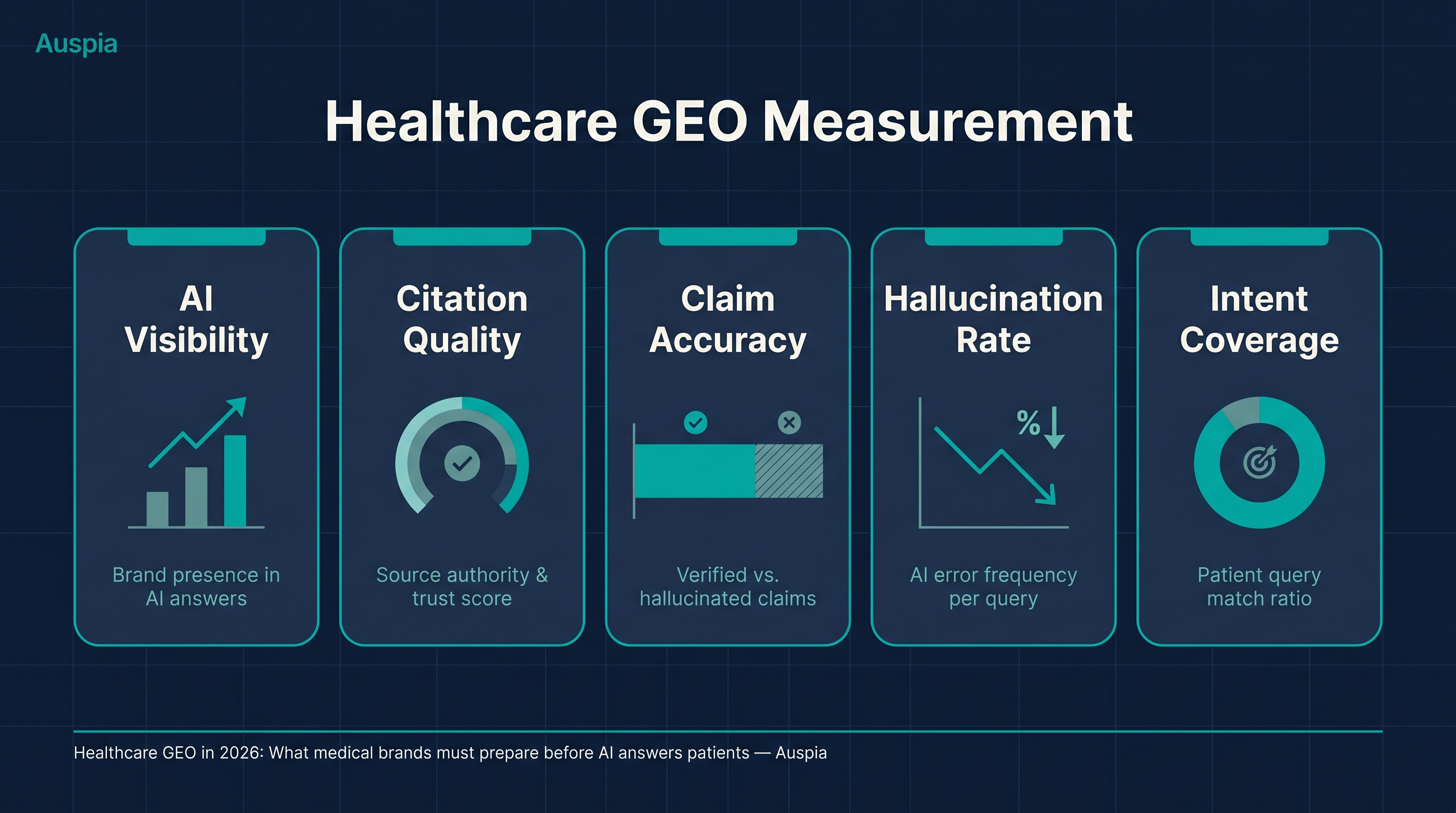
Caption: Healthcare GEO measurement should combine visibility, citation quality, claim accuracy, hallucination rate, and intent coverage.
A 12-month healthcare GEO startup plan
Do not try to do everything in the first month. Healthcare GEO works better as an operating system than a campaign.
Months 1-3: get the foundation clean
Start with the basics:
- List the top 50-100 patient, provider, or buyer questions that AI systems should answer correctly.
- Identify the official source page for each topic.
- Confirm claim boundaries with medical and legal reviewers.
- Add owner, reviewer, date, and source information to high-priority pages.
- Fix obvious entity inconsistencies across your website and major profiles.
- Check crawlability, indexability, and AI crawler policy.
The output of this phase should be a controlled source map, not a pile of new articles.
Months 3-6: build AI-readable content and entity structure
Next, improve the pages and data that AI systems are most likely to use:
- Rewrite priority pages with direct answers, evidence blocks, FAQs, and risk language.
- Add appropriate structured data.
- Build clinician, organization, treatment, and condition entity maps.
- Create comparison-neutral education pages for common patient questions.
- Publish or update medical review policy pages.
- Align third-party directories and knowledge profiles with approved facts.
This is where GEO starts to become visible. You should see fewer incorrect summaries and more consistent source selection.
Months 6-12: monitor, correct, and expand
Once the foundation works, scale carefully:
- Track AI answers for your prompt library.
- Compare AI summaries against approved content.
- Refresh pages that are cited but outdated.
- Build new pages for prompts where AI answers are weak or competitor-heavy.
- Expand trusted third-party source coverage.
- Report visibility and risk together, not separately.
Healthcare GEO is a long-term trust asset. The brands that win will not be the ones that publish the most pages. They will be the ones whose approved facts are the easiest for AI systems to find, verify, and repeat safely.
Auspia takeaway
The healthcare GEO question for 2026 is not "How do we get AI to recommend us?" That framing is too shallow and too risky.
The better question is: "When AI systems answer important medical questions, have we made the correct, reviewed, traceable version of our information the easiest version to retrieve?"
If the answer is no, start with compliance, source quality, entity clarity, and measurement. Visibility comes later. In healthcare, that order matters.
FAQ
Is healthcare GEO the same as medical SEO?
No. Medical SEO focuses on search visibility, rankings, snippets, and organic traffic. Healthcare GEO focuses on how AI answer systems retrieve, synthesize, cite, and summarize medical information. The two overlap, but GEO adds answer accuracy, source traceability, and hallucination monitoring.
Should healthcare brands optimize for ChatGPT, Perplexity, Gemini, or Google AI Overviews first?
Start with the platforms your patients, providers, or buyers actually use. For many teams, that means monitoring Google AI Overviews and ChatGPT first, then adding Perplexity, Gemini, and vertical medical search experiences. The prompt library matters more than the platform list at the beginning.
Can healthcare GEO create compliance risk?
Yes. GEO can increase the visibility of outdated, vague, or over-promotional content. It can also expose inconsistent facts across the web. That is why medical review, legal review, claim mapping, and source version control should come before aggressive content expansion.
What is the fastest healthcare GEO improvement?
Clean up your authoritative pages. Add direct answers, medical reviewer information, update dates, references, risk language, and structured sections. Then check whether AI systems summarize those pages accurately for priority prompts.
Does schema markup guarantee AI citations?
No. Schema helps machines understand page entities and relationships, but it does not guarantee citation or inclusion in AI answers. Treat schema as one layer of a broader GEO system that includes content quality, source authority, crawlability, entity consistency, and third-party validation.
Author: Bennett Hayes, Applied GEO Analyst Across 400+ Implementation Reviews at Auspia. Bennett writes about practical GEO execution, readiness audits, and implementation details for teams that need AI visibility without operational shortcuts.