Direct answer
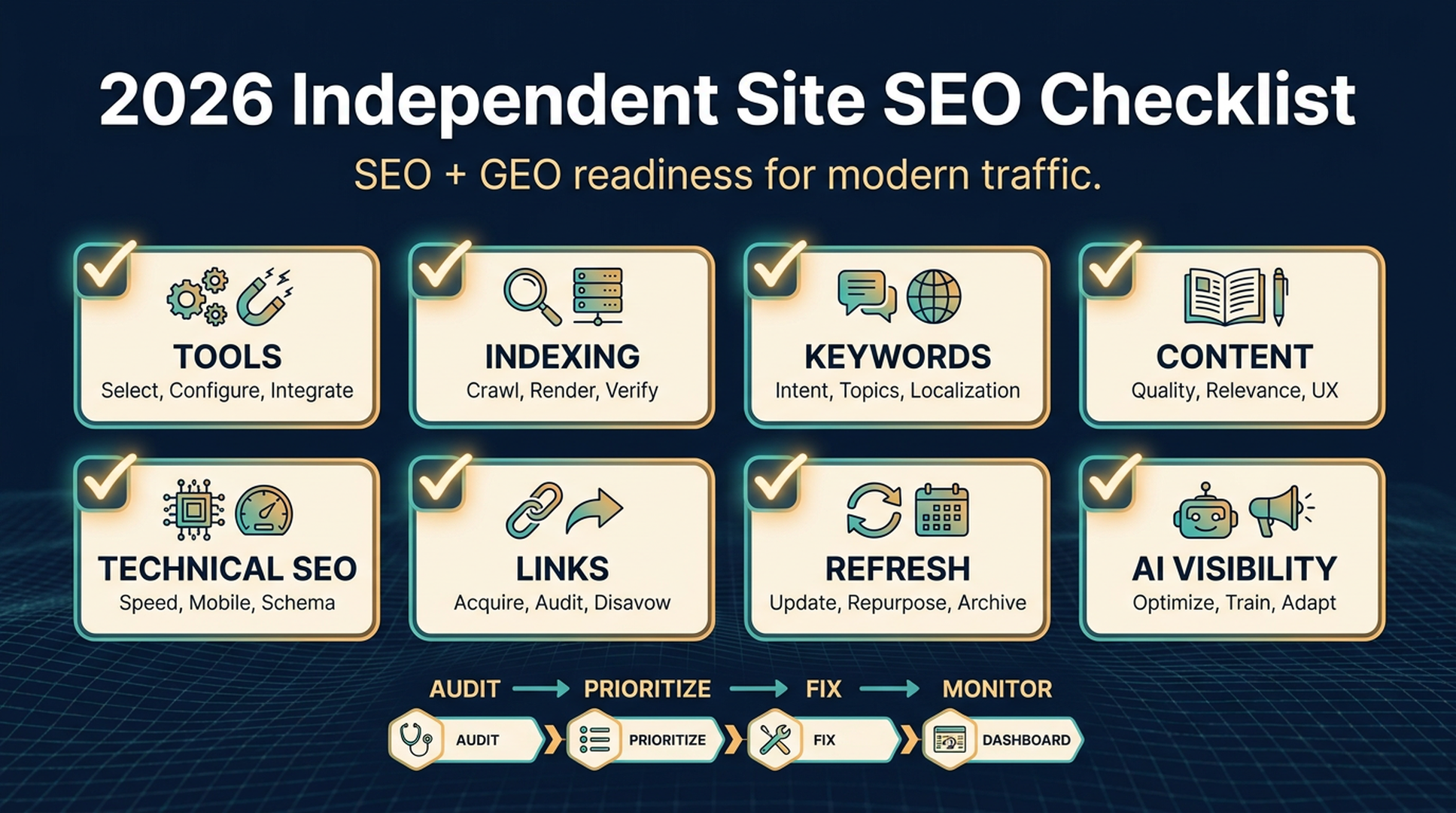
Independent-site SEO in 2026 is no longer just a keyword and blog-post game. The checklist now has three layers: make the site discoverable, make the pages useful enough to rank, and make the brand clear enough to appear in AI search answers.
If you run an ecommerce store, SaaS site, B2B lead-gen site, or local service site, the practical order is simple:
- Set up measurement and indexing tools.
- Fix crawlability, speed, mobile usability, and page structure.
- Research keywords by buyer intent, not only search volume.
- Build useful pages that answer real questions.
- Add internal links, schema, images, and trust signals.
- Earn relevant mentions and backlinks.
- Refresh pages before they decay.
- Track both Google Search performance and AI answer visibility.
This 2026 version matters because buyers now move between Google, AI Overviews, AI Mode, ChatGPT, Perplexity, Gemini, Reddit, YouTube, and comparison pages before they buy. SEO still matters, but the site also needs to be GEO-ready: clear, structured, evidence-rich, and easy for AI systems to summarize.
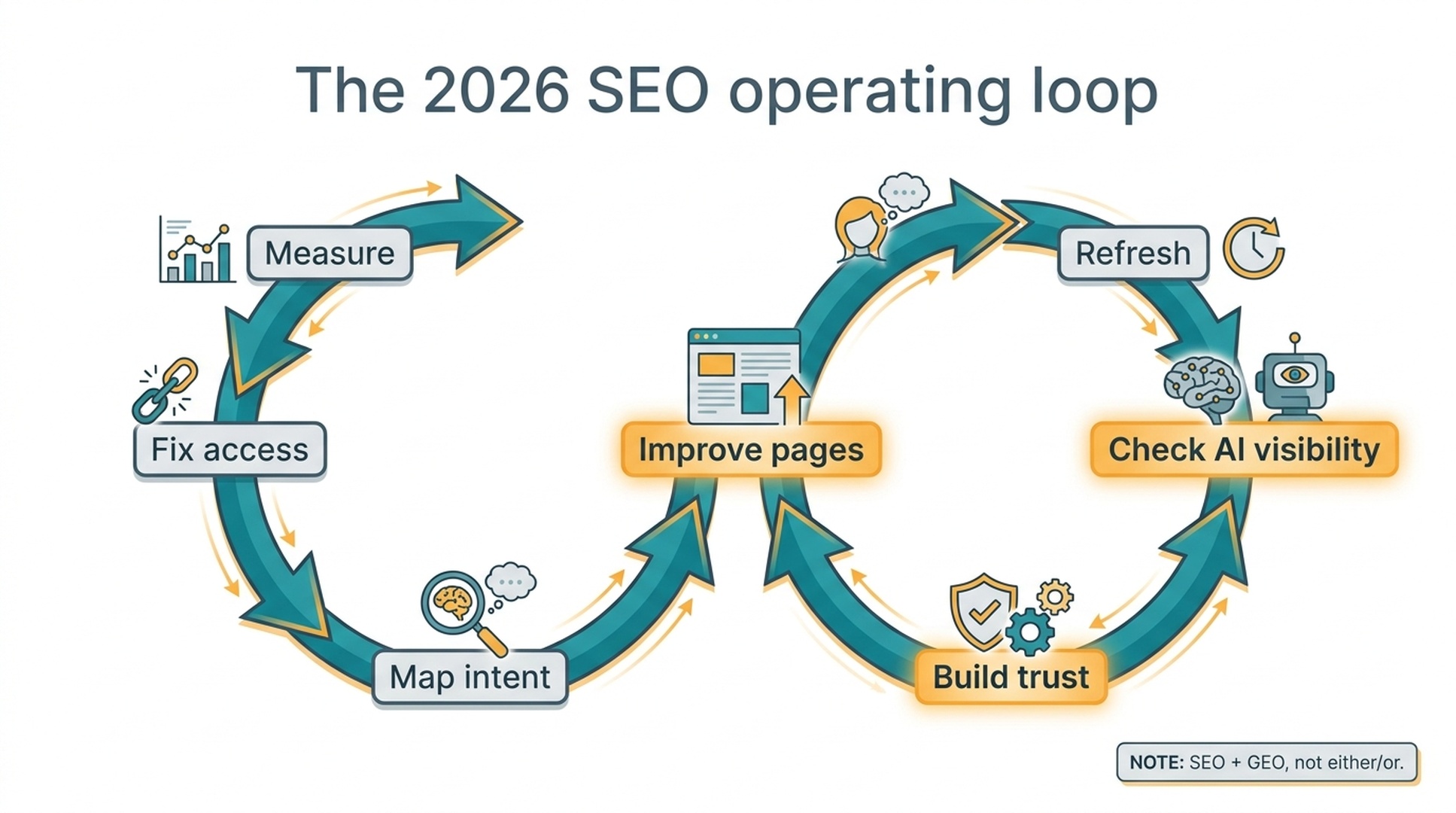
The 2026 SEO map for independent sites
The old SEO checklist was mostly about rankings. The new checklist is about visibility across search and AI-assisted discovery.
That does not mean the basics disappeared. Google still needs to find, crawl, render, index, and understand your pages. Users still need fast pages, clear answers, trustworthy proof, and useful navigation. What changed is the buying journey.
A buyer may search Google for a product category, ask ChatGPT for a shortlist, compare options on Reddit, read a buying guide, click an ad, and then return through a branded search. If your site only optimizes one touchpoint, you miss the journey.
So do not treat this as 37 random tasks. Treat it as an operating system.
Phase 1: Set up the control room
Before rewriting pages, set up the tools that tell you what is happening.
1. Google Search Console
Search Console is the first tool to install. It tells you which queries trigger impressions, which pages earn clicks, whether URLs are indexed, and whether Google sees technical problems.
For a new or neglected site, check:
- Sitemap submission
- Indexed page count
- Pages discovered but not indexed
- Core Web Vitals issues
- Manual actions or security warnings
- Top queries and top pages
Use URL Inspection when a page should be ranking but seems invisible. If Google cannot fetch it, render it, or index it, content optimization will not fix the problem.
2. Bing Webmaster Tools
Bing is easy to ignore, but it still matters for desktop users, Microsoft surfaces, and some AI/search ecosystems. Import your verified Google Search Console property, submit your sitemap, and review Bing's SEO reports.
You do not need a separate Bing strategy on day one. You do need to make sure Bing can access your site.
3. GA4 and conversion tracking
Traffic without business context is misleading. GA4 helps you see which pages bring engaged users, which channels convert, and which content supports revenue or leads.
Set up conversion events such as:
- Form submissions
- Purchases
- Demo requests
- Add to cart
- Checkout start
- Newsletter signup
- Pricing page visits
SEO reports should not stop at clicks. A page with modest traffic and high conversion value may matter more than a high-traffic article that never assists revenue.
4. Rank and visibility tracking
Search Console is enough to start, but a serious team eventually needs rank tracking, competitor monitoring, and AI visibility checks.
Track:
- Core commercial keywords
- Long-tail question keywords
- Branded queries
- Category and comparison queries
- Local or regional keywords if relevant
- AI answer presence for high-intent buyer prompts
For 2026, add a prompt library. Example: "best inventory software for Shopify brands under 20 employees" is often more useful than a single keyword like "inventory software."
Phase 2: Build the keyword and intent map
Keyword research is not about collecting a huge spreadsheet. It is about understanding how buyers describe their problems.
5. Define the market and buyer persona
Before using a keyword tool, write down who the page is for. A high-end coffee equipment buyer, a procurement manager, a solo founder, and a local homeowner use different language.
Capture:
- Market and country
- Language and terminology
- Budget level
- Pain points
- Buying stage
- Common objections
- Channels they trust
This prevents generic content.
6. Use search suggestions for long-tail demand
Google Suggest, YouTube suggestions, Amazon suggestions, Reddit threads, and People Also Ask-style questions reveal real wording. Look for modifiers such as:
- best
- alternative
- near me
- under $100
- for small business
- vs
- how to
- does it work with
- beginner
- 2026
Long-tail keywords often have lower search volume, but they reveal intent. A query like "best standing desk for small apartment 2026" is more actionable than "standing desk."
7. Separate keywords by intent
Group keywords into four buckets:
Intent | What the user wants | Best page type |
|---|---|---|
Learn | Understand a concept or process | Guide, glossary, tutorial |
Compare | Evaluate options | Comparison page, alternatives page, table |
Buy | Choose a product or provider | Product page, service page, pricing page |
Fix | Solve a specific problem | Troubleshooting article, checklist, how-to page |
If the page type does not match the intent, it will struggle. A sales page should not pretend to be a neutral beginner guide. A beginner guide should not open with a hard pitch.
Phase 3: Fix on-page clarity
On-page SEO is still the easiest place to improve quickly.
8. Use clear titles and descriptions
A title should tell the reader what the page helps them do. Avoid vague slogans.
Weak: "Solutions for modern teams"
Better: "Inventory management software for Shopify brands in 2026"
Meta descriptions do not directly guarantee rankings, but they influence clicks and clarify the page promise.
9. Use one clear H1 and helpful H2s
The H1 should match the main topic. H2s should help users scan the page and help search systems understand structure.
Good headings often answer:
- What is it?
- Who is it for?
- How does it work?
- What does it cost?
- What are the alternatives?
- What should I do next?
10. Make URLs short and descriptive
A URL should be readable. Use lowercase words, hyphens, and avoid unnecessary dates unless the date is part of the query.
Good: /blog/seo-checklist-2026
Weak: /post?id=9283&utm_source=homepage
11. Optimize images without stuffing keywords
Use descriptive filenames, compressed formats, and helpful alt text. For ecommerce and B2B sites, images can help both search and conversion.
Good alt text: "Black ergonomic office chair with adjustable lumbar support"
Bad alt text: "best office chair best ergonomic chair cheap office chair"
12. Add internal links intentionally
Internal links help users and crawlers understand what matters. Link from high-authority pages to priority pages. Use descriptive anchor text instead of "click here."
A blog post about SEO audits should naturally link to a website SEO checker, a technical SEO guide, or a related case study.
Phase 4: Publish content that deserves to rank
Content volume matters less than usefulness. A site with 50 strong pages can beat a site with 500 thin pages.
13. Match the format to the problem
Different intents need different formats:
- Step-by-step tutorials for operational tasks
- Comparison tables for vendor research
- Buying guides for ecommerce categories
- Case studies for proof
- FAQ pages for recurring objections
- Glossaries for foundational concepts
- Templates and calculators for repeatable decisions
Do not force every keyword into a blog post.
14. Add information gain
If the top results already explain the basics, add something useful:
- A 2026 update
- A decision table
- Original screenshots
- Real examples
- Failure cases
- Pricing context
- Regional differences
- A downloadable checklist
- A practical workflow
Information gain is not about writing more words. It is about adding something the reader did not already get from ten similar pages.
15. Write for humans and AI extraction
In 2026, content should be easy for readers to use and easy for AI systems to summarize accurately.
That means:
- Answer the main question early.
- Use tables for comparisons.
- Name entities clearly.
- Explain assumptions.
- Keep claims specific.
- Add evidence where possible.
- Avoid vague marketing language.
This helps SEO and GEO at the same time.
Phase 5: Fix technical SEO before it blocks growth
Technical SEO is not glamorous, but it can decide whether your best content ever gets a chance.
16. Check crawl and index errors
In Search Console, review why pages are not indexed. Common issues include:
- Crawled but not indexed
- Discovered but not indexed
- Duplicate without user-selected canonical
- Alternate page with proper canonical
- Blocked by robots.txt
- Excluded by noindex
- Soft 404
- Server error
Do not panic at every excluded URL. Some exclusions are normal. Focus on important pages that should be indexed.
17. Test how Google sees the page
Use URL Inspection and live testing. If Google's rendered screenshot is blank, missing products, or missing main content, JavaScript rendering may be a problem.
For ecommerce sites, watch out for infinite scroll, faceted navigation, delayed product loading, and JavaScript-only reviews.
18. Improve mobile usability and speed
Most independent sites lose money on mobile friction. Check:
- Largest Contentful Paint
- Interaction to Next Paint
- Cumulative Layout Shift
- Tap target size
- Font readability
- Sticky elements blocking content
- Checkout speed
- Image compression
Speed is not only a ranking factor. It is a conversion factor.
19. Use schema where it clarifies facts
Useful schema types include Product, Article, FAQPage, BreadcrumbList, Organization, LocalBusiness, Review, and HowTo where appropriate.
Keep schema aligned with visible content. Do not mark up reviews, prices, FAQs, or availability that users cannot see on the page.
Phase 6: Build trust and links
Backlinks still matter, but the quality bar is higher. Buying random links, posting in irrelevant directories, or creating low-quality guest posts can waste money or create risk.
Better link assets include:
- Original research
- Industry statistics
- Calculators
- Templates
- Comparison data
- Expert commentary
- Case studies
- Useful visuals
- Public benchmarks
For small teams, start with realistic tactics: reclaim unlinked brand mentions, answer journalist requests, partner with relevant blogs, contribute expert quotes, and publish assets worth citing.
Phase 7: Prune and refresh old content
Content decay is normal. What worked in 2023 may look stale in 2026.
Every quarter, review pages that used to get traffic but declined. Ask:
- Is the advice outdated?
- Are screenshots old?
- Did competitors add better examples?
- Has the search intent changed?
- Is the page too thin?
- Should several weak pages be merged?
- Should no-traffic pages be updated, redirected, or removed?
When you update a page, keep the URL if it has authority. Refresh the examples, improve the structure, add current details, update the publish date where appropriate, and request reindexing.
Phase 8: Add GEO readiness in 2026
The newest layer is AI visibility. GEO does not replace SEO. It asks whether your content is citable in AI-generated answers.
A GEO-ready page usually has:
- A direct answer near the top
- Clear entity names
- Specific claims
- Evidence and examples
- Comparison tables
- Updated dates when freshness matters
- Consistent business information
- Internal links to supporting pages
- Schema that matches visible content
- A clear next step
Track a fixed set of AI prompts each month. Record whether your brand appears, which competitors appear, and what sources the AI answer cites.
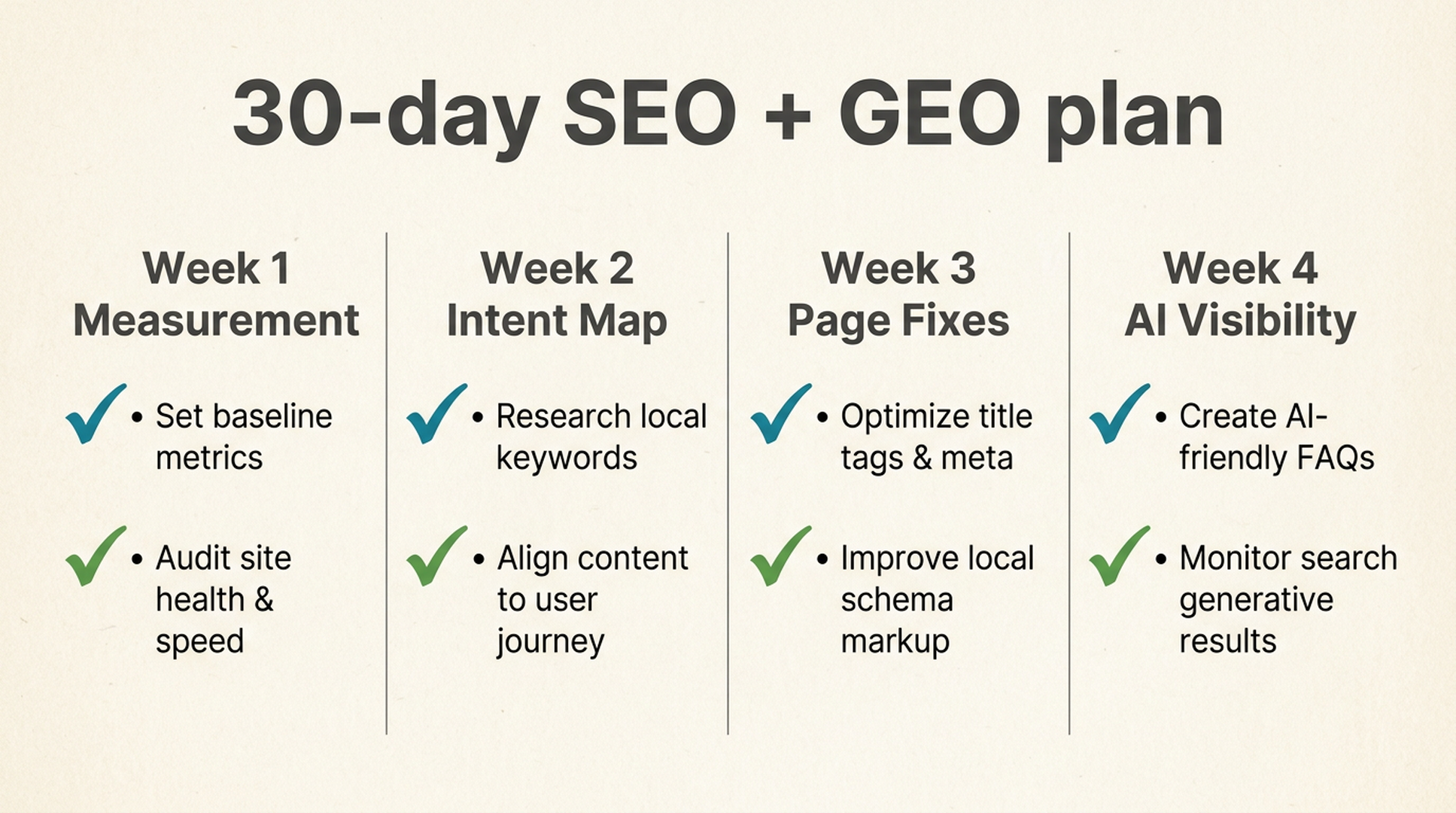
A 30-day execution plan
Week | Focus | Output |
|---|---|---|
Week 1 | Measurement and technical baseline | GSC, Bing, GA4, sitemap, index review, speed check |
Week 2 | Keyword and intent map | Persona, keyword clusters, priority page list |
Week 3 | Page improvements | Titles, headings, internal links, schema, image alt, content gaps |
Week 4 | GEO and refresh loop | Prompt tracking, AI visibility check, old content updates, next-month roadmap |
Do not try to fix the entire website at once. Pick the 10 pages closest to revenue first.
Auspia's 2026 takeaway
The best independent-site SEO program in 2026 is not a giant checklist. It is a repeatable loop: audit, prioritize, fix, publish, measure, refresh, and check AI visibility.
If you want to do it manually, the checklist above gives you the map. If you want the faster path, use Auspia.ai. Auspia automates site audits, SEO issue detection, GEO readiness checks, page-level recommendations, and AI search visibility monitoring, so teams can run intelligent SEO without mastering every technical detail first.
FAQ
What is independent-site SEO in 2026?
Independent-site SEO is the process of making a standalone website discoverable, useful, technically healthy, and trustworthy across organic search. In 2026, it also includes GEO readiness so pages can appear in AI-generated answers and recommendations.
What should a new site optimize first?
Start with Search Console, sitemap submission, indexability, page titles, H1s, internal links, mobile speed, and the most important product or service pages. Do not publish dozens of articles before fixing basic access and clarity.
How many SEO tasks should I do at once?
Start with the 10 pages closest to revenue. Fix technical blockers, on-page clarity, content gaps, and internal links there first. Then expand to supporting articles and link assets.
Is GEO part of SEO?
GEO builds on SEO but focuses on AI answer visibility. SEO helps pages rank and earn clicks. GEO helps pages become clear, trustworthy sources that AI systems can summarize or cite.
How often should old content be updated?
Review important pages quarterly. Update pages when facts, screenshots, rankings, competitors, product details, or user intent have changed. For fast-changing topics, add a visible 2026 update note and refresh examples.