The short version
Reddit is no longer just a place to find community chatter. In 2026, it is one of the clearest public windows into how real people describe problems before they become polished search queries.
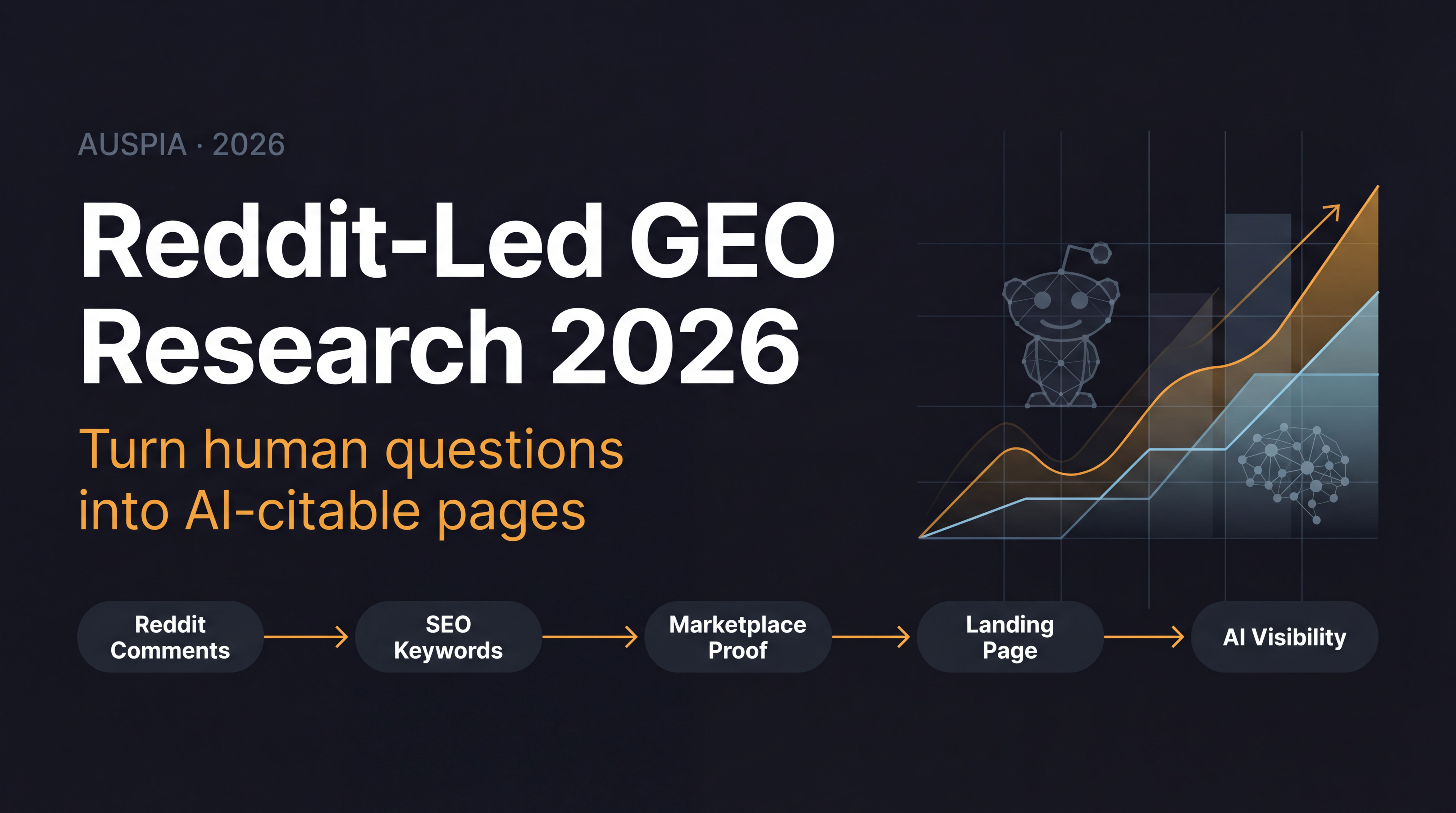
The workflow is simple:
Step | What to collect | What it becomes |
|---|---|---|
1 | Repeated Reddit phrases and complaints | Demand roots |
2 | SEMrush, Ahrefs, or similar keyword expansion | Searchable long-tail terms |
3 | Amazon, eBay, review sites, and TikTok checks | Commercial and content proof |
4 | Landing page modules | AI-readable page structure |
5 | A 7-14 day content plan | A repeatable GEO growth loop |
The point is not to copy Reddit threads. The point is to translate human wording into pages that answer specific questions, cite evidence, and give AI systems clean material to retrieve.
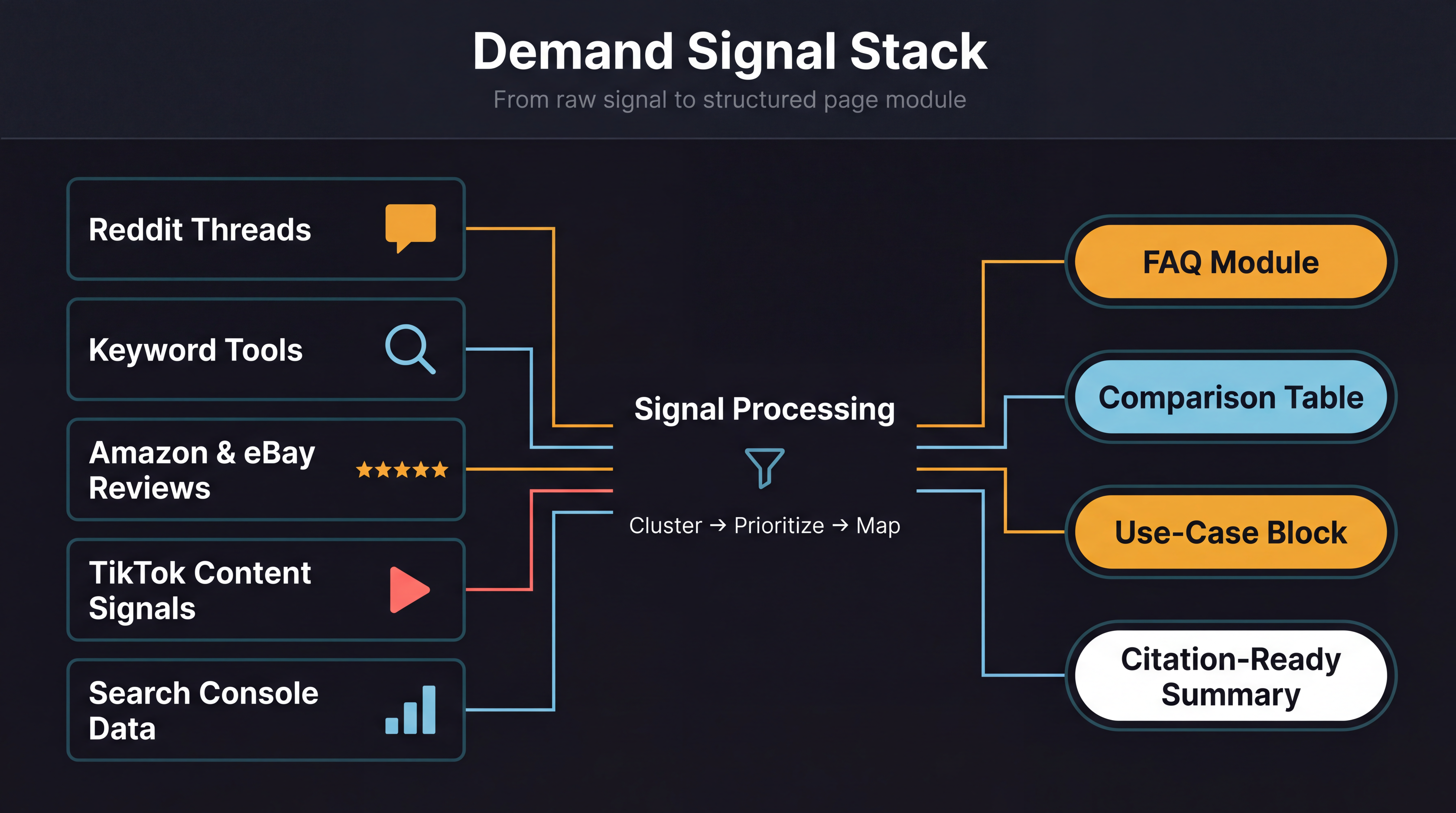
The demand signal stack: start with messy human language, then validate it before building pages.
Why Reddit belongs in a 2026 GEO workflow
A useful GEO workflow starts where users speak naturally. Reddit is good at that because people do not usually write like landing pages there. They complain, compare, ask for alternatives, admit what failed, and describe trade-offs in plain language.
That matters because AI search systems need more than a keyword. They need context: who the problem affects, what has already failed, what alternatives exist, and which sources explain the answer clearly.
Reddit also became harder to ignore after its platform partnerships. OpenAI announced its Reddit partnership in May 2024, saying it would access Reddit's Data API for real-time, structured Reddit content. Google announced an expanded partnership with Reddit on February 22, 2024, including access to Reddit's Data API. Reddit's own business audience page now describes the platform at more than 24 billion posts and comments, with more than 127 million daily active uniques and more than 490 million weekly active uniques.
There is also an SEO angle. Amsive reported that Reddit.com saw a 1,328% increase in Google SEO visibility from late July 2023 to April 2024, based on Sistrix data. Sistrix separately wrote about Reddit's unusual rise in Google visibility.
None of this means every brand should rush into Reddit and start posting. That is usually where teams get clumsy. The better use case is research: study the language, verify the demand, then build better answer assets on your own site.
Step 1: collect phrases before keywords
Most teams start too late. They open a keyword tool, type a seed term, and accept whatever the tool returns.
Reddit lets you start one layer earlier.
Look for repeated sentence patterns in threads and comments:
Reddit phrase pattern | Underlying demand |
|---|---|
"I tried X but it does not work for Y" | The current solution failed in a specific context |
"Best X for Y" | Buyer is comparing options for a clear use case |
"Any alternative to X" | The user has a named competitor or category in mind |
"How do you deal with Y" | The user wants a process, not just a product |
"Is X worth it for Y" | The user needs decision support |
Do not turn these into titles yet. First, save them as demand roots.
A demand root is not a finished keyword. It is the raw language behind a page, FAQ, comparison block, product explanation, or buying guide.
Example:
Raw demand root | Possible page angle |
|---|---|
"wired earbuds for sleeping" | Sleeping use case page |
"earbuds that do not hurt side sleepers" | Pain-point landing page |
"sleep headphones alternative" | Comparison page |
"wired earbuds vs sleep headphones" | Decision-support article |
Auspia's view: the phrases with awkward grammar are often the most useful. They show how people search when they are annoyed, tired, or close to buying.
Step 2: expand the demand roots in keyword tools
After you have the raw wording, move into SEMrush, Ahrefs, Google Search Console, DataForSEO, or another keyword source.
The job now is not to chase the biggest search volume. The job is to find terms with the right mix of intent, competition, and commercial signal.
Use a simple scoring pass:
Metric | What to check | Why it matters |
|---|---|---|
Search volume | Does anyone search it outside Reddit? | Confirms there is search behavior |
Keyword difficulty | Can a focused page compete? | Avoids wasting time on impossible terms |
CPC | Are advertisers paying for related clicks? | Suggests commercial value |
SERP shape | Are forums, listicles, product pages, or videos ranking? | Tells you what format Google already rewards |
Query wording | Does the term preserve the user's real context? | Keeps the page from becoming generic |
A low-volume keyword can still be worth building around if it appears repeatedly in Reddit, has buying intent, and maps to a page your product can answer honestly.
This is where many GEO programs go wrong. They treat AI visibility as separate from SEO. In practice, the strongest pages often do both: they answer the long-tail search query and give AI systems a concise, structured explanation to reuse.
If you want a quick diagnostic before building the page, run the target page or draft through an AI Search Visibility Checker after publication and compare the same prompts across ChatGPT, Perplexity, Gemini, and Google AI-style surfaces.
Step 3: use marketplaces and social video to validate demand
Reddit can tell you what hurts. It cannot tell you everything about whether people buy.
For commercial validation, check places where money, reviews, and content behavior show up:
Source | What to inspect | What it proves |
|---|---|---|
Amazon | Reviews, low-star complaints, bestseller patterns | Buyers already pay for a solution |
eBay | Used-product listings, resale demand, product variants | Demand exists beyond polished retail pages |
TikTok | Search suggestions, creator hooks, comments | The problem can be explained visually |
YouTube | Review titles, comparison videos, comment questions | People research before buying |
Product forums | Edge cases and objections | Your page can answer what product pages skip |
For the earbuds example, a marketplace review may reveal that the real pain is not "sleeping earbuds" in general. It may be cable stiffness, pressure on the ear cartilage, Bluetooth battery anxiety, or latency while watching video in bed.
That level of detail is what turns a thin SEO page into a page that AI systems can summarize with confidence.
Step 4: build the landing page from modules, not keyword stuffing
Once you have the validated demand, do not dump every keyword into one page.
Build the page like an answer system would parse it.
- H1: use the main demand phrase, such as "Wired Earbuds for Sleeping Without Ear Pain."
- Hero section: name the user context and outcome, such as side sleepers who want stable audio without charging another device.
- Feature blocks: use solution language like low-profile shell, soft cable, no battery, and low latency.
- FAQ: answer long-tail questions such as "Are wired earbuds better for side sleepers?"
- Comparison section: cover alternatives and trade-offs, such as wired earbuds vs sleep headphones.
- Evidence section: summarize review patterns and use cases in your own words.
- Summary block: add a concise answer AI systems can quote or paraphrase.
This structure is useful for SEO, but it is also useful for GEO. You are turning scattered human language into clean sections that can be retrieved, compared, and cited.
A good landing page should answer one narrow demand better than a broad category page does.
Step 5: turn one demand into a 7-14 day content plan
A single validated demand root can support a short content sprint.
- Day 1: publish the main demand landing page.
- Day 2: write the most common pain-point article.
- Day 3: turn marketplace complaints into a buying checklist.
- Day 4: publish a product or method comparison.
- Day 5: write the TikTok-friendly use-case explainer.
- Day 6: cover the "best for" keyword cluster.
- Day 7: cover the "alternative to" keyword cluster.
- Days 8-14: add FAQ, mistakes, comparison, and selection-guide pages.
Each article should solve one intent. Each one should link back to the landing page naturally. Each one should preserve the user's original question, but the analysis and recommendations must be your own.
The best test is simple: if someone pasted the section into a chat assistant, would the assistant have enough context to answer accurately without guessing?
Step 6: review GEO performance without obsessing over one metric
Do not review the sprint only by Google ranking. Ranking still matters, but AI visibility is messier.
Use a four-part review loop:
Review area | What to check |
|---|---|
Search Console | Are long-tail impressions appearing for the phrases you targeted? |
AI answer platforms | Do ChatGPT, Perplexity, Gemini, or AI search tools mention your brand, page, or point of view for the same prompt set? |
Citation quality | Are AI systems citing your page, a competitor, Reddit, or no source at all? |
New demand signals | Are Reddit, reviews, and comments surfacing the next question? |
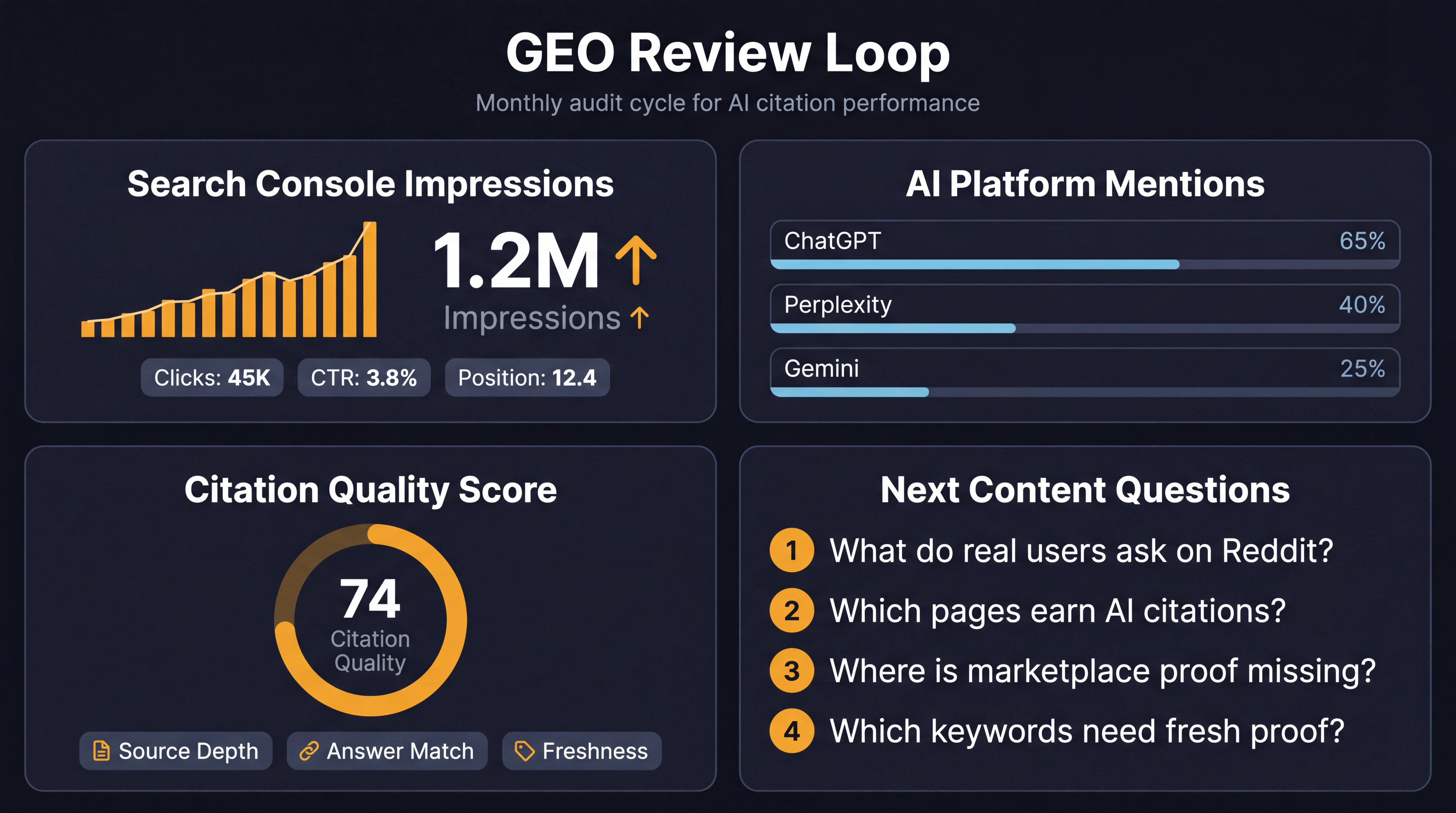
The GEO review loop: measure visibility, citation quality, and the next question your content should answer.
A practical prompt set might include:
Prompt type | Example |
|---|---|
Problem prompt | "What are the best wired earbuds for side sleepers who get ear pain?" |
Comparison prompt | "Wired earbuds vs sleep headphones for sleeping: which is better?" |
Alternative prompt | "What is a good alternative to sleep headphones?" |
Buying prompt | "What should I check before buying earbuds for sleeping?" |
Run the same prompts every week for a month. Record mentions, citations, answer wording, and missing context. Then update the page if the AI answer keeps skipping a detail your audience cares about.
Common mistakes
The first mistake is copying community language too directly. Reddit is a research source, not a content farm. Rewrite, verify, and add your own point of view.
The second mistake is treating keyword tools as the whole truth. A zero-volume phrase can still expose a future page angle if it appears repeatedly in buyer conversations.
The third mistake is building one giant article instead of a page system. GEO works better when the main page, supporting articles, FAQs, and comparison blocks reinforce the same entity and answer set.
The fourth mistake is measuring only rankings. A page can start appearing in AI answers, comparison summaries, or citation trails before it wins a classic blue-link position.
FAQ
Is Reddit data enough for GEO research?
No. Reddit is strongest as a language and pain-point source. Validate the same demand with keyword tools, marketplace reviews, product pages, short-form content, and your own analytics before building a page system.
Should brands post on Reddit for GEO?
Sometimes, but posting is not the first move. Start by listening. If a brand enters a subreddit too early with promotional comments, it usually damages trust. Research, build better answers, and participate only when you can be genuinely useful.
How many Reddit threads should I review before choosing a topic?
For a narrow product use case, review at least 20-30 relevant threads and pay attention to repeated comment patterns, not just upvotes. For a larger category, build a spreadsheet of recurring phrases across multiple subreddits.
How does this help AI search visibility?
AI answer systems need clear entities, specific use cases, direct explanations, and credible evidence. A Reddit-led workflow helps you find the exact questions people ask, then turn those questions into structured pages that are easier to retrieve and summarize.
What should I publish first: a landing page or supporting articles?
Publish the landing page first if the demand is commercial and your product can answer it. Then publish supporting articles for pain points, comparisons, alternatives, and FAQs. If the demand is still unclear, publish one exploratory article before committing to a full page.
Sources checked
- Reddit for Business, "Audience Insights," accessed June 27, 2026.
- OpenAI, "OpenAI and Reddit Partnership," May 2024.
- Reddit, "Expanding our Partnership with Google," February 22, 2024.
- Google, "An expanded partnership with Reddit," February 22, 2024.
- Amsive, "Reddit is Seeing Explosive SEO Growth," citing Sistrix visibility data.
- Sistrix, "Google's Unusual, Special Relationship with Reddit."
Author: Isabel Grant, Researcher of 2,000+ AI Citation Patterns at Auspia. Isabel writes about citation earning, source quality, and how AI answer systems choose which pages to trust.