There is a source of AI citations that most GEO programs ignore, and it is not on your own site.
When buyers ask ChatGPT, Perplexity, or Google's AI surfaces for a recommendation, a meaningful share of the answers are built from community discussions rather than brand pages. Reddit is one of the largest of those sources. It shows up disproportionately in Perplexity, appears regularly in Google's AI surfaces, and has historically been a heavy input for ChatGPT's search behavior.
That creates a problem and an opportunity at the same time. The opportunity is that a well-placed, genuinely useful Reddit thread can influence what AI systems repeat about your category. The problem is that Reddit is enormous, fast-moving, and hostile to anything that looks like marketing.
You cannot read every relevant thread by hand. You also cannot automate replies, because that gets you banned and it does not work anyway. What you can do is use a decision layer to sort the noise and tell you which threads are worth a human's attention.
That is what this workflow does.
What you will finish with
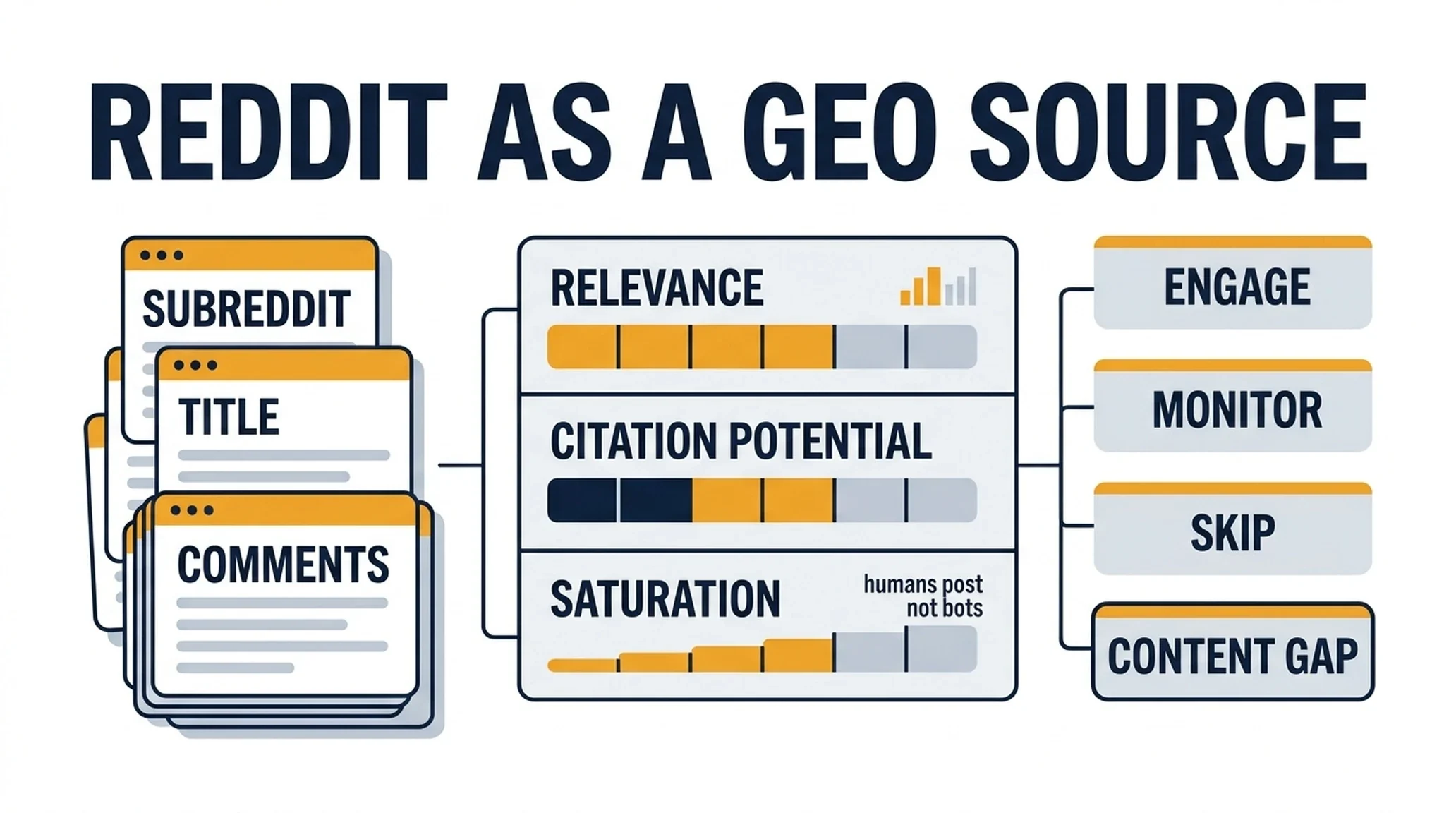
A monitored thread list where every candidate carries:
- A relevance score for your brand or category
- A citation-potential score, based on whether AI systems are likely to draw from it
- A saturation flag, so you know if the thread is already dominated by competitors
- An engagement recommendation: monitor, engage, or skip
- A confidence score for each decision, routed to auto-queue or human review
Who this is for: a GEO or content lead who already tracks AI citations and wants to add community sources to the program.
Prerequisites:
- A list of the questions your buyers actually ask, the same set you use for prompt tracking
- A way to collect Reddit threads by keyword or subreddit (the platform's search, a monitoring tool, or the public API)
- A Jev API key, or an agent with the TypeSafe skill installed
- A human who can write a genuine, non-promotional reply
Definition of done: every candidate thread has a decision and a confidence score, and nothing has been posted to Reddit by an automated system.
Why Reddit matters, and why the numbers move
Before you build anything, understand what you are monitoring for.
Reddit's share of AI citations varies sharply by platform. Reported analyses put Reddit at roughly 6.6% of all citations in Perplexity, with a much higher share within the top sources. In Google's AI surfaces it sits lower, around 2.2% of all citations. In ChatGPT's search behavior it has historically been a significant input, though its share dropped sharply during 2026, with one analysis reporting a decline of more than 70% in a single month.
That volatility is the point. Reddit citation share is not a stable constant you can plan around. It is a moving signal that differs by engine and changes over time.
Two practical conclusions follow.
Track it per engine, not in aggregate. A thread that matters for Perplexity may be irrelevant for ChatGPT. If you average them together, you lose the signal.
Re-measure regularly. A source that was dominant three months ago may not be today. The workflow below is designed to run on a schedule for exactly this reason.
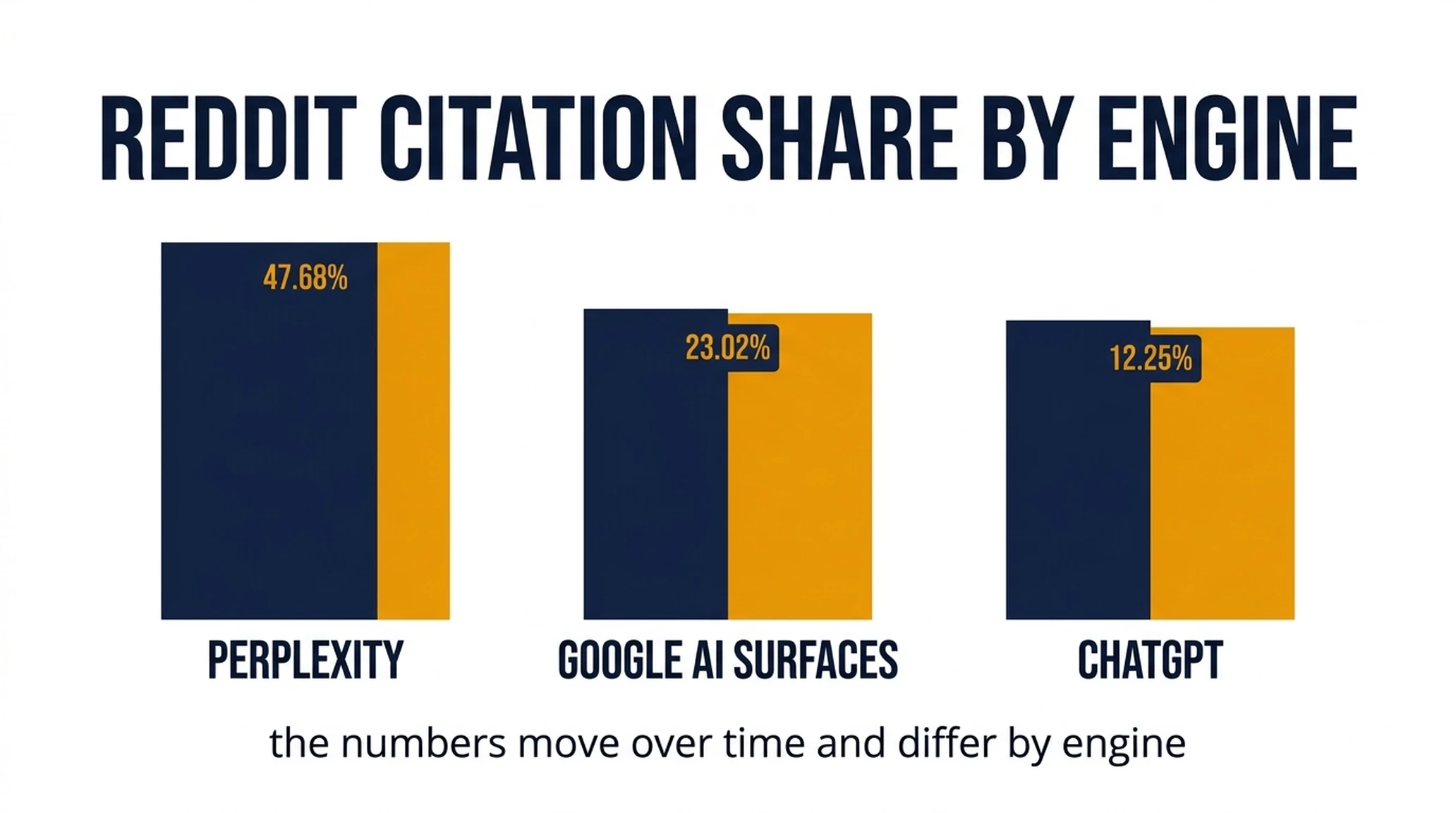
Reddit's weight in AI answers is not one number. It differs by engine and moves over time.
Collect threads before you judge them
The same rule from every other workflow in this series applies here: Jev has no live web access. It cannot browse Reddit. You collect the threads first, then send them to Jev for judgment.
For each candidate thread, capture:
- The subreddit
- The thread title
- The original post text
- The top few comments
- The thread's age and activity level
- Whether your brand or a competitor is already mentioned
A workable record:
{
  "thread_id": "r_1042",
  "subreddit": "r/smallbusiness",
  "title": "What CRM actually works for a 10-person team?",
  "post_text": "We've outgrown spreadsheets and tried two tools that were too complex...",
  "top_comments": [
    "We use Acme PM and it's been fine for a small team.",
    "Honestly most of them are overkill. Depends on your workflow."
  ],
  "age_days": 4,
  "comment_count": 38,
  "brand_mentioned": false,
  "competitors_mentioned": ["competitor_a", "competitor_b"]
}
Keep the raw text. Do not summarize before you send it, because the summary is where the useful nuance gets lost.
Score relevance and citation potential
Now the decisions. Two questions matter most: is this thread relevant to what you sell, and is it the kind of thread AI systems would draw from.
{
  "model": "jev-latest",
  "state": {
    "thread": {
      "subreddit": "r/smallbusiness",
      "title": "What CRM actually works for a 10-person team?",
      "post_text": "We've outgrown spreadsheets and tried two tools that were too complex...",
      "top_comments": ["We use Acme PM and it's been fine for a small team.", "Honestly most of them are overkill."],
      "comment_count": 38
    },
    "brand": "Acme PM",
    "category": "project management software for small teams"
  },
  "questions": {
    "relevance": {
      "type": "choice",
      "instructions": "How relevant is this thread to the brand's category?",
      "criteria": {
        "direct": "The thread is asking the exact question the brand's product answers",
        "adjacent": "The thread is in the same category but a different specific problem",
        "tangential": "The thread touches the category but is not about the brand's problem",
        "irrelevant": "The thread has no meaningful connection to the brand"
      }
    },
    "citation_potential": {
      "type": "score",
      "instructions": "How likely is an AI system to draw on this thread when answering a related buyer question?",
      "criteria": [
        "Unlikely to be cited by any AI system",
        "Possibly cited for a narrow query",
        "Likely cited for common category questions",
        "Highly likely to be cited and repeated"
      ]
    },
    "saturation": {
      "type": "choice",
      "instructions": "How saturated is this thread with competitor mentions?",
      "criteria": {
        "open": "No competitor dominates the discussion",
        "mixed": "Several competitors mentioned, no clear leader",
        "saturated": "One or two competitors dominate the thread",
        "not_applicable": "The thread is not a recommendation thread"
      }
    }
  }
}
Three questions, one request. The citation_potential score is the one that separates this from ordinary social listening. A thread with high relevance but low citation potential is a conversation, not a GEO opportunity.
Decide what to do with each thread
Now the action decision. This is where most social monitoring tools stop, and where the value actually is.
{
  "model": "jev-latest",
  "state": {
    "thread": {
      "title": "What CRM actually works for a 10-person team?",
      "age_days": 4,
      "comment_count": 38,
      "relevance": "direct",
      "citation_potential": 2,
      "saturation": "mixed"
    },
    "brand": "Acme PM"
  },
  "questions": {
    "action": {
      "type": "choice",
      "instructions": "What should the team do with this thread?",
      "criteria": {
        "engage": "A human should consider adding a genuinely useful comment",
        "monitor": "Watch the thread; it may become relevant or grow",
        "skip": "No action is warranted",
        "flag_for_content": "The thread reveals a content gap worth addressing on our own site"
      }
    },
    "engagement_risk": {
      "type": "choice",
      "instructions": "If a human engages, what is the main risk?",
      "criteria": {
        "looks_promotional": "Any brand mention would read as advertising in this thread",
        "already_answered": "The question is already well answered by others",
        "low_visibility": "The thread is unlikely to be seen or cited",
        "low_risk": "A genuine, useful comment would be well received",
        "not_applicable": "No engagement recommended"
      }
    }
  }
}
The engagement_risk question is doing important protective work. Reddit punishes promotional behavior, and a brand that gets flagged as a marketer loses the ability to participate at all. Having the model flag "this would look promotional" before a human posts is worth more than any volume gain.
Note the flag_for_content option. Some of the most valuable output from this workflow is not a Reddit reply at all. It is the discovery that a question keeps coming up and your own site does not answer it well. That becomes a page brief, which is a much more durable GEO asset than a comment.
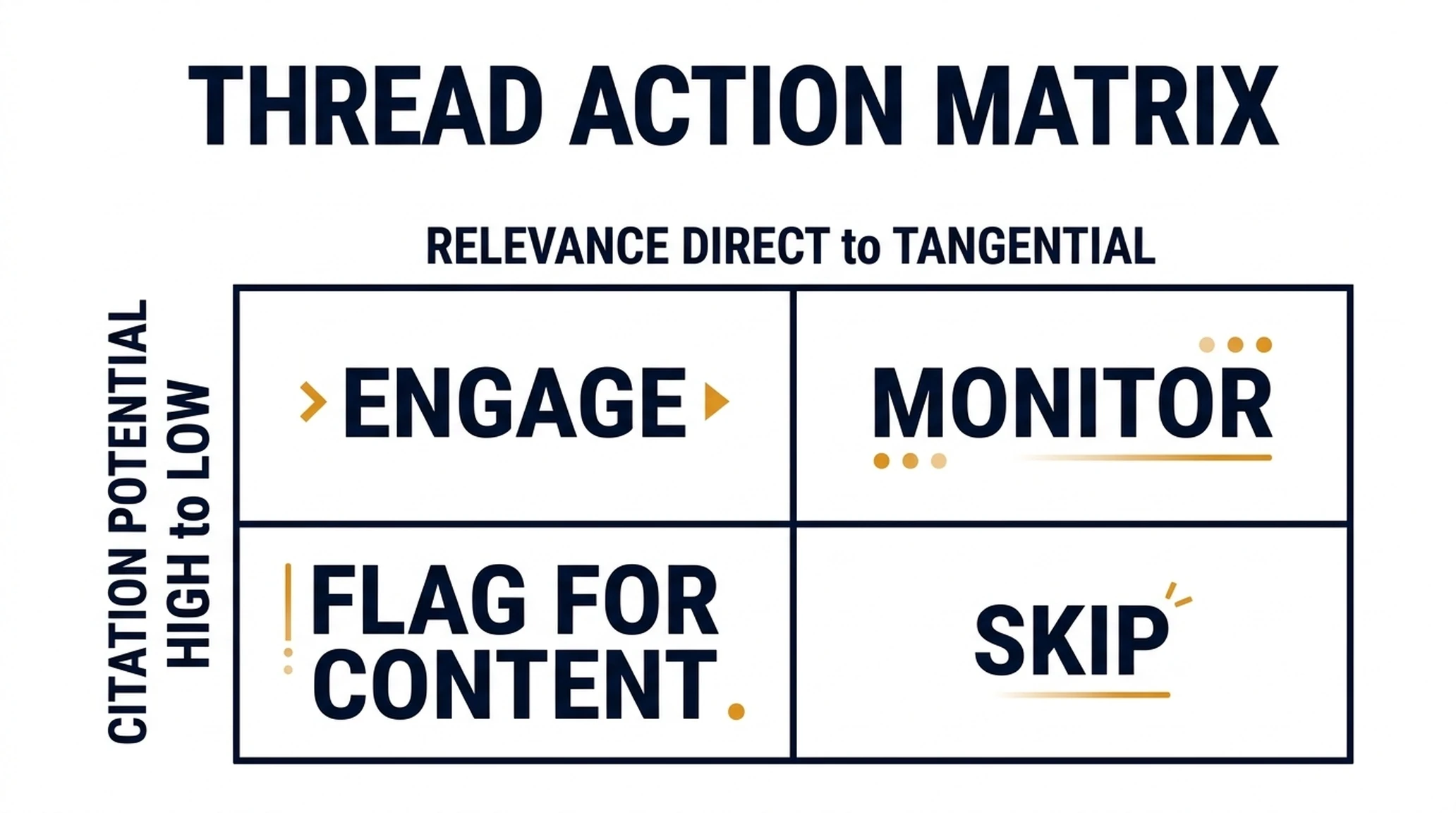
Most threads should be monitored or skipped. Engagement should be rare and genuine.
Route by confidence and keep humans in the loop
Set your thresholds before you look at the output.
Confidence | Route | What happens |
|---|---|---|
0.90 and above | Auto-queue | Added to the review list for a human to consider |
0.75 to 0.90 | Human review | A person decides whether the thread is worth attention |
Below 0.75 | Skip | Do not act; the signal is too weak |
Two hard rules that are not negotiable.
Never post automatically. Not with a model, not with a template, not with a scheduled job. Every comment on Reddit should be written and posted by a human who has read the thread. Automation here does not just fail, it damages the brand.
Never let the pipeline decide what is true. Jev can tell you a thread is relevant and likely to be cited. It cannot tell you whether the claims in the thread are accurate, and it should never be used to generate a rebuttal of something you have not verified.
Verify before you trust the list
Run these checks on the first batch.
- Read twenty auto-queued threads yourself. Would you actually want your brand in that conversation? If not, your relevance criteria are too loose.
- Check the citation-potential scores against reality. Pick five threads that scored high. Ask the relevant AI systems the related question and see whether the thread's content shows up in the answer. That is your ground truth.
- Re-run a sample twice. If the decisions move substantially, your criteria need tightening.
- Confirm the saturation flag matches what you see. Read the top comments. If a competitor clearly dominates and the model said "open," the criteria are wrong.
- Track what happens after engagement. Did the thread grow? Did it get cited later? Without this column, you cannot tell whether the workflow is producing results.
Maintain the loop
- Weekly: collect new threads and run the scoring pass.
- Monthly: re-check citation potential on the threads you engaged with, since AI citation behavior changes.
- Quarterly: re-measure Reddit's share of citations for your category, per engine, because the platform's weight in AI answers moves.
- Continuously: feed the
flag_for_contentitems into your content pipeline. That is where the compounding value is.
FAQ
Can Jev read Reddit directly? No. It has no web access. You collect the threads and pass the text in as the state.
Can I automate the replies? No. Automated replies get accounts banned and damage the brand. The workflow automates the sorting, not the participation.
How is this different from a social listening tool? A listening tool tells you where your brand is mentioned. This workflow tells you which threads are likely to influence AI answers, whether they are saturated, and whether engagement is worth the risk.
Which AI engines should I care about for Reddit? It varies. Perplexity has historically drawn on Reddit heavily. Google's AI surfaces draw on it less. ChatGPT's behavior has shifted significantly during 2026. Track each engine separately rather than assuming one number applies to all.
What if my brand is never mentioned in these threads? That is the most common starting point and it is useful information. A category where competitors dominate the community discussion is a category where you have no third-party footprint, which is a real GEO gap.
How much does this cost? The decision layer is cheap enough to run across thousands of threads. The real cost is the human time to write genuine replies, which is the part you should not automate.
Should I engage in every relevant thread? No. Engagement should be rare and genuine. Most threads should be monitored or skipped. If you are commenting on a large share of relevant threads, you are behaving like a marketer, and the community will treat you like one.
What to do next
Build a list of twenty threads from your category. Run the relevance and citation-potential pass. Then read the top five yourself and check whether the content actually shows up when you ask an AI system the related question.
That check tells you whether the citation-potential score means anything in your market. If it does, expand the thread set and add the workflow to your weekly cadence.
Read the rest of the series
This article is part of a twelve-part series on using Jev for SEO and GEO work.
- Start here: what Jev is and how to install it
- How to build a Jev internal-linking and cannibalization workflow
- How to use Jev to audit and route your content library
- How to run AI-visibility checks with Jev as the scoring layer
- Where Jev breaks in SEO work
- How one team built a Jev internal-link analyzer for 78 yen
- How to turn Jev citation gaps into page fixes
- Is Jev actually accurate for SEO? What the evidence really shows
- How to run a full Search Console export through Jev (and the three traps)
- We rebuilt a 566-page internal link map with Jev, and only 287 links survived review
- Ghost citations: the AI visibility failure your dashboard hides
Author: Isabel Grant, Researcher of 2,000+ AI Citation Patterns at Auspia. Isabel writes about citation earning, source quality, and how AI systems decide which sources to trust.