Every article in this series has told you how to build with Jev. This one asks the uncomfortable question: does it actually work well enough to trust?
That question matters more than it sounds, because the honest answer is not a single number. It is a set of numbers measured under different conditions, and the most important thing you can learn is which ones apply to your situation and which ones do not.
Let me start with the claim that gets repeated most often, because it is also the one most likely to mislead you.
The 67.8% number, and why it is not what you think
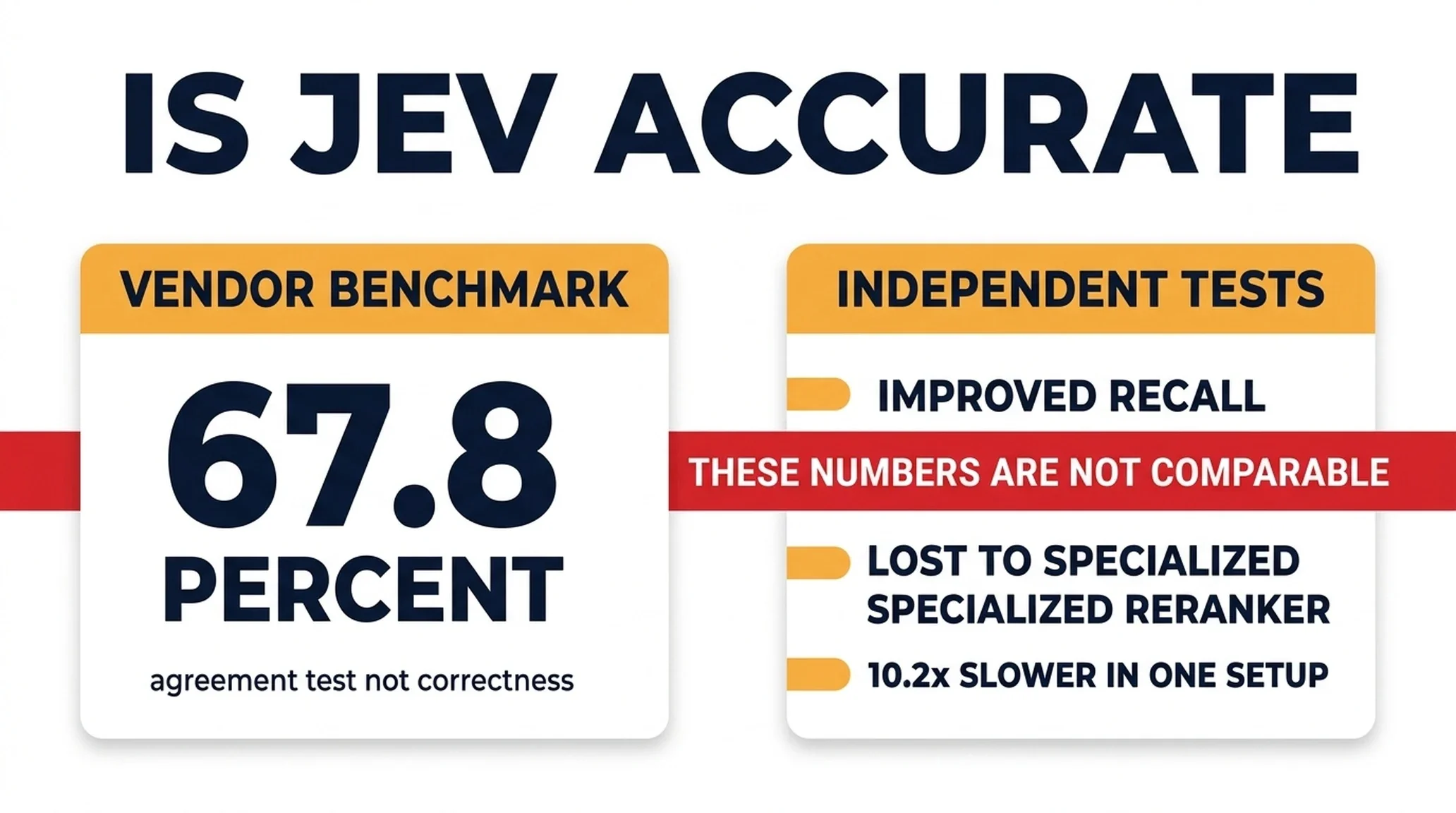
Jev's reported accuracy on TypeSafe's own four-workflow production benchmark is about 67.8%.
That number circulates alongside two others: GPT-5.6 Sol at 74.1% on the same benchmark, and Claude Opus 5 at 73.1%. Put side by side, it looks like a clean ranking. Jev loses.
It is not a clean ranking, and the comparison is not valid as presented.
Here is why. The 67.8% and the 74.1% come from the same TypeSafe four-workflow benchmark, so those two are comparable to each other. The 73.1% for Claude Opus 5 comes from a different evaluation entirely, a benchmark called Toolathon-Verified measuring a Pass-3 rate. That is a different task set, a different scoring method, and a different definition of success.
Comparing them is like comparing a sprinter's 100m time to a swimmer's 50m time and concluding one athlete is faster. The numbers are real. The comparison is not.
There is a second problem, and it is bigger. TypeSafe's public benchmark is a model agreement test, not a verified ground-truth test. It measures how often Jev's answers match what other models would answer on the same workflows. Agreement is not correctness. If every model in the comparison shares the same blind spot, they all agree, and the benchmark reports a high score for a wrong answer.
And the whole thing is vendor-reported. It has not been independently reproduced.
None of this means the number is fake. It means you cannot use it to decide whether Jev is accurate enough for your SEO work. For that, you need a different kind of evidence.
What the independent tests actually show
Away from the vendor benchmarks, a more useful picture emerges. Several independent evaluations have tested Jev on retrieval and reranking tasks, which is close to what an SEO workflow actually asks it to do: given a query and a set of candidates, pick the best one.
The results are mixed, and the mix is informative.
One test found Jev improved retrieval accuracy but lost to a specialized reranker. In a memory-reranking evaluation, Jev improved Recall@5 from a 74.71% baseline, but a dedicated reranking model reached 81.87% and did a better job of putting the most useful result near the top. Jev helped. It was not the best tool for that job.
Another test found Jev best on accuracy but much slower. In a vector-database evaluation, Jev improved retrieval accuracy by 0.0778 and ranked best of the three models tested. But its median reranking latency was 10.2 times higher than the alternatives. Better answers, at a real speed cost.
A speed comparison found the quality difference was not decisive. Against Qwen, Jev was about 1.8 times faster at the median and 2.4 times faster at the 95th percentile, but the ranking quality was close enough that the speed advantage did not translate into a clear quality win.
One independent test found Jev beat a smaller model but lost to a larger one. Jev outperformed GPT-4o-mini on both datasets tested, but fell short of GPT-5-mini. Relative performance depends heavily on what you are comparing against.
And the vendor's own reranking demo reports adding Jev on top of a BM25 baseline pushed top-1 accuracy from 21% to 54%. That is a dramatic improvement, and it is also measured against a weak baseline. Independent tests do not consistently reproduce gains of that size.
The pattern across all of these: Jev's advantage depends almost entirely on what it is replacing.
The three variables that decide whether Jev helps
If you take one thing from the independent tests, take this. Reranking and decision quality are not properties of the model alone. They are properties of the model plus three specific conditions.
The baseline you are replacing. Jev's improvement over a weak first-stage retriever like BM25 is large. Its advantage over a strong vector search or a specialized reranker may be small, or even negative on some metrics. If you are replacing a frontier LLM call, Jev is a huge win on cost and speed. If you are replacing a purpose-built reranker, the picture is much less clear.
The chunk size and the candidate count. Jev's cost advantage over LLM rerankers grows as chunks get larger, because you are paying per input token and the output is free. But latency behaves differently, and in some configurations Jev is slower than specialized alternatives. The economics and the speed do not move in the same direction.
The metric you care about. Top-1 accuracy, Recall@5, MRR, and nDCG each measure something different. A model can win on one and lose on another. If your SEO workflow cares about "is the single best link at the top," that is a different test from "is the right page somewhere in the top five."
This is why a single headline accuracy number is close to useless for planning. The number only means something relative to a baseline, a configuration, and a metric.
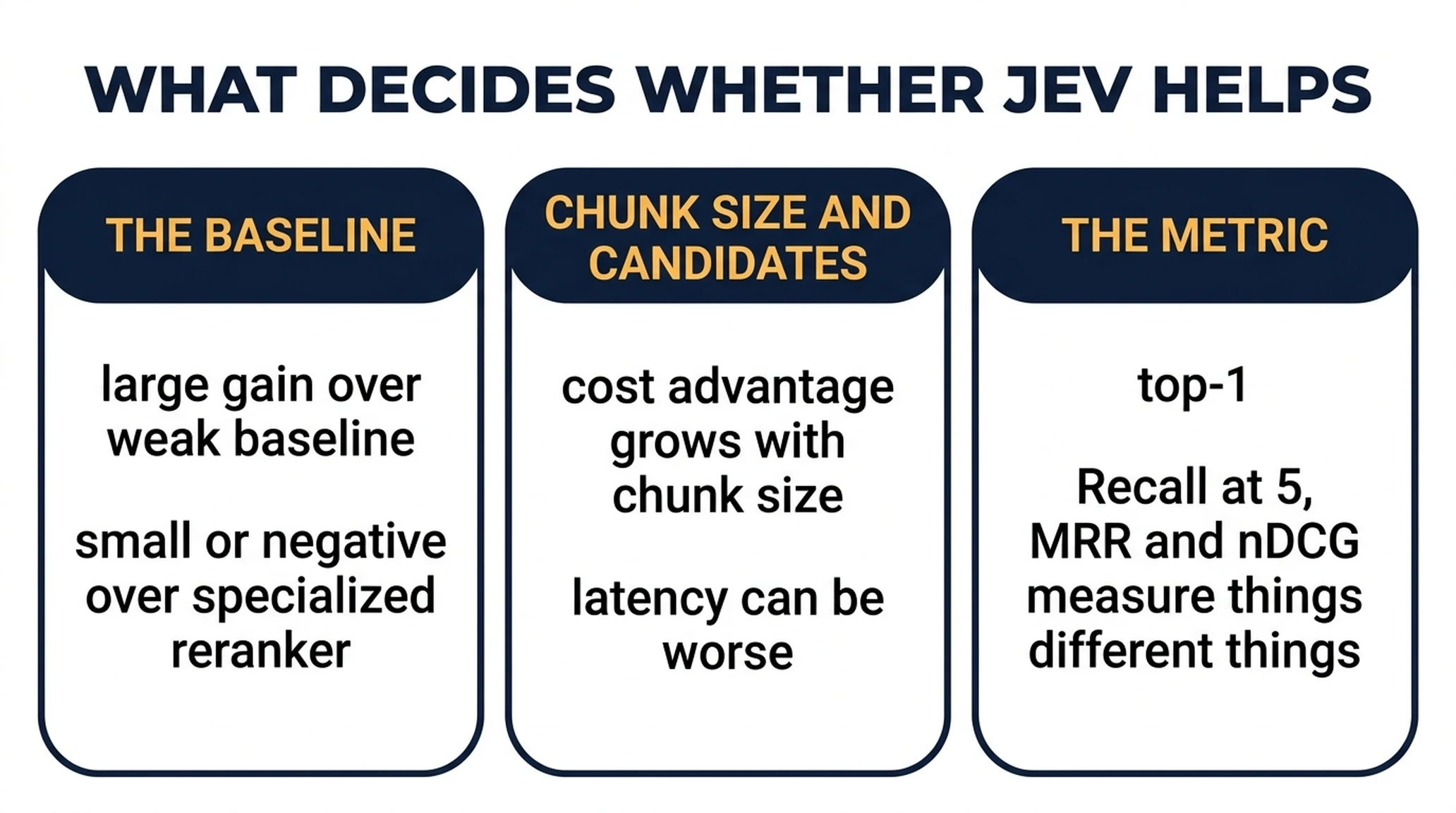
The model is only one input. The baseline, the configuration, and the metric decide the outcome.
What this means for the SEO workflows in this series
Let me translate the evidence into practical guidance for the workflows covered earlier in this series.
Internal linking decisions. The independent evidence supports cautious optimism. Jev improved retrieval accuracy in multiple tests, and the internal-linking task is a bounded choice among a shortlist, which is the shape these tests measure. But the reported "not a free win" finding means you should not assume the recommendations are correct just because the model is confident. The verification pass in the internal-linking workflow exists for exactly this reason.
Content classification and intent tagging. This is Jev's strongest fit. The answer space is small and well-defined, and the reported confidence on clear examples has been high. The risk here is not accuracy, it is vagueness in your criteria.
Citation gap diagnosis. This is the weakest fit for blind trust. Diagnosing why a page lost a citation requires judgment about causes that may not be fully present in the state you send. The diagnosis is a hypothesis, not a finding, which is why the fix workflow treats it as one and routes it through review.
Anything requiring explanation. Jev returns a number, not a reason. No benchmark changes that. If you need to defend a decision, you need a separate rationale step.
How to run your own accuracy test
This is the part that actually matters, because your data is not the benchmark data, and your baseline is not the benchmark baseline.
Here is a test you can run in an afternoon.
Step 1: Build a labeled set. Take 100 to 200 decisions from your real workflow. For each one, write down the answer you believe is correct, based on your own review. This is the ground truth, and it is the only ground truth that matters for your use case.
Step 2: Record your baseline. Run the same decisions through whatever you are currently using, whether that is a frontier model, a specialized tool, or a human reviewer. You need the comparison, not just the Jev number.
Step 3: Run Jev on the same set. Same inputs, same option lists, same criteria. Log the decision and the confidence for every row.
Step 4: Measure agreement with your labels. How often did Jev match your ground truth? How often did the baseline? Report both. A Jev score in isolation tells you nothing.
Step 5: Break it down by confidence band. This is the step most people skip, and it is the most valuable one. Compute accuracy separately for decisions above 0.9, between 0.7 and 0.9, and below 0.7. If accuracy does not rise with confidence, your confidence gate is not doing useful work, and you need to fix the question before you fix the threshold.
Step 6: Re-run a sample to check stability. Run fifty of the same decisions again. If the answers move substantially, your criteria are not specific enough, and the accuracy number you measured is not reproducible.
Step 7: Price the errors. Take the cases where Jev was wrong. How much human rework does each one cause? A model that is 85% accurate on low-stakes meta descriptions may be a better deal than one that is 90% accurate on page restructuring.
That last step is the one that turns accuracy into a business decision.
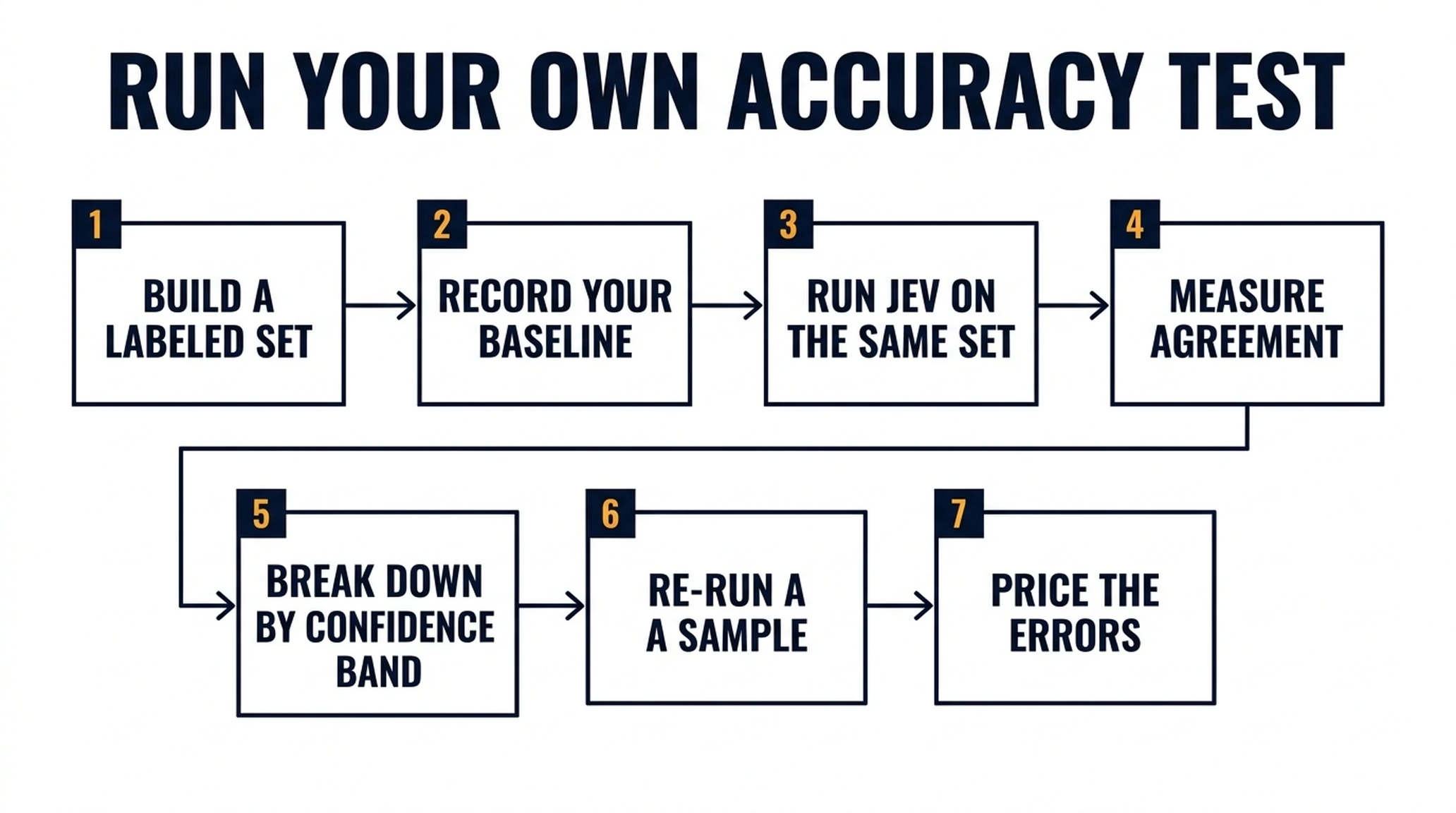
Seven steps. The confidence-band breakdown and the error pricing are the two most people skip.
What to do when the accuracy is not good enough
If your test shows Jev is not accurate enough for a given decision, you have four options, roughly in order of effort.
Fix the question before you abandon the model. Most accuracy problems in this kind of workflow are criteria problems. Vague instructions produce vague judgments. Rewrite the criteria with concrete examples from your own data and re-test.
Narrow the decision. If a five-way choice is unreliable, try a two-way question first. Binary decisions are easier to get right than multi-way ones.
Raise the threshold and add review. Accept the model as a triage layer rather than a decision-maker. Route more of the output to humans.
Use a different tool for that specific decision. Some decisions genuinely need a stronger model, a specialized reranker, or a person. That is a legitimate outcome of the test, not a failure of the process.
The honest summary
Here is what the evidence supports, stated as plainly as I can.
Jev is fast and cheap, and those claims hold up better than the accuracy claims. Its structured output is reliable, which matters more than it sounds for pipeline stability.
Its accuracy is genuinely useful for bounded classification and selection tasks, and the independent tests support that with caveats.
Its accuracy is not established as superior to specialized alternatives, and in at least one independent reranking test it lost to a purpose-built model.
The vendor benchmark is an agreement test, not a correctness test, and it is not comparable to the other model scores it gets printed next to.
And no benchmark, vendor or independent, tells you whether Jev is accurate enough for your workflow. Only your own test does.
FAQ
Is the 67.8% number reliable? It is a real reported figure from TypeSafe's own benchmark, but it measures agreement with other models rather than verified correctness, and it has not been independently reproduced. Treat it as a starting point, not a conclusion.
Can I compare Jev's 67.8% to Claude's 73.1%? No. Those come from different benchmarks with different task sets and different scoring methods. The comparison is not valid.
Does the independent evidence say Jev is bad? No. It says Jev's advantage depends on what you are replacing. Against a weak baseline it helps a lot. Against a specialized reranker it may not.
Should I still use Jev for SEO work? Yes, for the right tasks, with the right guardrails. Bounded classification and selection are its strong fit. Causal diagnosis and anything needing an explanation are weaker fits.
How many decisions do I need to test? 100 to 200 labeled examples is enough to see whether the accuracy is in the right range. More is better if the decisions are high-stakes.
What if my test shows lower accuracy than the vendor benchmark? That is normal and expected. Your data, your baseline, and your criteria are different. What matters is whether the accuracy is good enough for the specific decision, at the cost of the errors it produces.
Do I need to re-test after changing my criteria? Yes, every time. The criteria are the main driver of accuracy in this kind of workflow, so a criteria change invalidates the previous measurement.
What to do next
Pick one decision from your current workflow. Label a hundred examples yourself. Run Jev and your current method against the same set. Break the results down by confidence band.
Then decide, with numbers instead of vendor claims, whether that decision belongs in the automated path or the review queue.
Read the rest of the series
This article is part of a twelve-part series on using Jev for SEO and GEO work.
- Start here: what Jev is and how to install it
- How to build a Jev internal-linking and cannibalization workflow
- How to use Jev to audit and route your content library
- How to run AI-visibility checks with Jev as the scoring layer
- Where Jev breaks in SEO work
- How one team built a Jev internal-link analyzer for 78 yen
- How to turn Jev citation gaps into page fixes
- How to monitor Reddit as a GEO citation source with Jev
- How to run a full Search Console export through Jev (and the three traps)
- We rebuilt a 566-page internal link map with Jev, and only 287 links survived review
- Ghost citations: the AI visibility failure your dashboard hides
Author: Marcus Ellery, Growth Experimenter Behind 150+ SEO Tests at Auspia. Marcus writes about experiments, benchmarks, learning loops, and evidence-led growth content.