There is a sentence going around about Jev that sounds reassuring and is quietly dangerous: "It doesn't hallucinate."
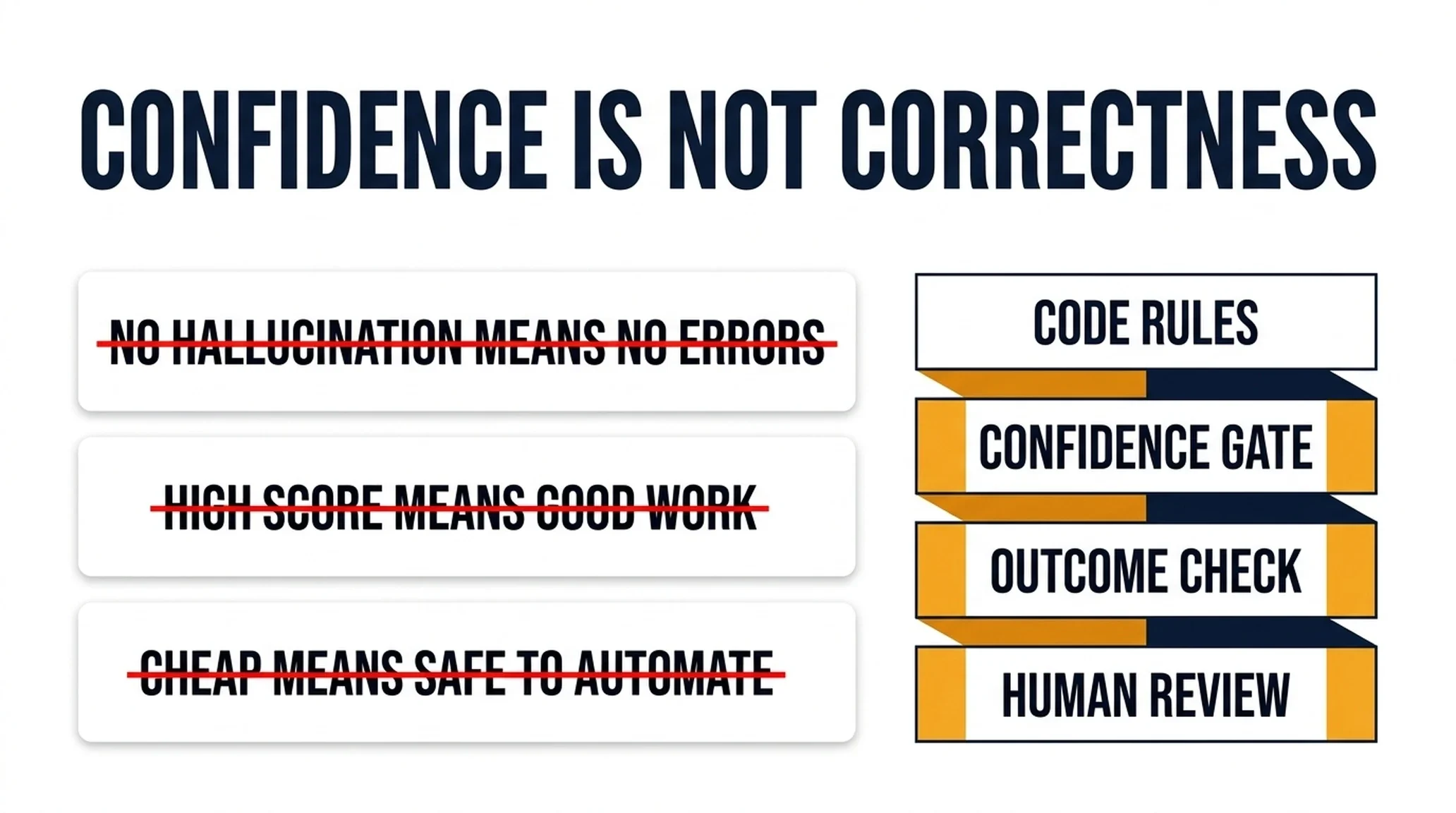
That is true in a narrow, technical sense. Jev cannot return an option you did not define. It cannot invent a tool name, produce malformed JSON, or leave the schema. Structurally, it is incapable of those failures.
It can still be wrong. It can pick the wrong option with high confidence, and it will never tell you why.
That distinction is the whole problem. Teams are reading "no hallucination" as "safe to automate," wiring Jev into pipelines that change live pages, and skipping the review layer that would have caught the errors. This article is about the three myths driving that behavior and the guardrail design that actually holds up.
Myth 1: "No hallucination means no wrong answers"
The misconception. If the model cannot produce an off-schema answer, then its answers must be trustworthy.
The more useful reality. Jev cannot leave the answer space, but it can confidently choose the wrong option inside it. Those are completely different guarantees.
Think about what a choice question actually does. You give it four options and ask it to pick. It will always pick one. If the honest answer is "none of these fit well," and you did not provide that option, it will select whichever option is least wrong and return it with whatever confidence it has. You get a clean, well-formed, schema-valid answer that is also incorrect.
This is the failure mode that makes people distrust the model after they have already trusted it too much.
What to do instead. Every choice question needs an escape hatch. Add a "none," "no action," or "not applicable" option to any decision where the honest answer might be that none of the options fit. This is not a nice-to-have. A forced choice with no exit is a design error, and it will produce confident nonsense at exactly the moments you most need a clear signal.
Myth 2: "A high score means the work is good"
The misconception. If Jev scores a piece of content at 0.9, the content is good.
The more useful reality. The score tells you the model is certain. It says nothing about whether the artifact is actually correct.
This is the lesson from one of the more honest practitioner accounts of running Jev in production. The author wired it into content review, recruiting evidence checks, and video output, and the conclusion after real use was blunt: a high score is not proof that the work is good. The model is confident about its judgment, and its judgment can be wrong.
There is a second layer to this that catches teams off guard. Confidence is meaningful in aggregate but dangerous as a single threshold. A 0.9 confidence on a well-framed question is a useful signal. A 0.9 confidence on a vague question like "is this content good?" is a number with no meaning attached. The model is certain about a question that was never well-defined.
Reported examples show this clearly. Clear intent classification has landed around 96% confidence, which is high enough to act on. A harder case — a reader describing a vague buying situation — scored 54% and was correctly routed to human review. A meta description relevance check scored 61% and was flagged rather than auto-applied. In each case, the useful output was not the label. It was the confidence telling you which path to take.
What to do instead. Stop reading confidence as quality. Read it as a routing signal. Set thresholds per decision type, not one global number, because the cost of being wrong varies wildly between "which page should this link to" and "should we delete this URL."
A workable starting structure:
Decision risk | Threshold for auto-action | Below threshold |
|---|---|---|
Read-only sorting and tagging | 0.80 | Log and continue |
Content edits in place | 0.85 | Human review |
Link changes | 0.85 | Human review |
URL merges, redirects, deletions | 0.90 plus human sign-off | Never auto-apply |
And write those thresholds into a version-controlled config file. When someone changes a threshold, you want a diff and a reviewer, not a silent behavior change discovered three months later.
Myth 3: "It's cheap enough to run everywhere"
The misconception. At roughly $0.042 per million input tokens with free output, the inference cost is negligible, so cost is not a constraint.
The more useful reality. Inference cost is negligible. Decision cost is not.
A decision that is wrong 15% of the time and requires human rework is expensive regardless of what the API call cost. Add the review time, the rework, the logging, and the occasional bad link that ships to production, and the real cost per decision is orders of magnitude above the token price.
There is a second cost that teams miss entirely: the whole history gets resent with every batch of questions. A long session means several requests per cleanup, not one. The per-token price is low, but the volume is not always what you assumed.
And there is a third: cheap decisions encourage you to make decisions you should not make at all. When a call costs almost nothing, it becomes tempting to score everything, route everything, and automate everything. Restraint is cheaper than automation.
What to do instead. Price the review step into your plan before you scale. If a decision needs human review 30% of the time, that is the real cost, and it should determine whether the decision is worth automating at all.
The failure modes you should know about
Beyond the myths, Jev has specific known weaknesses. None of them are disqualifying. All of them matter for design.
Failure mode | What it looks like | Mitigation |
|---|---|---|
Literal reading | Follows the instruction exactly and misses the intent behind it | Write criteria with examples, not just labels |
Arithmetic | Gets numeric comparisons or calculations wrong | Keep all math in code |
Date comparison | Misjudges which date is later or how much time has passed | Compute dates in code, pass the result as state |
Adversarial input | Manipulated by content designed to skew the judgment | Sanitize untrusted content; treat it as data, not instructions |
Flat probabilities | Returns near-uniform distributions that carry no signal | Rewrite the criteria; the question is too vague |
No live data | Cannot know anything not in the state you sent | Fetch first, then judge |
No explanation | Returns a number with no reasoning attached | Add a separate rationale step if you need to defend the decision |
Bias risk | Black-box judgments can encode bias | Do not use it for decisions about people |

Every failure mode has a design answer. None of them require abandoning the model.
Two of these deserve more than a table row.
The black box is a real operational constraint. There is no chain of thought, no explanation field, no "here is why." For high-volume routing that is fine. For anything you need to explain to a stakeholder, a client, or a regulator, you need either a human or a generative model to produce the rationale. Jev can make the decision; it cannot defend it.
The bias risk is not theoretical. A probability model with no explanation is the wrong tool for ranking people, screening candidates, or making decisions about individuals. The reported guidance is explicit about this, and it should be treated as a hard boundary rather than a caution.
The four-layer guardrail
Here is the design that holds up in practice. Four layers, each catching what the one above it misses.
Layer 1: Hard rules in code. Spending limits, permissions, arithmetic, date logic, and destructive actions do not go through Jev. They are deterministic, and they stay that way. If a decision has an exact correct answer, code should make it.
Layer 2: The confidence gate. Every Jev decision passes through a threshold. Above it, the decision proceeds. Below it, the decision routes to the next layer. The threshold is per decision type and lives in version control.
Layer 3: Outcome verification. A confident "done" does not prove that the file was saved, the link was added, or the page actually changed. Verify the outcome independently. This is a code check, not a model check.
Layer 4: Human review. Low-confidence decisions, all destructive actions, and anything with legal or ethical exposure go to a person. This is not a fallback for a broken system. It is a designed part of a working one.
The flow looks like this:
Decision -> Hard rules in code? -> Confidence gate -> Outcome verification -> Human review (if needed)A useful test for any pipeline you build: can you point to the layer that would catch a confidently wrong decision? If the answer is "nothing, we trust the model," you have a single point of failure wearing four layers of documentation.

Four layers, each catching what the one above it misses.
Weak approach versus stronger approach
Weak: Send every URL to Jev with the question "should we keep this page?" Auto-apply anything above 0.8. Trust the result because the model does not hallucinate.
Why it fails: the question is too vague to produce a meaningful score, there is no escape hatch, and there is no verification of what actually happened to the page.
Stronger: Send each URL with its intent, target query, traffic trend, and overlap data. Ask a choice question with keep, update, merge, remove, and no-action options. Route keep and update by confidence. Send every merge and remove to a human regardless of score. Verify after the change that the redirect resolves and the target page is live.
Why it works: the question has a defined answer space, the destructive paths have a human gate, and the outcome is verified independently of the model's confidence.
The difference is not the model. It is the design around it.
Guardrails checklist
- [ ] Every
choicequestion has a "none" or "no action" option where appropriate. - [ ] Hard rules (spend limits, permissions, arithmetic, dates) live in code, not in prompts.
- [ ] Thresholds are set per decision type and stored in version control.
- [ ] Destructive actions require human sign-off regardless of confidence.
- [ ] Outcomes are verified independently of the model's own confidence.
- [ ] The full probability distribution is logged, not just the winning label.
- [ ] Model version, state, decision, confidence, route, and outcome are all recorded.
- [ ] Untrusted content is treated as data, never as instructions.
- [ ] A fallback path exists for low confidence, timeouts, and unavailability.
- [ ] Decisions about individual people are out of scope entirely.
FAQ
So is Jev safe to use for SEO? Yes, with the right design. The failures come from skipping the guardrails, not from the model being unusable. Treat it as a decision layer with a confidence signal, not as an oracle.
Why can't I just set a high confidence threshold and trust everything above it? Because confidence is the model's certainty, not a correctness guarantee. A high threshold reduces the volume of wrong decisions, but it does not eliminate them, and it does not help with a badly framed question.
What should I do when confidence is low? Route it. Low confidence is useful information, not a failure. It usually means the input is ambiguous, the criteria are vague, or the decision genuinely needs a human.
How do I know if my criteria are good? Re-run the same sample twice. If the decisions move substantially between runs, the criteria are not specific enough. If they hold steady and match your manual review, they are working.
Can I add an explanation layer? Yes, but not from Jev. It returns numbers, not reasoning. If you need a rationale, generate it separately with a model that writes text, and treat it as commentary rather than evidence.
What about using Jev to evaluate people? No. A black-box probability model with no explanation is the wrong tool for decisions about individuals. Keep it to content, routing, classification, and scoring of non-human artifacts.
Does this mean I should not use Jev at all? No. It means the value is in the design around it. The teams getting good results are the ones who built the confidence gate and the human review before they built the automation.
What to do next
Audit one pipeline you have already built or are about to build. Find the layer that catches a confidently wrong decision. If there is not one, build it before you scale.
Then run this test: pick ten decisions the system made and verify the outcomes by hand. If you cannot tell whether the decisions were correct, you are not measuring accuracy. You are measuring activity.
The model is fast and cheap. The judgment about when to trust it is still yours.
Author: Victor Lane, GEO Audit Specialist with 300+ Readiness Reviews at Auspia. Victor writes about readiness audits, decision quality, checklists, and the diagnostics that keep automation honest.