The short answer: Hotel GEO is now a direct-booking channel, not a buzzword
In 2026, many travelers no longer begin with a search box or an OTA filter. They ask an AI assistant: "Where should I stay near the convention center?" "Which boutique hotel is quiet enough for remote work?" "What is the best family-friendly hotel near the old town?"
If your hotel is invisible in those answers, you are not just missing a new marketing trend. You are missing the decision moment before the traveler compares rates, opens an OTA, or clicks a paid result.
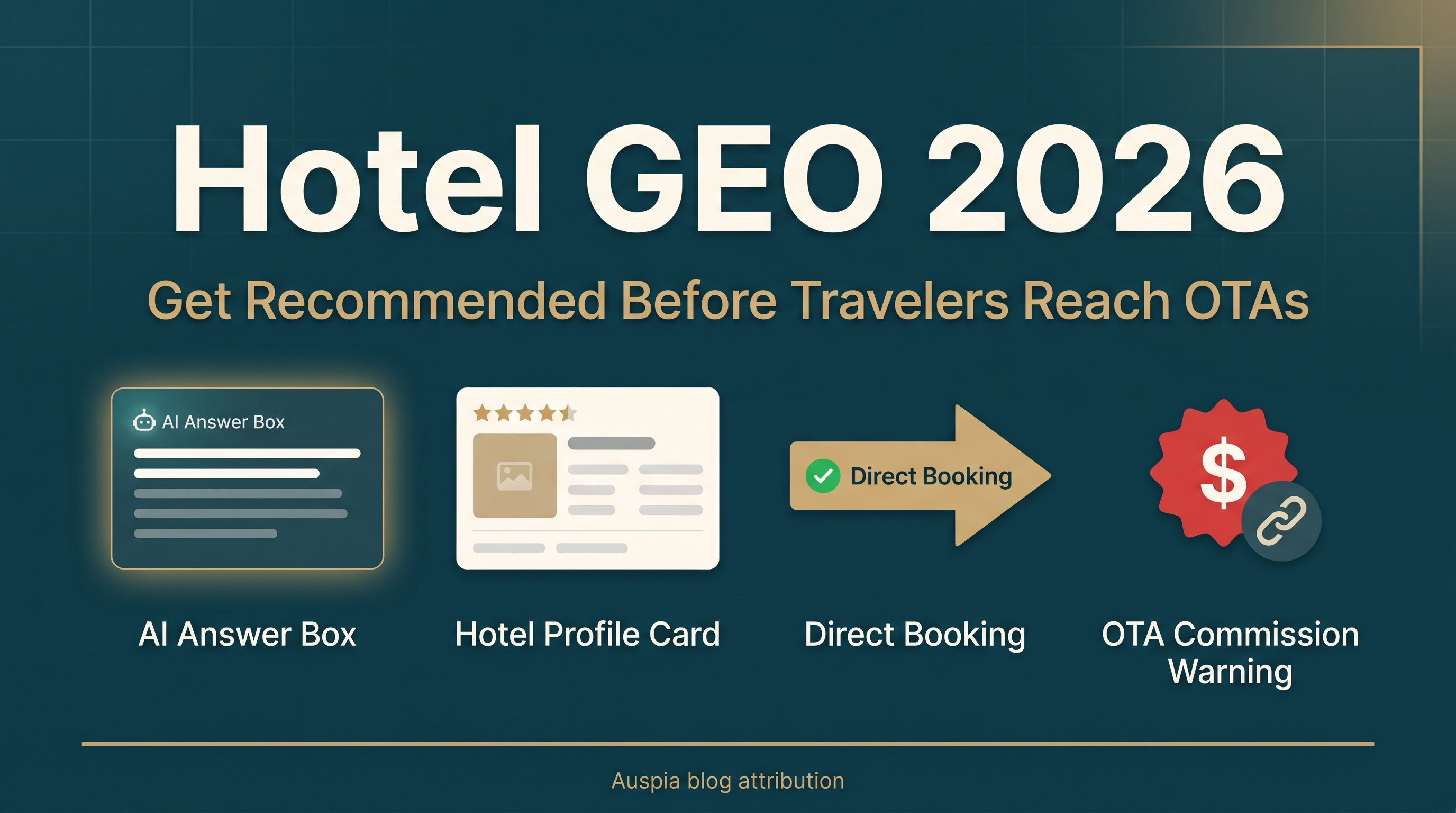
Hotel GEO, short for Generative Engine Optimization, is the work of making AI systems understand, trust, and recommend your property when travelers ask lodging questions. It does not replace SEO, OTA distribution, or brand marketing. But in 2026, it deserves a seat next to them because AI assistants are becoming a new layer between traveler intent and booking behavior.
The practical goal is simple: make your hotel easier for ChatGPT, Perplexity, Gemini, Google AI Overviews, and other answer systems to describe accurately, cite confidently, and recommend in the right travel scenario.
The margin problem: hotels are still paying for attention they should own
Ask an independent hotel owner what hurts most, and the answer is rarely "we need more dashboards." It is usually one of three things:
- OTA commissions keep eating into profitable demand.
- Paid visibility gets more expensive every year.
- Direct bookings are harder to grow because travelers trust platforms more than hotel websites.
That problem becomes sharper when AI enters the traveler journey.
A guest who asks an assistant for "the best quiet business hotel near LAX with reliable Wi-Fi" is already showing strong intent. They are not casually browsing. They are asking for a shortlist. If the assistant gives three properties and your hotel is absent, you may never get a chance to compete on price, reviews, room quality, or service.
This is the uncomfortable shift: the hotel that wins the AI answer may enter the guest's mind before the OTA does.
Why AI does not recommend your hotel yet
Most hotels are not ignored because they are bad. They are ignored because AI systems cannot form a clean, confident picture of them.
A hotel may have a beautiful lobby, strong guest reviews, and a useful location, yet still look vague to an AI system because the public web says too little, says it inconsistently, or says it in places the model does not treat as reliable.
Here are the most common gaps:
Visibility gap | What AI sees | Booking impact |
|---|---|---|
Inconsistent hotel facts | Different names, addresses, amenities, or category labels across platforms | The model becomes less confident describing the property |
Generic positioning | "Comfortable rooms" and "great location" with no specific use case | The hotel does not match high-intent prompts such as business, family, wellness, airport, or meetings |
Thin third-party evidence | Few useful mentions outside OTAs and review platforms | AI has fewer independent sources to cite or synthesize |
Weak structured content | No clear FAQ, schema, location pages, or answer-ready descriptions | AI struggles to extract direct answers |
Unmonitored AI results | No one checks whether the property appears in AI answers | The team does not know which traveler prompts are already lost |
A useful question for every hotel team is this: if a traveler asks an AI assistant for a hotel like yours, can the AI confidently explain who you are, where you are, what you are best for, and why you deserve the recommendation?
If the answer is "not sure," that is a GEO problem.
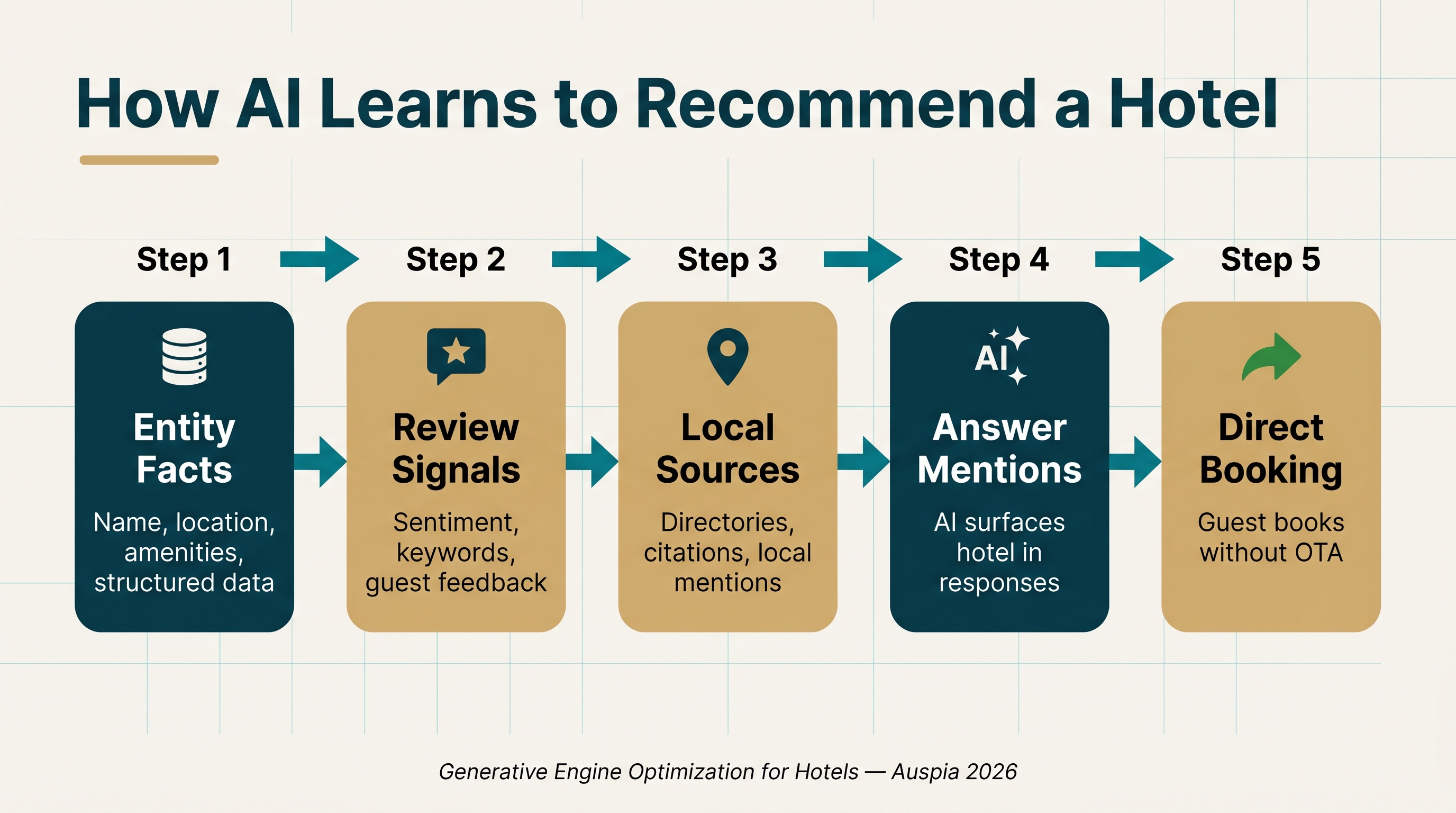
The Hotel GEO workflow: entity facts, review signals, local sources, answer mentions, and direct booking paths have to reinforce the same story.
What Hotel GEO actually means in 2026
Hotel GEO is not a trick for forcing AI to mention a property. It is a structured visibility program built around three outcomes:
- AI can recognize the hotel as a clear entity.
- AI can connect the hotel to specific traveler use cases.
- AI can find enough trustworthy evidence to include the hotel in answers.
In practice, that means combining several disciplines:
- Entity SEO: clean name, address, phone, brand facts, categories, and schema.
- Local SEO: location pages, landmarks, neighborhood relevance, and map consistency.
- Reputation signals: specific, review-backed strengths instead of vague claims.
- Answer engine optimization: concise content blocks that answer traveler questions directly.
- Citation readiness: third-party mentions, local guides, travel resources, and niche sources that AI can use as evidence.
- Prompt monitoring: recurring tests across buyer prompts, cities, use cases, and AI platforms.
Auspia's view is that hotel GEO should start with clarity, not content volume. Before publishing more pages, hotels need to define the recommendation they want AI to make.
For example:
- "Best quiet business hotel near the airport for one-night stays."
- "Family-friendly hotel near the museum district with connecting rooms."
- "Boutique hotel for remote workers in the city center."
- "Meeting-friendly hotel near the convention venue with reliable catering."
Those phrases are not just copywriting. They are entity labels, content briefs, review prompts, FAQ topics, and measurement prompts.
OTA ads vs Hotel GEO: the real strategic difference
OTA ads and paid search help hotels capture existing marketplace demand. Hotel GEO tries to influence the answer before the traveler reaches that marketplace.
Dimension | OTA ads and paid placement | Hotel GEO |
|---|---|---|
Trigger | Traveler browses or searches inside a platform | Traveler asks an AI assistant for a recommendation |
Trust mechanism | Platform ranking, discount, review score, ad position | AI synthesis from brand facts, sources, reviews, and web evidence |
Cost structure | Commission, bidding, sponsored placement, rate pressure | Fixed optimization work plus ongoing monitoring |
Durability | Visibility often drops when spend stops | Strong entity and source signals can continue influencing answers |
Measurement | Clicks, bookings, commission cost, ROAS | AI mention rate, answer position, citation quality, direct booking lift |
This does not mean hotels should abandon OTAs. For many properties, OTAs remain essential distribution. The better question is whether a hotel should depend on rented visibility alone when travelers are starting to ask AI assistants for the shortlist.
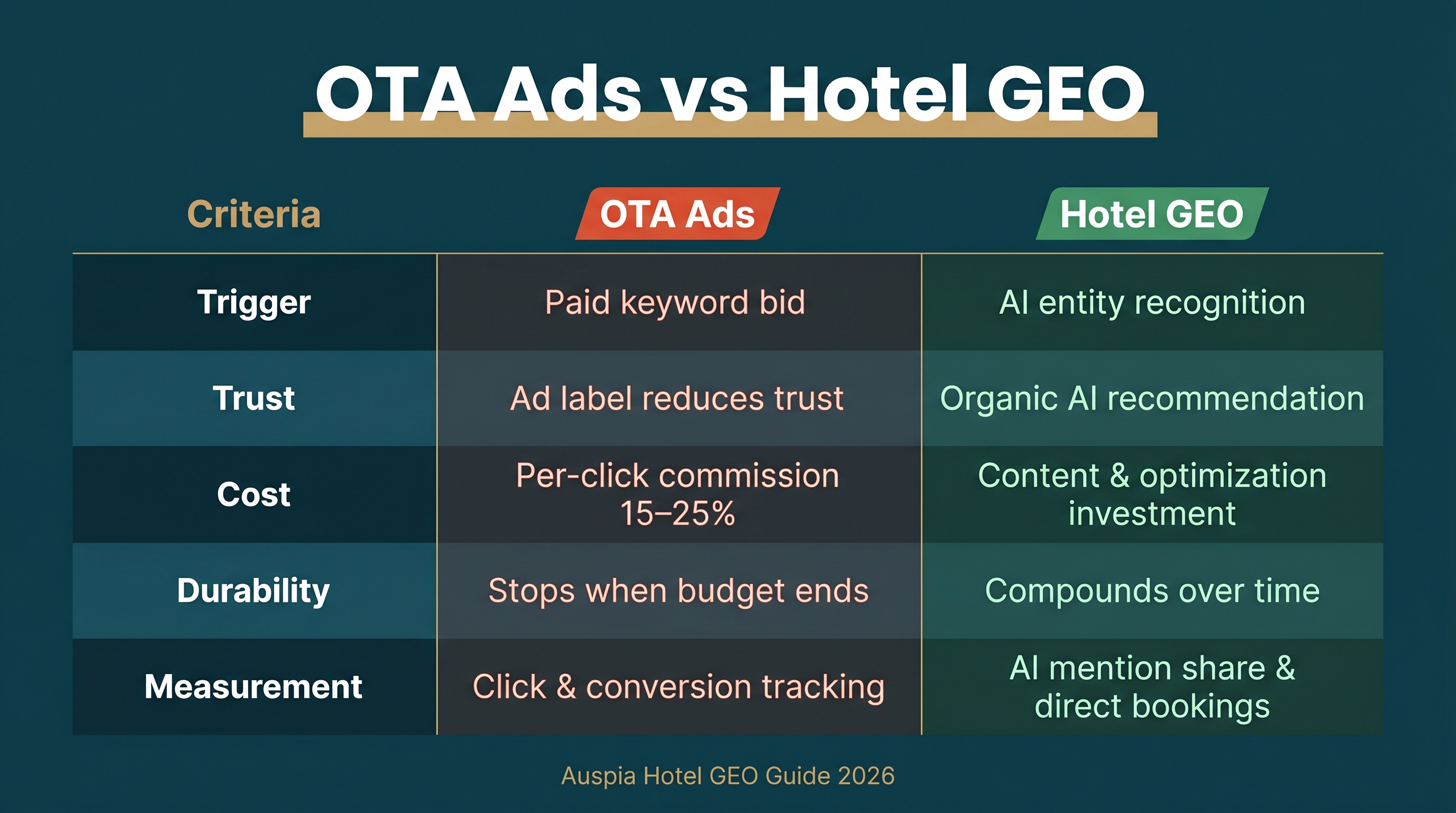
OTA ads compete inside the platform. Hotel GEO competes for the recommendation before the platform visit.
A practical Hotel GEO action plan
Hotels do not need to boil the ocean. A useful first GEO program can be built in four steps.
Step 1: Run an AI visibility diagnosis
Start by testing real traveler prompts. Do not only search your hotel name. That measures branded demand, not discovery.
Use prompts like:
- "Best business hotel near [airport or station] with quiet rooms."
- "Where should a family stay near [landmark] for a weekend trip?"
- "Hotels near [convention center] with good meeting facilities."
- "Boutique hotels in [neighborhood] for remote workers."
- "Best hotel in [city area] for a two-night business trip."
Track five things:
- Whether your hotel appears.
- Which competitors appear.
- What reasons the AI gives.
- Which sources or citations are used.
- Whether any facts are wrong, outdated, or missing.
This is where a tool like Auspia's AI Search Visibility Checker can help teams move from guesswork to a repeatable prompt audit.
Step 2: Build a clean hotel entity profile
Create a source-of-truth profile for the property. It should include:
- Official hotel name and common variants.
- Address, neighborhood, nearby landmarks, and transport nodes.
- Hotel category and strongest use cases.
- Room types, amenities, accessibility details, meeting spaces, parking, breakfast, pet policy, and family features.
- Review-backed strengths, not invented claims.
- Ideal traveler segments: business, family, couples, events, long stay, wellness, airport transit, luxury, budget, or boutique.
Then make sure this profile is consistent across your website, Google Business Profile, OTA listings, travel directories, local pages, schema markup, and public descriptions.
If AI sees six slightly different versions of your hotel, it becomes less confident. GEO begins by removing that uncertainty.
Step 3: Turn generic claims into answer-ready content
Most hotel websites say similar things: great location, comfortable rooms, friendly service. AI systems need more specific evidence.
Replace generic copy with extractable answers:
Generic copy | GEO-ready version |
|---|---|
"Great for business travelers" | "A 12-minute drive from the airport, with quiet work desks, 24-hour check-in, early breakfast, and meeting rooms for teams of 6-40." |
"Family-friendly hotel" | "Connecting rooms, crib availability, stroller-friendly access, laundry service, and a 9-minute walk to the science museum." |
"Good location" | "Located between the central station and the riverside business district, within 15 minutes of three major office towers." |
Good GEO content is not longer. It is clearer, more factual, and easier to quote.
For more technical foundations, hotels should also check whether their pages are crawlable and AI-readable through schema, internal links, and clean page structure. Auspia's Website SEO Score Checker is a useful starting point for that technical layer.
Step 4: Earn third-party proof that matches your target prompts
AI answers are not built from your website alone. They often synthesize public sources. That is why hotel GEO should include source-building beyond the homepage.
Useful source types include:
- Local travel guides.
- Neighborhood pages.
- Event and convention resources.
- Destination blogs.
- Business travel recommendations.
- Family travel guides.
- Niche directories for wellness, boutique stays, pet-friendly travel, or meeting venues.
- Review responses that clarify the hotel's strengths without sounding scripted.
The goal is not to spam the web with promotional blurbs. The goal is to make true strengths visible in credible places where AI systems can discover and corroborate them.
What most hotels get wrong
The biggest mistake is treating Hotel GEO as a one-time article or a few AI-generated directory posts.
That approach misses the point. AI recommendation systems respond to patterns. They look for consistent entities, repeated attributes, trusted sources, recent evidence, and clear use cases.
Avoid these mistakes:
- Claiming too many positioning labels at once.
- Publishing vague AI-written content that says nothing specific about the property.
- Ignoring OTA listing consistency while optimizing the website.
- Tracking only branded prompts instead of discovery prompts.
- Chasing AI mentions without checking whether the facts are accurate.
- Treating GEO separately from SEO, reviews, local visibility, and direct booking pages.
Hotel GEO works best as an operating loop: diagnose prompts, fix entity data, improve content, earn sources, monitor answers, then repeat.
The 2026 Hotel GEO checklist
Use this as a simple readiness audit:
- Can AI systems identify your hotel name, location, and category without confusion?
- Do your strongest use cases appear clearly on your website and third-party profiles?
- Do you have pages or content blocks that answer common traveler questions directly?
- Are your amenities, policies, room types, and nearby landmarks consistent across platforms?
- Do reviews and public mentions support the same positioning you want AI to repeat?
- Do you monitor AI answers across at least 20-50 high-intent prompts each month?
- Do you know which competitors AI recommends instead of you?
- Do you have a direct-booking page that matches the use case AI is recommending?
If several answers are "no," the hotel is not late. It is simply under-described for the AI search era.
Auspia takeaway
Hotel GEO in 2026 is about owning the recommendation moment.
OTAs help hotels sell rooms after travelers enter a marketplace. SEO helps hotels appear when travelers search. GEO helps hotels become part of the answer when travelers ask AI what to choose.
The hotels that move first will not win every prompt. But they can build clearer entity signals, stronger recommendation labels, and better source coverage before competitors define the category for them.
The next practical step is not to publish 30 generic pages. It is to run a prompt audit, identify where your hotel is missing, and decide which traveler scenarios you want to own.
FAQ
What is Hotel GEO?
Hotel GEO is Generative Engine Optimization for hotels. It helps AI answer systems understand, trust, and recommend a hotel for relevant traveler prompts such as business trips, family stays, airport hotels, boutique stays, or meeting venues.
Is Hotel GEO the same as SEO?
No. SEO focuses on visibility in search engines and search result pages. Hotel GEO focuses on visibility inside AI-generated answers and recommendation shortlists. The two overlap because AI systems still need crawlable, trustworthy, well-structured web content.
Does Hotel GEO replace OTA marketing?
Usually no. OTAs remain important for distribution, reviews, and demand capture. Hotel GEO gives hotels another path to influence demand earlier, before the traveler enters an OTA comparison flow.
How do hotels measure GEO performance?
Useful metrics include AI mention rate, answer position, competitor share of answer, citation quality, factual accuracy, prompt coverage, direct-booking traffic from AI-referred journeys, and changes in branded search or direct bookings after AI visibility improves.
How long does Hotel GEO take to work?
It depends on the hotel's existing entity clarity, website quality, review profile, source coverage, and competition. Some fixes improve answer accuracy quickly, while durable recommendation gains usually require ongoing content, source-building, and prompt monitoring.
Author: Maya Ellison, 12-Year GEO Strategy Researcher at Auspia. Maya writes about AI search visibility, brand entity clarity, and practical GEO operating systems for growth teams.