

The Seller Decision In One Minute
Most Amazon sellers should not build an Alexa skill as their first GEO move. A custom skill can be useful, but it is not a ranking shortcut, a replacement for product listing quality, or a guaranteed path into Alexa shopping recommendations.
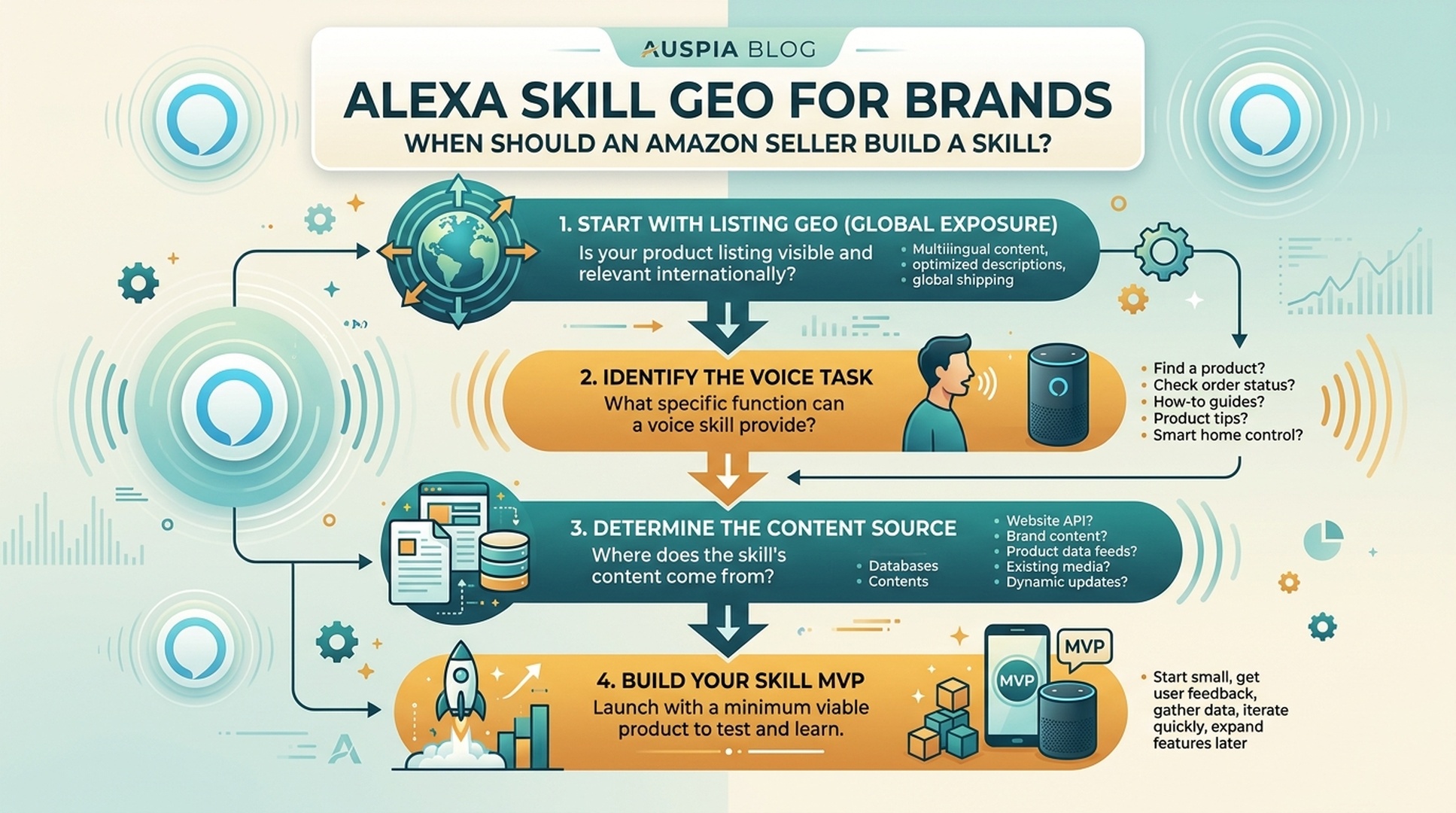
Build a skill only when your brand has a repeatable voice-friendly task that buyers will intentionally ask for: setup help, recipes, product routines, replenishment guidance, compatibility support, or post-purchase troubleshooting. If the use case is just “make our brand discoverable on Alexa,” start with Amazon listing GEO, A+ Content, product Q&A, reviews, search terms, shopping-list clarity, and reorder signals instead.
DataForSEO research for this series also supports that distinction. Queries such as voice search optimization and voice search marketing show paid-search value, while Alexa-specific terms such as alexa skills, alexa developer console, and alexa for business are smaller and more informational. In other words, the commercial opportunity is usually the strategy around voice discovery, not the act of launching a thin Alexa skill.
What An Alexa Skill Actually Changes
An Alexa skill is an owned voice experience. Amazon's Alexa Skills Kit documentation describes custom skills as voice experiences that use an interaction model, intents, utterances, and backend logic to respond to user requests. That makes a skill closer to a lightweight product surface than a blog post, ad campaign, or listing field.
For sellers, that distinction matters. A skill can give a brand a controlled answer space, but it also creates new work:
Skill element | What sellers must define | GEO implication |
|---|---|---|
Invocation | The phrase users say to open the skill | Weak brand recall makes usage unlikely |
Intents | The tasks the skill can handle | Thin intents create shallow answers |
Utterances | The many ways people ask for the task | Query research becomes product design |
Content source | Where answers, product facts, recipes, or support steps come from | Outdated content damages trust |
Measurement | Skill usage, completion, errors, retention | Visibility must connect to behavior |
This is why a skill is rarely the first step. It requires a brand entity, a repeatable task, and a maintenance owner. Without those, the seller ends up with another surface to keep updated while the actual Amazon listing still fails to answer buyer questions.
The Decision Matrix For Amazon Seller GEO
Use this practical rule: if the buyer does not already have a reason to ask for your brand by voice, an Alexa skill will probably not create that reason by itself.
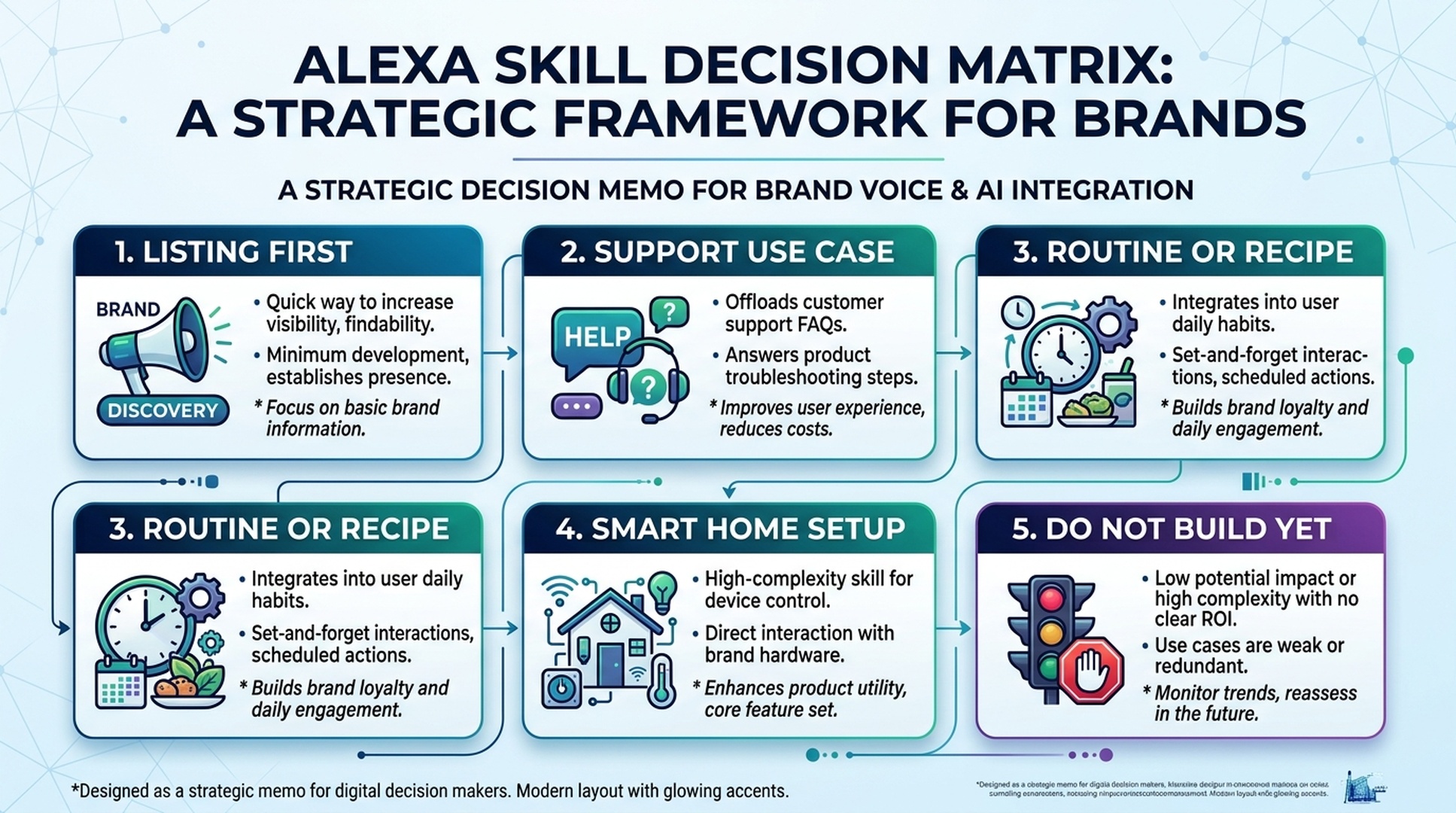
The strongest seller-side cases usually meet at least three of these five conditions:
- Buyers have a repeated post-purchase question.
- The answer is easier by voice than by screen.
- The brand has structured content or an API to keep answers current.
- The product category naturally connects to a routine, room, device, or habit.
- The team can measure usage and maintain the experience after launch.
If only one of those is true, the better GEO move is usually content architecture. Rewrite listings, expand A+ Content, improve review themes, add support answers, and map shopping-list or reorder language before creating a custom voice experience.
When A Brand Skill Makes Sense
A seller should consider an Alexa skill when the product creates an ongoing relationship after the first purchase. The skill should help the buyer do something, not just hear a sales pitch.
Strong examples include:
- Coffee and beverage brands: brew ratios, roast matching, recipe suggestions, subscription prompts, grind-size guidance.
- Food and grocery brands: recipe ideas, pantry planning, allergen-safe usage guidance, shopping-list reminders.
- Pet brands: feeding routines, age or size guidance, refill reminders, product transition support.
- Smart home brands: setup, device discovery, troubleshooting, compatibility checks, control flows.
- Beauty and personal-care brands: usage routines, replacement timing, ingredient explanations, safety-aware disclaimers.
- Fitness or wellness-adjacent brands: routine support and habit reminders, without unsupported health claims.
The common pattern is not “Alexa can mention our brand.” The pattern is “a customer has a reason to invoke our brand because voice removes friction from a repeated task.”
When A Skill Is A Distraction
A skill is a distraction when it is built to compensate for weak fundamentals. It will not fix unclear positioning, poor reviews, missing product details, or a listing that cannot explain why the product is different.
Avoid building a skill first if:
- Your product title and bullets still rely on keyword stuffing.
- A+ Content does not answer comparison, sizing, compatibility, ingredient, or use-case questions.
- Reviews repeatedly mention the same confusion, defect, or expectation gap.
- The brand has no memorable name or invocation phrase.
- The proposed skill only says what the product is and where to buy it.
- No one owns updates, analytics, testing, and support after launch.
For many sellers, the best Alexa GEO strategy is invisible at first: better product facts, cleaner category language, answerable support content, consistent brand entity signals, and fewer buyer uncertainties.
GEO Assets To Fix Before Engineering A Skill
Before opening the Alexa Developer Console, audit the assets that AI shopping assistants and human buyers can already inspect.
Asset | Question it should answer | Why it comes before a skill |
|---|---|---|
Product title | What is this, who is it for, and what makes it distinct? | Title clarity affects search, scanning, and assistant summaries |
Bullet points | What should the buyer know before choosing? | Bullets carry specifications, benefits, and constraints |
A+ Content | What questions need visual explanation? | A+ Content can pre-answer use cases and comparisons |
Product Q&A | What do uncertain buyers ask repeatedly? | Q&A exposes language for intents and utterances |
Reviews | What proof, complaints, and expectations appear naturally? | Reviews reveal trust signals and risk themes |
Backend search terms | What variants do buyers use that do not belong in visible copy? | Search terms support discovery without stuffing |
Support content | What happens after purchase? | A skill often needs this source material |
If these assets are weak, a skill will inherit the weakness. If these assets are strong, they become the research base for a much better skill brief.
A Minimum Viable Alexa Skill Brief
Do not start with development. Start with a one-page brief. If the team cannot answer the brief, the skill is not ready.
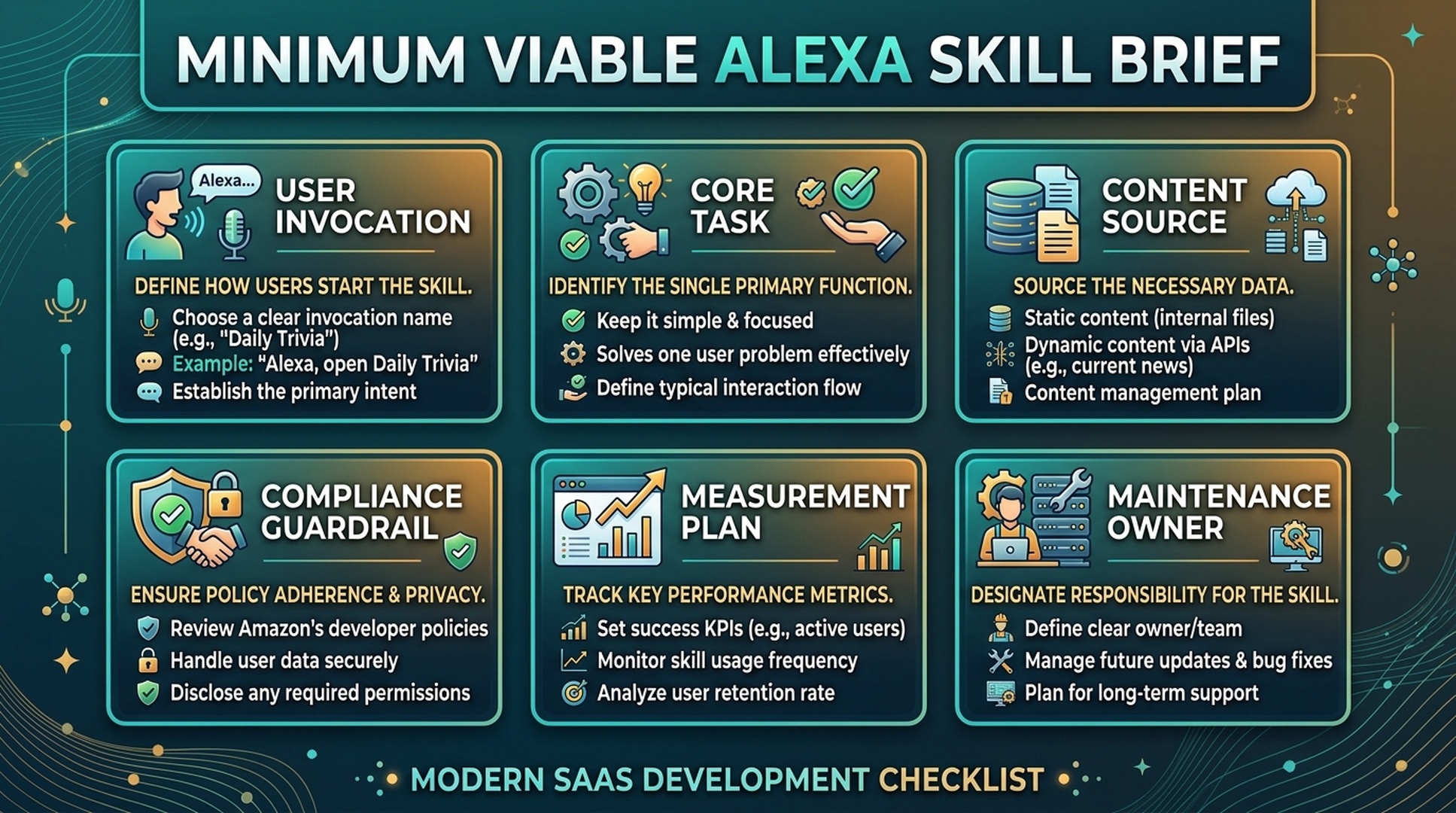
A useful brief should include:
Brief field | Good answer | Weak answer |
|---|---|---|
User invocation | “Alexa, open Brew North.” | “Users will ask Alexa about coffee.” |
Core task | Find a recipe based on roast, device, and cup size. | Tell users about our brand. |
Primary user | Existing buyers who brew at home weekly. | Everyone who drinks coffee. |
Content source | Recipe database, product catalog, support docs. | Static launch copy. |
Compliance guardrail | No medical, unsafe, or unsupported claims. | We will review later. |
Measurement plan | Invocations, completed tasks, repeat usage, failed utterances. | Downloads or launch announcement clicks. |
Maintenance owner | Marketplace lead plus support content owner. | Agency or developer only. |
That brief turns “Should we build an Alexa skill?” into a testable business decision.
Skill Use Cases By Seller Type
Different product categories need different skill logic. A seller should not copy another brand's structure just because it sounds innovative.
Seller type | Better skill concept | Bad skill concept |
|---|---|---|
Consumables | Reorder timing, usage routine, recipe or refill guidance | A voice brochure about the product line |
Smart home | Setup, discovery, control, compatibility, troubleshooting | Generic brand introduction |
Kitchen tools | Cooking timers, conversion help, recipe workflows | A catalog readout |
Supplements | Routine reminders with conservative, compliant language | Diagnosis or treatment advice |
Baby products | Setup, care instructions, safety reminders | Claims that imply medical authority |
Pet supplies | Feeding schedule, transition guide, reorder reminders | A thin list of SKUs |
The sharper the task, the better the skill. A narrow skill that solves one repeated problem is more useful than a broad skill that tries to become a second website.
How To Use Query Research Without Keyword Stuffing
DataForSEO and Amazon query research should shape the skill, not turn it into a pile of repeated phrases. The goal is to discover how buyers express tasks.
For Alexa skill GEO, collect questions in four buckets:
Query bucket | Example question | What it informs |
|---|---|---|
Setup | “How do I connect this device to Alexa?” | Onboarding intent and troubleshooting flow |
Routine | “How often should I replace this filter?” | Reminder logic and content cadence |
Recipe or usage | “What can I make with oat milk and espresso?” | Content database and response format |
Safety or constraint | “Is this compatible with small apartments?” | Guardrails, disclaimers, and product-fit answers |
Then translate those questions into natural utterances. Do not paste the same keyword into every response. A voice interaction should sound like help, not SEO copy read aloud.
Metrics And Risks To Track
A skill needs a measurement plan because the success signal is not the same as a product listing test.
Track:
- Invocations by week.
- Intent completion rate.
- Failed utterances and misunderstood requests.
- Repeat usage.
- Support deflection for setup or troubleshooting topics.
- Reorder or shopping-list assisted behavior, where measurable.
- Review themes after launch.
Also define risks before launch:
- The invocation phrase is hard to remember.
- The brand receives questions the skill cannot answer.
- Product facts become outdated.
- The skill gives overconfident advice in regulated categories.
- Analytics show curiosity but no repeat use.
- The team treats launch as the finish line.
For GEO, the real value of a skill is not only the new surface. It is the discipline of turning buyer questions into structured tasks, tested answers, and maintained brand facts.
FAQ
Does every Amazon seller need an Alexa skill for GEO?
No. Most sellers should improve listings, A+ Content, reviews, Q&A, search terms, and support content first. A skill makes sense only when the brand has a repeatable voice-friendly task.
Can an Alexa skill improve Amazon product ranking?
Do not treat a skill as a direct ranking lever. It is better understood as an owned voice experience that can support post-purchase value, brand recall, customer support, and routine engagement.
What is the difference between Alexa SEO and Alexa Skill GEO?
Alexa SEO usually refers to being discoverable through voice and Amazon surfaces. Alexa Skill GEO is narrower: it asks whether a brand-owned skill can provide structured answers and tasks that align with AI-assisted discovery and buyer intent.
Should a seller hire developers before writing the skill brief?
No. Write the skill brief first. Define the invocation, audience, core task, content source, compliance rules, and measurement plan before development starts.
What should sellers research before building a skill?
Start with Amazon search queries, product Q&A, review language, support tickets, DataForSEO keyword data, and recurring buyer questions. Those sources reveal whether a real voice task exists.
Auspia Takeaway
An Alexa skill is worth considering when the brand has earned a role in the buyer's routine. It is not a shortcut around listing quality or a magic GEO tactic.
The practical order is simple: fix answer quality first, prove that buyers ask repeatable questions, define one voice task, then decide whether a skill deserves engineering time. Sellers who follow that order are less likely to launch a thin skill and more likely to build a useful voice surface that supports brand trust.
For broader AI search readiness, sellers can also use Auspia's GEO resources to connect Amazon content, brand entity clarity, and answer-friendly page structure.
Author: Lydia Hart, Brand Entity Strategist for 200+ Entity Audits at Auspia. Lydia writes about brand facts, entity consistency, category language, and GEO-ready positioning for growth teams.