Quick answer
In 2026, the company website is no longer just a place people visit after they discover you. It is one of the source systems AI assistants inspect when they decide whether your brand belongs in an answer.
That changes the job of the website. A good GEO-ready site does five things well: it states durable brand facts, turns product knowledge into extractable answer blocks, exposes technical signals such as schema and llms.txt, connects claims to evidence, and gives AI-referred visitors a landing path that matches the answer they just read.
The original mistake is treating GEO as "SEO with new acronyms." It is not. SEO still matters, but GEO asks a different question: when a buyer asks ChatGPT, Perplexity, Gemini, Google AI Overviews, or another answer surface for recommendations, can your website be understood, trusted, and cited?
Why this matters in 2026
Search behavior has changed enough that growth teams can no longer treat AI answers as a side channel. Google has expanded AI features inside Search, including AI Mode and AI Overviews. OpenAI, Perplexity, Gemini, Claude, Copilot, and vertical AI agents have also trained users to ask full questions instead of typing two-word keywords.
The result is a quieter kind of traffic loss. Your analytics may not show a dramatic collapse on day one. Instead, more buyers solve the top half of their research inside an answer engine. They ask:
- "What are the best tools for AI search visibility?"
- "Which vendors help B2B SaaS teams improve GEO?"
- "How do I compare product A and product B?"
- "What should I check before hiring an SEO agency in 2026?"
If your site is not present in the material those systems can parse and trust, you may never enter the shortlist. The buyer does not reject you. The buyer never sees you.
This is why the website matters again. Social posts, PR mentions, directories, and review pages all help, but the official site is still the place where an AI system can verify who you are, what you sell, which market you serve, and which claims are safe to repeat.
SEO site vs GEO source
Traditional SEO asks whether a page can rank. Website GEO asks whether a site can support an answer.
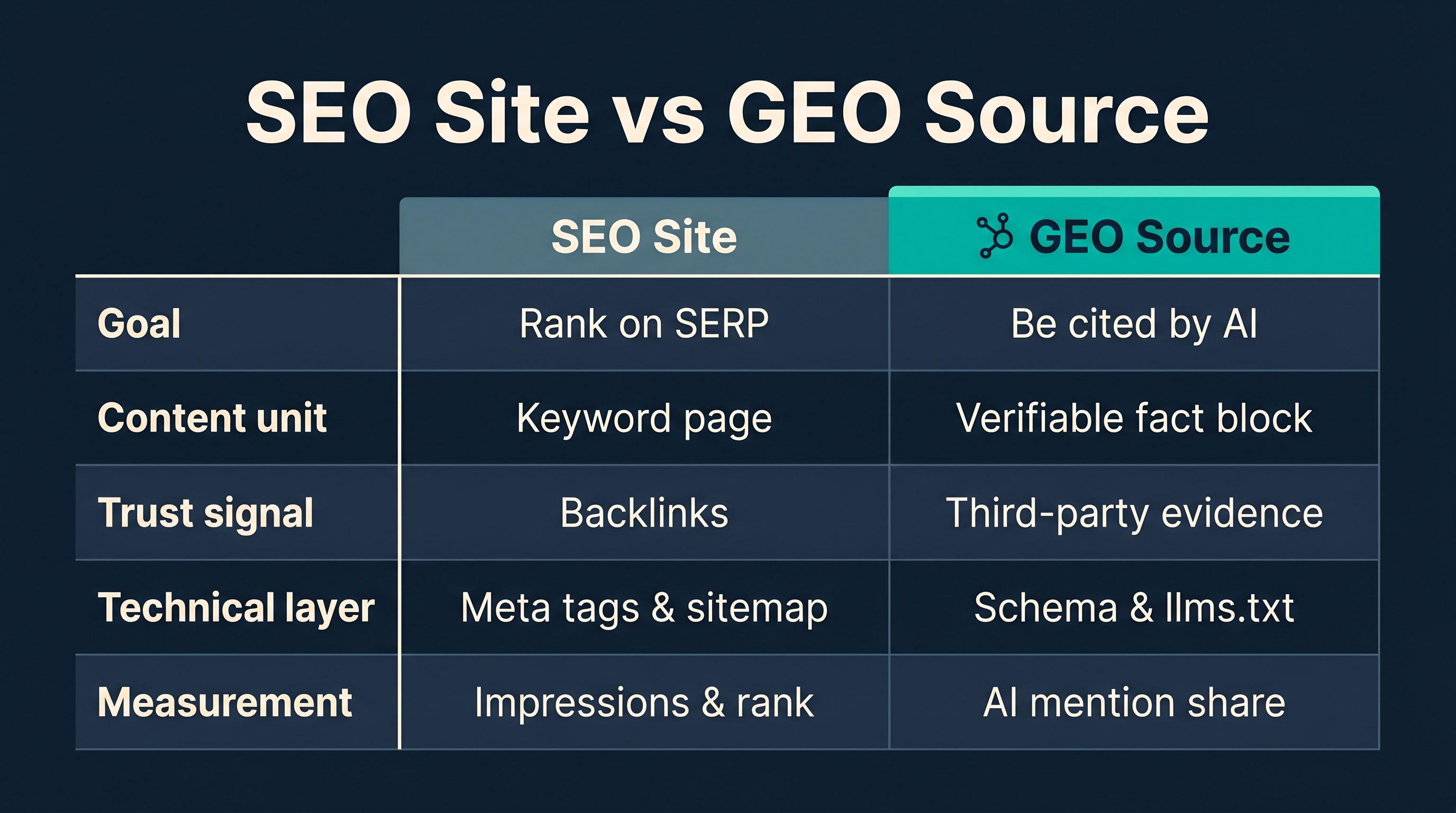
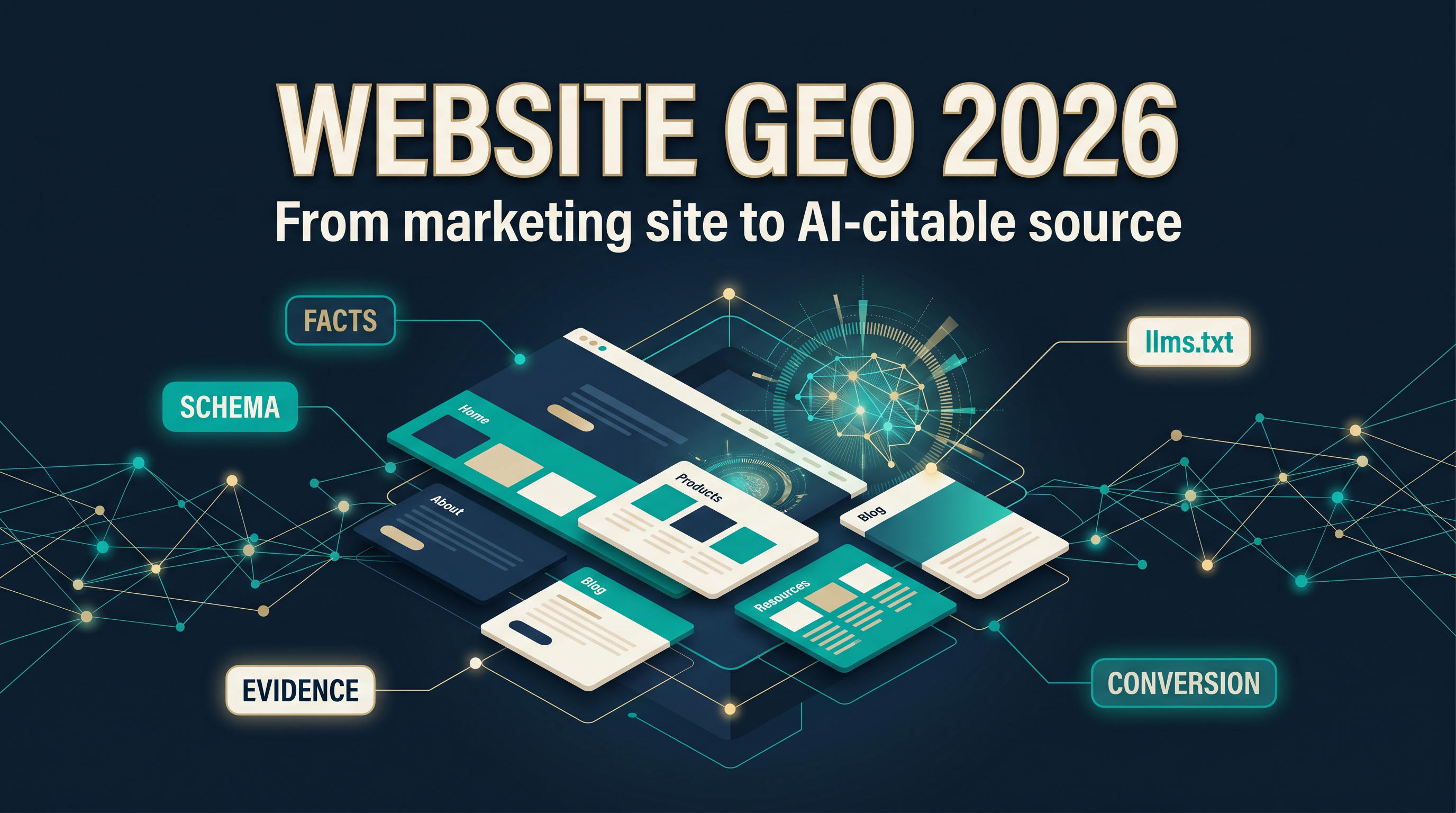
Caption: A GEO-ready website behaves less like a brochure and more like a structured source that answer engines can inspect.
Layer | Traditional SEO site | GEO-ready source site |
|---|---|---|
Primary goal | Win rankings and clicks | Become a trusted input for AI answers |
Content unit | Keyword-targeted page | Question, fact, entity, comparison, evidence block |
Trust signal | Backlinks, topical coverage, engagement | Verifiable claims, consistent entity facts, third-party corroboration |
Technical layer | Crawlability, indexability, Core Web Vitals | Crawlability plus schema, clean HTML, llms.txt, answer-friendly structure |
Measurement | Rankings, impressions, clicks | AI mentions, citations, share of answer, answer accuracy, assisted conversions |
None of this makes SEO obsolete. In practice, GEO depends on many SEO fundamentals: accessible HTML, clear titles, strong internal links, fast pages, helpful content, and crawlable architecture. But a page that ranks can still fail as an AI source if its useful facts are buried under slogans, tabs, scripts, vague claims, or disconnected PDFs.
The website becomes a truth layer
A GEO-ready website gives AI systems a stable version of the brand. That sounds basic until you audit a real site.
Many companies have three or four versions of the same fact in public:
- one positioning statement on the homepage;
- a different one in the sales deck;
- outdated product names in old blog posts;
- customer segments that changed two years ago;
- case studies with claims that no longer match the product;
- schema markup that names the wrong organization or social profiles.
Humans can often resolve these contradictions. AI systems may not. If a model sees conflicting descriptions, it may choose a safer competitor, omit the brand, or summarize the company in a bland way that misses the actual value.
Start with a simple brand fact table. It should live on the site, appear in your about page, and inform schema, profiles, press pages, and comparison content.
Fact type | What to define | Why AI systems need it |
|---|---|---|
Entity name | Legal name, product name, common name | Reduces confusion with similarly named brands |
Category | What market you belong to | Helps answer engines place you in recommendation lists |
Audience | Who the product is for | Prevents irrelevant recommendations |
Use cases | Problems you solve | Connects brand to buyer prompts |
Proof | Customers, benchmarks, certifications, public reviews | Gives models safer evidence to cite |
Contact path | Demo, trial, audit, documentation, pricing | Helps referred users complete the next action |
Auspia's view: every company doing GEO should maintain a "source-of-truth page" or equivalent knowledge hub. It does not need to be flashy. It needs to be accurate, crawlable, and easy to quote.
The three common reasons websites disappear from AI answers
The first reason is vague language. A phrase like "we empower teams with next-generation solutions" gives an AI model almost nothing. It does not say what the product is, who it is for, how it works, or when to choose it. Replace that with specific sentences: "Auspia helps growth teams audit AI search visibility, identify missing citations, and improve SEO/GEO content structure."
The second reason is poor extractability. Critical information often sits inside carousels, accordions, images, client-side rendered blocks, or PDF files. Search engines have become better at rendering complex pages, but many AI crawlers and retrieval systems still prefer plain, well-structured HTML. If a buyer-critical answer is not visible in the rendered or raw content, do not assume an answer engine can use it.
The third reason is unsupported claims. AI answer systems tend to be cautious with commercial assertions. "The leading platform" is weak unless the site points to a credible basis. "Used by 2,000 teams" is stronger if the number is dated, scoped, and supported. "Rated 4.8 on G2 as of May 2026" is stronger still if the source is linked and the claim is not exaggerated.
How to rebuild a website for GEO in 2026
A practical GEO rebuild does not start with a redesign. It starts with a content and evidence audit.
1. Audit the facts AI should learn
List the questions you want AI systems to answer correctly:
- What is the company?
- What category does it belong to?
- Who should use it?
- What problems does it solve?
- How is it different from alternatives?
- What evidence supports the claim?
- Which page should a user visit next?
Then check whether each answer exists on the website in plain text. If the answer exists only in sales calls, pitch decks, images, gated PDFs, or a founder's LinkedIn post, it is not reliable GEO infrastructure.
2. Turn pages into answer blocks
A GEO-ready page should include short, self-contained answer blocks. These blocks help humans scan and make it easier for retrieval systems to extract useful passages.
A good block usually includes:
- a direct answer in the first sentence;
- the entity being discussed;
- the condition or use case;
- one proof point or constraint;
- a next-step link.
Example:
A GEO audit checks whether a brand is visible, accurately described, and cited inside AI answer engines. It usually reviews prompt coverage, brand entity consistency, citation sources, technical crawlability, and conversion paths from AI-referred visitors.
That is more useful than a long paragraph about "the future of discoverability."
3. Add schema where it clarifies meaning
Structured data will not force an AI system to cite you, but it can clarify what a page is about. Google's structured data documentation describes JSON-LD, Microdata, and RDFa as ways to provide explicit clues about page meaning. For most marketing sites, JSON-LD is the cleanest option.
Prioritize:
- Organization schema for company identity;
- Product or SoftwareApplication schema for products;
- FAQPage where the questions are real and visible on the page;
- Article schema for research and editorial pages;
- BreadcrumbList schema for site hierarchy;
- Review or AggregateRating only when it follows platform rules and reflects real visible reviews.
Do not stuff schema with claims that are absent from the page. That creates a trust problem, not a GEO advantage.
4. Publish an llms.txt file
llms.txt is an emerging convention that gives AI systems a concise map of important site content. It is not a replacement for sitemap.xml or robots.txt. Think of it as a human-readable guide for AI retrieval: what the site is, which pages matter, and where high-quality reference material lives.
A useful llms.txt file might include:
- the company or product summary;
- links to docs, product pages, pricing, case studies, and research;
- preferred canonical resources;
- pages that explain the brand, category, and methodology.
Use Auspia's LLMs.txt Generator / Checker if you need a fast way to draft or inspect one.
5. Build evidence paths outside the website
The official website is the truth layer, but AI systems rarely trust one source in isolation. They compare it with third-party mentions, reviews, news, documentation, repositories, directories, forums, and customer references.
For each major claim, ask: "Where else can this be verified?"
Good evidence paths include:
- public customer stories with concrete use cases;
- comparison pages that fairly describe alternatives;
- expert articles that explain methodology;
- review profiles with consistent category language;
- partner pages and integrations;
- documentation that proves product depth;
- public changelogs or release notes.
Weak evidence paths include copied press releases, thin directory listings, spun guest posts, and unverified superlatives.
The AI-citable website loop
GEO is not a one-time migration. It behaves more like a maintenance loop.
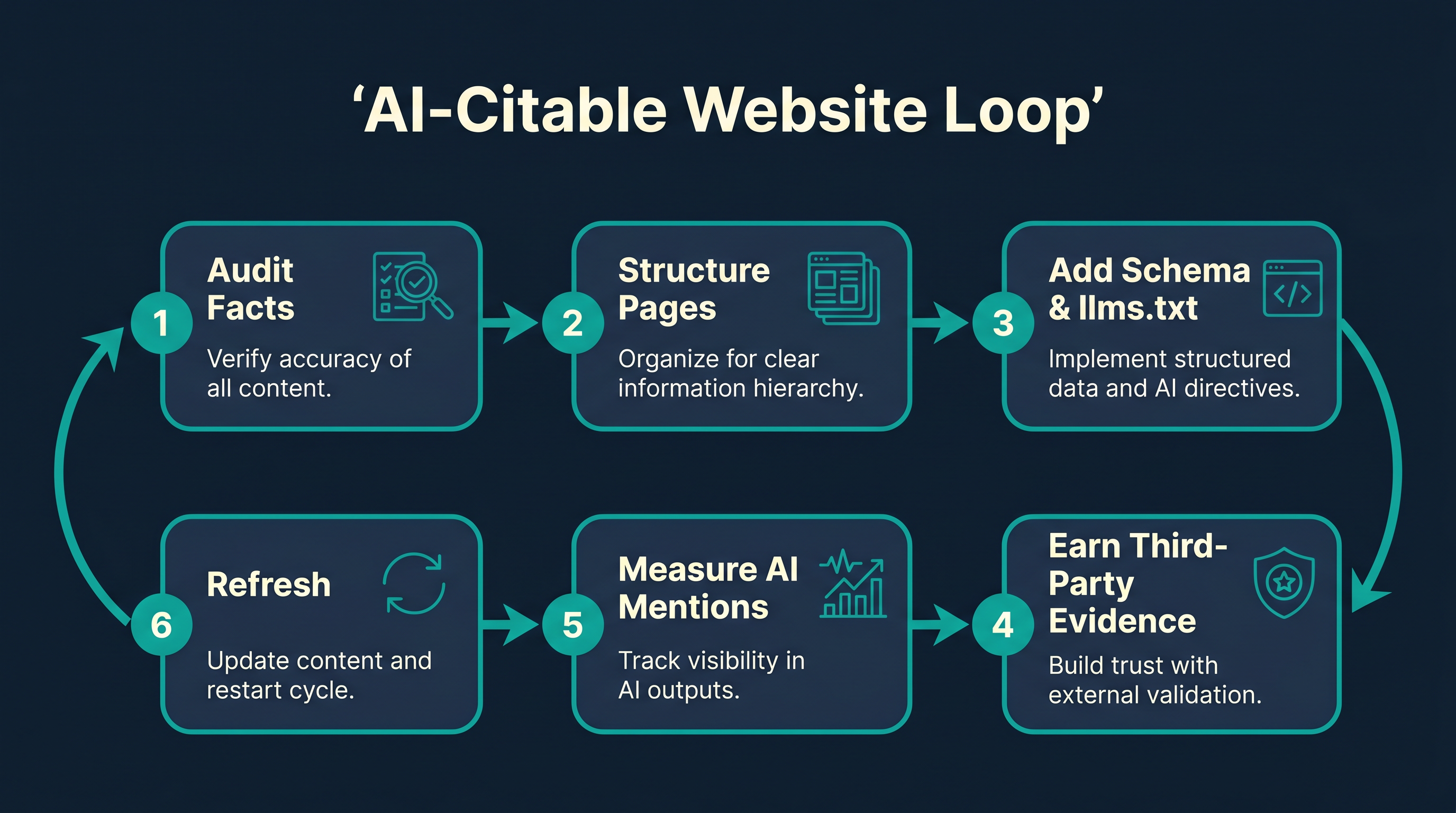
Caption: Treat website GEO as a recurring operating loop, not a redesign project that ends at launch.
The loop is simple:
- Audit facts: find outdated, vague, or conflicting brand information.
- Structure pages: make each important page answer a specific buyer question.
- Add technical signals: schema, clean HTML, internal links, sitemaps, and llms.txt.
- Earn evidence: create third-party validation that supports the official site.
- Measure AI mentions: test prompts across answer engines and record accuracy.
- Refresh: update pages when product positioning, evidence, or AI behavior changes.
If you only do the first three steps, your site may become readable but not trusted. If you only do the evidence work, AI systems may mention you but describe you inaccurately. The loop needs both.
A 2026 website GEO checklist
Use this checklist before a redesign, migration, or major content refresh.
Area | Check | Pass condition |
|---|---|---|
Entity clarity | Does the site clearly state what the company is? | A visitor or AI system can describe the brand in one accurate sentence |
Category language | Is the market category consistent? | Homepage, about page, product page, schema, and profiles use aligned terms |
Answer blocks | Do key pages answer buyer questions directly? | Each priority page has concise, extractable summaries |
Technical access | Can crawlers read critical content without complex interaction? | Core facts appear in crawlable HTML |
Schema | Is structured data accurate and visible-content aligned? | JSON-LD matches the page and uses suitable schema types |
llms.txt | Does the site guide AI systems to canonical resources? | Root-level llms.txt links to high-value pages |
Evidence | Are claims supported beyond the website? | Important claims have public corroboration |
Measurement | Are AI answers tested regularly? | Prompt library tracks mentions, citations, accuracy, and competitors |
Conversion | Does the destination match the AI answer? | Referred users land on pages that continue the same topic |
For a quick diagnostic, run your domain through Auspia's AI Search Visibility Checker and compare the results with your own prompt tests.
What most teams get wrong
The most common mistake is starting with design. A beautiful homepage can still be useless to AI systems if the content is vague or locked inside scripts. Start with the knowledge layer, then design around it.
The second mistake is creating FAQ spam. Real FAQ sections help when they answer questions buyers actually ask. Fake Q&A blocks written only for markup are easy to spot and rarely useful.
The third mistake is treating llms.txt as magic. It is a map, not a reputation engine. If the pages it points to are thin, outdated, or unsupported, the file will not fix the source.
The fourth mistake is ignoring conversion. GEO visibility without a matching destination page creates a broken handoff. If an AI answer says your product is useful for "B2B SaaS GEO audits," the click should not send users to a generic homepage with no audit path.
How Auspia thinks about website GEO
Auspia treats website GEO as a source-quality problem. The goal is not to trick answer engines. The goal is to make the brand easier to understand, safer to cite, and easier to choose.
That means the work often looks less glamorous than a campaign launch:
- clean up entity facts;
- rewrite vague product pages;
- add answer blocks and comparison tables;
- fix schema errors;
- publish llms.txt;
- build evidence pages;
- test prompts every month;
- update pages when AI answers drift.
This is also why website GEO belongs with SEO, content, product marketing, PR, and web engineering. No single team owns the whole system. SEO can fix crawlability. Content can improve extractability. PR can support third-party evidence. Product marketing can sharpen category language. Engineering can make the site machine-readable.
When those teams work from the same source-of-truth map, the website becomes much more than a brochure. It becomes the place AI systems can use to understand the company correctly.
FAQ
What is website GEO?
Website GEO is the process of making a website easier for AI answer engines to understand, trust, cite, and recommend. It combines SEO fundamentals, structured content, schema, entity clarity, evidence building, and AI-answer measurement.
Is GEO replacing SEO in 2026?
No. GEO builds on SEO. Search engines, AI answer engines, and retrieval systems still need crawlable, useful, well-structured pages. The difference is that GEO optimizes for answer inclusion and citation quality, not only rankings and clicks.
Does every website need llms.txt?
Not every small site needs it urgently, but most content-rich companies should consider it. llms.txt is especially useful when a site has documentation, product pages, research, case studies, or comparison content that AI systems should find quickly.
What is the fastest GEO improvement for a company website?
Start by rewriting the homepage, product pages, and about page so they state clear entity facts in crawlable text. Then add accurate Organization and Product or SoftwareApplication schema, publish a simple llms.txt file, and test whether AI assistants describe the brand correctly.
How do you measure website GEO performance?
Track prompt-level visibility across AI systems: whether the brand appears, whether it is cited, how accurately it is described, which competitors appear, which sources are used, and whether AI-referred visitors convert on the destination page.
Author: Julian Mercer, 14-Year Technical SEO Practitioner at Auspia. Julian writes about crawlability, schema, rendering, site architecture, and technical foundations for AI-readable content.