Google Clarifies Googlebot IP Location Declaration Differs From Actual Crawl Egress Points
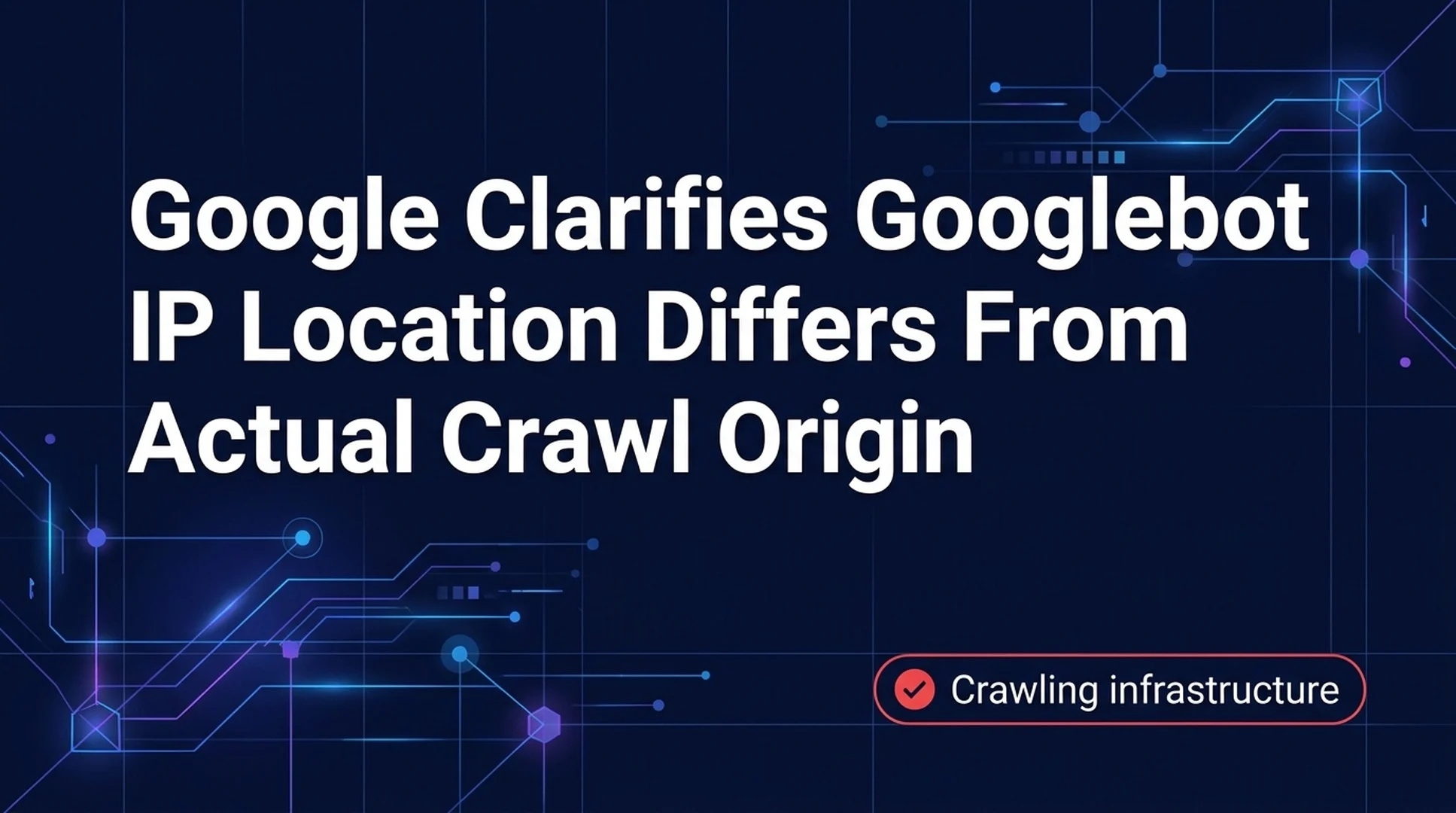
Google's Gary Illyes explained on August 14, 2026 that Googlebot's IP address records declare a location of Mountain View, California in most cases, but the crawler's actual network egress points vary depending on which data center cluster handles the request.
What was announced
Gary Illyes, a Webmaster Trends Analyst at Google, published a public post on Bluesky clarifying how Googlebot's IP geolocation works in practice. He wrote that the IP location field is a text record that Google sets for the IP addresses it manages, and that it reads "US, Mountain View" in most cases. The actual egress point, however, depends on the data center cluster assigned to the crawl.
Illyes gave a specific example: "if the IP is assigned to a cluster in ATL, the egress point will be ATL." This means a crawl request that appears to originate from Mountain View, California based on its IP registration may in fact be served from a Google data center in Atlanta or another location.
What changed
Google's public documentation has long associated Googlebot with Mountain View, California. The Google Search Central documentation states that when crawling from IP addresses in the US, Googlebot operates on Pacific Time. What Illyes' statement adds is an explicit confirmation that the declared IP location is a registration detail rather than a reliable indicator of the physical network point from which a specific crawl request originates.
The distinction matters for site operators who use IP-based access controls, geo-blocking rules, or server-side firewall configurations that reference Googlebot's declared location. A rule that permits traffic only from California-based IP ranges could inadvertently block legitimate Googlebot requests that egress from other US data centers.
Details and availability
Illyes described the IP location field as "just a text bit you can set for the IPs you manage." In networking, this refers to the geolocation data associated with an IP address block in regional internet registry records. The field is administrative, not a real-time indicator of where a packet originates on the network.
Google operates data centers across multiple regions. When a crawl is assigned to a cluster in a specific region, the network egress — the point where the request exits Google's infrastructure and reaches the public internet — corresponds to that region's data center, regardless of what the IP registration record says.
Google's Search Central documentation provides guidance on verifying Googlebot requests using reverse DNS lookups rather than relying on IP address alone. The documentation also notes that Google can deploy locally aware crawlers for region-specific crawling when necessary.
Context
The question of Googlebot's physical crawl location has arisen periodically among site operators and SEO practitioners. Google has historically identified its crawlers as originating from Mountain View, California. In 2011, instances of Google crawling from Chinese IP addresses were observed, which Google attributed to regional legal requirements at the time. Google has also documented that blocking all US traffic would cause significant crawling problems for sites that depend on Google Search visibility.
Illyes' statement does not indicate a change in Google's crawling behavior. Rather, it makes explicit a technical detail about how IP geolocation records relate to the actual network path of crawl requests — information that was not previously stated in this form in Google's public documentation.
What has not been confirmed
Google did not provide a complete list of data center locations used for Googlebot egress. The statement does not address whether the proportion of crawls from non-California egress points has changed recently or whether this has always been the case. Google also did not indicate whether it plans to update its public documentation to reflect this distinction between declared IP location and actual egress point.
Sources
- Gary Illyes, Bluesky post, August 14, 2026: https://bsky.app/profile/methode.bsky.social/post/3mszo3bacnk2h
- Google Search Central, "Googlebot" documentation: https://developers.google.com/search/docs/crawling-indexing/googlebot