


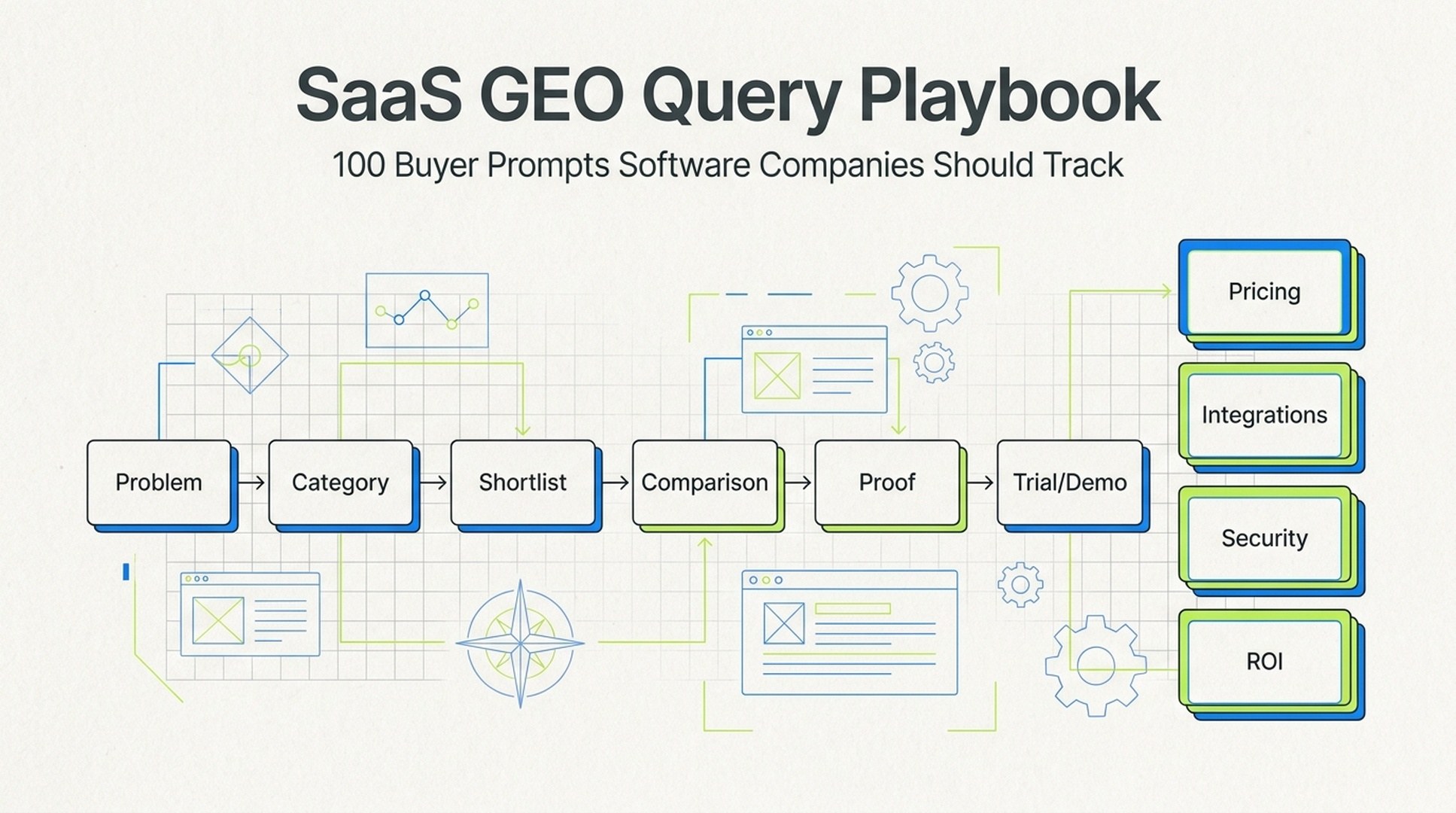
Quick Answer
SaaS GEO is not just about appearing when someone asks for “best software.” The real opportunity is to show up throughout the AI-assisted buying journey: when a buyer defines a problem, compares categories, asks for alternatives, checks integrations, estimates pricing, evaluates implementation risk, validates security, and prepares a business case for a team.
A SaaS buyer rarely makes a decision from one query. They move through a chain of prompts:
Problem -> Category -> Use Case -> Shortlist -> Comparison -> Proof -> Pricing -> Risk -> Trial or Demo
That chain should shape the SaaS website. Product pages, use-case pages, comparison pages, alternatives pages, pricing pages, integration pages, security pages, docs, case studies, and help-center content all become GEO assets.
The goal is not to publish 100 thin “best tool” blog posts. The goal is to map 100 buyer prompts into a smaller set of high-trust owner pages that AI systems can retrieve, summarize, and cite.
This playbook gives SaaS teams 100 AI Search buyer prompts, a SaaS-specific prioritization model, a query-to-page map, and a 30-day execution plan.
The SaaS AI Buying Chain
SaaS search behavior is changing because buyers now use AI tools to compress research. Instead of opening 20 tabs, they ask for a category explanation, shortlist, comparison, implementation plan, and pricing questions in one session.
A realistic AI-assisted SaaS evaluation may look like this:
Buyer Stage | What The Buyer Asks | Page That Should Support The Answer |
|---|---|---|
Problem framing |
| Use-case page |
Category discovery |
| Category explainer |
Shortlist |
| Product/category page |
Comparison |
| Comparison page |
Integration check |
| Integration page |
Proof check |
| Case studies |
Pricing |
| Pricing page |
Risk review |
| Limitations / FAQ page |
Conversion |
| Trial / demo page |
This is why SaaS GEO should not be treated as a blog-only project. AI systems need product facts, feature tables, pricing clarity, docs, integration details, customer proof, and clear “who this is for” language.
A good first move is to test current brand visibility across buyer prompts with an AI Search Visibility Checker, then use the prompt library below to decide which pages need stronger evidence.
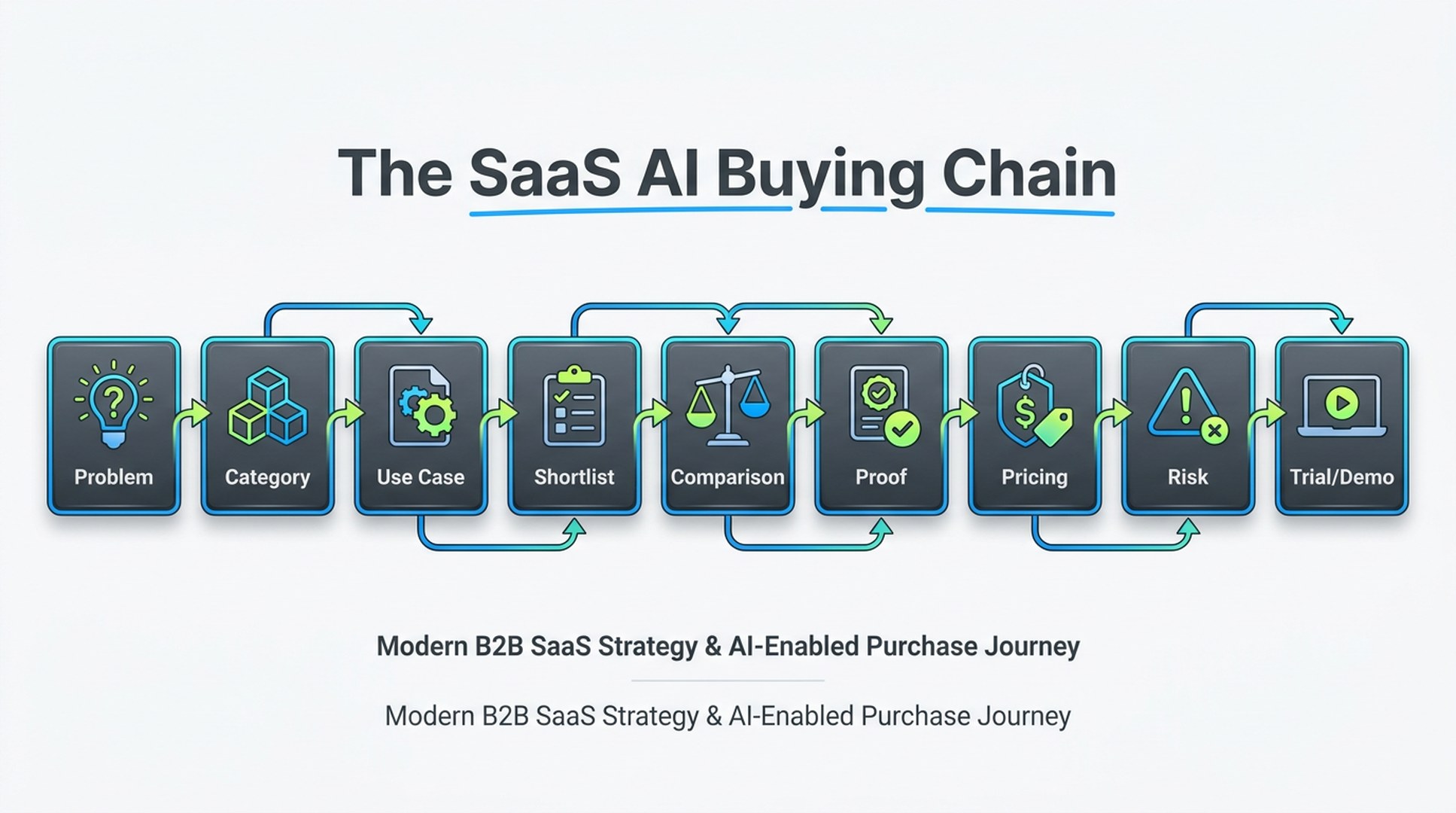
SaaS GEO should follow the AI-assisted buying chain, not just a list of category keywords.
Why SaaS GEO Is Different From Generic SEO
SaaS SEO often over-focuses on category keywords and comparison pages. Those still matter, but AI Search adds a new layer: the system may synthesize a recommendation from multiple sources and explain why one tool fits a specific use case.
That creates four SaaS-specific requirements.
First, product facts need to be explicit. AI systems cannot reliably recommend a product if the site hides pricing, supported integrations, target customer, limits, security posture, or onboarding process behind vague marketing copy.
Second, comparison content needs to be fair and specific. A good comparison page does not simply say “we are better.” It explains when each option fits, where the product is not ideal, and which buyer constraints matter.
Third, docs and help content become marketing assets. For developer tools, workflow tools, analytics products, and AI platforms, documentation can be a major citation source because it contains precise product behavior.
Fourth, the buyer committee matters. A founder may ask about speed, a marketer about workflows, a RevOps lead about CRM integration, a security reviewer about data handling, and a finance owner about total cost. GEO content should answer all of them without turning every answer into a sales pitch.
The 10 Query Types SaaS Teams Should Map
SaaS prompt mapping should start with buyer intent, not keywords.
Query Type | What The Buyer Wants | Best SaaS Content Asset |
|---|---|---|
Problem | Understand how to solve an operational pain | Use-case page, workflow guide |
Category | Understand software category and options | Category explainer, glossary |
Recommendation | Find tools for a role, company size, or use case | Best-for page, product page |
Comparison | Compare products, alternatives, or approaches | Comparison page, alternatives page |
Pricing / ROI | Estimate cost, plan fit, business case, or value | Pricing page, ROI guide |
Integration | Check whether the tool fits the existing stack | Integration page, docs |
Implementation | Understand setup, migration, onboarding, and adoption | Onboarding guide, implementation page |
Trust / Proof | Validate customers, reviews, case studies, and market presence | Case studies, review summary, customer page |
Security / Compliance | Understand data handling, permissions, SOC 2, GDPR, privacy, or AI risk | Security page, trust center |
Role / Scenario | Match a specific team, role, company size, or maturity stage | Persona page, scenario guide |
These query types should map to owner pages. If every prompt becomes a blog post, the site will compete with itself and confuse both users and AI retrieval systems.
How To Prioritize SaaS GEO Queries
Use a SaaS-specific scoring model:
Priority = Buying Intent + Product Fit + Revenue Impact + Evidence Strength + AI Answer Probability - Competitive Difficulty - Claim Risk
Factor | How To Evaluate It |
|---|---|
Buying Intent | Is the buyer defining a vendor shortlist, comparing tools, checking pricing, or preparing to trial/demo? |
Product Fit | Does the query match a use case where the product is genuinely strong? |
Revenue Impact | Could this query influence pipeline, trial activation, demo conversion, or expansion? |
Evidence Strength | Do you have product facts, docs, integrations, screenshots, case studies, reviews, or benchmarks to support the answer? |
AI Answer Probability | Is the query likely to trigger a synthesized recommendation, comparison, or checklist? |
Competitive Difficulty | Are large software directories, review sites, and better-known vendors already dominating the answer? |
Claim Risk | Would answering the query require unsupported superiority claims or overpromising AI/software outcomes? |
For most SaaS teams, the first backlog should focus on queries that connect directly to product evaluation: alternatives, integrations, pricing, use cases, onboarding, security, and buyer-specific recommendations.
100 SaaS GEO Query Examples
Use these prompts as a starting library. Replace the category, competitors, integrations, and buyer roles with your actual product context.
Problem Queries
- How can a small marketing team automate SEO content briefs?
- How can a sales team reduce manual CRM updates?
- How can a support team answer repetitive customer questions faster?
- How can a product team collect and prioritize user feedback?
- How can a finance team automate monthly reporting?
- How can a remote team manage project handoffs better?
- How can a B2B startup track AI Search visibility?
- How can a content team find SEO gaps faster?
- How can a customer success team identify churn risk earlier?
- How can an ecommerce team improve product search workflows?
Category Queries
- What is AI SEO software?
- What is content automation software?
- What is revenue intelligence software?
- What is product analytics software?
- What is customer support automation software?
- What is a workflow automation platform?
- What is the difference between GEO software and SEO software?
- What is the difference between CRM automation and sales engagement software?
- What is the difference between product analytics and web analytics?
- What is the difference between help desk software and knowledge base software?
Recommendation Queries
- Best AI SEO tools for B2B SaaS teams
- Best content automation software for small marketing teams
- Best workflow automation tools for startups
- Best customer support automation tools for SaaS companies
- Best product analytics tools for product-led growth teams
- Best CRM automation tools for lean sales teams
- Best AI Search visibility tools for growth teams
- Best reporting automation tools for finance teams
- Best knowledge base tools for customer support teams
- Best project management tools for remote operations teams
Comparison Queries
- [Product] vs [Competitor]: which is better for small teams?
- [Product] alternatives for B2B SaaS companies
- [Product] vs spreadsheet workflows for content planning
- AI SEO software vs traditional SEO tools
- Content automation platform vs project management tool
- Product analytics vs business intelligence software
- Help desk software vs AI chatbot platform
- CRM automation vs sales engagement software
- All-in-one SaaS platform vs specialized point solution
- Open-source tool vs paid SaaS platform for growing teams
Pricing / ROI Queries
- How much does AI SEO software cost?
- How should a startup budget for SaaS workflow tools?
- What pricing model is best for a small SaaS team?
- Is usage-based pricing better than seat-based pricing?
- How do I calculate ROI for content automation software?
- How do I calculate ROI for customer support automation?
- What hidden costs should buyers check before choosing SaaS software?
- How do annual contracts compare with monthly SaaS plans?
- When should a team upgrade from a free plan to a paid plan?
- What should a SaaS pricing page explain clearly?
Integration Queries
- Does the tool integrate with HubSpot?
- Does the tool integrate with Salesforce?
- Does the tool integrate with WordPress?
- Does the tool integrate with Webflow?
- Does the tool integrate with Slack?
- Does the tool integrate with Google Sheets?
- Does the tool support API access?
- Does the tool support Zapier or Make automation?
- How do I connect SaaS workflow software to my existing stack?
- What integrations matter most when choosing SaaS software?
Implementation Queries
- How long does it take to implement this type of software?
- What should a SaaS onboarding process include?
- How difficult is it to migrate from spreadsheets to SaaS software?
- What data should a team prepare before onboarding?
- How much training does a team need before using the tool?
- What implementation risks should buyers check before choosing software?
- How do I roll out new SaaS software to a small team?
- What should happen during a SaaS pilot project?
- How do I measure adoption after a SaaS trial?
- What makes a SaaS implementation fail?
Trust / Proof Queries
- How do I know if a SaaS vendor is trustworthy?
- Are SaaS review sites reliable?
- What should I look for in a SaaS case study?
- How should buyers compare customer testimonials?
- What product proof matters before booking a demo?
- How important are software review platforms in SaaS evaluation?
- What should a SaaS vendor disclose on its website?
- How can I verify whether a tool actually supports my use case?
- What makes a SaaS comparison page trustworthy?
- What customer evidence should a SaaS buyer ask for?
Security / Compliance Queries
- What security questions should I ask a SaaS vendor?
- Does this software handle customer data safely?
- What is SOC 2 and why does it matter for SaaS buyers?
- What privacy details should a SaaS website disclose?
- How should buyers evaluate AI tool data privacy?
- What should a SaaS trust center include?
- Does the product support role-based access control?
- Does the product support SSO?
- How should teams evaluate vendor risk before buying software?
- What security documents should a SaaS vendor provide?
Role / Scenario Queries
- Best AI SEO tool for a solo founder
- Best content workflow tool for a 5-person marketing team
- Best reporting automation tool for a finance lead
- Best customer support tool for a SaaS startup
- Best product analytics tool for a product manager
- Best CRM automation tool for a sales manager
- Best workflow tool for a remote operations team
- Best AI Search visibility tool for an agency
- Best software for teams replacing spreadsheets
- Best SaaS tool for companies preparing for scale
How To Turn SaaS Queries Into Citation-Ready Pages
A SaaS prompt library should become a product-led page system. The strongest pages are usually not generic blog posts; they are pages that answer buyer questions with product facts.
Query Cluster | Owner Page | Page Type | Required Proof |
|---|---|---|---|
Problem and workflow prompts | Use-case page | Use-case / solution page | Workflow steps, screenshots, feature mapping, CTA |
Category education | Category explainer | Glossary / category page | Definition, category boundaries, fit and non-fit cases |
Best-for and recommendation prompts | Product or persona page | Product / persona page | Buyer fit, feature table, limitations, proof |
Competitor and alternative prompts | Comparison page | Comparison / alternatives page | Fair comparison, use-case fit, migration notes |
Pricing and ROI prompts | Pricing page | Pricing / ROI page | Plan details, limits, example scenarios, billing FAQ |
Integration prompts | Integration page | Integration / docs page | Supported systems, setup steps, API details |
Implementation prompts | Onboarding page | Implementation guide | Timeline, required inputs, training, success criteria |
Security and compliance prompts | Trust center | Security page | Data handling, certifications, policies, access controls |
Proof prompts | Case study hub | Customer proof page | Case studies, review summaries, methodology, caveats |
Role and scenario prompts | Persona page | Role / segment page | Role-specific workflows, pain points, relevant CTA |
A good SaaS GEO page should answer a buyer's evaluation question in the first screen. It should not force the buyer to decode a vague headline and three abstract value propositions before finding product facts.
For technical readiness, SaaS teams should also check whether product pages, pricing pages, docs, and comparison pages are crawlable and indexable. A quick Website SEO Score Checker can help catch basic issues before a content team rewrites pages.
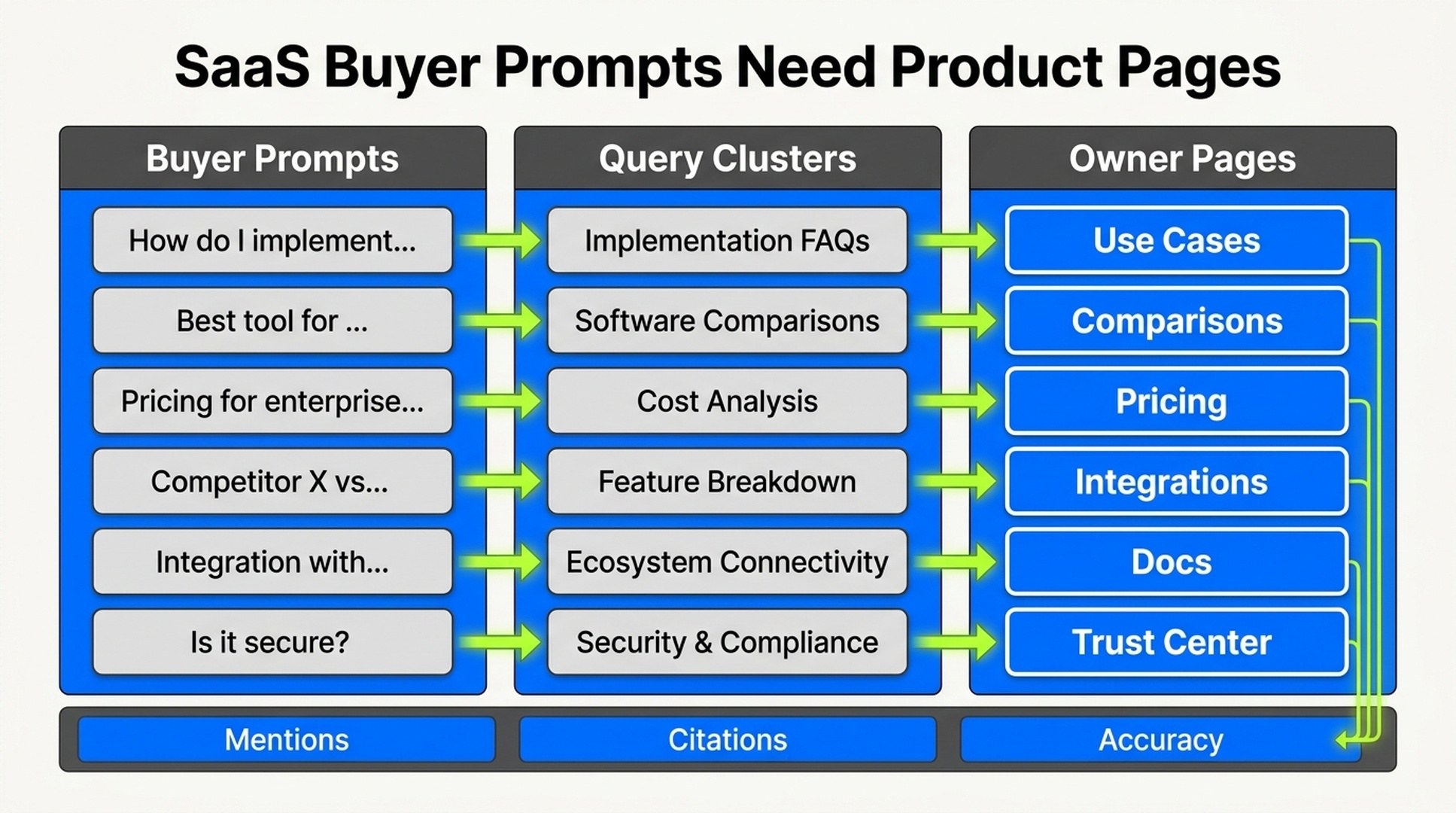
SaaS buyer prompts should map to product-led owner pages instead of overlapping blog posts.
The First 20 Queries To Prioritize
If a SaaS team is starting from scratch, these 20 prompts usually create a useful first backlog.
Priority | Query | Why It Matters | Likely Owner Page |
|---|---|---|---|
1 | Best AI Search visibility tools for growth teams | High product discovery intent | Product/category page |
2 | What is the difference between GEO software and SEO software? | Defines category position | Category explainer |
3 | [Product] alternatives for B2B SaaS companies | Captures comparison demand | Alternatives page |
4 | [Product] vs [Competitor]: which is better for small teams? | High evaluation intent | Comparison page |
5 | How much does AI SEO software cost? | Pricing friction | Pricing page |
6 | What hidden costs should buyers check before choosing SaaS software? | Trust-building buying question | Pricing FAQ |
7 | Does the tool integrate with HubSpot? | Stack-fit question | Integration page |
8 | Does the tool support API access? | Technical buyer question | Docs / API page |
9 | How long does it take to implement this type of software? | Adoption-risk question | Onboarding page |
10 | What should happen during a SaaS pilot project? | Trial-to-paid motion | Pilot guide |
11 | How do I calculate ROI for content automation software? | Business-case support | ROI page |
12 | How do I know if a SaaS vendor is trustworthy? | Vendor validation | Trust page |
13 | What should I look for in a SaaS case study? | Proof evaluation | Case study hub |
14 | What security questions should I ask a SaaS vendor? | Security review | Trust center |
15 | How should buyers evaluate AI tool data privacy? | AI-specific risk | Privacy page |
16 | Best content workflow tool for a 5-person marketing team | Persona/use-case intent | Small team page |
17 | Best AI Search visibility tool for an agency | Segment intent | Agency use-case page |
18 | Best software for teams replacing spreadsheets | Migration intent | Spreadsheet alternative page |
19 | What makes a SaaS comparison page trustworthy? | Comparison-page credibility | Evaluation guide |
20 | How can a B2B startup track AI Search visibility? | Strong product-use alignment | Use-case page |
These prompts are valuable because they align with buyer evaluation, not just top-of-funnel education.
30-Day Execution Plan
Timeframe | Action | Output |
|---|---|---|
Days 1-3 | Build the SaaS AI Search prompt library and classify by buyer stage, persona, and page owner | 100-prompt buyer library |
Days 4-7 | Score prompts by buying intent, product fit, revenue impact, evidence strength, AI answer probability, difficulty, and claim risk | First 20 prompt backlog |
Days 8-14 | Map prompts to product, use-case, comparison, pricing, integration, docs, trust, and proof pages | Query-to-page map |
Days 15-21 | Rewrite top pages with direct answers, feature tables, screenshots, limitations, proof, and CTAs | Updated citation-ready pages |
Days 22-30 | Test prompts across AI answer surfaces and record mentions, citations, competitors, and inaccurate product facts | AI visibility tracker |
A small SaaS company can start with five pages: category explainer, primary use-case page, pricing page, one comparison page, and a trust/security page. A more mature SaaS company should also improve docs, integrations, case studies, alternatives pages, and persona pages.
Common Mistakes
SaaS GEO fails when teams write for keywords instead of software evaluation.
Avoid these mistakes:
- Publishing too many thin comparison pages. A comparison page should be fair, specific, and useful, not a disguised sales pitch.
- Hiding product facts. Pricing, integrations, limits, security, setup time, and ideal customer fit should be visible.
- Ignoring docs and help content. Documentation often contains the facts AI systems need to describe the product accurately.
- Overclaiming AI capabilities. Explain what the product does, where it helps, and where human review is still needed.
- Treating all buyers the same. A founder, marketer, engineer, finance owner, and security reviewer ask different questions.
- Only measuring rankings. Track AI mentions, cited URLs, competitor inclusion, and inaccurate product descriptions.
FAQ
What is SaaS GEO?
SaaS GEO is the process of making software product pages, use-case pages, comparison pages, pricing pages, docs, and proof assets easier for AI answer systems to understand, summarize, and cite during buyer research.
Is SaaS GEO the same as SaaS SEO?
No. SaaS SEO focuses on organic rankings, technical accessibility, content relevance, and pipeline from search. SaaS GEO builds on that foundation but focuses on how AI systems synthesize recommendations, comparisons, and product facts.
Should every SaaS buyer prompt become a blog post?
No. Many SaaS prompts should be answered by product pages, docs, pricing pages, integration pages, comparison pages, security pages, and case studies. The goal is a better page map, not more thin posts.
Which SaaS GEO queries should teams start with?
Start with prompts about category fit, alternatives, pricing, integrations, implementation, security, use cases, and buyer-specific recommendations. These prompts tend to influence trial, demo, and vendor-shortlist decisions.
How can SaaS teams avoid repetitive GEO content?
Use product facts, screenshots, integration details, pricing constraints, customer proof, limitations, and role-specific use cases. If the article could apply to any SaaS company after replacing the product name, it is too generic.
How should SaaS teams measure GEO performance?
Track a stable prompt set across AI answer surfaces used by your market. Record whether your brand appears, which pages are cited, which competitors appear, what product facts are wrong, and how visibility changes after page updates.
Auspia Takeaway
SaaS GEO is a product marketing discipline as much as an SEO discipline. The best results come from making product facts, buyer fit, integrations, pricing, proof, and limitations easy to retrieve.
Start with the AI buying chain. Then map your first 20 prompts to owner pages that help buyers decide whether your product belongs on their shortlist. If those pages are clear, specific, and verifiable, they have a better chance of being used in AI-assisted software evaluation.
Author: Caleb Brooks, SaaS SEO Strategist for 100+ Product-Led Pages at Auspia. Caleb writes about SaaS pages, product-led SEO, comparison content, and buyer journeys.


