The decision for 2026
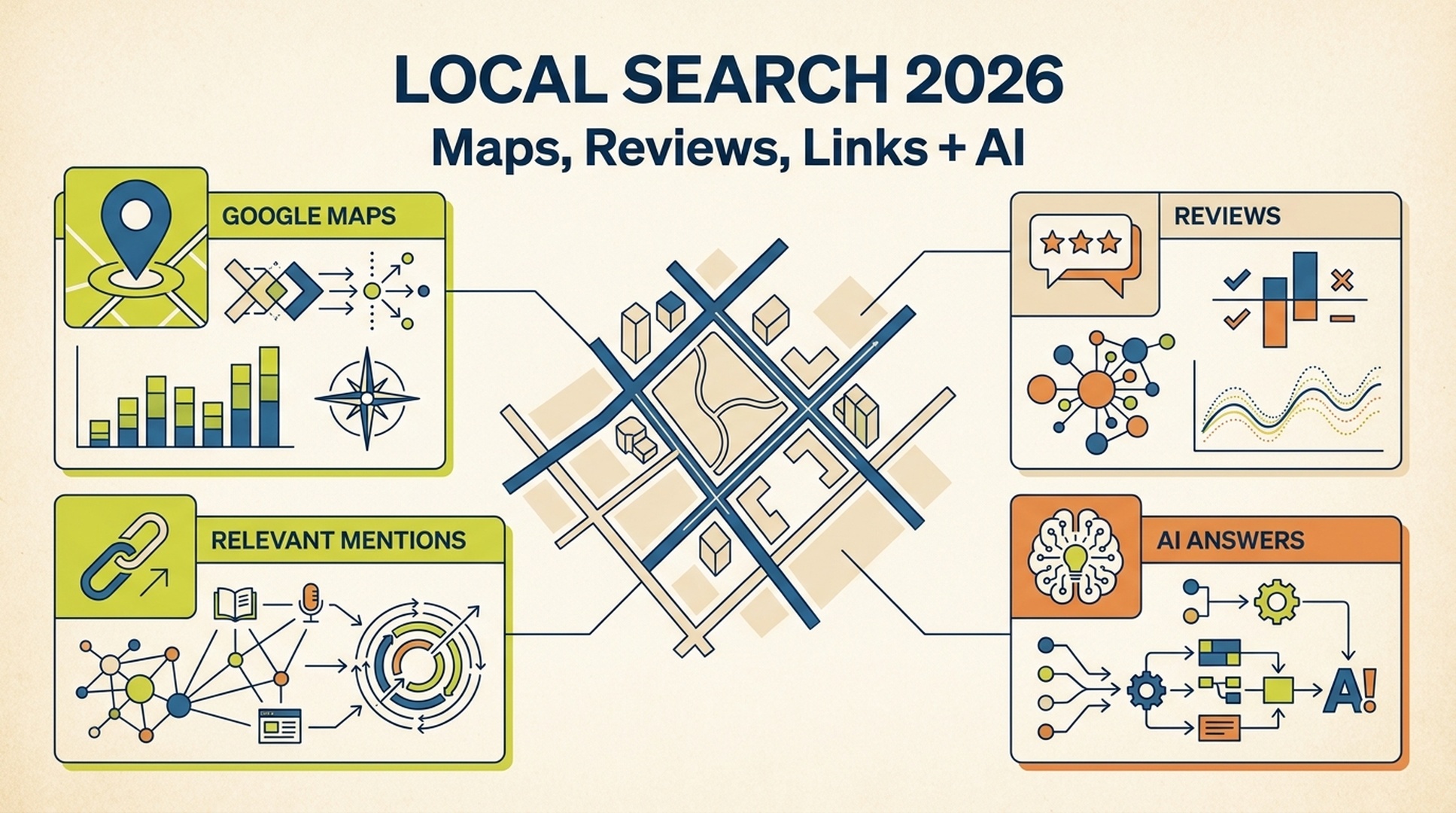
For a US or Canadian business that depends on calls, bookings, visits, or local leads, the sensible 2026 priority is straightforward: make your business facts accurate, make customer experience visible through genuine reviews, prove what you do on your website, and make sure trusted third parties describe the same business.
That is more useful than treating local SEO as a race to buy the most links or publish the most city pages. Links still matter. Google explicitly says that links to a business and its review profile contribute to local prominence. But a link program cannot repair an inaccurate Google Business Profile, stale hours, weak review practice, an unclear service area, or a website that does not answer the question a local customer is asking.
This guide separates two things that are often mixed together:
Evidence type | What it can tell you | What it cannot tell you |
|---|---|---|
Google documentation | The principles, policy boundaries, and eligibility requirements Google has published | The precise weight of every signal or a guaranteed way to rank |
Your own testing | Whether a change improves qualified leads and visibility for your market | Whether the same result will carry over to every location or competitor |
The distinction matters. It keeps business owners from spending money on folklore and gives agencies an honest way to explain what they are testing.
What Google actually documents about local ranking
Google says local results are mainly based on relevance, distance, and prominence. It does not publish a percentage breakdown for these factors, and it says there is no way to request or pay for a better local ranking.
Relevance: can Google match the business to the request?
Relevance is about fit. A complete Business Profile helps Google understand what the company does, where it is, when it is open, and which searches it should be considered for. That turns profile maintenance into basic search work, not administrative cleanup.
For a restaurant, this means an accurate primary category, current hours, menu or ordering details where available, and useful attributes. For a home-service company, it means an accurate service-area model, real services, correct hours, and a website that explains the work. For a multi-location clinic, it means each real location has its own correct facts and customer path.
Distance: the factor you cannot optimize away
Distance is how far the business is from the person searching or from the location named in the query. A better profile or stronger website does not remove geography from local results.
That is why a business should define its real service boundary before publishing location content. A plumbing company that can reach a suburb within an hour should say so. It should not create a page that implies it serves a city it cannot serve profitably. The goal is qualified discovery, not an unmanageable volume of irrelevant calls.
Prominence: why reputation and links belong in the same conversation
Google describes prominence as how well-known a business is. Its guidance says that prominence is based, in part, on how many websites link to the business and how many reviews it has. Google also says that more reviews and positive ratings can help local ranking.
This is the useful correction to two bad pieces of advice:
- "Links no longer matter for local SEO" is false.
- "More links will solve local SEO" is also false.
The practical question is whether a local mention or link adds credible evidence that the business is real, relevant, and known for the service in question. A mention from a local professional association, a supplier, a community partnership, a local news story, or a relevant industry directory can do more than a generic placement because it helps both customers and search systems understand the business in context.
Do not confuse industry estimates with Google's documentation
Google does not publish a percentage breakdown for local ranking signals. The documented framework is relevance, distance, and prominence. Google also says that complete business information, links to the business, and genuine reviews can contribute to how a business appears locally.
That means a local program should not treat one tactic as a universal score. Profile accuracy, review practice, useful service information, website quality, and real-world prominence solve different problems. Use testing to identify the current bottleneck, then report the result as an observed outcome rather than as a hidden Google weight.
Where to put effort first
The right priority depends on what is broken. Use this table before commissioning another batch of content or links.
If you see this problem | Check this first | First practical fix | Do not assume |
|---|---|---|---|
The listing appears for the wrong searches | Primary category, services, business description, website landing page | Correct facts and make the associated service page more specific | A keyword-stuffed business name will solve relevance |
Calls arrive from places you do not serve | Address or service-area setup, location copy, ad targeting, conversion forms | State the service boundary plainly and filter quote requests | More city pages will improve lead quality |
A competitor has more visible trust | Review recency, review detail, third-party profiles, local proof | Build a compliant review-request process and repair missing proof | Buying reviews or generic backlinks is a safe shortcut |
Maps visibility is weak while organic pages perform | Profile completeness, verification, categories, hours, review health, local competition | Audit the Business Profile and location-level evidence | Organic authority automatically translates into strong map visibility |
Organic pages do not perform while the profile does | Indexability, service-page quality, internal links, local proof, search intent | Improve the pages that support the actual services and decisions | The profile can substitute for a useful website |
AI answers describe the business incorrectly or omit it | Business facts across website, profiles, directories, reviews, and partner pages | Create one canonical facts sheet and correct the highest-trust sources | A special AI schema or |
Reviews are evidence, not a rating-harvesting campaign
Reviews now affect three separate parts of the buying journey. They can support local prominence, help a customer decide whether to contact a business, and provide descriptive language about service, location, staff, and outcomes that may surface elsewhere on the web.
Google's guidance is clear about the boundary. A business may ask customers for reviews with a Google review link or QR code. The review must reflect a genuine experience. Offering a discount, free item, or other incentive in return for a review, an edit, or removal of a negative review is prohibited. Google also prohibits selectively soliciting only positive reviews.
For a local business, the better process is simple:
- Ask every eligible customer after the service or purchase is complete, using a consistent moment in the customer journey.
- Make the ask neutral. Request honest feedback, not a five-star rating.
- Respond to reviews as a real operator would: thank people for specific feedback, answer legitimate concerns, and avoid sharing private details.
- Read reviews monthly for operational evidence. Repeated complaints about scheduling, parking, service timing, or estimates point to an operations problem, not only a marketing problem.
An agency should report review health with more than an average star rating. Track review volume, recency, response coverage, recurring topics, and operational problems that customers repeatedly name. That makes reputation work useful even before it changes a ranking.
Local citations should verify the business, not create directory noise
In local SEO, a citation usually means a public mention of a business's name, address or service area, phone number, website, category, or other identifying facts. The old habit was to submit a business to as many directories as possible. That creates a larger cleanup job without necessarily making the business easier to trust.
Use a smaller, evidence-led hierarchy instead:
Priority | Sources to review | Why they matter |
|---|---|---|
1 | Google Business Profile, website, major consumer platforms used by your customers | These sources often shape the first customer impression and must agree on core facts |
2 | Industry directories, licensing bodies, professional associations, and marketplace profiles | They can validate category, credentials, service area, and specialization |
3 | Local chambers, local media, suppliers, charities, schools, community partners, and event pages | They add locally relevant proof when the relationship is real |
4 | Long-tail directories | Add only when the site is credible, maintained, relevant to the customer, and able to show accurate information |
Create a one-page canonical business record before updating anything. It should include the legal and public business name, phone number, website URL, primary category, services, address or service-area model, regular and special hours, booking URL, key credentials, and a short approved description. This becomes the reference for profiles, partnerships, location pages, and agency work.
Consistency does not mean every listing must use identical wording. It means the important facts do not contradict one another.
Build service and location pages that earn their place
US and Canadian local businesses often inherit a site full of city pages with nearly identical copy. These pages are easy to produce and hard to defend. A page deserves to exist when it helps a real person make a better decision for that service and place.
A useful local service page can answer questions such as:
- Which locations or neighborhoods do you actually serve?
- What work do you perform, and what work do you not perform?
- What does the process look like for a customer in this area?
- What affects availability, timing, or pricing?
- Which license, insurance, warranty, accessibility, or safety facts are relevant?
- What local project evidence, customer feedback, or team experience can you show without making claims you cannot prove?
That is enough material for a good page. It does not require manufacturing local color or publishing a page for every postal code.
Structured data can clarify the content of a page when it accurately matches what users can see. It is not a ranking switch. Google says there is no special schema required for AI Overviews or AI Mode, and it specifically advises businesses to keep Business Profile information current. Use LocalBusiness markup where it fits the visible page and passes validation. Do not use it to invent locations, ratings, or services.
What changes for AI search, and what does not
Local buyers increasingly ask longer questions: "Which emergency electrician near me handles older homes?" "What are the best dentists in Toronto for anxious patients?" "Which accounting firm serves small construction companies in Denver?"
These questions make local information quality more important, but they do not create a separate magic discipline that replaces local SEO. Google says there are no additional requirements or special optimizations for AI Overviews and AI Mode. A page needs to be indexed and eligible to appear with a snippet, and the same basics still apply: crawlability, internal linking, helpful content, visible text, accurate structured data, and up-to-date Business Profile information.
The word "AI search" also hides important differences:
Surface | What you should assume | What you should not assume |
|---|---|---|
Google AI Overviews and AI Mode | Google can use Google Search and Business Profile information; Google documents the normal Search eligibility requirements | A Business Profile guarantees inclusion, or a special AI markup exists |
Gemini | Google ecosystem facts may be relevant, especially for local questions | Its answers will match Maps, Search, or AI Mode every time |
ChatGPT, Perplexity, and other answer engines | Clear web pages and accurate third-party references are useful because these systems may retrieve or cite public web sources | They use the same ranking factors, databases, or citation behavior as Google |
For this reason, a local GEO program should be conservative. Build a clean public record, write useful pages, maintain credible third-party proof, and test the actual prompts your customers use. Do not claim that a particular citation, directory, or page format will guarantee an AI recommendation.
If you need a starting point for prompt testing, an AI Search Visibility Checker can help turn a one-off question into a repeatable review. The business should still judge whether the answer sends qualified customers and describes the service accurately.
A 90-day local visibility plan
This plan is deliberately small. It gives a single-location business or a focused agency team a way to establish a baseline without spreading effort across hundreds of tasks. Multi-location brands can run the same plan on a prioritized group of locations before scaling it.
Timeframe | Owner | Work | Evidence of completion |
|---|---|---|---|
Days 1-14 | Owner or local operations lead | Verify Business Profile ownership; audit categories, hours, address or service area, phone, website, services, photos, and booking path; document the canonical business facts | Approved facts sheet and profile audit log |
Days 1-14 | Agency or SEO lead | Record baseline local visibility by area, organic landing pages, review health, calls or bookings, and priority competitors | Baseline dashboard with date, query set, and locations tested |
Days 15-45 | Customer-facing team | Launch a compliant, neutral review request process and response standard | Review-request workflow, training note, and weekly quality check |
Days 15-45 | Website owner | Upgrade the most important service and location pages with clear service boundaries, customer questions, proof, and contact paths | Five to ten priority pages reviewed against a local-page checklist |
Days 30-60 | Agency or marketing lead | Correct high-priority third-party profiles and pursue a short list of relevant local or industry proof opportunities | Source inventory with corrected facts and relationship notes |
Days 46-90 | Owner and agency | Test priority local and recommendation prompts, review qualified lead quality, and choose the next bottleneck | Monthly review with actions and rank screenshots in context |
The plan does not promise a ranking increase in 90 days. It creates the conditions for a business to learn which weak signal is costing it visibility or trust.
A reporting model that owners can use and agencies can defend
Avoid a report that starts and ends with a single grid rank. Local results vary by searcher location, device, query, time, and competition. Grid tracking is useful, but it is a diagnostic, not the business outcome.
Report five views together:
View | Questions to answer |
|---|---|
Profile integrity | Are business facts, hours, services, and customer paths correct and current? |
Local visibility | Where do we appear for the query and area set that matters to the business? |
Reputation | Are recent, genuine reviews and thoughtful responses improving customer confidence? |
Website support | Do priority pages answer the service, area, price, trust, and booking questions behind local searches? |
Commercial quality | Are calls, bookings, quote requests, directions, and AI-referred visits becoming more qualified? |
For AI prompts, add two checks: was the business mentioned, and was it described correctly? A mention that sends a homeowner to a service the business does not provide is not a win.
The budget rule to remember
Before increasing link-building spend, ask four questions:
- Is the Business Profile complete, verified, policy-safe, and aligned with the business's actual operating model?
- Does the business receive genuine reviews consistently, and are customer problems being addressed?
- Can a local customer verify services, boundaries, trust facts, and next steps on the website?
- Do the most trusted external sources repeat accurate business facts?
If the answer to any of the first three is no, fix it before treating links as the primary constraint. If the answer is yes, invest in relationship-based local and industry mentions that bring real referral, credibility, or evidence value. That is a safer definition of local link building in 2026.
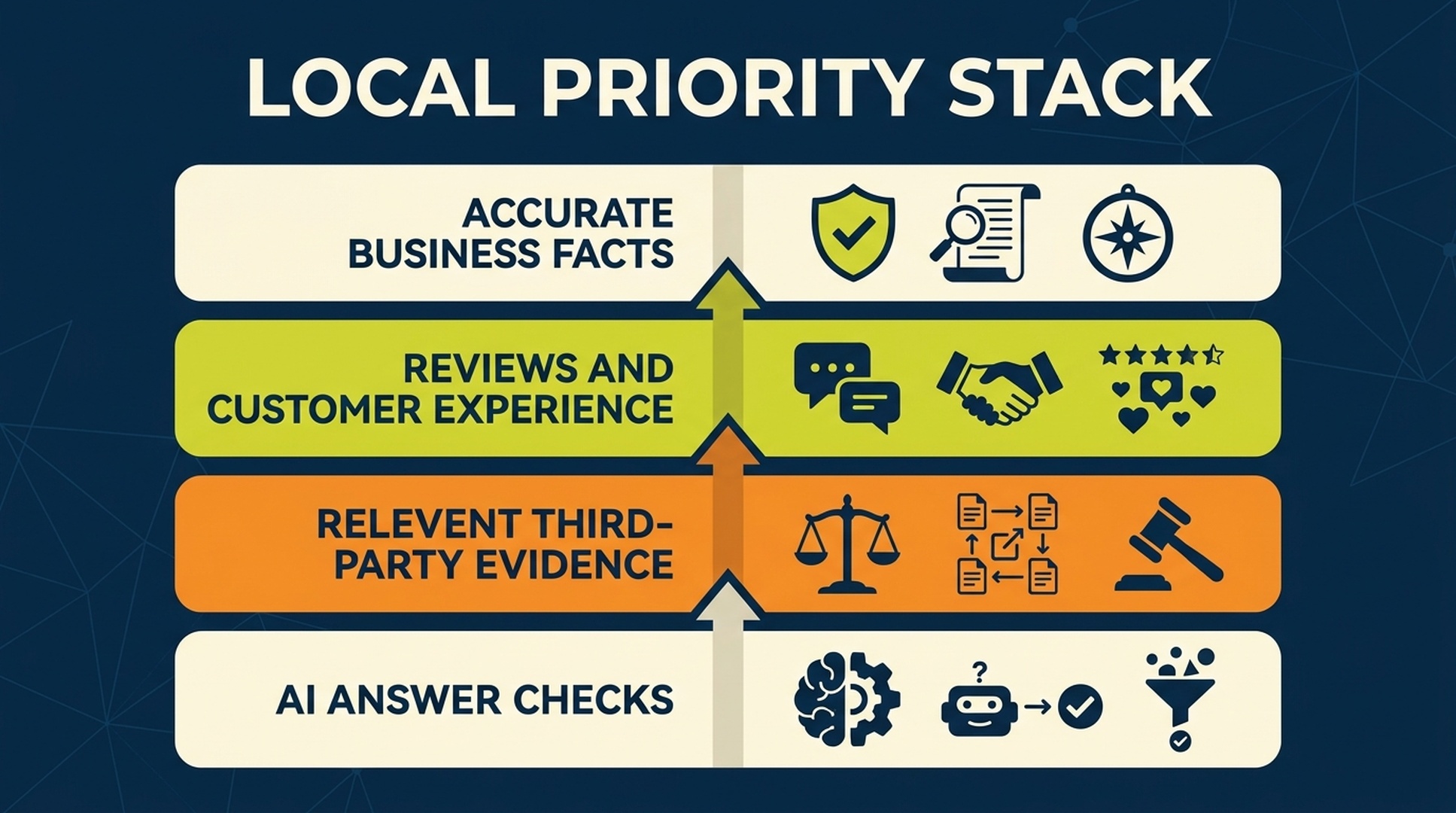
Use this framework to separate operational facts, customer trust, relevant evidence, and answer-quality checks.
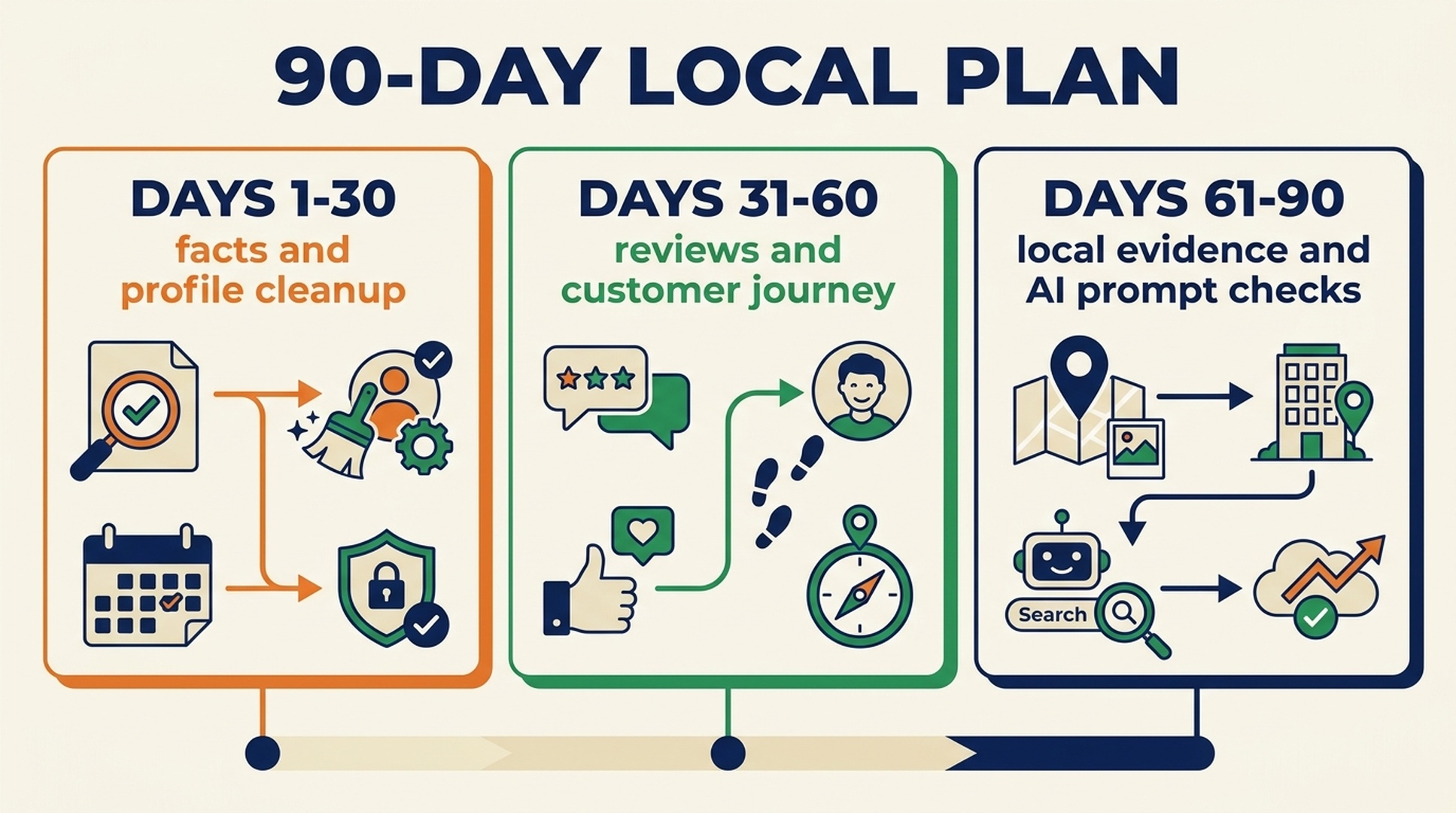
Use the timeline as an operating sequence, not as a ranking guarantee.
FAQ
Are links still a local ranking factor in 2026?
Yes. Google says local prominence is based in part on how many websites link to a business. The practical lesson is not to buy more generic links. Earn or maintain relevant mentions and links that support a real local or industry reputation.
Do reviews improve Google Maps rankings?
Google says more reviews and positive ratings can help local ranking. Reviews must be genuine. Do not offer incentives, filter for only positive reviewers, or pressure customers to write a particular rating or statement.
What are the most important Google Maps ranking factors?
Google documents relevance, distance, and prominence as the main local-ranking principles. The detailed mix varies by query, location, category, competition, and the information Google can verify. Google does not publish a factor-weight formula.
Does LocalBusiness schema improve Maps or AI rankings?
Use structured data to describe visible, accurate information on a page when it is appropriate. It can help search systems interpret content and may enable eligible search appearances. Google does not describe LocalBusiness schema as a Maps-ranking lever or a special requirement for AI Overviews or AI Mode.
Should a service-area business show an address on Google?
Follow Google's Business Profile rules for your actual operating model. A business that travels to customers generally uses one profile for its central office or location and defines its service area. Do not use a virtual office or false address. If customers are served at a staffed, signed location during stated hours, the address may be shown according to Google's guidelines.
Can local GEO guarantee an AI recommendation?
No. It can make the business easier to understand and verify across its website, profile, reviews, and third-party sources. AI answers vary by platform and prompt, and no ethical optimization program can guarantee inclusion.
Continue the local search series
Use these related guides to move from diagnosis to an operating plan:
- Google Business Profile optimization in 2026
- Local reviews in 2026
- Local citations after AI search
- Local link building and relevant mentions
- Local GEO for AI search
- Local service and location pages without doorway risk
- How to measure local search and AI visibility
Sources
- Google Business Profile Help, Tips to improve your local ranking on Google. Google documents relevance, distance, prominence, the role of links and reviews in prominence, and the importance of complete business information.
- Google Business Profile Help, Guidelines for representing your business on Google. Consult this before changing a business name, address, service area, or profile structure.
- Google Business Profile Help, Tips to get more reviews, and Google Maps policy, Prohibited and restricted content. These define the review-request and anti-manipulation boundaries used in this guide.
- Google Search Central, AI features and your website, and LocalBusiness structured data. Google says there are no special AI Overview or AI Mode requirements, and that structured data must match visible page content.
Author: Miles Donovan, Local AI Search Analyst Across 500+ Service Queries at Auspia. Miles writes about local visibility, service-area pages, local reputation, and practical ways to make a business easier for search and AI systems to understand.