Local GEO starts with a platform boundary
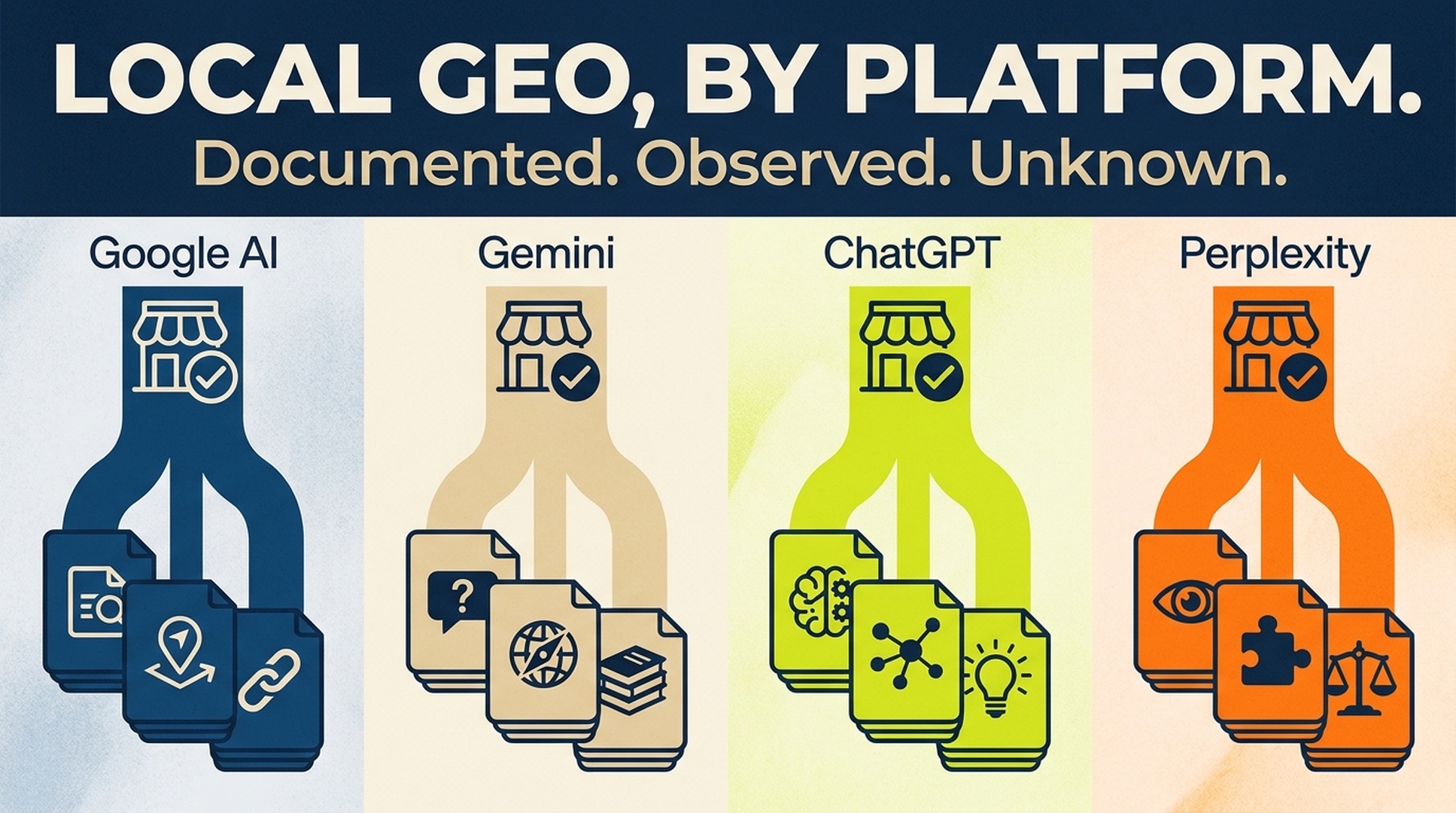
"Optimize for AI search" sounds like one job. For a local business, it is at least four different questions:
- Can Google understand the business for Maps and local search?
- Is the business's website eligible to appear as a supporting link in Google AI Overviews or AI Mode?
- When Gemini, ChatGPT, or Perplexity answer a local recommendation question, do they describe the business correctly?
- If an answer mentions the business, does it send the customer to a useful next step inside the real service boundary?
The first two have meaningful published guidance from Google. The last two require testing because answer systems can vary by product, query, location, user context, available sources, and time. Treating them as one algorithm is how local teams end up making promises they cannot support.
This is the operating rule for US and Canadian businesses:
Build a clear, accurate local business record that customers can verify. Then test each answer surface separately. Do not infer a recommendation rule from a single answer, and do not invent a special GEO tactic when the platform has not documented one.
The evidence ladder: documented, observable, and unknown
Use three labels in every local AI report. This prevents an agency from presenting a guess as a platform rule.
Label | Meaning | Example |
|---|---|---|
Documented | The platform has published the rule or requirement | Google says a page needs to be indexed and eligible for a snippet to appear as a supporting link in AI Overviews or AI Mode |
Observable | The team has repeatedly seen an outcome in a controlled prompt set | A business appears in Perplexity citations for a defined local comparison prompt on several dated checks |
Unknown | The team cannot see enough of the system to explain the outcome reliably | Why one similarly qualified local business was selected while another was not |
The label does not make observable evidence unimportant. It tells the reader how much confidence to place in it. A local business should act aggressively on documented data-quality failures and cautiously on platform-specific pattern claims.
What Google AI search documents for local businesses
Google's AI Features documentation is the clearest official source in this area. It says there are no additional requirements to appear in AI Overviews or AI Mode and no special optimization necessary. Google says existing SEO fundamentals still apply.
For a page to be eligible as a supporting link in AI Overviews or AI Mode, Google says the page must be indexed and eligible to appear in Google Search with a snippet. It also says that meeting technical requirements and policies does not guarantee crawling, indexing, or serving.
For local businesses, Google's published best practices include:
Foundation | What Google documents | Local operating implication |
|---|---|---|
Crawlability | Allow Googlebot access through robots.txt and relevant hosting/CDN controls | Do not block the service, location, pricing, booking, or FAQ pages that customers need |
Findability | Make content easy to find through internal links | Link important service and location pages from navigation and relevant supporting content |
Helpful content | Follow Search policies and create helpful, reliable, people-first content | Answer actual customer questions about fit, service area, availability, process, pricing factors, and limitations |
Visible facts | Make important content available in text and ensure structured data matches visible content | Do not hide local facts in images or use markup for services, ratings, or locations that the page does not support |
Business information | Keep Business Profile information current | Align name, category, hours, service area, contact path, and website facts with operations |
Measurement | AI-feature traffic is included in Search Console's Web performance data | Measure Search Console and conversion changes, but do not claim an AI-only report where Google does not provide one |
Google also says that new machine-readable AI files, AI text files, or special schema.org markup are not required for these features. LocalBusiness structured data can still be useful when it accurately represents visible business information, but it is not a special AI Overview or AI Mode admission ticket.
Google AI Overviews and AI Mode are not Google Maps
A common local GEO mistake is to assume that a complete Google Business Profile will automatically produce a link or recommendation in AI Overviews or AI Mode. Google does not make that promise.
Maps and local results are primarily about relevance, distance, and prominence. Google AI features can surface supporting links for complex questions and may use query fan-out across related subtopics and sources. A business can be a solid Maps result for a nearby category query and still not be a supporting link in an AI answer about pricing, accessibility, provider selection, or a multi-step comparison.
The practical response is to map local questions to the pages that can answer them:
Local question | Page or source that should carry the answer |
|---|---|
"Do you serve my neighborhood?" | Accurate Business Profile service area, service-area page, booking or quote form |
"Can you handle this type of job?" | Specific service page with exclusions, process, proof, and contact path |
"What should I expect to pay?" | Pricing or quote-explainer page that states real factors and limitations |
"Is this provider legitimate?" | License, credential, About, review, association, and partner evidence |
"Can I book today or after hours?" | Current hours, emergency or appointment rules, and booking page |
"Which provider is right for my situation?" | Selection guide, transparent fit criteria, and local service boundaries |
This does not make the page "AI optimized" in a separate sense. It gives Google and a customer material that can be found, read, and verified.
Gemini: use the same factual discipline, test the actual experience
Gemini is part of Google's product ecosystem, but it is not safe to assume that a Gemini Apps response will mirror Google Maps, Google Search, AI Overviews, or AI Mode. Google documents that Gemini Apps can use information from connected apps and other Google services a user uses, subject to product settings and context. That means answers may be more context-dependent than a public SERP.
For a local business, do not build a separate "Gemini profile" based on unverified advice. Use the same public facts that should already be correct: Business Profile information, visible website content, service boundaries, reviews, relevant third-party records, and useful local pages. Then test the business's priority prompts in a documented, reproducible way.
Record whether the answer:
- names the business at all;
- uses the correct location and service boundary;
- describes the actual services and exclusions;
- provides sources or a next step;
- changes when a location, neighborhood, constraint, or customer scenario changes.
If a response is wrong, fix public facts first. Do not assume that changing one sentence on the website will change the next Gemini response, especially if the answer is personalized or informed by a user's connected services.
ChatGPT and Perplexity: treat citations as observed outputs, not a shared ranking system
ChatGPT and Perplexity can present web-grounded answers and citations in relevant product experiences, but neither should be treated as a replica of Google local search. Their public interfaces, retrieval behavior, and source presentation can change. A local business cannot inspect a universal ranking formula or assume that every answer will use the same source set.
The practical method is simple: test what the customer actually sees.
Check | What to capture | Why it matters |
|---|---|---|
Prompt | Exact wording, date, locale, device/session state when known | Lets the team compare like with like |
Local context | City, neighborhood, ZIP code, distance or travel constraint, and service need | Local recommendations can change sharply with context |
Answer | Full response, brands named, exclusions, and next-step advice | Shows whether the business is present and accurately positioned |
Sources | Visible citations, linked pages, directories, reviews, maps, or media references | Identifies the public evidence that may need correction or support |
Customer fit | Whether the answer sends the right kind of lead | Avoids treating irrelevant mentions as wins |
Recheck result | Same prompt on a reasonable cadence | Separates one-off variance from a repeated pattern |
If ChatGPT or Perplexity cites a stale directory, correct the directory and the owned facts it contradicts. If it cites a useful third-party source that omits a material service or location detail, ask whether the source can be updated through a real relationship. Do not use fake reviews, mass mentions, or low-quality sites to try to force a different answer.
The local AI visibility stack that works across platforms
Platform differences are real, but the foundation is shared. A business that cannot state what it does, where it works, how a customer contacts it, and why it is credible will struggle on every surface.
Layer | What to maintain | Why it travels well |
|---|---|---|
Operational truth | Actual locations, service area, hours, availability, licenses, insurance, and exclusions | Customers and systems both need facts that match the real business |
Google and owned facts | Business Profile, local pages, service pages, booking paths, visible text, and accurate structured data | Supports Maps, organic search, Google AI eligibility, and customer conversion |
Independent verification | Reviews, licensing records, associations, suppliers, partners, local media, and vertical platforms | Helps buyers and answer systems corroborate the business beyond its homepage |
Answer assets | Pricing factors, selection guides, FAQs, accessibility details, process explanations, emergency guidance, and local constraints | Gives complex queries a page that can answer more than a category label |
Measurement | Repeated prompt set, source log, answer accuracy review, Search Console, analytics, leads, and bookings | Turns an uncertain surface into an observable operating loop |
This is the reason local GEO should not become a content factory. The work is to reduce ambiguity in the business's public record, then close the gaps that a real customer or answer system exposes.
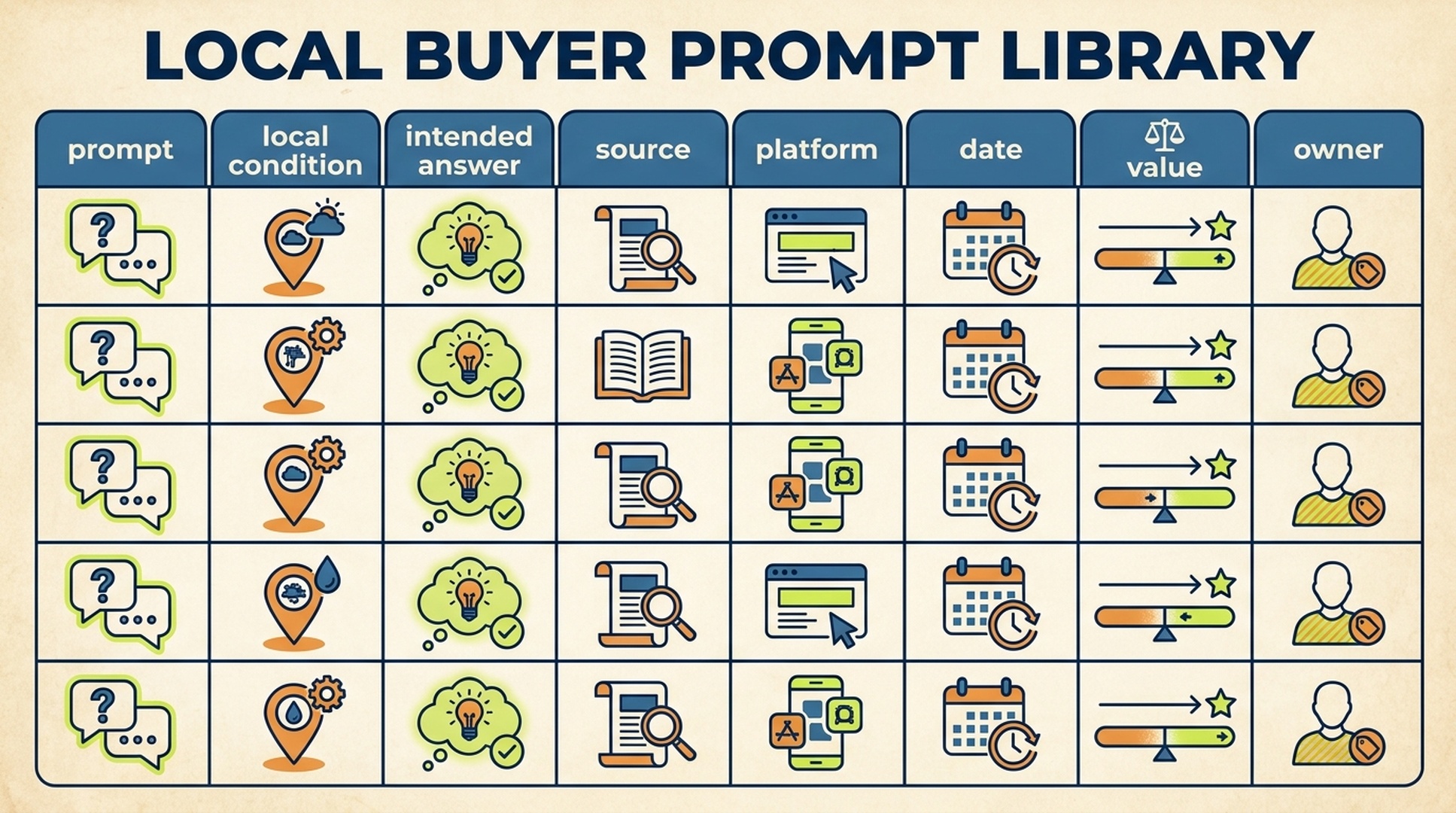
Build a prompt set that represents local buying decisions
Do not begin with 500 generic prompts. Start with 20 to 30 questions that reflect the decisions customers make before calling, booking, visiting, or requesting a quote.
Prompt family | Example template | Best evidence to inspect |
|---|---|---|
Nearby fit | "Who provides [service] in [area] for [customer situation]?" | Service boundary, profile category, local page, relevant reviews |
Urgency | "Who can help with [urgent problem] in [area] today?" | Current hours, emergency policy, response expectations, booking route |
Selection | "How should I choose a [provider] in [city]?" | Selection guide, licenses, review themes, fair fit criteria |
Comparison | "Which [providers] are suitable for [constraint]?" | Specialization, exclusions, accessibility, pricing factors, third-party proof |
Cost or process | "What does [service] cost in [area], and what affects the quote?" | Pricing explainer, scope limits, local process, actual contact path |
Trust and eligibility | "Is [business] licensed/qualified/experienced for [need]?" | Licensing records, credentials, association pages, service pages |
Service recovery | "What should I do if [problem] happens before a provider arrives?" | Safe preparation guidance, emergency boundaries, no unsupported claims |
Run each question in the platform that matters to the business. A restaurant may prioritize Maps, Search, Gemini, and dining-oriented review surfaces. A local law firm may prioritize Google Search, Google AI features, ChatGPT, and legal directories. A home-services company may need Maps, emergency prompts, reviews, and Local Services Ads alongside answer-engine checks.
A weekly test protocol that an agency can defend
AI answer screenshots are not a reporting system. They become useful when every test has a consistent prompt, context, capture method, and decision rule.
Step | What to do | Quality gate |
|---|---|---|
1. Freeze the prompt library | Approve 20 to 30 buyer questions and their intended location context | Each prompt maps to a real service, market, and customer decision |
2. Choose surfaces | Select Google Search/Maps, Google AI features where visible, Gemini, ChatGPT, Perplexity, and any category-specific source that customers use | Do not test a platform only because it is fashionable |
3. Capture the answer | Save prompt, date, locale, location context, response, sources, named businesses, and screenshots where permitted | Do not overwrite prior answers or remove unfavorable results |
4. Grade the outcome | Score presence, description accuracy, source quality, customer fit, and next-step quality | A brand mention is not a pass if the service or area is wrong |
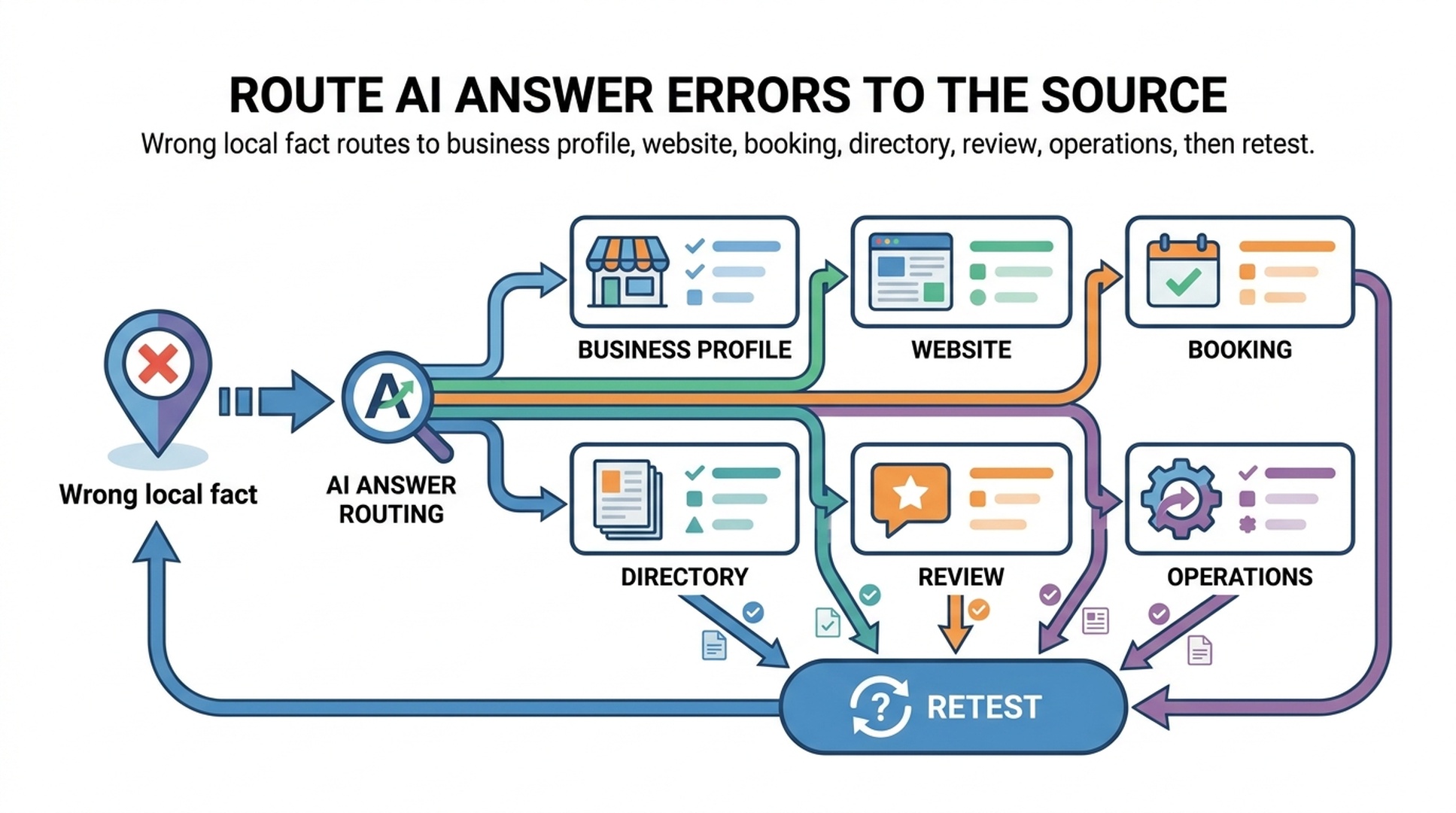
5. Assign a fix | Route the issue to profile facts, owned pages, citations, reviews, service operations, or a source correction | Do not treat content writing as the default fix |
6. Re-test | Repeat the same prompts after a reasonable period and record the difference | Do not attribute a change to one edit without corroborating evidence |
Use a simple five-point score rather than a false precision model:
Score | Meaning |
|---|---|
0 | Not named or materially wrong |
1 | Named but wrong fit, location, service, or next step |
2 | Named accurately but without useful evidence or customer path |
3 | Accurate answer with relevant evidence or source support |
4 | Accurate, well-fitted answer that directs a qualified customer to a useful next step |
Track the explanation alongside the score. A score can show movement; the notes show what needs to be fixed.
What not to promise a local client
Do not promise any of the following:
- "We will get you cited by ChatGPT."
- "We can make your Google Business Profile rank in AI Mode."
- "Adding
llms.txt, schema, or a city page will unlock AI recommendations." - "One directory, review campaign, or article will change every answer engine."
- "An AI answer means the business will receive qualified leads."
The better promise is operational: the team will make local business facts easier to verify, test the buyer questions that matter, document what the platforms actually show, correct material public-information gaps, and measure qualified outcomes.
Use this framework to separate operational facts, customer trust, relevant evidence, and answer-quality checks.
Use the timeline as an operating sequence, not as a ranking guarantee.
FAQ
Is local GEO different from local SEO?
Local SEO focuses on Maps, local results, business information, reviews, local pages, and organic discovery. Local GEO builds on those foundations by checking whether AI answer systems can accurately understand and mention the business for local recommendation, comparison, process, and decision questions.
Does Google Business Profile optimization guarantee visibility in AI Overviews or AI Mode?
No. Google says there are no special requirements for AI Overviews or AI Mode, and a page must be indexed and eligible for a Search snippet to appear as a supporting link. Keeping Business Profile information current is a documented best practice, but it does not guarantee inclusion.
Do ChatGPT, Gemini, and Perplexity use the same local ranking factors as Google Maps?
Do not assume that they do. Each product can use different sources, retrieval methods, personalization, and answer formats. Test the actual local prompts your customers use and label the findings as observed behavior unless the platform has documented the rule.
Do I need special schema or an AI file for local GEO?
Google says no special schema.org markup, machine-readable AI file, or AI text file is required for AI Overviews or AI Mode. Use structured data when it accurately matches visible page content and helps represent the business; do not treat it as a recommendation guarantee.
How often should a local business test AI prompts?
Start weekly for a small priority set during an active cleanup or launch, then move to a monthly cadence. Re-test after major changes to business facts, service areas, hours, locations, pages, reviews, or important third-party sources.
What should we fix first when an AI answer is wrong?
Start with the source that carries the incorrect fact: the Business Profile, website, booking path, high-decision directory, licensing record, review platform, or partner page. Confirm the operating truth before publishing more content. Then re-test the same prompt rather than switching to a new question.
Continue the local search series
Use these related guides to move from diagnosis to an operating plan:
- Local search ranking factors in 2026
- Local citations after AI search
- Local service and location pages without doorway risk
- How to measure local search and AI visibility
Sources
- Google Search Central, AI features and your website. Source for AI Overview/AI Mode eligibility, no special requirements or special schema, Business Profile freshness, supporting-link requirements, and Search Console measurement boundaries.
- Google Business Profile Help, Tips to improve your local ranking on Google. Source for Google's local relevance, distance, and prominence framework.
- Google Gemini Apps Help, Gemini Apps Privacy Hub. Source for the limited, context-dependent statement that Gemini Apps may use information from connected apps and other Google services, subject to settings and usage.
Author: Adrian Cole, Analyst of 1,000+ AI Search Results at Auspia. Adrian writes about prompt checks, answer quality, source patterns, and the limits of AI-visibility claims.