Quick Answer
Legal GEO is different from most industry GEO work because the user's question is rarely just informational. A legal query often carries urgency, jurisdiction, financial risk, reputational risk, or fear of making the wrong first move.
A person does not ask AI, Do I need a lawyer after a car accident? in the same way they ask for a software recommendation. They may be trying to understand whether their situation is serious, which type of attorney fits the case, whether local law matters, what a consultation involves, and how to avoid hiring the wrong firm.
That means law firms should not build GEO content by stuffing pages with AI search optimization for lawyers or publishing generic “100 legal questions” lists. The better approach is to map real client questions to jurisdiction-aware, ethically safe, evidence-supported pages:
- practice area pages that explain who the firm helps and who it does not help;
- attorney profile pages that show relevant credentials, admissions, and case focus;
- consultation process pages that explain what happens before someone hires the firm;
- local pages that clarify service area, court familiarity, and jurisdictional boundaries;
- comparison and selection guides that help users understand attorney fit without making guarantees;
- review, case-result, and trust pages that are transparent about limitations and disclaimers.
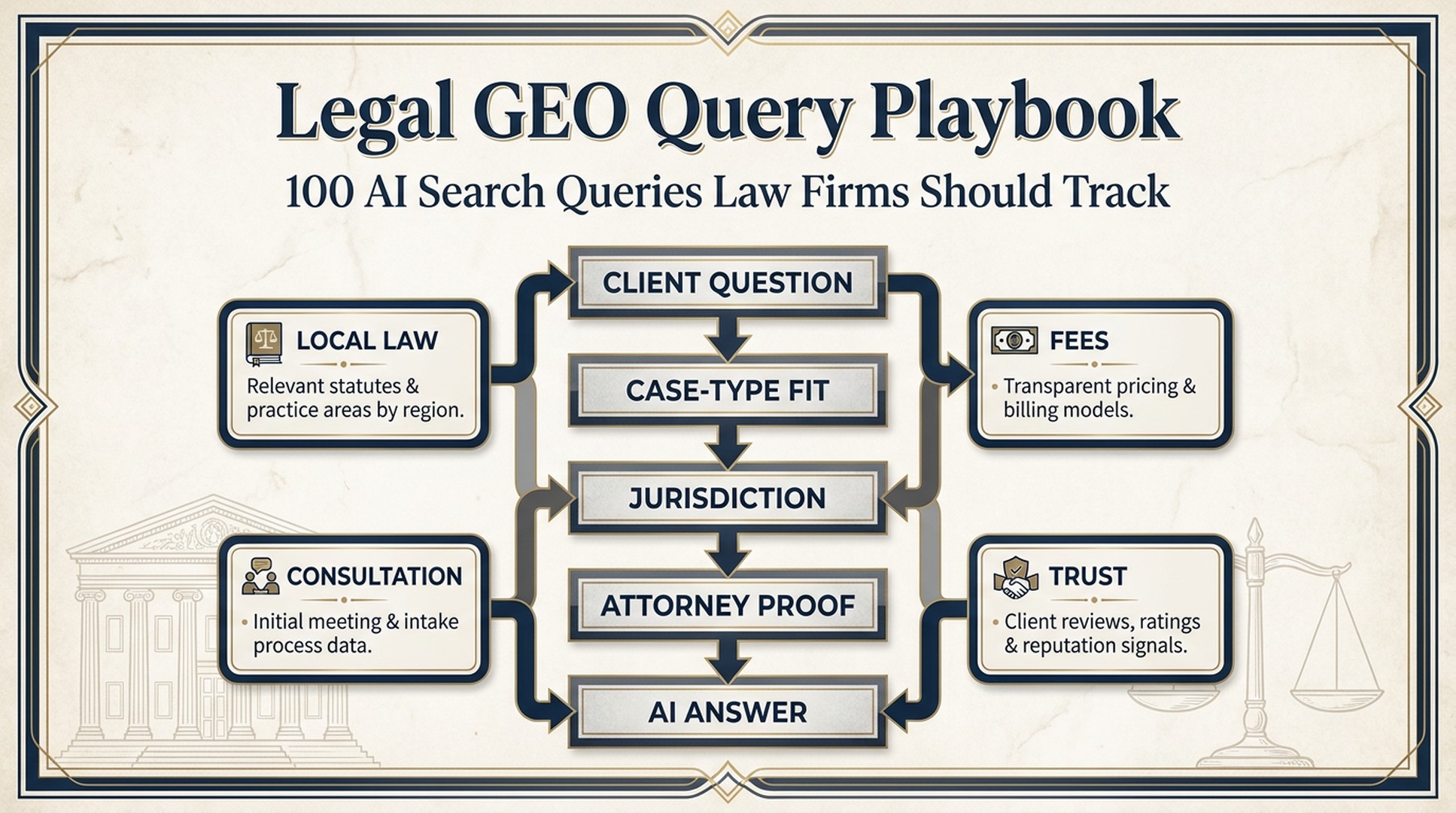
This playbook gives law firms 100 AI Search queries to track, a legal-specific prioritization model, a query-to-page map, and a 30-day execution workflow.
Important note: this article is about legal marketing and content strategy. It is not legal advice. Law firms should apply jurisdiction-specific rules, advertising ethics requirements, and attorney review before publishing legal content.
The Legal Search Decision Ladder
Legal AI Search visibility starts with understanding the ladder a potential client climbs before contacting a firm.
Most legal queries fall into one of five decision stages:
Stage | What The User Is Trying To Decide | Example Query | Best Page Asset |
|---|---|---|---|
1. Situation clarity | Is this legally serious? |
| Practice-area explainer |
2. Case-type fit | What kind of lawyer handles this? |
| Case-type guide |
3. Jurisdiction fit | Does location or state law matter? |
| Local practice page |
4. Firm selection | Which attorney or firm should I contact? |
| Selection checklist |
5. Contact confidence | What happens if I book a consultation? |
| Consultation process page |
A law firm that only publishes broad practice-area content usually misses stages 2-5. That is where many AI answer opportunities live.
For example, personal injury lawyer near me is a traditional SEO keyword. But an AI Search user may ask:
How do I know if a personal injury lawyer is worth contacting?What questions should I ask before hiring a car accident attorney?Do I need a lawyer if the insurance company already made an offer?Can a lawyer help if the accident happened in another state?
These queries require more than keyword targeting. They require explanation, constraints, jurisdiction awareness, and trust signals.
A practical way to begin is to test how the firm appears for real client prompts using an AI Search Visibility Checker, then build a query map around the gaps.
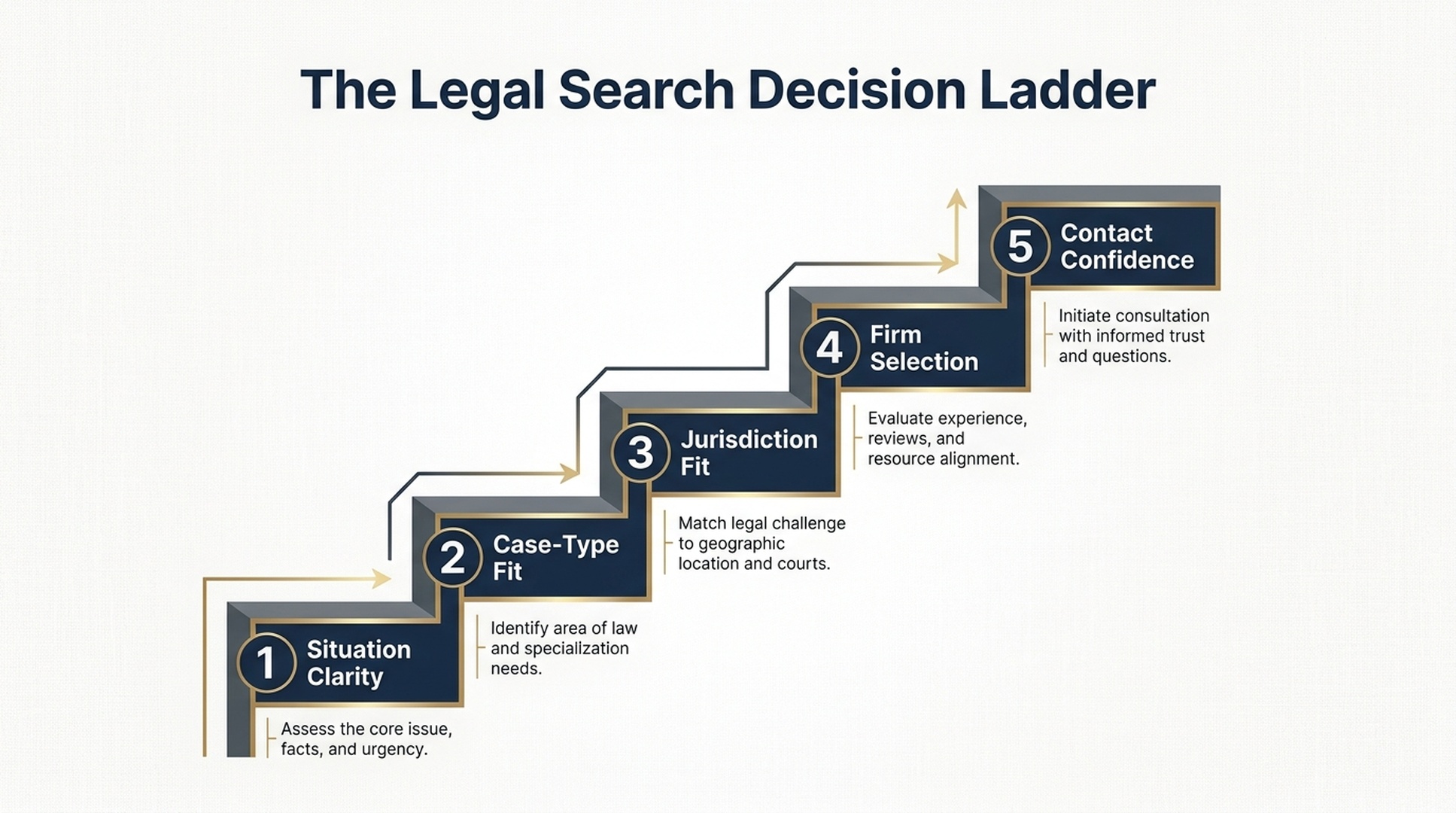
Legal AI Search queries often move through a decision ladder before a client contacts a firm.
Why Legal GEO Cannot Be Generic SEO With New Labels
Legal content faces three constraints that generic GEO advice often ignores.
First, jurisdiction matters. A query about employment law, divorce, landlord-tenant issues, criminal defense, or personal injury may change meaning depending on state, country, court system, or procedural rules. A page that fails to state location and scope may be too vague for both users and AI systems.
Second, legal marketing has ethical boundaries. Firms should avoid implying guaranteed outcomes, overstating case results, or presenting generalized legal information as advice for a specific person's situation.
Third, trust is personal. Potential clients evaluate the attorney, not just the firm. Attorney profiles, bar admissions, practice focus, consultation process, reviews, and transparent disclaimers all matter.
This is why legal GEO should be built around a case-fit content model:
User situation -> Legal category -> Jurisdiction -> Attorney fit -> Consultation next step
If a page does not help a user move along that chain, it may rank for keywords but still fail in AI answer environments.
The 10 Query Types Law Firms Should Map
Legal teams should classify prompts before writing content. The goal is to avoid a pile of overlapping blog posts and create clear owner pages instead.
Query Type | What The User Wants | Best Legal Content Asset |
|---|---|---|
Situation | Understand whether a problem may have legal significance | Practice-area explainer, issue guide |
Case-Type Fit | Identify what type of lawyer handles the issue | Case-type guide, practice hub |
Jurisdiction | Understand whether location, state, court, or venue matters | Local practice page, state-specific guide |
Attorney Selection | Choose a lawyer or firm | Selection checklist, attorney profile hub |
Cost / Fee | Understand fees, retainers, contingency, billing, or consultation cost | Fees page, consultation FAQ |
Process | Understand what happens before, during, or after hiring a lawyer | Consultation guide, process page |
Evidence / Documents | Know what to bring, preserve, or prepare | Document checklist, evidence guide |
Risk / Timing | Understand deadlines, mistakes, urgency, or when to act | Deadline explainer, risk checklist |
Trust / Reputation | Validate credibility, reviews, results, and credentials | Reviews page, attorney profiles, case-results page |
Local / Scenario | Match a location, court, case type, or client situation | Local page, scenario-specific guide |
For AI answer visibility, each query cluster should have a clear owner URL. If three blog posts and one practice page all answer the same question differently, AI systems have a weaker retrieval path.
How To Prioritize Legal GEO Queries
Use a scoring model that reflects legal risk and firm fit.
Priority = Client Intent + Case-Fit Value + Jurisdiction Clarity + Evidence Availability - Ethics Risk - Competition Difficulty
Factor | How To Evaluate It |
|---|---|
Client Intent | Is the user close to contacting a lawyer, booking a consultation, or comparing firms? |
Case-Fit Value | Does the query help the firm attract the right cases and avoid poor-fit inquiries? |
Jurisdiction Clarity | Can the answer clearly state geography, court, state, or legal-scope boundaries? |
Evidence Availability | Does the firm have attorney profiles, practice pages, reviews, case examples, process details, or FAQs to support the answer? |
Ethics Risk | Could the answer imply legal advice, guaranteed outcomes, or misleading claims? |
Competition Difficulty | Are legal directories, government sites, large firms, or high-authority publishers already dominant? |
Start with queries that help users choose the correct type of lawyer, understand the consultation process, compare law firms responsibly, and clarify local fit. These are commercially meaningful but safer than publishing definitive answers to complex legal questions.
100 Legal GEO Query Examples
Use these as a starting prompt library. Adapt them by practice area, jurisdiction, bar advertising rules, and attorney review requirements.
Situation Queries
- What should I do after receiving a legal notice?
- Do I need a lawyer after a car accident?
- Do I need a lawyer if an insurance company already made an offer?
- Do I need a lawyer for a workplace injury?
- Do I need a lawyer if I was fired unexpectedly?
- Do I need a lawyer before signing a severance agreement?
- Do I need a lawyer for a contested divorce?
- Do I need a lawyer if I was charged with a misdemeanor?
- Do I need a lawyer if my landlord is trying to evict me?
- Do I need a lawyer for a business contract dispute?
Case-Type Fit Queries
- What type of lawyer handles car accident claims?
- What type of lawyer handles truck accident cases?
- What type of lawyer handles unpaid overtime claims?
- What type of lawyer handles wrongful termination cases?
- What type of lawyer handles divorce and custody disputes?
- What type of lawyer handles DUI charges?
- What type of lawyer handles landlord-tenant disputes?
- What type of lawyer handles medical malpractice claims?
- What type of lawyer handles business partnership disputes?
- What type of lawyer handles estate disputes?
Jurisdiction Queries
- Does state law matter when choosing a lawyer?
- Do I need a local attorney for a personal injury case?
- Do I need a lawyer in the state where the accident happened?
- Can an attorney from another state represent me?
- Why do court location and venue matter in a lawsuit?
- Do divorce laws vary by state?
- Do employment law deadlines vary by state?
- Does a lawyer need to be admitted in my state?
- How do I find a lawyer familiar with local courts?
- What should a law firm explain on a local practice page?
Attorney Selection Queries
- How do I choose a personal injury lawyer?
- How do I choose a criminal defense attorney?
- How do I choose a divorce lawyer?
- How do I choose an employment lawyer?
- What questions should I ask before hiring a lawyer?
- What should I look for in an attorney profile?
- How important is practice-area focus when choosing a lawyer?
- Should I hire a large law firm or a small law firm?
- How do I compare law firms online?
- How do I know if a lawyer is a good fit for my case?
Cost / Fee Queries
- How much does a legal consultation usually cost?
- What does a free consultation with a lawyer include?
- What is a contingency fee in a personal injury case?
- What is an hourly legal fee?
- What is a legal retainer?
- How do law firms explain billing before someone hires them?
- Do divorce lawyers charge hourly or flat fees?
- Do criminal defense lawyers offer payment plans?
- What legal costs should clients ask about before hiring a lawyer?
- Why do attorney fees vary by case type?
Process Queries
- What happens during a first legal consultation?
- What should I bring to a consultation with a lawyer?
- What happens after I hire a lawyer?
- How long does it take for a lawyer to review my case?
- What happens after a personal injury claim is opened?
- What happens after someone files for divorce?
- What happens after a DUI arrest?
- What happens during a workplace discrimination claim?
- What happens before a business lawsuit is filed?
- How often should a lawyer update a client about a case?
Evidence / Document Queries
- What documents should I bring to a personal injury lawyer?
- What documents should I bring to a divorce consultation?
- What documents should I bring to an employment lawyer?
- What should I save after a car accident?
- What should I save after being fired?
- What evidence matters in a landlord-tenant dispute?
- What evidence matters in a business contract dispute?
- Should I keep text messages for a legal case?
- Should I talk to the other party before consulting a lawyer?
- How should clients organize documents before contacting a law firm?
Risk / Timing Queries
- How quickly should I contact a lawyer after an accident?
- What mistakes should I avoid after a car accident?
- What mistakes should I avoid during a divorce?
- What mistakes should I avoid after being arrested?
- What mistakes should I avoid after being fired?
- What is a statute of limitations?
- Why do legal deadlines matter?
- Can waiting too long hurt a legal case?
- Should I sign a settlement agreement before talking to a lawyer?
- Should I post about my case on social media?
Trust / Reputation Queries
- How do I know if a law firm is trustworthy?
- Are online lawyer reviews reliable?
- How should I read law firm case results?
- What should a law firm disclose about past results?
- How can I verify a lawyer's bar admission?
- What makes an attorney profile credible?
- How important are client testimonials when choosing a lawyer?
- What should I look for on a law firm's About page?
- What makes legal content trustworthy online?
- How can I tell if a legal website is giving general information or legal advice?
Local / Scenario Queries
- Personal injury lawyer near me for a car accident consultation
- Divorce lawyer near me for contested custody issues
- Criminal defense attorney near me after a DUI arrest
- Employment lawyer near me for wrongful termination questions
- Business litigation lawyer near me for a contract dispute
- Estate dispute lawyer near me for family conflict
- Landlord-tenant lawyer near me for eviction questions
- Spanish-speaking lawyer near me for a consultation
- Lawyer near me with evening consultation hours
- Law firm near me that handles cases in local court
How To Turn Legal Queries Into Citation-Ready Pages
A legal prompt library should become a page architecture, not a mass blog calendar. The best structure depends on practice area, but most law firms need a mix of these page assets.
Query Cluster | Owner Page | Page Type | Required Proof |
|---|---|---|---|
Case-type fit questions | Practice area hub | Practice page | Case types handled, exclusions, attorney review, jurisdiction scope |
Attorney selection questions | Lawyer selection guide | Decision guide | Selection checklist, credentials, process, no-guarantee disclaimer |
Jurisdiction questions | State or city practice page | Local page | Admissions, court/location notes, service area, local contact path |
Fee and consultation questions | Fees and consultation page | FAQ / policy page | Fee model, consultation scope, billing caveats, update date |
Process questions | What-to-expect page | Process page | Intake steps, communication expectations, next-step CTA |
Evidence questions | Document checklist | Checklist page | Document examples, preservation cautions, attorney review note |
Timing and risk questions | Deadline and mistake guide | Risk guide | General deadline explanation, jurisdiction disclaimer, urgent CTA |
Trust questions | Attorney profiles and reviews page | Trust page | Bar admission, practice focus, reviews, testimonials, result disclaimers |
A strong legal GEO page should state what it can and cannot answer. For example, a page can explain what a consultation usually covers, but it should not tell every visitor what their case is worth. It can explain common factors in a claim, but it should not promise an outcome.
For technical readiness, legal websites should also make sure key practice pages are crawlable, indexable, and easy to summarize. A basic Website SEO Score Checker can catch crawl and metadata issues before the firm rewrites content for AI Search.
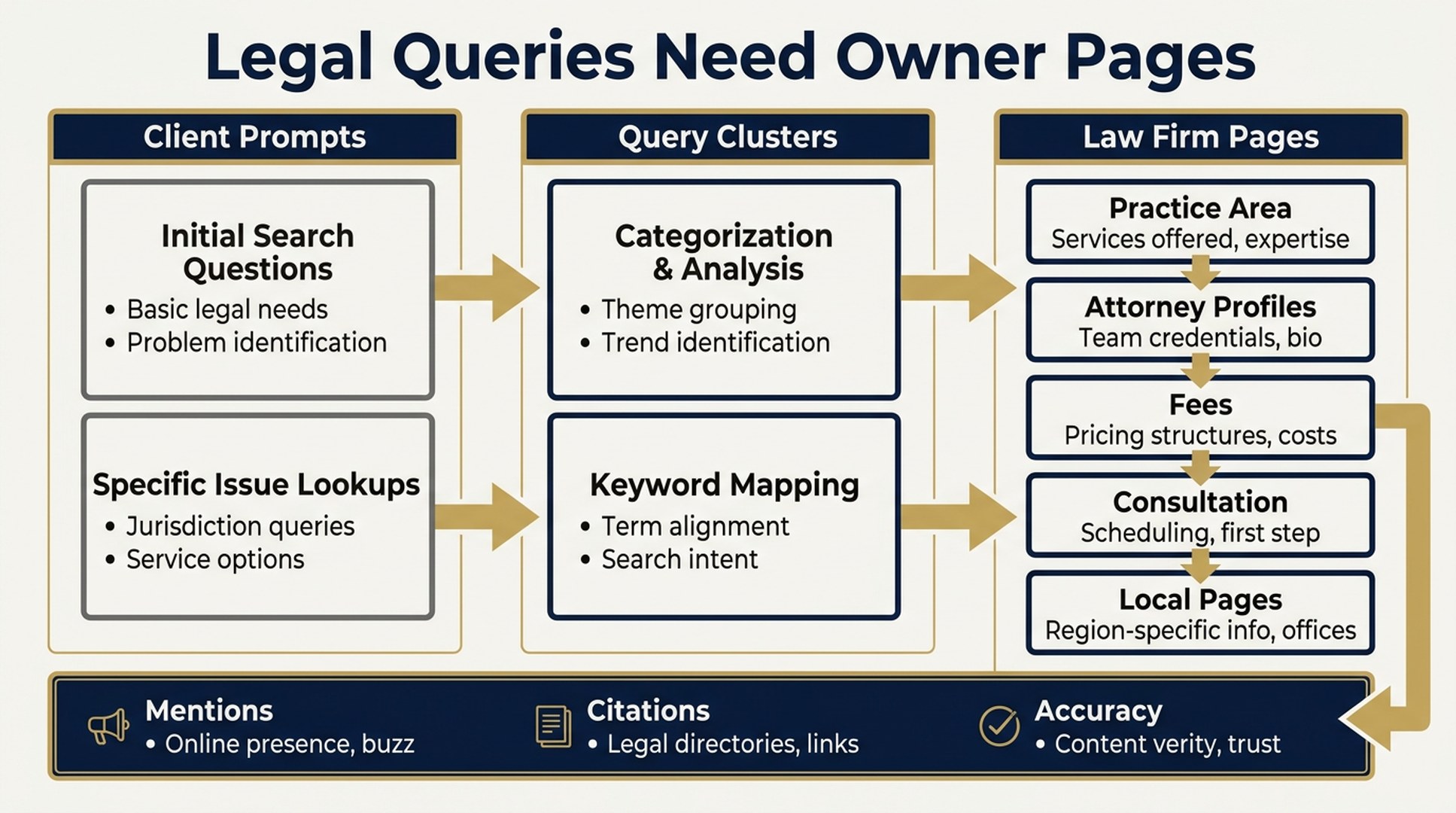
Legal GEO works best when query clusters map to clear owner pages instead of many overlapping blog posts.
The First 20 Queries To Prioritize
If a law firm is starting from scratch, these 20 queries usually make a strong first backlog because they help users decide whether to contact the firm without requiring risky case-specific advice.
Priority | Query | Why It Matters | Likely Owner Page |
|---|---|---|---|
1 | How do I choose a personal injury lawyer? | High firm-selection intent | Selection guide |
2 | What questions should I ask before hiring a lawyer? | Helps users compare firms | Consultation checklist |
3 | What happens during a first legal consultation? | Reduces contact friction | Consultation process page |
4 | What should I bring to a consultation with a lawyer? | Useful and low-risk | Document checklist |
5 | What type of lawyer handles car accident claims? | Clarifies case-type fit | Personal injury hub |
6 | What type of lawyer handles wrongful termination cases? | Clarifies practice fit | Employment law page |
7 | Do I need a local attorney for a personal injury case? | Adds jurisdiction clarity | Local practice page |
8 | Does state law matter when choosing a lawyer? | Explains scope | Jurisdiction guide |
9 | What is a contingency fee in a personal injury case? | Explains fee model | Fees page |
10 | What legal costs should clients ask about before hiring a lawyer? | Builds transparency | Billing FAQ |
11 | How do I know if a law firm is trustworthy? | Strong trust query | About / trust page |
12 | What makes an attorney profile credible? | Supports attorney pages | Attorney profile hub |
13 | Are online lawyer reviews reliable? | Helps reputation interpretation | Reviews guide |
14 | How can I verify a lawyer's bar admission? | Builds credibility | Credentials guide |
15 | What mistakes should I avoid after a car accident? | Urgent but general | Practice risk guide |
16 | What is a statute of limitations? | High legal timing intent | Deadline explainer |
17 | Can waiting too long hurt a legal case? | Encourages timely consultation | Timing guide |
18 | Should I sign a settlement agreement before talking to a lawyer? | High decision impact | Settlement caution page |
19 | Lawyer near me with evening consultation hours | Local conversion query | Location page |
20 | Spanish-speaking lawyer near me for a consultation | Access and local intent | Language access page |
30-Day Execution Plan
Timeframe | Action | Output |
|---|---|---|
Days 1-3 | Build the legal AI Search prompt library and classify by practice area, jurisdiction, and decision stage | 100-query legal prompt library |
Days 4-7 | Score queries using client intent, case-fit value, jurisdiction clarity, evidence, ethics risk, and competition | First 20 query backlog |
Days 8-14 | Map the first 20 queries to existing or missing pages | Query-to-page map |
Days 15-21 | Rewrite priority pages with direct answers, jurisdiction scope, disclaimers, attorney proof, and consultation CTAs | Updated citation-ready pages |
Days 22-30 | Test prompts across AI answer surfaces and track brand mentions, cited URLs, competitors, and inaccurate summaries | AI visibility tracker |
The best first pages for many firms are not blog posts. They are usually the practice area hub, consultation page, attorney profiles, fee explainer, local pages, and a few high-intent decision guides.
Common Mistakes
Legal GEO fails when firms treat all legal questions as keyword targets instead of client-decision prompts.
Avoid these mistakes:
- Publishing generic legal definitions without jurisdiction scope. The answer may be too vague to trust.
- Implying legal advice where the page only provides general information. Add clear boundaries and attorney review.
- Overusing case results without disclaimers. Results can support credibility, but they should not imply guaranteed outcomes.
- Hiding attorney proof. Bar admission, practice focus, attorney bios, and consultation process should be easy to find.
- Creating overlapping blog posts for the same query. Assign one owner page per query cluster.
- Ignoring local intent. Many legal queries depend on state, court, county, language access, and consultation availability.
- Measuring only rankings. GEO also requires tracking AI mentions, citations, competitor inclusion, and inaccurate summaries.
FAQ
What is legal GEO?
Legal GEO is the process of making law firm pages easier for AI answer systems to understand, summarize, and cite. It combines SEO foundations with clearer practice-area pages, jurisdiction-aware explanations, attorney proof, consultation guidance, and prompt-level monitoring.
Is legal GEO the same as law firm SEO?
No. Law firm SEO focuses on search visibility, rankings, local SEO, technical health, content quality, and conversions. Legal GEO builds on that foundation but focuses on whether AI systems mention the firm, cite its pages, and describe its practice areas accurately.
Should law firms publish 100 blog posts for 100 AI Search queries?
No. A legal query library should become a page map. Many questions should be answered by practice pages, attorney profiles, consultation pages, fee FAQs, local pages, and trust pages rather than thin standalone blog posts.
What legal GEO queries should a law firm start with?
Start with questions about attorney selection, case-type fit, consultation process, fees, jurisdiction, local access, documents to prepare, and how to evaluate trust. These are commercially useful and can often be answered without giving case-specific legal advice.
How can law firms avoid legal marketing risk in GEO content?
Use attorney review, jurisdiction-specific scope, disclaimers where appropriate, careful case-result language, clear fee explanations, and no outcome guarantees. The goal is to educate and clarify fit, not to provide personalized legal advice on a public page.
How should law firms measure GEO performance?
Track a fixed set of prompts across AI answer surfaces available in the firm's market. Record whether the firm appears, which URL is cited, which competitors are mentioned, whether the answer is accurate, and whether the answer reflects the firm's actual practice areas.
Auspia Takeaway
Legal GEO is not a race to publish more legal content. It is a system for making the right legal pages clearer, safer, and easier for AI systems to cite.
Start with the client decision ladder: situation clarity, case-type fit, jurisdiction fit, firm selection, and contact confidence. Then map the first 20 high-intent prompts to strong owner pages. If a page can explain scope, process, proof, limitations, and next steps better than a generic directory profile, it has a stronger chance of becoming useful in AI Search.
Author: Elena Shaw, Prompt Library Strategist, 3,000+ Buyer Prompts Mapped at Auspia. Elena writes about query maps, prompt libraries, and practical AI Search workflows for growth teams.