The comparison between a local model and a hosted one usually ends with a recommendation to pick one. That is the wrong conclusion.
The two models have different strengths, and those strengths are complementary. Laya is free, local, and fast, which makes it ideal for the high-volume decisions. Jev is more accurate out of the box and better calibrated, which makes it ideal for the decisions Laya is unsure about.
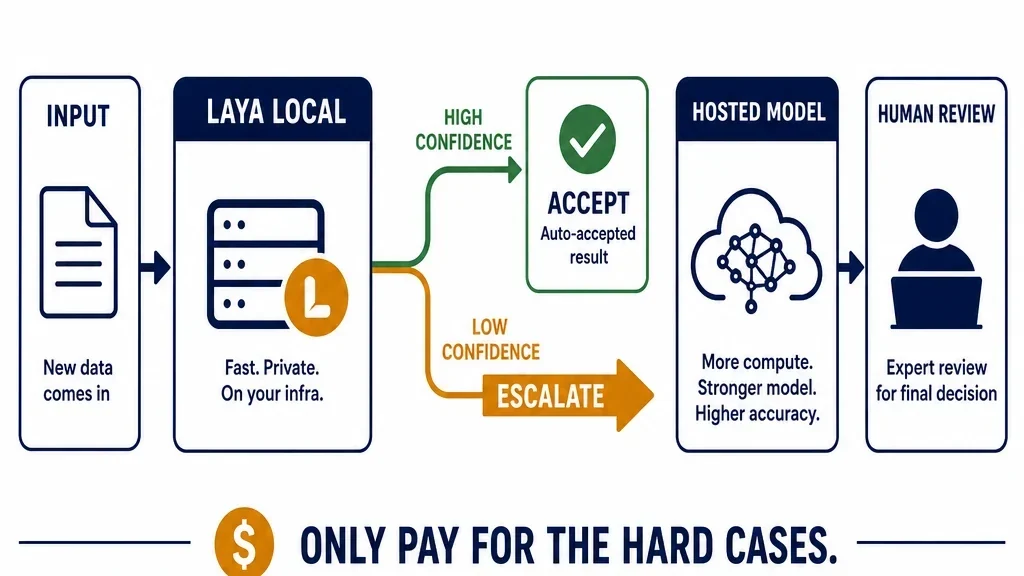
Put them in sequence and you get the cost profile of the local model with the accuracy of the hosted one, and you only pay for the hard cases.
This article covers the architecture, the routing question that makes it work, and the failure mode that makes it dangerous if you get the routing wrong.
What you will finish with
A hybrid pipeline where:
- Every decision runs locally first
- Only low-confidence decisions escalate to the hosted model
- The escalation rate is measured, not assumed
- Data-handling rules are explicit about what may leave the machine
- The confident-wrong failure mode is handled
Who this is for: anyone who has read the comparison and wants the practical synthesis rather than a choice.
Prerequisites:
- Laya running locally
- Access to a hosted decision model
- A labeled sample for measuring both models
- A clear rule about which data may leave your infrastructure
Definition of done: you know your escalation rate, your blended cost per decision, and your accuracy on the decisions that never escalated.
The architecture
input
  -> Laya (local, free)
      -> high confidence  -> accept
      -> low confidence   -> escalate
  -> Jev (hosted, paid)
      -> accept
  -> human review for anything still uncertain
Three stages, in order of cost. The cheap stage handles the volume. The expensive stage handles the residue. The human handles what neither model will commit to.
The design principle is the same one that runs through this whole series: cheap filter first, expensive judgment second. The only difference is that the expensive judgment is now a different model rather than a human.
The routing question
The whole architecture depends on one decision: should this case escalate?
There are two ways to make it, and they are not equivalent.
Option 1: route on confidence
The simplest approach. If Laya's confidence is below your threshold, escalate.
if laya_confidence < threshold:
    escalate to Jev
else:
    accept Laya's answer
This is easy to implement and easy to reason about. Its weakness is that confidence is not the same as correctness. A model can be confidently wrong, and a confidence-based router will happily accept those cases.
Option 2: route on a separate question
Ask Laya a second question about its own first answer.
Is this decision uncertain or ambiguous?

true  — the input is ambiguous, the criteria do not clearly apply, or the
        correct answer depends on information not present

false — the input clearly matches one option and the criteria apply
This is a noul question, and it costs almost nothing because the model is local. It catches a different failure mode than raw confidence: cases where the input itself is ambiguous rather than cases where the model is unsure.
Use both. Route on confidence OR on the ambiguity question. Either signal should trigger escalation.
Set the threshold from your own data
Same procedure as everywhere else in this series, and here it has a direct cost consequence.
- Take your labeled sample.
- Run it through Laya.
- For each confidence level, measure two things: the accuracy on the accepted set, and the share of cases that would escalate.
- Pick the threshold where the accuracy is acceptable and the escalation rate is affordable.
A worked example, with invented numbers:
Threshold | Accepted accuracy | Escalation rate | Blended cost per decision |
|---|---|---|---|
0.6 | 78% | 12% | low |
0.7 | 86% | 24% | low |
0.8 | 92% | 41% | medium |
0.9 | 96% | 63% | high |
The trade is visible. A higher threshold buys accuracy and pays for it in escalation. There is no universal right answer, and the table above is the calculation you run with your own numbers.
Higher threshold, better accuracy, more escalation. Pick your point on the curve.
The cost model
The blended cost is the number that decides whether the hybrid is worth building.
blended_cost = local_cost_per_decision
             + escalation_rate x hosted_cost_per_decision
Because the local cost is effectively zero at the margin, this simplifies to:
blended_cost = escalation_rate x hosted_cost_per_decisionWorked example, with invented numbers:
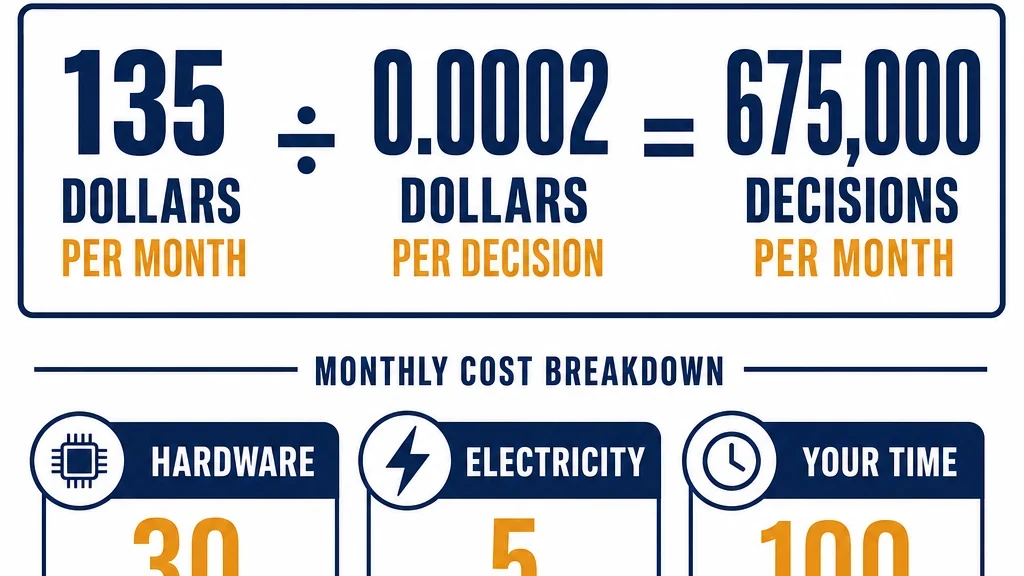
- Hosted cost per decision: $0.0002
- Escalation rate at your threshold: 24%
- Blended cost: $0.000048 per decision
That is roughly a quarter of the cost of sending everything to the hosted model, at 86% accuracy on the accepted set.
Compare that to the alternative. Sending everything to the hosted model costs $0.0002 per decision and gets you its accuracy. The hybrid costs a quarter of that and gets you 86% of the accuracy on the accepted set, plus the hosted model's accuracy on the escalated set.
Whether that is a good trade depends on how much the accuracy difference is worth to you. For a high-volume, low-stakes classification, it usually is. For a decision that affects a client deliverable, it may not be.
Data-handling rules
This is where the hybrid gets complicated, and it deserves an explicit policy rather than an assumption.
The whole point of running Laya locally is that data does not leave your machine. If you escalate to a hosted model, that data does leave. So you need a rule.
Rule 1: classify your data before you route it. Some inputs may never leave your infrastructure, regardless of confidence. Client data under a confidentiality agreement, unpublished strategy, anything with personal information. Mark these as local-only and never escalate them.
Rule 2: escalate the decision, not the data. Where possible, send the hosted model a minimized version of the input: the specific passage and the question, without the surrounding context. This is not always possible, but it should be the default.
Rule 3: log what escalated. Keep a record of which inputs went to the hosted model and why. When someone asks whether client data was transmitted, you need to be able to answer.
Rule 4: make the local-only path explicit in code. Do not rely on the threshold to protect sensitive data. A threshold is a tuning parameter, and someone will change it. A local-only flag is a rule.
The failure mode that makes this dangerous
Here is the thing to be careful about.
The hybrid architecture assumes that a confident local answer is a correct local answer. When that assumption fails, you have shipped a wrong decision without review, and you did it cheaply and at scale.
Laya's probabilities are overconfident. Its reported calibration error is worse than the hosted alternative's, and the temperature parameter was fitted on training data. There is a documented case where the English checkpoint scored 0.080 accuracy on Bengali script while reporting 0.945 confidence.
So the failure mode is real, and it looks like this: a batch of inputs that Laya handles confidently and wrongly, accepted without escalation, producing a large volume of consistent errors.
How to defend against it:
Run in shadow mode first. For a week, let the hybrid pipeline run without acting on its output. Compare Laya's accepted decisions against the hosted model's answers on the same inputs. The disagreement rate on accepted cases is your real error rate, and it is usually higher than the confidence suggests.
Sample the accepted set continuously. Every day, take a random sample of accepted decisions and check them by hand. If the error rate drifts up, your threshold is wrong or your inputs have changed.
Watch for input drift. A model tuned on last quarter's content may be confidently wrong on this quarter's. Re-measure when your content or query mix changes.
Never let the accepted set go unreviewed forever. Even a small error rate compounds across thousands of decisions. Periodic sampling is not optional.
Wiring it in
The pipeline is a function with three branches.
def decide(state, question, local_only=False):
    local = laya.decide(state, question)

    if local_only:
        return route_to_human(local) if local.confidence < LOCAL_THRESHOLD else local

    if local.confidence < ESCALATION_THRESHOLD:
        return jev.decide(state, question)

    if local.confidence < REVIEW_THRESHOLD:
        return route_to_human(local)

    return local
Three thresholds, and they do different jobs.
The escalation threshold decides when to pay for the hosted model.
The review threshold decides when to stop trusting either model and ask a person.
The local-only threshold is stricter than the escalation threshold, because data that cannot leave the machine has no second model to fall back on.
Verify before you rely on it
Three checks.
Measure the escalation rate. If it is much higher than you planned, your threshold is too high or your task is harder than expected. Both are worth knowing.
Measure accuracy on the accepted set. This is the number that matters. The escalated set is handled by a more accurate model, so the accepted set is where your errors live.
Measure the disagreement rate. For a sample of accepted decisions, run the hosted model on the same input and see how often it disagrees. That disagreement rate is your error estimate, and it is the cheapest way to monitor the pipeline without hand-labeling everything.
Maintain it
Re-measure both models after any change. A new checkpoint for either model invalidates your thresholds.
Re-check the escalation rate monthly. If it drifts, your inputs have changed.
Keep the local-only list current. New client engagements bring new data-handling rules.
Revisit the cost model. Hosted pricing changes, and your hardware amortization changes. The break-even point moves.
What to do next
Build the pipeline in shadow mode first. Run it for a week without acting on the output, and measure three numbers: your escalation rate, your accuracy on the accepted set, and the disagreement rate against the hosted model.
Those three numbers tell you whether the hybrid is worth running. If the escalation rate is low and the accepted accuracy is high, you have a pipeline that costs a fraction of the hosted-only version. If the escalation rate is high, you have learned that your task needs the more accurate model, and you should send everything to it.
Either answer is useful, and both are better than guessing.
Read the rest of the series
This article is part of a thirteen-part series on using Laya for SEO and GEO work.
- Start here: how to use Laya for SEO and GEO
- What Laya is: the open decision model, explained
- Running Laya locally: hardware, latency, and the real cost model
- Laya for search intent classification at scale
- Fine-tuning Laya on your own SEO labels
- Laya as a local reranker for internal search and RAG
- Laya for GEO answer scoring, offline
- Laya for content audits: keep, update, merge, remove
- Laya for internal linking, and where it breaks
- Guardrails: using Laya to check your own agents
- Laya vs Jev: an honest decision guide
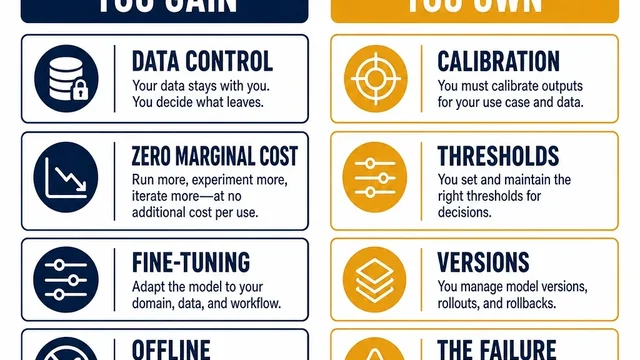
- The open-model trade: what you own when you self-host
Author: Ethan Marlowe, GEO Measurement Lead Across 500+ Prompts at Auspia. Ethan writes about prompt tracking, citation reporting, visibility dashboards, and AI answer quality checks.