Every article in this series has been about a specific workflow. This one is about the decision underneath all of them.
When you self-host an open model, you are not just choosing a cheaper way to make the same calls. You are taking on a set of responsibilities that a hosted API quietly handled for you. Some of those responsibilities are the reason to self-host. Others are the reason people give up.
This article is the honest accounting.
The short version
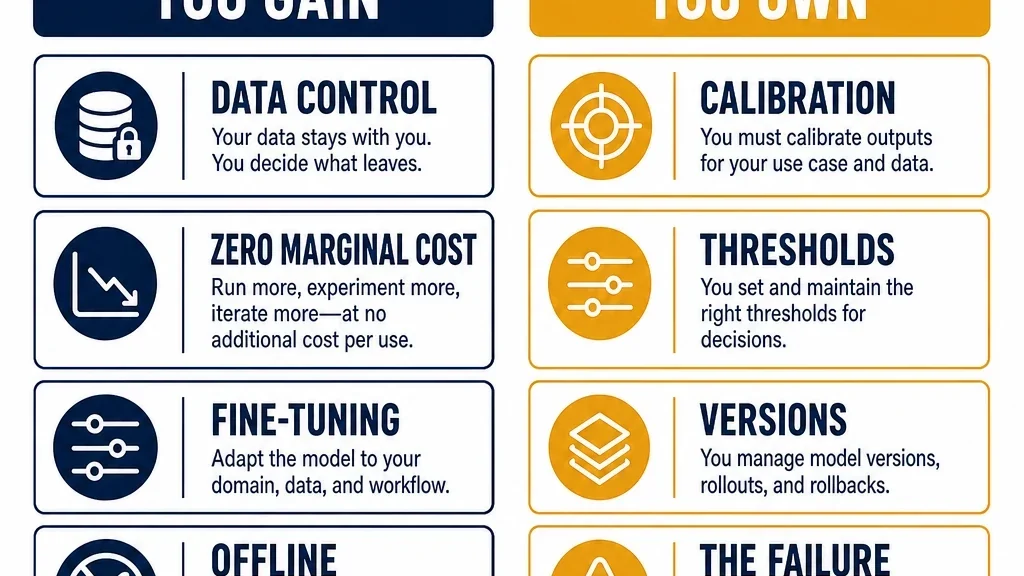
What you gain: control over your data, zero marginal cost, the ability to fine-tune, the ability to run offline, and the ability to inspect and modify the model.
What you take on: calibration, thresholds, version management, dependency maintenance, and the fact that when it breaks, nobody else is fixing it.
What you lose: the vendor's accuracy, their calibration work, their infrastructure, and the ability to escalate a problem to someone whose job it is to solve it.
The trade is real in both directions, and it is worth making for a specific set of teams. This article is about knowing whether you are one of them.
What you actually own
Five things, and each one is a job rather than a feature.
1. Calibration
A hosted model's confidence values are tuned by the vendor, and you inherit whatever work they did. When you self-host, you inherit the raw numbers.
Laya's probabilities are overconfident. Its reported calibration error is worse than the hosted alternative's, and the temperature parameter used to tune it was fitted on training data. That means the confidence value is not a probability you can take at face value.
Your job: measure calibration on your own data and set your thresholds accordingly. Never take a threshold from documentation.
This is the single most important responsibility, because every routing decision in every workflow in this series depends on it. Get it wrong and you will auto-accept the cases you should have reviewed.
2. Thresholds
A threshold is a business decision disguised as a technical parameter.
Where you set it determines how much of your volume gets automated and how much goes to a human. That is a trade between cost and risk, and only you can make it.
Your job: set thresholds per workflow, and set them differently for destructive actions than for reversible ones. A wrong content label costs you a correction. A wrong deletion costs you a page.
3. Version management
A hosted API is a moving target you do not control, but it is also one you do not have to manage. A self-hosted model is a fixed artifact you do control, and that means you own the versioning.
Your job: pin your model version, pin your runtime version, keep a known-good environment, and re-measure accuracy after any change. A new checkpoint is a new model, and your thresholds do not transfer.
4. Dependency maintenance
The model is a Python package with dependencies, running on a runtime that has its own version history. When you update one thing, you may break another.
Your job: budget for it. This is the line everyone underestimates, and it is the reason the break-even calculation in the cost article is dominated by labor rather than hardware.
5. The failure
This is the one people do not think about until it happens.
When a hosted API returns something wrong, you have a support channel, a status page, and a vendor whose reputation depends on fixing it. When your self-hosted model returns something wrong, you have a bug.
Your job: own it. Log every decision, keep the inputs, and build the ability to reconstruct what happened. The log is your only diagnostic tool, and it is also your evidence when someone asks why a decision was made.
What you gain
The other side of the ledger, and it is not small.
Data control
The strongest reason, and the one that settles the question for many teams. If your data cannot leave your infrastructure, there is no comparison to make. You self-host, and the cost is whatever it costs.
This is not only a compliance issue. It is a commercial one. An agency that can tell a client their data never left the agency's infrastructure has something a competitor using a hosted API cannot say.
Zero marginal cost
Every decision after the first one is free at the margin. That changes what you can afford to attempt. Audits you would have sampled, you can now run in full. Questions you would have asked sparingly, you can ask on every row.
This is a subtler benefit than it sounds. The interesting change is not that the same work gets cheaper. It is that work you had ruled out becomes possible.
Fine-tuning
The capability a hosted model cannot offer. You can train the model on your own labeled decisions and get something that knows your taxonomy.
This is where the accuracy lives, and it is the single strongest technical argument for an open model.
Offline operation
The model runs without a network. If your environment is air-gapped, or if you need the workflow to keep running when a service is down, this is not a convenience. It is a requirement.
Inspectability
You can look at the weights, read the training method, and modify the model. For most teams this matters less than the other four, but for anyone building something they need to defend, it matters a great deal.
What you lose
Three things, stated plainly.
The vendor's accuracy. Out of the box, the hosted model is better. If you are not going to fine-tune, you are trading accuracy for control, and you should be honest with yourself about that trade.
The vendor's calibration work. You inherit raw probabilities and have to do the calibration yourself.
The ability to escalate. No support channel, no status page, no one whose job it is to fix your problem.
The ledger. Both columns are real.
How to tell whether the trade is working
Four measurements. If you are not tracking these, you do not know whether self-hosting is working.
1. Accuracy on your own labeled data
Not the benchmark number. Your number, on your task, measured on data the model never saw.
Track it over time. If it degrades, either your inputs have drifted or a version change broke something.
2. The auto-accept rate
What share of decisions land above your threshold and get applied without review?
This number is the whole economic argument for self-hosting. If it is very low, you are paying the maintenance cost without getting the automation benefit, and you should either fix your criteria or reconsider.
3. The error rate on the auto-accepted set
This is the number that matters most and the one people skip.
Take a random sample of auto-accepted decisions every week and check them by hand. The error rate on that sample is your real quality number. Confidence is not a substitute for it.
If this number drifts up, your threshold is wrong or your inputs have changed. Both are worth knowing early.
4. The maintenance hours
Track the actual time you spend on the self-hosted component. Model updates, dependency fixes, threshold retuning, debugging.
This is the number that determines whether self-hosting was cheaper. If you are not tracking it, you are guessing, and the guess is usually wrong.
When to stop self-hosting
There is no shame in this, and it is worth saying explicitly because the sunk-cost trap is real.
If your auto-accept rate stays low. You are doing the maintenance without getting the automation. Either fix the criteria or move to a hosted model.
If your maintenance hours exceed the cost difference. Run the calculation. If you are spending ten hours a month to save twenty dollars, stop.
If nobody owns it. A self-hosted component with no owner degrades. If the person who set it up has moved on and nobody else maintains it, migrate.
If the accuracy is not good enough and you are not going to fine-tune. Fine-tuning is the reason to choose an open model. If you are not going to do it, you are taking on the maintenance for the privacy benefit alone, and that may not be worth it.
The honest summary
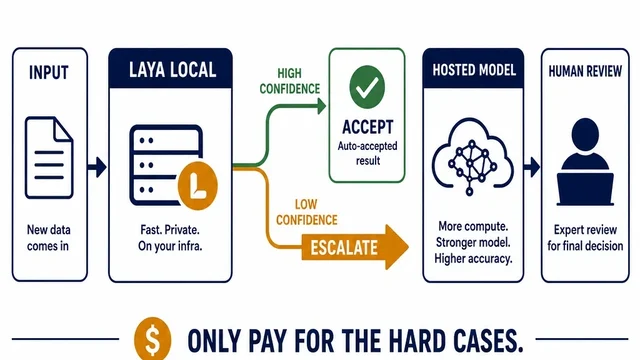
Laya is not a free version of a hosted decision model. It is a different tool with a different cost structure.
You are trading per-call pricing for hardware and labor. You are trading the vendor's accuracy and calibration for control and the ability to fine-tune. You are trading a support channel for ownership.
For a team with data that cannot leave the building, a labeled dataset worth training on, and someone who will own the component, that trade is clearly worth making. You get a model that knows your taxonomy, runs on your hardware, and costs nothing per call.
For a team prototyping an idea, running a few hundred decisions a month, or without anyone to maintain the component, the hosted model is the responsible choice.
Both answers are correct. The mistake is choosing based on the word "free" without doing the accounting.
What to do next
If you have read this far, you have the whole picture. Here is the sequence.
Start with the getting-started guide and run the thirty-minute test. Measure your baseline. Then pick one workflow and build it, with a threshold measured on your own data.
If it works, expand. If it does not, fine-tune before you give up on the model, because that is where the accuracy lives.
And track the four numbers above from the beginning. Accuracy, auto-accept rate, error rate on the accepted set, and maintenance hours. Those four tell you whether the trade is working, and they are the only way to know.
Read the rest of the series
This article is part of a thirteen-part series on using Laya for SEO and GEO work.
- Start here: how to use Laya for SEO and GEO
- What Laya is: the open decision model, explained
- Running Laya locally: hardware, latency, and the real cost model
- Laya for search intent classification at scale
- Fine-tuning Laya on your own SEO labels
- Laya as a local reranker for internal search and RAG
- Laya for GEO answer scoring, offline
- Laya for content audits: keep, update, merge, remove
- Laya for internal linking, and where it breaks
- Guardrails: using Laya to check your own agents
- Laya vs Jev: an honest decision guide
- Building a hybrid stack: Laya local, Jev cloud
Author: Isabel Grant, Researcher of 2,000+ AI Citation Patterns at Auspia. Isabel writes about citation earning, source quality, and how AI systems decide which sources to trust.