Quick Answer
Ecommerce GEO starts where shoppers ask AI systems for help choosing, comparing, and validating products. These queries are not just running shoes, protein powder, or office chair. They are decision prompts:
best running shoes for flat feet under $150is this jacket warm enough for winter travel?which air purifier is best for pet hair in a small apartment?does this brand have easy returns?what should I check before buying refurbished electronics?
For ecommerce brands, the most valuable GEO work is not publishing more generic buying guides. It is making product, category, comparison, review, policy, and availability pages clear enough for AI systems to retrieve, compare, and summarize.
A practical ecommerce GEO program should map shopper prompts to page assets:
- product detail pages with specs, use cases, constraints, images, variants, and review summaries;
- category pages that explain product differences and buyer criteria;
- comparison pages that help shoppers choose between models, materials, sizes, or bundles;
- review pages that summarize real customer feedback without cherry-picking;
- shipping, return, warranty, and availability pages that reduce buying risk;
- gift, scenario, and audience pages that match how people actually ask AI shopping questions.
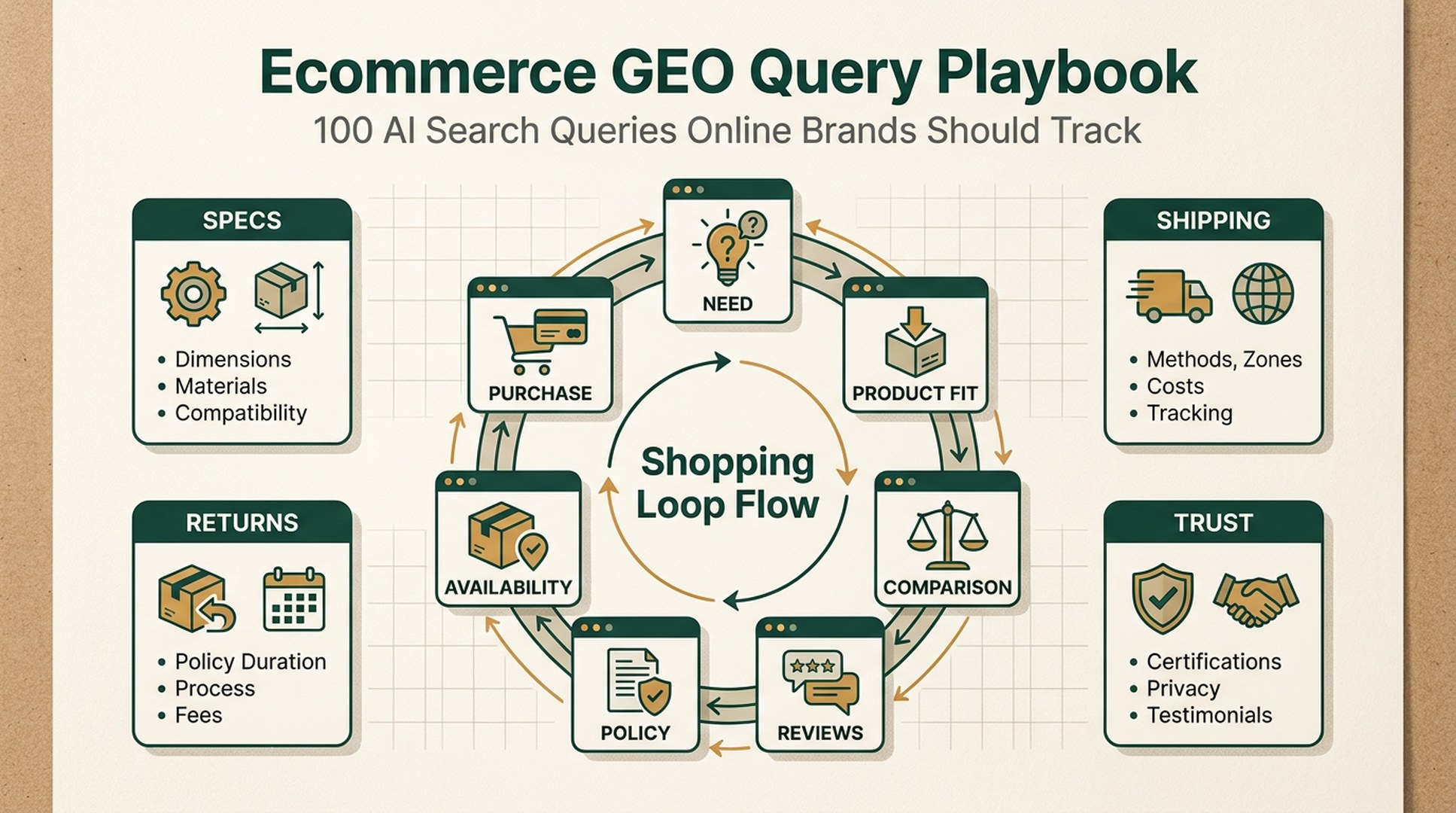
This playbook gives ecommerce teams 100 AI Search queries to track, an ecommerce-specific prioritization model, a query-to-page map, and a 30-day execution plan.
The Ecommerce AI Shopping Loop
AI-assisted shopping usually does not follow a straight keyword path. A shopper may start with a use case, ask for product types, compare options, check reviews, verify fit, and then look for shipping or return details before buying.
The ecommerce AI shopping loop looks like this:
Stage | What The Shopper Asks | Page That Should Support The Answer |
|---|---|---|
Need |
| Use-case guide |
Product Type |
| Category explainer |
Fit |
| Scenario page |
Comparison |
| Comparison page |
Proof |
| Review summary / product page |
Policy |
| Return policy page |
Availability |
| Product / inventory page |
Purchase |
| Product detail / collection page |
This is why ecommerce GEO should be treated as a product information system, not a blog-only strategy. AI systems need structured product facts, real reviews, shipping rules, return terms, pricing, inventory, and clear “best for / not for” language.
A good starting point is to test whether your brand appears for real shopping prompts using an AI Search Visibility Checker, then build your query map around the gaps.
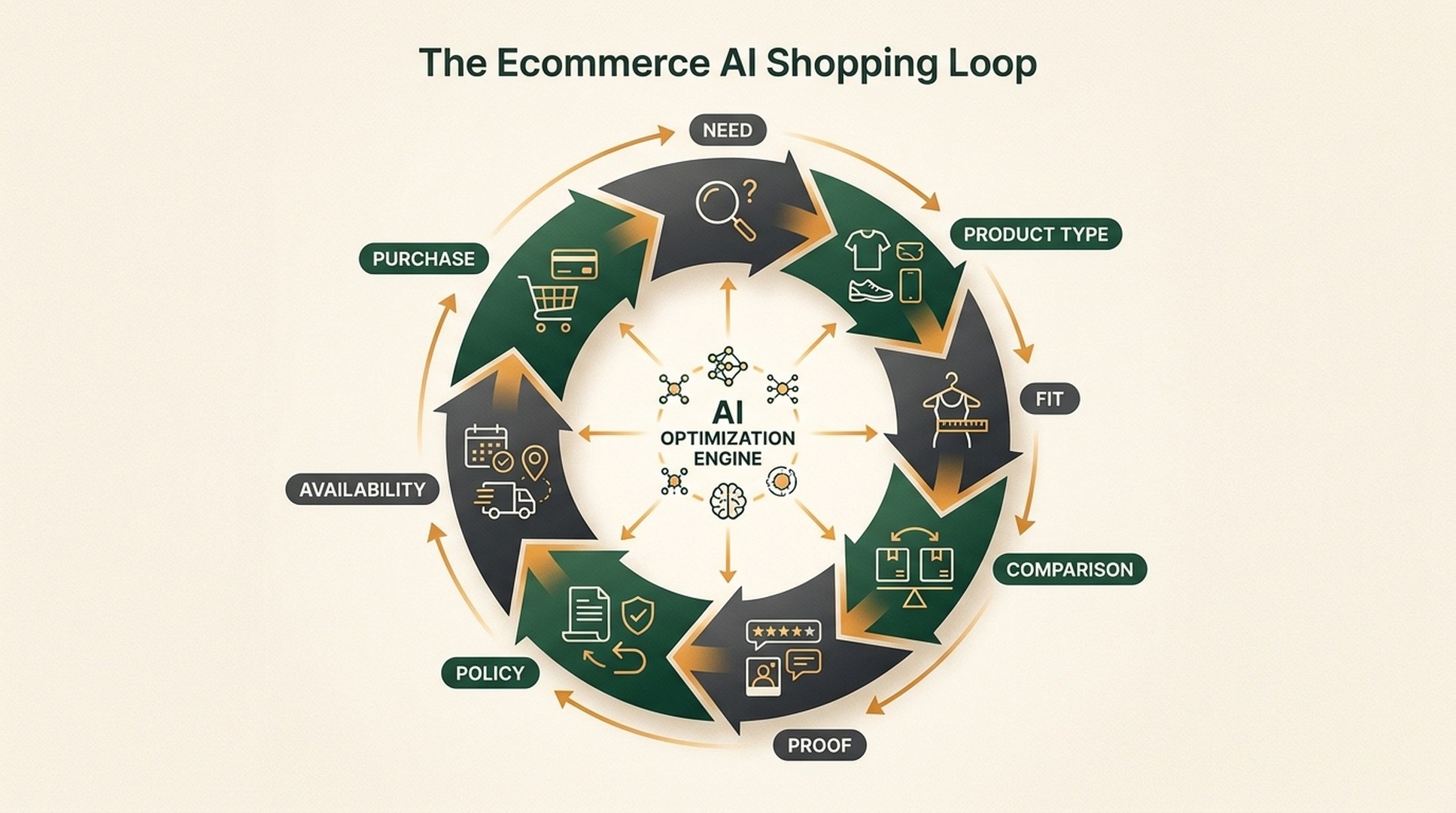
Ecommerce GEO should follow the shopping loop, not just generic category keywords.
Why Ecommerce GEO Is Different From Generic SEO
Ecommerce SEO often prioritizes category rankings and product-page optimization. Those remain important. But AI Search changes the shopping surface in four ways.
First, shoppers ask for fit, not just products. They rarely ask only for best backpack. They ask for best backpack for a 15-inch laptop and weekend travel, best lightweight backpack for back pain, or best waterproof backpack under $100.
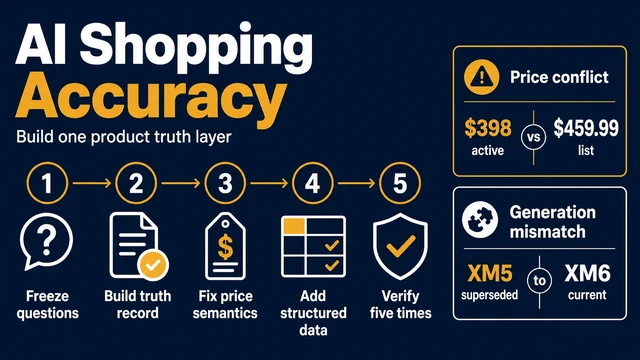
Second, AI answers often synthesize product claims, review summaries, specs, and policies. If your product facts are vague, inconsistent, image-only, or hidden in tabs, you reduce the chance that an AI system can use them accurately.
Third, risk-reduction content matters. Shipping time, returns, warranty, sizing, materials, ingredient details, compatibility, and availability are not boring support pages. They are conversion and GEO assets.
Fourth, marketplaces and retailers compete with brand-owned pages. If Amazon, Walmart, Reddit, YouTube, review sites, or affiliate blogs explain your product better than your own site, AI systems may rely on them instead.
That means ecommerce GEO should follow a shopping evidence model:
Shopper need -> Product fit -> Comparison -> Proof -> Policy -> Purchase confidence
The 10 Query Types Ecommerce Teams Should Map
Classify shopping prompts before creating new content. This prevents a brand from turning 100 prompts into 100 thin buying guides.
Query Type | What The Shopper Wants | Best Ecommerce Content Asset |
|---|---|---|
Need / Problem | Find a product for a problem, goal, or pain point | Use-case guide, category page |
Product Fit | Match size, material, compatibility, style, ingredient, or audience | Product page, fit guide |
Recommendation | Find the best option for a scenario, budget, or buyer type | Collection page, best-for guide |
Comparison | Compare models, materials, bundles, brands, or product types | Comparison page, buying guide |
Specs / Compatibility | Verify dimensions, ingredients, features, device fit, or requirements | PDP, specs table, FAQ |
Reviews / Proof | Understand what real customers say and whether claims hold up | Review summary, UGC hub, case examples |
Price / Value | Compare price, bundles, discounts, cost per use, or premium value | Pricing block, collection page |
Shipping / Returns | Reduce purchase risk around delivery, returns, exchanges, and warranty | Policy page, product FAQ |
Availability | Check inventory, variants, restock, delivery timing, or local pickup | Product / inventory page |
Gift / Scenario | Buy for a person, event, lifestyle, room, season, or use case | Gift guide, scenario collection |
The goal is clear ownership. Each high-value query cluster should map to one page that answers the shopper better than your ads, marketplaces, or third-party reviewers do.
How To Prioritize Ecommerce GEO Queries
Use an ecommerce-specific scoring model:
Priority = Purchase Intent + Product Fit Value + Margin Impact + Evidence Strength + AI Answer Probability - Competition Difficulty - Claim Risk
Factor | How To Evaluate It |
|---|---|
Purchase Intent | Is the shopper close to choosing, comparing, or buying? |
Product Fit Value | Does the query help shoppers avoid the wrong product, size, material, or compatibility choice? |
Margin Impact | Does the query influence high-margin products, bundles, subscriptions, or repeat purchases? |
Evidence Strength | Do you have specs, reviews, UGC, testing, images, policies, or product data to support the answer? |
AI Answer Probability | Is the query likely to trigger a recommendation, comparison, checklist, or shopping summary? |
Competition Difficulty | Are marketplaces, big retailers, affiliates, Reddit, YouTube, or review sites dominating the answer? |
Claim Risk | Would the answer require unsupported health, safety, performance, or durability claims? |
Start with queries that connect to purchase decisions and can be answered with product facts, not exaggerated claims. For most ecommerce brands, this means fit, comparison, review, shipping, returns, specs, and scenario-based buying prompts.
100 Ecommerce GEO Query Examples
Use these as a starting prompt library. Replace the examples with your actual category, products, materials, variants, policies, and buyer segments.
Need / Problem Queries
- What should I buy for better posture while working from home?
- What should I buy for dry skin in winter?
- What should I buy for a small apartment with pet hair?
- What should I buy for meal prep if I have limited kitchen space?
- What should I buy for better sleep while traveling?
- What should I buy for organizing a home office?
- What should I buy for low-impact workouts at home?
- What should I buy for camping in rainy weather?
- What should I buy for reducing plastic use in the kitchen?
- What should I buy for a beginner coffee setup?
Product Fit Queries
- Best office chair for short people
- Best running shoes for flat feet
- Best backpack for a 15-inch laptop and weekend travel
- Best moisturizer for sensitive skin
- Best air purifier for pet hair in a small apartment
- Best cookware for induction stoves
- Best suitcase size for a one-week trip
- Best mattress firmness for side sleepers
- Best protein powder for lactose-sensitive buyers
- Best desk lamp for small workspaces
Recommendation Queries
- Best ergonomic office chair under $300
- Best sustainable water bottle for daily use
- Best noise-canceling headphones for remote work
- Best skincare starter kit for beginners
- Best travel backpack under $150
- Best air fryer for a family of four
- Best standing desk converter for small desks
- Best running shoes for beginners
- Best gifts for coffee lovers under $50
- Best bedding set for hot sleepers
Comparison Queries
- Mesh office chair vs leather office chair
- Memory foam mattress vs hybrid mattress
- Stainless steel water bottle vs plastic water bottle
- Air fryer vs convection oven
- Hard-shell suitcase vs soft-shell suitcase
- Cotton sheets vs bamboo sheets
- Whey protein vs plant-based protein
- Noise-canceling headphones vs earbuds
- Backpack vs rolling carry-on for weekend trips
- Refillable skincare packaging vs single-use packaging
Specs / Compatibility Queries
- Will this backpack fit a 15-inch laptop?
- Will this case fit the newest iPhone model?
- Is this cookware compatible with induction stoves?
- What size rug fits under a queen bed?
- What dimensions should I check before buying a desk?
- What ingredients should I check before buying skincare?
- What weight capacity should I check before buying a chair?
- What battery life should I expect from wireless headphones?
- What filter type should an air purifier use for pet hair?
- What suitcase dimensions fit most airline carry-on rules?
Reviews / Proof Queries
- Are reviews for this product reliable?
- What do customers complain about most in reviews?
- What do verified buyers say after 30 days?
- What should I look for in product reviews before buying?
- Are customer photos useful for evaluating product quality?
- How can I tell if product reviews are fake?
- What review signals matter for skincare products?
- What review signals matter for furniture purchases?
- What review signals matter for electronics?
- How should brands summarize product reviews honestly?
Price / Value Queries
- Is this product worth the premium price?
- When should I buy the budget version vs the premium version?
- Is a bundle cheaper than buying items separately?
- What is the cost per use for this product?
- Should I wait for a sale before buying?
- Are subscription discounts worth it?
- What hidden costs should I check before buying online?
- Is refurbished electronics worth buying?
- What makes an expensive product better than a cheaper alternative?
- How do I compare value across similar products?
Shipping / Returns Queries
- Does this brand offer free returns?
- How long does shipping usually take?
- Can I return the product after opening it?
- Can I return assembled furniture?
- What should I check in a return policy before buying?
- Does the brand offer exchanges for different sizes?
- What does the warranty cover?
- Who pays return shipping?
- Can I cancel an order before it ships?
- What happens if a product arrives damaged?
Availability Queries
- Is this product in stock?
- When will this product be restocked?
- Which color or size is available now?
- Does this product ship before the weekend?
- Can I buy this product with local pickup?
- Is this limited edition product still available?
- Which bundle is currently available?
- Is this product available internationally?
- Does the brand ship to my country?
- Are replacement parts available for this product?
Gift / Scenario Queries
- Best gift for a remote worker under $100
- Best gift for a new homeowner
- Best gift for a frequent traveler
- Best gift for someone who loves coffee
- Best products for a minimalist kitchen
- Best products for a small nursery
- Best products for a dorm room
- Best outdoor gear for rainy weekend trips
- Best skincare set for a beginner
- Best home office upgrades for a small apartment
How To Turn Ecommerce Queries Into Citation-Ready Pages
An ecommerce query library should become a product information architecture. The strongest GEO assets are often product and category pages, not blog posts.
Query Cluster | Owner Page | Page Type | Required Proof |
|---|---|---|---|
Need and problem prompts | Use-case collection | Scenario / collection page | Product fit criteria, recommended products, limitations |
Product fit prompts | Product detail page | PDP / fit guide | Specs, dimensions, ingredients, materials, size guide |
Recommendation prompts | Best-for collection | Collection / buying guide | Selection criteria, product cards, review summary |
Comparison prompts | Comparison page | Product / material comparison | Side-by-side table, use cases, tradeoffs |
Specs and compatibility prompts | Product FAQ | PDP module / FAQ | Compatibility data, measurements, requirements |
Review prompts | Review summary | Review / UGC module | Verified reviews, common pros and cons, customer photos |
Price and value prompts | Pricing / bundle page | Offer page | Price, bundles, cost per use, discount terms |
Shipping and return prompts | Policy page | Shipping / returns page | Delivery time, return window, exclusions, warranty |
Availability prompts | Product availability block | PDP / inventory module | Stock, variants, restock date, shipping region |
Gift and scenario prompts | Gift guide | Scenario collection | Recipient type, budget, use case, availability |
A good ecommerce GEO page should make the product easy to evaluate. It should answer who the product is for, who it is not for, what the shopper should check, what the reviews say, how shipping and returns work, and what alternatives might fit better.
For technical readiness, ecommerce teams should make sure category pages, PDPs, policy pages, and product images are crawlable and indexable. A quick Website SEO Score Checker can help find basic crawl, metadata, and structured data issues before content teams rewrite product pages.
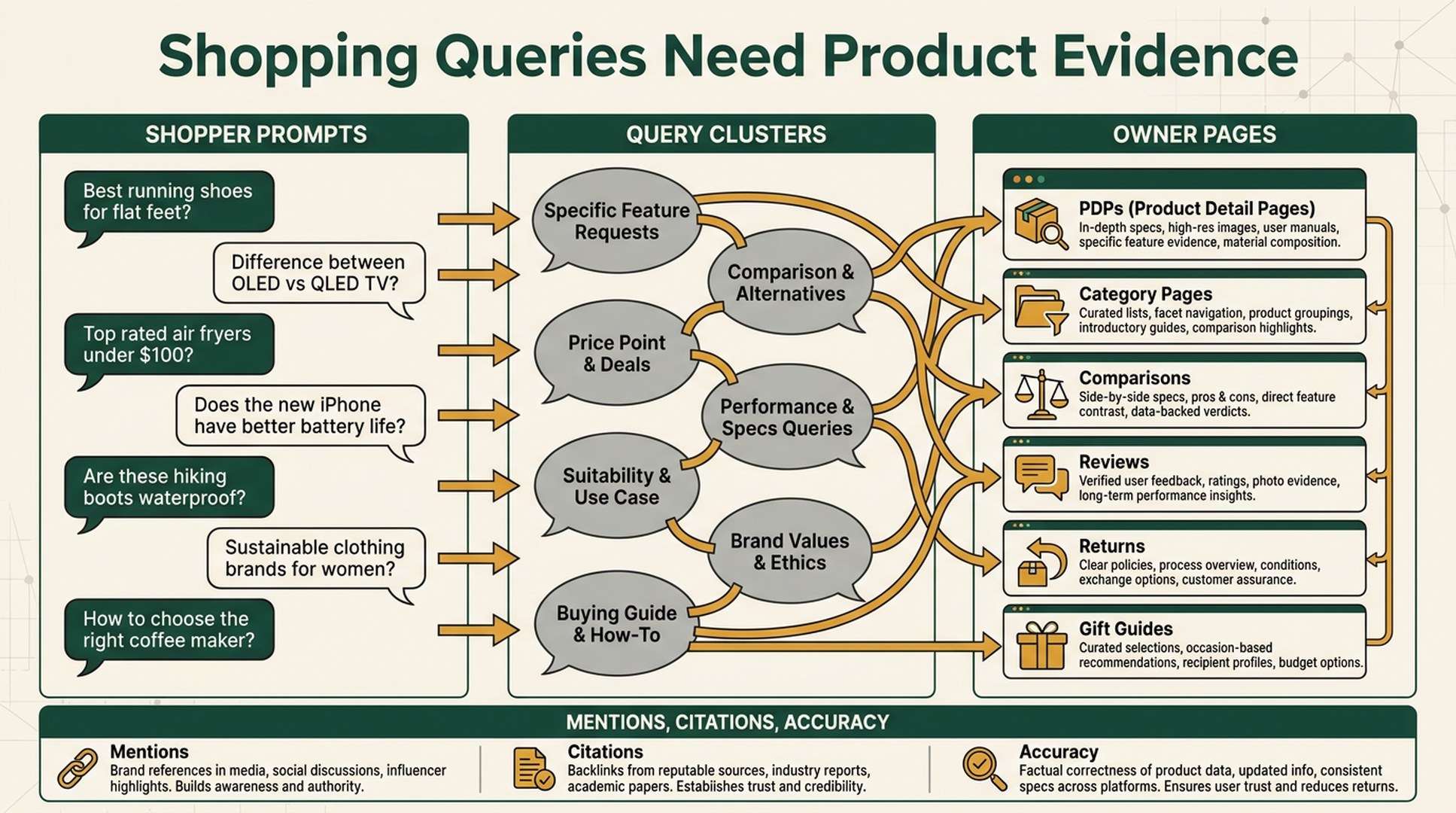
Shopping prompts become stronger GEO assets when they map to product evidence and owner pages.
The First 20 Queries To Prioritize
If an ecommerce brand is starting from scratch, these 20 prompts usually make a strong first backlog because they connect directly to product selection and purchase confidence.
Priority | Query | Why It Matters | Likely Owner Page |
|---|---|---|---|
1 | Best [product category] for [specific use case] | High shopping intent | Use-case collection |
2 | Best [product] under [budget] | Budget-driven purchase query | Collection page |
3 | [Product type A] vs [product type B] | Comparison intent | Comparison page |
4 | Is this product worth the premium price? | Value objection | Product / value page |
5 | Will this product fit [specific device, size, room, or need]? | Product-fit blocker | PDP FAQ |
6 | What should I check before buying [category]? | Buyer education | Buying guide |
7 | Are reviews for this product reliable? | Trust validation | Review summary page |
8 | What do customers complain about most in reviews? | Risk reduction | Review summary module |
9 | Does this brand offer free returns? | Purchase-risk blocker | Return policy page |
10 | Can I return the product after opening it? | Return-risk query | Policy FAQ |
11 | What does the warranty cover? | Durability and trust query | Warranty page |
12 | How long does shipping usually take? | Delivery expectation | Shipping page |
13 | Is this product in stock? | Immediate purchase intent | PDP inventory block |
14 | When will this product be restocked? | Lost-demand recovery | Restock page / PDP |
15 | Which color or size is available now? | Variant choice | PDP variant module |
16 | Best gift for [recipient] under [budget] | Scenario shopping | Gift guide |
17 | Best products for [room, trip, event, or lifestyle] | Collection opportunity | Scenario collection |
18 | Should I buy refurbished [category]? | Value and risk decision | Refurbished guide |
19 | What hidden costs should I check before buying online? | Trust and transparency | Buying guide / policy page |
20 | What makes an expensive product better than a cheaper alternative? | Premium positioning | Value comparison page |
These prompts are useful because they can be answered with real product data rather than vague category advice.
30-Day Execution Plan
Timeframe | Action | Output |
|---|---|---|
Days 1-3 | Build the ecommerce AI Search query library and classify by product category, shopper stage, and page owner | 100-query shopping prompt library |
Days 4-7 | Score queries by purchase intent, product fit value, margin impact, evidence, AI answer probability, difficulty, and claim risk | First 20 prompt backlog |
Days 8-14 | Map top prompts to PDPs, category pages, comparison pages, review modules, policy pages, and gift/scenario pages | Query-to-page map |
Days 15-21 | Rewrite top pages with direct fit guidance, specs, review summaries, shipping/return details, and comparison blocks | Updated citation-ready pages |
Days 22-30 | Test prompts across AI answer surfaces and record brand mentions, cited URLs, competitor mentions, and inaccurate product facts | AI shopping visibility tracker |
A small ecommerce brand can start with five assets: one category guide, three top PDPs, and one shipping/returns page. A larger brand should expand into comparison pages, review summaries, gift guides, scenario collections, and structured product feeds.
Common Mistakes
Ecommerce GEO fails when brands treat shopping queries as generic blog keywords.
Avoid these mistakes:
- Writing buying guides that do not link to real product facts. Shoppers need specs, availability, reviews, and policies.
- Hiding fit information in images or tabs. Dimensions, ingredients, compatibility, and size guidance should be visible in text.
- Ignoring returns and shipping. These pages answer high-conversion risk questions and can influence AI summaries.
- Cherry-picking reviews. Summarize common pros and cons honestly. AI systems and shoppers both reward useful specificity.
- Creating too many thin “best product” pages. Build stronger category, scenario, and comparison pages instead.
- Overclaiming product performance. Avoid unsupported health, durability, sustainability, or safety claims.
- Letting marketplaces explain your products better than your own site. Brand-owned pages should be the clearest source of product truth.
FAQ
What is ecommerce GEO?
Ecommerce GEO is the process of making product, category, comparison, review, policy, and scenario pages easier for AI answer systems to understand, summarize, and cite during shopping research.
Is ecommerce GEO the same as ecommerce SEO?
No. Ecommerce SEO focuses on rankings, crawlability, product metadata, category pages, internal linking, structured data, and organic revenue. Ecommerce GEO builds on that foundation but focuses on whether AI systems can accurately compare, recommend, and cite your products.
Should every ecommerce shopping query become a blog post?
No. Many ecommerce queries should be answered by product pages, category pages, comparison pages, review modules, shipping pages, return policy pages, and scenario collections. A query library should become a page map, not a thin blog calendar.
Which ecommerce GEO queries should brands start with?
Start with queries about product fit, comparisons, specs, reviews, returns, shipping, warranty, availability, gift use cases, and budget-based recommendations. These prompts are close to purchase decisions.
How can ecommerce brands avoid repetitive GEO content?
Use real product data, review summaries, specs, materials, dimensions, compatibility, availability, policy details, and scenario-specific recommendations. If a page would work for any product after changing the name, it is too generic.
How should ecommerce teams measure GEO performance?
Track a fixed set of shopping prompts across AI answer surfaces. Record whether the brand appears, which pages are cited, which competitors or marketplaces appear, and whether product facts are accurate.
Auspia Takeaway
Ecommerce GEO is a product information discipline. AI systems need clear product facts, comparison logic, review evidence, policy details, and availability signals before they can recommend a brand confidently.
Start with the shopping loop: need, product type, fit, comparison, proof, policy, availability, and purchase confidence. Then map your first 20 prompts to the pages that already influence buying decisions. Better product pages often do more for ecommerce GEO than another generic blog post.
Author: Eva Laurent, Ecommerce Search Strategist for 10k+ Product Pages at Auspia. Eva writes about ecommerce SEO, product discovery, category content, and AI-assisted shopping journeys.