AI Citations Don't Drive Clicks. Here's What to Measure Instead
Short answer: AI citations are a brand-memory signal, not a traffic channel. The click was never the point — when a model quotes your page inside an answer, the user already has what they came for. Teams that keep judging GEO by referral clicks will conclude it failed right before it starts working. The fix is not to abandon citation work; it is to swap the dashboard.
What the OpenAI engineer actually said
On September 22, 2026, a practitioner account relayed a claim from an OpenAI engineer: users do not click citation links, even when those links are surfaced prominently in the interface.
Treat this carefully. It is a second-hand account of an internal observation, not an official OpenAI statement, and it has not been published as research. But it is consistent with every independent measurement we can find, which is why it is worth acting on rather than waiting for a press release.
The supporting evidence is not thin:
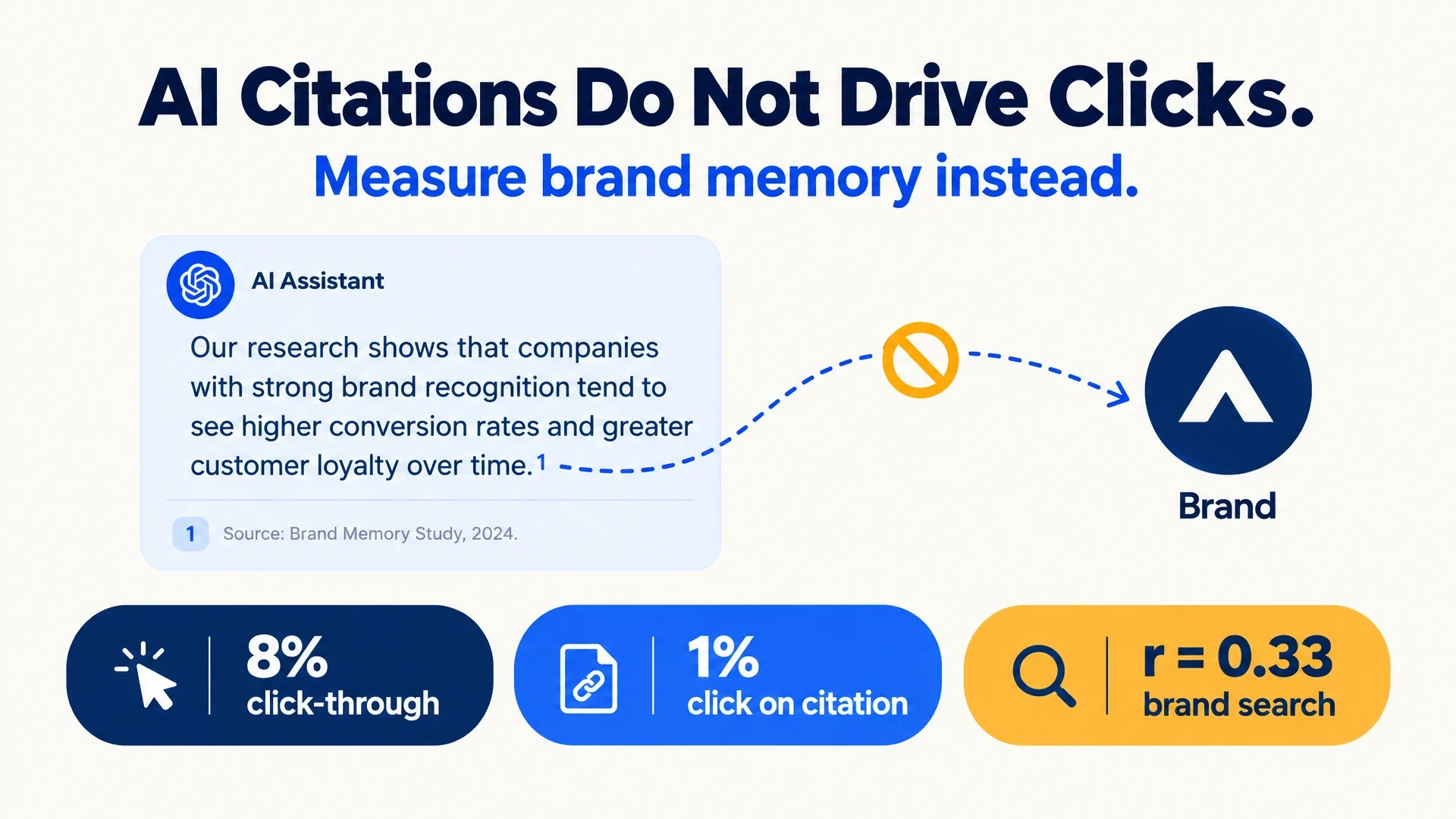
- Pew Research Center tracked 900 U.S. adults across 68,879 Google searches in March 2025. When an AI summary appeared, users clicked through to an ordinary result on 8% of visits, versus 15% when no summary appeared. They clicked a link inside the summary on 1% of visits.
- Seer Interactive analyzed 25.1 million impressions across 42 organizations and found organic CTR collapsing from 1.76% to 0.61% on AI Overview-present queries — a 61% decline.
- Ahrefs longitudinal data found AI Overviews reduce click-through to the #1 organic result by 58%.
Three independent datasets, three different methodologies, same direction. The click is not disappearing because users are lazy. It is disappearing because the answer arrived.
Why citations don't convert to clicks
The mental model most teams still carry comes from the blue-link era:
User has a question → user searches → user scans ten links → user picks one → user clicks → user reads.
In that world, being at the top of the list is the whole game, because the click is the only way to deliver value. Citations inherit that logic by default: get cited, get the click.
But the AI answer path is shorter:
User has a question → user searches → the answer is already on screen → user is done.
There is no navigation step left to perform. The citation is not a doorway; it is a footnote. It tells the user where the sentence came from, the way a bibliography entry does. Nobody reads a book's footnotes before deciding whether the chapter answered their question.
This is why the "AI citations drive traffic" pitch breaks down.
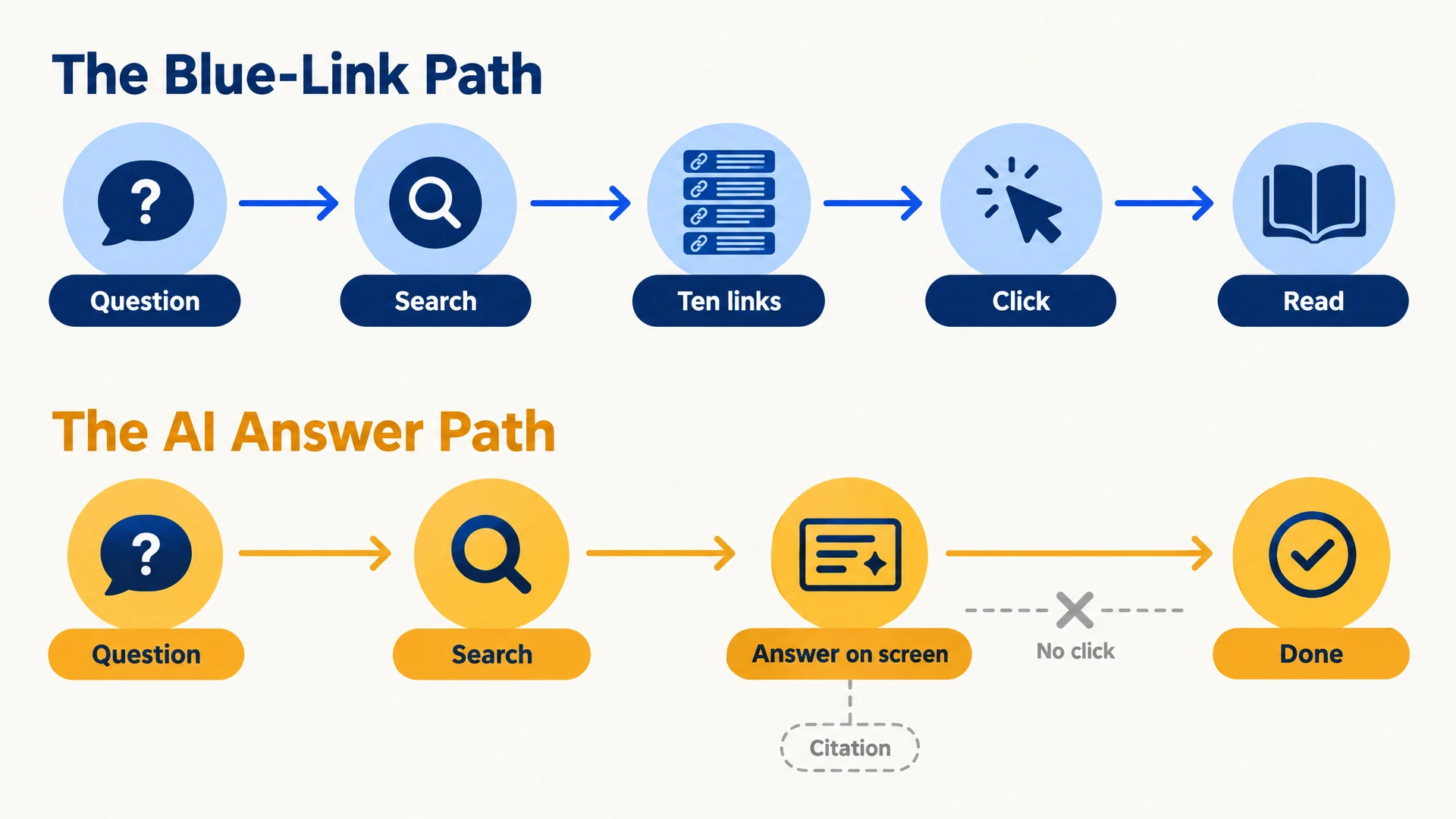
It assumes a navigation need that the answer itself has already satisfied.
There is a second reason, and it is structural. Google's own Search Console reporting now shows how often your pages were shown and which of them turn up in AI responses — but it does not hand you a click count for those appearances, because in most cases there is no click to count. When Google shipped the AI feature reporting to all website owners on August 31, 2026, it also shipped a switch: opt out of AI Overviews, AI Mode, and Discover's generative features, and Google's own documentation says you get no traffic and no impressions from them. The switch takes you out. It does nothing to get you in.
What actually moves: three signals worth tracking
If referral clicks are the wrong instrument, what should replace them? Three signals capture the value that citations create but clicks do not reveal.
1. Answer inclusion rate
What it is: the share of your target prompts where your brand, page, or claim appears inside the AI answer — regardless of whether a link is attached.
Why it beats clicks: it measures the thing you can actually influence. A citation with no click still puts your name in front of the user at the moment of decision.
How to measure it: build a fixed prompt set (20–50 questions your buyers actually ask), run it across ChatGPT, Perplexity, Gemini, and Google AI Overviews on a set cadence, and record whether you appear. Track the rate over time, not the individual answer.
What good looks like: you are looking for movement, not a high absolute number. A brand going from appearing in 4 of 40 prompts to 11 of 40 has a real signal even though the raw percentage is still low.
2. Brand mention rate (named but not linked)
What it is: how often your brand is named in an answer without being cited as a source. This is a distinct signal from citation, and conflating the two is one of the most common measurement errors in GEO reporting.
Why it beats clicks: a model that names your brand has learned your brand. That is entity recognition, and it is the precondition for being recommended later. It often shows up before citation does.
How to measure it: on the same prompt set, record two separate fields per answer — named and cited. They will diverge, and the divergence is the insight.
What good looks like: mention rate climbing while citation rate is flat is not a failure. It is the model building a representation of you. Citation usually follows.
3. Branded search lift
What it is: the change in how often people search for your brand name directly.
Why it beats clicks: it is the closest available proxy for "someone saw us in an AI answer, did not click, and came back later by name." That is the actual conversion path in an AI-mediated world, and it is invisible to any click-based dashboard.
How to measure it: track branded queries in Google Search Console and, if you have the data, in Bing Webmaster Tools. Compare the trend against your AI visibility work rather than against your content calendar.
What good looks like: branded search volume holding or rising while non-branded organic clicks fall is a good pattern in 2026. It means you are being remembered even as the click path erodes.
There is a supporting data point worth knowing here. When researchers measured what predicts AI citation, brand search volume correlated at r ≈ 0.33, while domain authority correlated at only r ≈ 0.18 — down from r ≈ 0.43 in 2024. The signal moved from "how strong is your domain" to "do people already know your name." Brand memory is not a soft metric. It is now the stronger predictor.
A GEO scorecard you can run this week
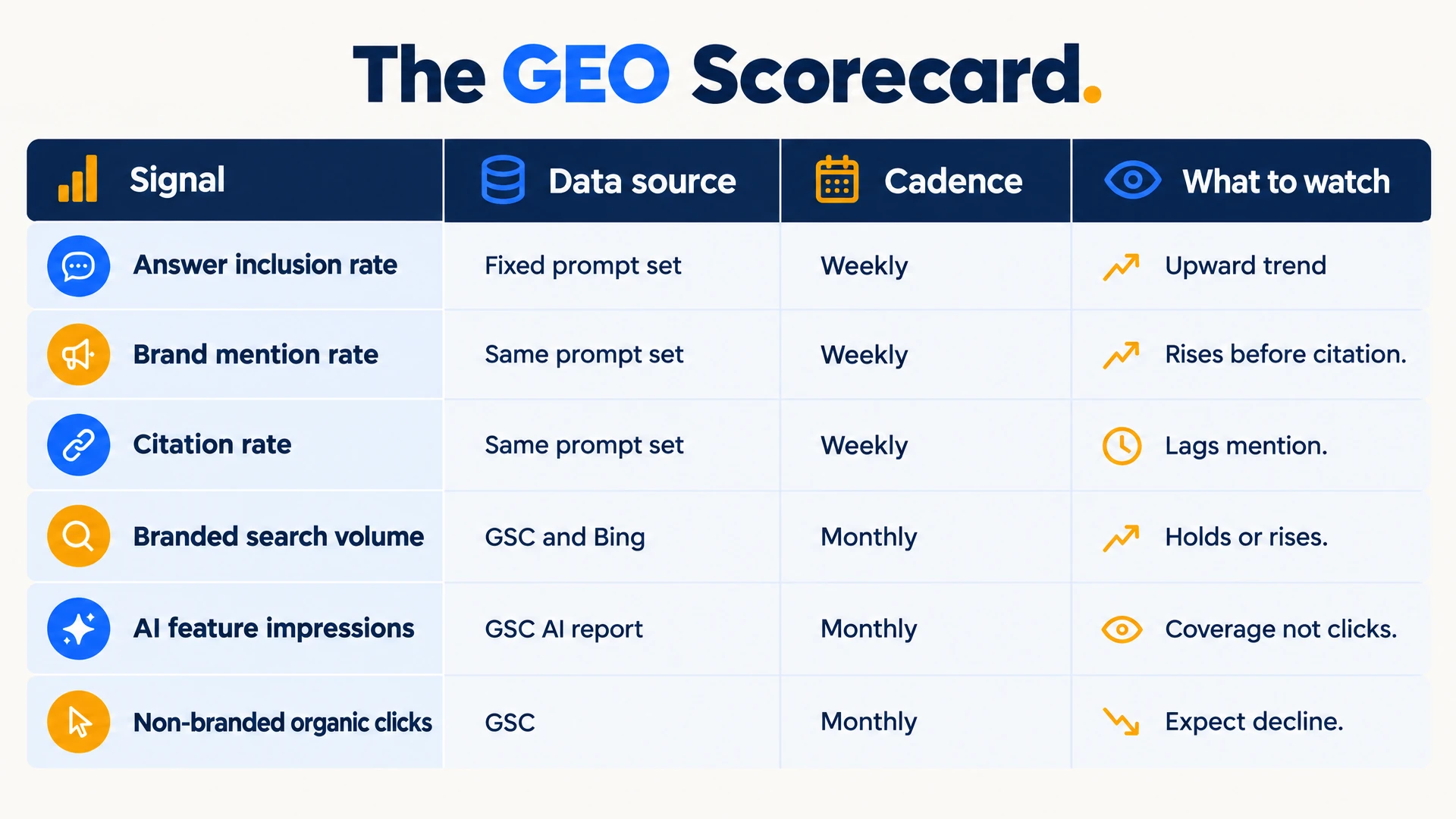
Signal | Data source | Cadence | What to watch |
|---|---|---|---|
Answer inclusion rate | Fixed prompt set across 4 platforms | Weekly | Upward trend over 4–8 weeks |
Brand mention rate (named, not cited) | Same prompt set, second field | Weekly | Rising before citation does |
Citation rate | Same prompt set, third field | Weekly | Lags mention by weeks, not days |
Branded search volume | GSC + Bing Webmaster | Monthly | Holds or rises while non-branded clicks fall |
AI feature impressions | GSC AI feature report | Monthly | Coverage, not clicks |
Non-branded organic clicks | GSC | Monthly | Expect decline; do not panic-treat it as failure |
Two rules for running this:
Do not collapse named and cited into one column. They measure different things and move on different timelines. Merging them is how teams end up reporting a "citation win" that was actually just a mention.
Give it a quarter, not a week. Brand memory is a slow signal. If you evaluate it on a 7-day window you will conclude it does not work, because the thing you are measuring has not had time to happen.
Where this breaks
The "citations don't drive clicks" finding is real, but it is not universal, and over-applying it will cost you traffic.
High-intent comparison queries still convert. When someone asks an AI to compare two specific vendors or asks "is X worth it," the answer often ends with a recommendation that the user acts on immediately. In those cases a citation can and does produce a click — because the user still needs to complete a task that the answer cannot finish for them.
Transactional and local queries still send traffic. "Book," "buy," "near me," and "pricing" intents route to a destination. The answer cannot substitute for the transaction.
Informational queries are where the click died. This is where the 8% figure lives, and it is where measurement needs to change first. If your entire traffic model depends on informational query clicks, that is a business-model problem, not a GEO problem.
The practical implication: segment your measurement by intent. Do not apply an informational-query finding to your entire traffic portfolio.
Auspia take
The industry spent two years building citation visibility and then measured it with a click counter. That mismatch is why so many GEO programs look like failures in their own dashboards while their brands are quietly becoming the answer.
We think the honest position is this: if you were doing GEO to get clicks, you were doing it for the wrong reason, and the data is now telling you so. If you were doing it to be the brand that gets named when a buyer asks a model for a recommendation, the data says you are on the right track — you just cannot see it in your old reports yet.
The teams that win the next two years will be the ones that change the instrument before they change the strategy. Start with the scorecard above. Run it for a full quarter. Then decide whether GEO is working — with a metric that can actually detect it.
Author: Ethan Marlowe, GEO Measurement Lead Across 500+ Prompts at Auspia. Ethan writes about prompt tracking, citation reports, and building visibility dashboards that measure what AI answers actually change.