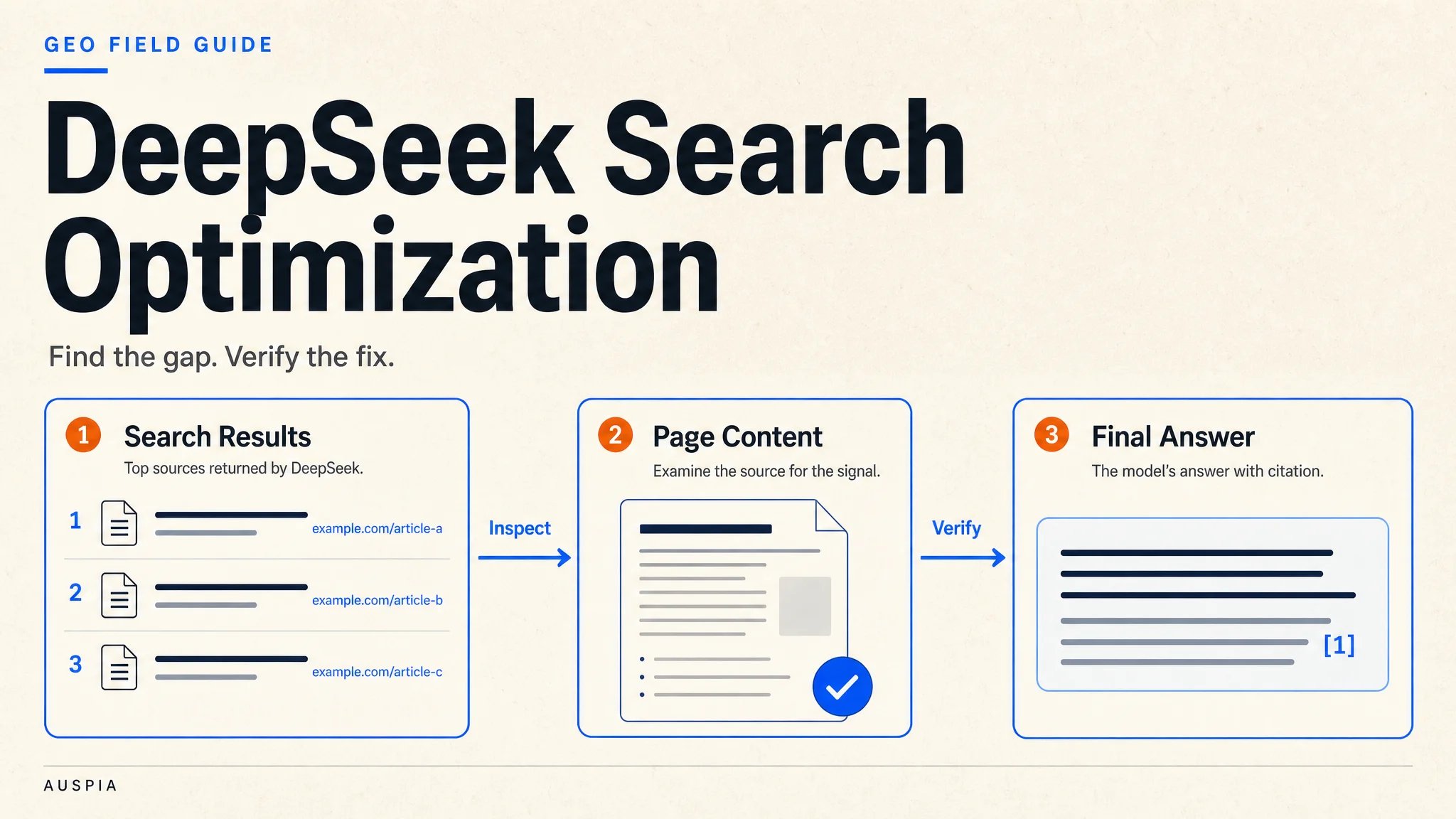
To improve your website's visibility in DeepSeek Search, start by checking where it loses visibility: the search results, the extracted page content, or the final answer. Each problem calls for a different fix.
DeepSeek's public Search and Fetch interfaces make parts of that process inspectable. You can examine which URLs appear, how the search service represents them, and whether its page extractor retrieves the information you intended to publish. That gives website owners a more useful starting point than a generic "AI readiness" checklist.
This guide turns those inspection points into a practical optimization workflow.
Research checked October 19, 2026. The mechanisms below are supported by DeepSeek's documentation and official Harness repository. The optimization workflow is an editorial recommendation; no live ranking experiment or visibility improvement is claimed.
What you will finish with
This workflow is for website owners, content teams, and SEO practitioners who want to understand and improve their visibility in DeepSeek-powered search experiences.
You will produce:
- A baseline for 20 relevant buyer questions.
- A diagnosis of missing pages, incomplete extraction, and inaccurate search summaries.
- A small set of page changes tied to those observations.
- A repeatable check of search visibility and final citations.
You need access to your website, permission to edit its content, and access to the DeepSeek product you want to evaluate. A DeepSeek API key is required for the direct Search and Fetch checks.
The first audit can fit into a focused working session. Verifying changes takes longer because you must observe when the search results reflect the updated page. This guide does not assume a guaranteed refresh interval.
You are finished when you can explain which problem you changed, show the before-and-after evidence, and identify what remains unresolved.
1. Identify which DeepSeek search experience you are testing
"DeepSeek visibility" can refer to several different things: its consumer chat product, a Harness configuration, or a third-party application using its search infrastructure.
Start your audit by naming the exact surface.
DeepSeek describes its Search and Fetch services as powered by its in-house search engine. However, a particular application still decides how to use the returned information. DeepSeek's official announcement
The public interfaces expose these useful inspection points:
Inspection point | What it tells you |
|---|---|
Ranked search results | Which pages were returned for a query |
| The short, query-related representation of a result |
| A longer, query-related representation intended for model consumption |
| Page text when requested and available |
| The service's reported relevance score and authority tier |
Fetch output | The title and Markdown extracted from a requested URL |
These fields are documented in the Search reference and Fetch reference.
There is an important implementation detail: DeepSeek Harness's current direct Search API adapter requests results without full content and passes along the title, URL, snippet, and available publication date. Its response mapper does not forward the longer summary field. Official adapter source
That makes "optimize your long summary for DeepSeek" an incomplete prescription. The application you care about may never use it.
For your baseline, record the product, model where visible, search setting, and test date. For an API integration, also record which fields reach the model. If that information is unavailable, label it unknown.
Check: Can someone else identify and reproduce the same test surface?
If they cannot, resolve that before comparing results. A change of application or search provider can otherwise look like a change in your website's performance.
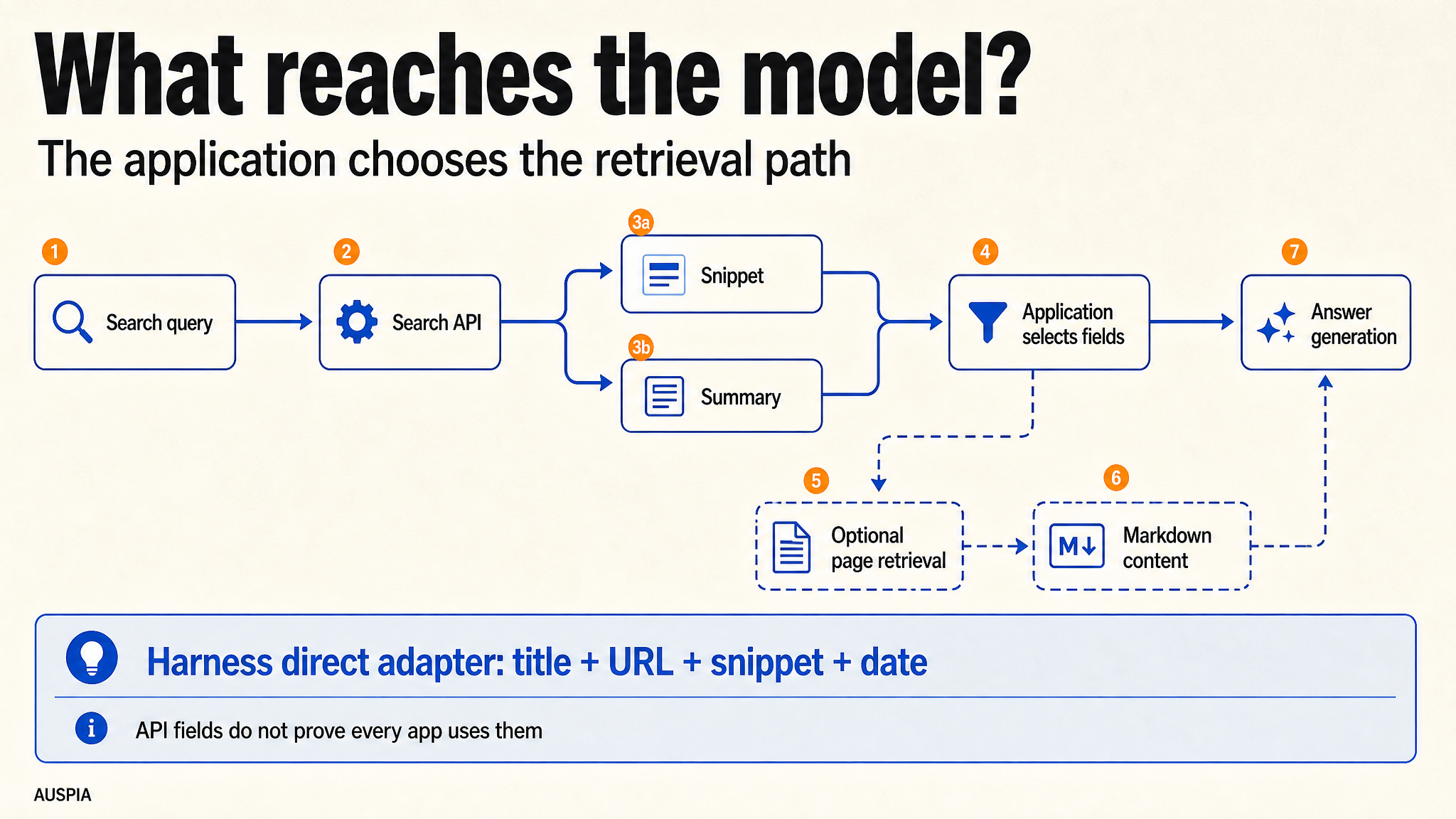
Applications choose which search fields reach the model and whether to retrieve full page content. The Harness note describes the direct adapter inspected for this guide.
2. Build a baseline around real buyer questions
Choose 20 questions that matter to your business. Use several intent types so that strong brand recognition does not hide weak discovery.
The following examples use AcmeFlow, a fictional customer support automation product.
Intent | Example question | What you are checking |
|---|---|---|
Brand understanding | What does AcmeFlow do? | Whether the product is described accurately |
Category discovery | Customer support automation for small SaaS teams | Whether the brand appears without being named |
Capability | Which tools route tickets by account tier? | Whether a specific capability is discoverable |
Comparison | How does AcmeFlow compare with a shared inbox? | Whether the answer identifies meaningful differences |
For the API baseline, keep the query and result count consistent. Save the complete response, rather than recording only whether your domain appeared.
DeepSeek supports an optional original-question field, ori_question, and IP-based localization. Record their exact values or omission. For an English diagnostic, its documented query syntax also includes lang:en. Search & Fetch guide
Keep ordinary buyer queries separate from diagnostic queries. A useful pair is:
customer support automation for small SaaS teamscustomer support automation site:example.com lang:enThe first tests competitive discovery. The second asks whether relevant pages from one site can be surfaced under a restriction.
Repeat the baseline on several occasions before editing. Three runs are a practical starting point for spotting obvious variation, although they do not establish statistical confidence.
Check: Does your record contain the returned URLs and their order, alongside the exact question and settings?
If a request fails, record the failure separately. An authentication error or timeout is not evidence that your website was absent from search.
3. Separate a discovery problem from a page-reading problem
Suppose AcmeFlow's main product page does not appear for an important query. Rewriting its introduction immediately would be guesswork.
First, establish what you can observe.
Observation | Interpretation | Next action |
|---|---|---|
The page appears in ordinary results | It was retrievable for that query and test | Examine how it was represented |
It appears only in a site-restricted query | It can surface under that restriction | Investigate relevance and competing results |
It does not appear in either query | Discovery remains unresolved | Check alternate URLs, query wording, and accessibility |
Fetch retrieves the page successfully | That URL was readable through Fetch | Inspect the extracted information |
Fetch returns incomplete text | The extraction missed useful content | Identify what was omitted and how the page delivers it |
A successful Fetch request does not prove that a page is indexed or competitive. It tests a different operation.
For a page that is missing or unreadable, inspect its public accessibility, redirects, canonical URL, and the location of its substantive content. These are technical troubleshooting checks. They are not documented DeepSeek ranking factors.
The practical question is: what information can the service actually retrieve from this URL?
DeepSeek's Fetch endpoint returns Markdown. Compare that output with the visible page and check whether it contains the product name, capabilities, pricing conditions, evidence, and limitations. Fetch API documentation
If a capability exists only inside an interactive demo and is absent from the extracted text, add a useful textual explanation to the public page. Then repeat Fetch.
That recommendation follows from an observed extraction gap. It does not require assuming that DeepSeek either always renders JavaScript or never renders it; the reviewed documentation does not establish such a guarantee.
Also inspect errors carefully. DeepSeek's guide lists several reasons for unusable Fetch content, including access restrictions, unsupported content, and extraction failure. An API error does not automatically mean the original page returned the same HTTP status. Official error guidance
Check: Does the extracted page now contain the missing information?
If it does, you have verified an extraction improvement. Search visibility and citations still need separate checks.
4. Rewrite the information that the search result gets wrong
Once your page appears in results, compare its search representation with the source.
Look for concrete errors:
- The product category is wrong.
- The brand name disappears.
- A capability loses its qualification.
- An old price appears.
- The result describes a secondary feature as the main product.
The Search API describes both snippet and summary as query-related. Treat them as outputs to inspect; do not assume they reproduce your meta description. Search response schema
For each important query, create a small review table:
Source fact | Returned representation | Decision |
|---|---|---|
AcmeFlow routes tickets by account tier | Described only as "workflow software" | Make the support use case explicit |
Automated routing requires a configured rule | Presented as automatic for every ticket | Keep the condition beside the capability |
Unmatched tickets require manual review | Limitation omitted | Explain the fallback clearly |
Now change the relevant page.
A weak fictional introduction might read:
AcmeFlow brings intelligent workflows to modern teams, helping them unlock a better customer experience.
A more useful version would be:
AcmeFlow routes customer support tickets for small B2B SaaS teams. Teams can create rules using account tier, language, and issue type. Tickets that do not match a rule remain available for manual review.
The second version provides facts a reader can verify. Its advantage for this workflow is that you can check whether those facts survive in the returned result.
This is a testable content hypothesis, not a demonstrated DeepSeek ranking technique. The proposed improvement is clearer source information; the test is whether the observed misrepresentation becomes less frequent.
Avoid compressing every page into a prescribed paragraph length. The useful unit is a complete statement with its conditions attached.
Check: After the updated page becomes visible in the returned material, is the representation more accurate across the relevant queries?
If the result still reflects an older version, record that. You cannot evaluate the new wording until you have evidence that the returned material reflects the change.
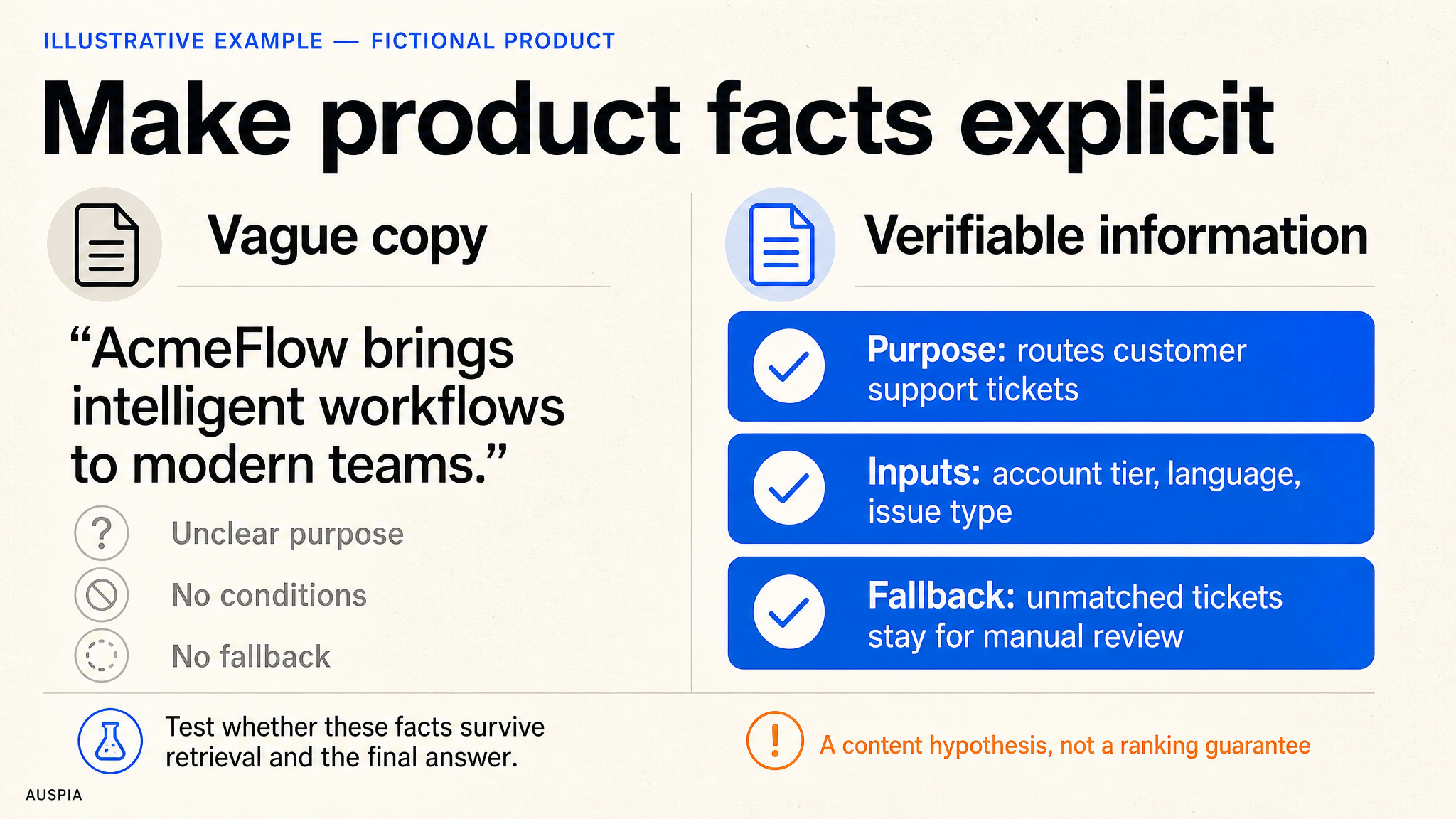
Illustrative AcmeFlow copy makes the purpose, inputs, and fallback explicit. Whether those facts survive in search results remains a testable question.
5. Build the page that answers the missing buyer question
Sometimes the website is readable and accurately summarized, but it still lacks the information needed for the query.
Consider:
Which customer support tools can route tickets by account tier?
A generic product page may say "advanced automation" without explaining account-tier routing. Publishing another broad article about customer support will not directly fix that gap.
Build or improve the page that can answer the question:
Buyer needs to know | Information the page should provide |
|---|---|
Does the capability exist? | A direct, accurate capability statement |
How does it work? | A worked example or setup explanation |
What does it depend on? | Required data, integrations, or configuration |
Where does it fail? | Limitations and fallback behavior |
Can I verify it? | Relevant documentation or demonstrable evidence |
For AcmeFlow, an account-tier routing guide could show a sample rule, explain where tier data comes from, and describe what happens when the field is missing.
This is an editorial response to a documented gap in the source material. It becomes DeepSeek-specific when you test whether that page is retrieved and represented for the target queries.
There is some documented basis for considering relevance, authority, and freshness: DeepSeek describes those as dimensions of its returned rerank_score. It also reports a separate authority tier. It does not publish the weights or a formula website owners can directly optimize. Search scoring fields
Use those fields as observations. A low score can prompt a closer comparison with other returned pages; it does not reveal which change will increase it.
If the results favor independent sources, inspect what those sources contribute. They may contain a comparison, implementation experience, or evidence your website lacks. Consider whether a legitimate review or documented customer example would help buyers evaluate the product.
Do not assume that buying links, adding schema, or repeating the brand name will raise DeepSeek's authority tier. The reviewed sources do not establish those relationships.
Check: Can the revised page answer the buyer's question without relying on unsupported claims?
If it cannot, gather the missing evidence before expanding the copy.
6. Test whether the final answer uses your information
Search-result visibility is an intermediate outcome. The final answer may cite your page, cite a third party, mention your brand without a link, or leave it out.
Test the target application separately.
For the fictional routing question, review:
- Whether AcmeFlow is mentioned.
- Whether the capability is described correctly.
- Whether the answer preserves the configuration requirement.
- Which URL, if any, supports the statement.
Open the citation. A link to the right domain is not enough if the linked page does not support the claim.
For a controlled application that you operate, record the search queries and sources passed into answer generation. For a consumer interface, record only what it exposes. Do not infer an unseen retrieval trace from the final answer.
Keep brand recommendations separate from citations. An answer may use your documentation to explain a concept without recommending your product. It may also recommend the product while citing someone else.
If your search representation is accurate but the final answer is wrong, investigate the additional sources and answer-generation stage where visible. Rewriting an already accurate paragraph may not address that failure.
Check: Does the cited source support the answer, and does the answer preserve important limitations?
That is a stronger quality check than counting brand mentions alone.
7. Verify the change before calling it an improvement
Retest the same query set using the original settings. Include a few unchanged pages or questions for context, so that a broad change in results is not automatically credited to your edits.
Track the outcomes separately:
Metric | Definition |
|---|---|
Search presence | Valid ordinary-query tests returning your target domain or URL, divided by valid ordinary-query tests |
Representation accuracy | Correct factual claims divided by factual claims reviewed; track important omissions separately |
Brand mention rate | Valid answer tests mentioning your brand, divided by valid answer tests |
Citation rate | Valid answer tests citing your target URLs, divided by valid answer tests |
Referral outcomes | Identifiable visits and conversions from the tested experience |
Keep site-restricted diagnostics outside the ordinary-query presence metric. Report failed tests separately, with a consistent exclusion rule.
A useful change record is short:
Target question:
Page changed:
Observed problem:
Change made:
Publication date:
Evidence the returned material reflects the update:
Repeated observations:
Remaining uncertainty:
For example, "the extracted page now includes the manual-review limitation" is a verified extraction result. "DeepSeek recommends us more often" requires repeated answer observations.
Even repeated improvement does not, by itself, prove causation. Other pages, search behavior, or the application may have changed during the same period.
Auspia's recommendation is to start with one observed failure on one important page. Fix it, verify the relevant output, and expand the process once the method produces useful decisions.
Questions website owners still need to ask
Is there a DeepSeek webmaster submission tool?
The official Search and Fetch documentation reviewed for this guide did not identify a webmaster console or URL-submission procedure. Do not describe Google or Bing submission as direct submission to DeepSeek.
Should I add a DeepSeek-specific robots.txt rule or llms.txt file?
This review did not establish an official search-crawler identity, a complete robots policy, or an llms.txt requirement for DeepSeek Search.
Base access changes on verified documentation and your site's policy. Neither file should be presented as a guaranteed route to inclusion or citation.
Does using a DeepSeek model mean an application uses DeepSeek Search?
No. Search depends on the application's configuration. DeepSeek Harness, for example, supports interchangeable search and fetch providers. Record the configured provider when evaluating that environment. Official Harness web documentation
Can the API tell me how often users saw my website?
A result from your test shows what the API returned for that request. It does not provide an impression count for all DeepSeek users.
Use your tests to diagnose and compare a defined sample. Use identifiable referral and conversion data to evaluate business outcomes, while acknowledging gaps in attribution.
Author: Adrian Cole, Analyst of 1,000+ AI Search Results at Auspia. Adrian writes about brand visibility and source citations in AI search.