The short answer
If you only remember one thing from this article, make it this: the strongest lever for AI search citations is what the model already knows and trusts about your brand, not the AI-specific files and formatting tricks that dominate GEO discourse.
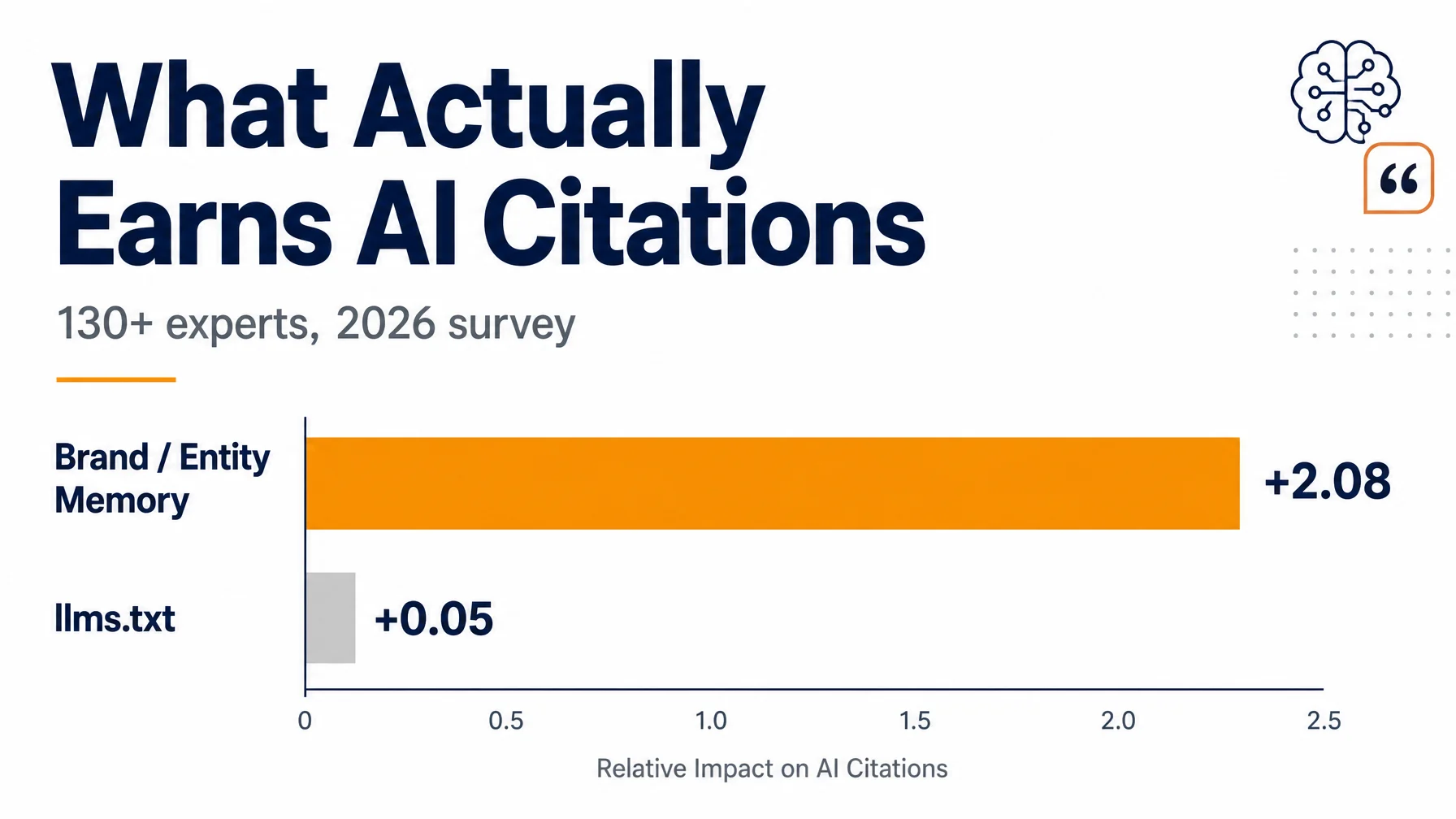
That is the headline finding from a September 2026 survey by Cyrus Shepard and Dawn Shepard at Zyppy. They asked more than 130 search professionals from companies including Ahrefs, Moz, iPullRank, Wix, SearchPilot, and Sterling Sky to rate 13 candidate factors on a seven-point scale from +3 (strongly positive) to -3 (strongly negative) for the question: how much does each factor affect whether a page or source is surfaced, selected, or cited in Google AI Overviews or AI Mode?
Three results deserve your attention:
- Brand / Entity in LLM Memory scored +2.08. Only crawl access and query-answer match scored higher.
- llms.txt scored +0.05. Effectively a shrug.
- Structured data scored +0.80. Real, but modest, and mostly for product and merchant data.
The gap between +2.08 and +0.05 is the whole story. Teams are spending calendar time on the file, and almost none on the thing experts say actually moves the number.
What the survey measured, and what it did not
Before you rebuild your roadmap around this, understand the boundaries. This is a survey of expert opinion, not a controlled experiment on Google's ranking systems. The authors say so themselves, and several respondents pushed back on the premise that anyone has confident answers yet.
- It is opinion, weighted by experience. The value is in the consensus, not in a causal claim.
- It is Google-specific. The question was about AI Overviews and AI Mode, not ChatGPT, Perplexity, or Gemini.
- It is directional. A +2.08 does not mean "this is 40x more important than llms.txt." It means experts put one near the top of the scale and the other near zero.
- It will age. One respondent's comment in the report was simply, "This will likely age poorly." Treat the findings as a 2026 snapshot.
With those caveats stated, the ranking is still useful, because it tells you where experienced practitioners would spend a limited budget.
The full ranking, in one table
Here is how the 13 factors scored, with the practical read for each.
Rank | Factor | Score | What it means for your team |
|---|---|---|---|
1 | AI Crawl Access & Snippet Eligibility | +2.20 | A hard gate. If Google cannot crawl you or use your content, nothing else matters. |
2 | Query-Answer Match | +2.15 | Answer the actual question, directly, on the page. |
3 | Brand / Entity in LLM Memory | +2.08 | What the model already knows about you from training data. |
4 | Citable / Specific Facts | +2.07 | Numbers, dates, named processes, first-party data. |
5 | Organic Fan-Out Coverage Rankings | +1.91 | Rank for the subqueries Google generates behind the main question. |
6 | Organic Search Ranking | +1.89 | Traditional rankings still feed AI answers. |
7 | Unique / First-Party Information | +1.85 | Information that exists nowhere else. |
8 | Cross-Web Consensus & Corroboration | +1.81 | Other sources agree on your basic facts. |
9 | Source / Publisher Reputation | +1.78 | Trust in the publisher, not just the page. |
10 | Extractable Content Structure | +1.69 | Headers, tables, lists, clean sentences. |
11 | Answer Prominence | +1.65 | Put the answer near the top. |
12 | Structured Data | +0.80 | Modest, with a real exception for product data. |
13 | llms.txt File | +0.05 | No measurable consensus value. |
The top four cluster tightly between +2.07 and +2.20. The bottom two fall off a cliff. That shape matters more than the exact ordering.
Why brand memory is the hardest lever to pull
Parametric memory is the knowledge a large language model absorbed during training and froze into its weights. It is the model's prior belief about your brand before it retrieves a single page. When Google's AI system already recognizes you as a relevant entity, it is more willing to surface and recommend you, and less likely to doubt you.
That creates an uncomfortable asymmetry:
- Retrieval-side work is fast. Fixing crawl access, adding a clear answer block, or publishing a table can change what a system can use within days or weeks.
- Memory-side work is slow. You cannot edit a model's weights. You can only influence what future training corpora and grounding signals will contain about you.
As Dan Petrovic of DEJAN put it in the report, entering the model's training data is "much harder than link building." Ross Simmonds of Foundation called memory "the sleeper variable in AI ranking that most brands are ignoring."
The practical implication is that brand memory is a compounding asset. Every consistent mention, every third-party citation, every authoritative profile you earn today is an input into a model you will be measured against in a year. You cannot sprint it. You can only start early.
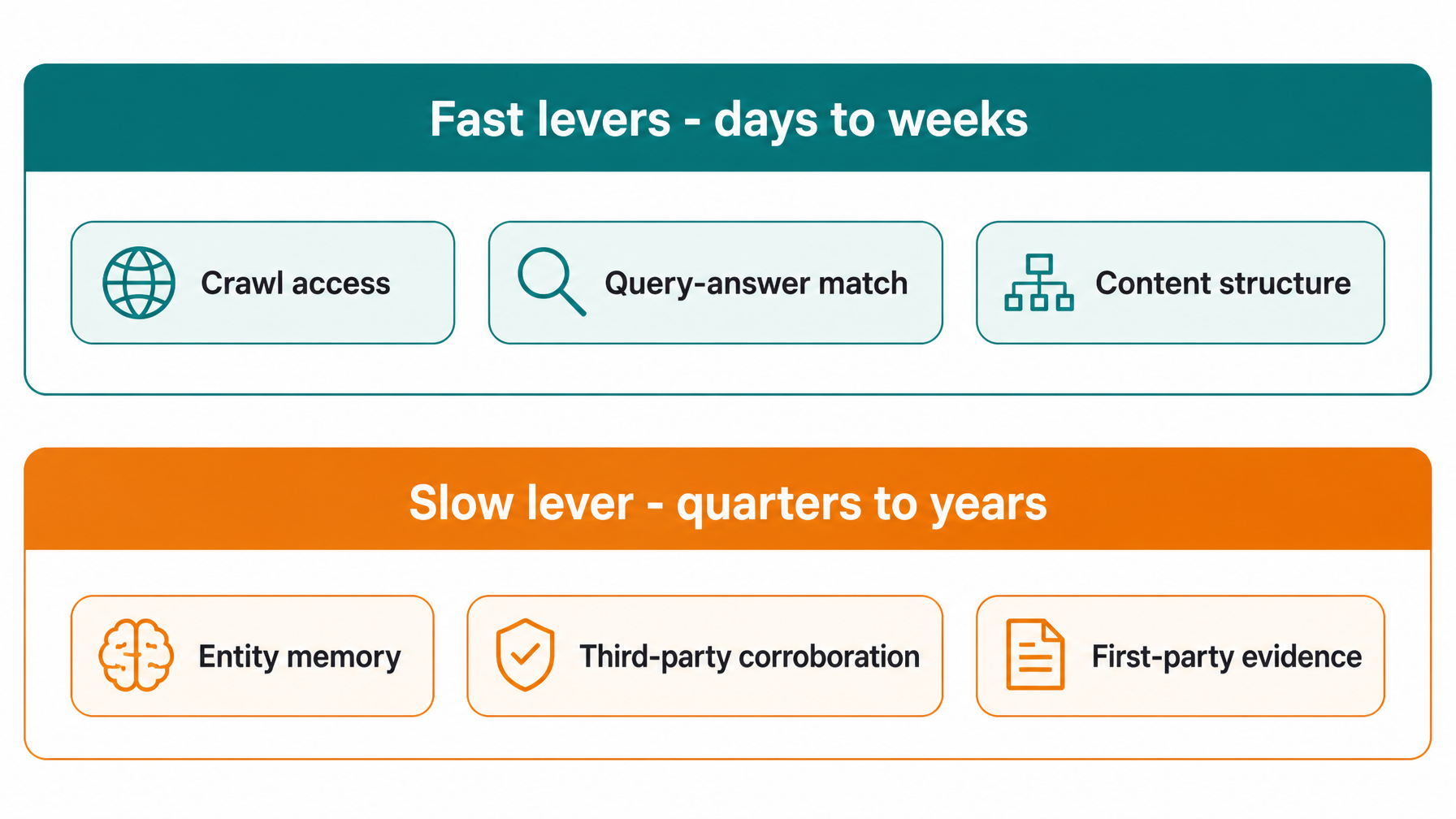
The survey splits cleanly into levers you can pull this month and one you can only start compounding now.
The AI-specific tactics experts are skeptical of
llms.txt
The report's sentiment on llms.txt was blunt. Andrew Shotland of Local SEO Guide wrote that "an llms.txt file and $8 will get you a decent Boba." Przemysław Charchan cited seven independent studies covering close to 500,000 domains, all of which found that AI bots do not check the file on their own.
That does not mean the file is harmful. It means it is not a citation strategy. If you already publish one, keep it. Do not put it on a roadmap as a growth initiative.
Chunking
"Chunking" — deliberately breaking content into small digestible blocks for AI — came up eight times in the expert comments, and the report summarizes the consensus as: you do not need to chunk your content for Google to understand it.
What still matters is ordinary structure: descriptive headers, tables, lists, and sentences a reader can follow. That is Extractable Content Structure, which scored +1.69. The lesson is that clear writing is the tactic. Manual chunking is a workaround for unclear writing.
Schema
Structured data landed at +0.80, which is not nothing but is well below the top group. The report flags one real exception: product and merchant data, which feeds the Shopping Graph and does work in AI Mode shopping results.
So the honest position is: keep your schema correct and complete, especially for products, but do not expect markup alone to earn citations.
What actually earns citations: specific, unique facts
Two factors sit right behind brand memory, and they are the ones you can act on this quarter: Citable / Specific Facts (+2.07) and Unique / First-Party Information (+1.85).
The report's analysis is worth quoting in substance: if AI search already has ten pages saying roughly the same thing, page eleven needs to bring something those ten did not. Original data, a test someone actually ran, a firsthand observation, a named process with steps — that is what gives a retrieval system something to cite.
Geoff Kenyon of Pomar added an important nuance: a specific number that is already everywhere is not useful for earning a citation. The value comes from being specific and unique.
This is where most content teams have an untapped advantage. You already sit on data that is not on the web:
Data you probably already own | Why it is citable | Where it could live |
|---|---|---|
Support ticket categories and volumes | Nobody else can publish your failure patterns | A "what breaks most often" page |
Average lead time or fulfillment time | Concrete, dated, verifiable | A benchmark page for your category |
Pricing or inventory spreads | Specific and hard to copy | A quarterly pricing index |
Onboarding completion or churn by segment | First-party evidence of what works | A methodology or lessons page |
Internal test results | A test someone actually ran | A documented experiment write-up |
None of this requires a new data team. It requires a decision to publish what you already measure.
The overlap with traditional SEO nobody should ignore
Two of the top six factors are plain SEO: Organic Fan-Out Coverage Rankings (+1.91) and Organic Search Ranking (+1.89). The report's explanation is technical and worth internalizing: AI Overviews and AI Mode run on retrieval-augmented generation grounded in Google's core ranking systems, and query fan-out generates related subqueries behind each answer. Pages get cited because they rank, either for the visible query or for the subqueries underneath it.
Fili Wiese of Search Brothers framed it as a hard gate: "Access works as a hard gate ahead of any ranking consideration."
The practical takeaway is that GEO is not a replacement for SEO. It is a second use of the same foundation. If your traditional rankings are weak, your AI visibility will be weak for the same underlying reasons.
A working order for the next quarter
Given the scores, here is a defensible sequence for a team that cannot do everything at once.
- Remove eligibility blockers. Confirm Googlebot and the relevant AI user agents can crawl the pages you want cited, and that your content is eligible to appear in snippets and AI features. This is the +2.20 gate.
- Fix query-answer alignment on your highest-value pages. For each priority query, check that the page answers the question directly and early. This is the +2.15 factor and the cheapest to improve.
- Publish one piece of first-party data. Pick a dataset you already own and turn it into a citable page with a clear methodology and a date. This targets the +2.07 and +1.85 factors simultaneously.
- Audit your entity footprint. Check that your about page, profiles, and third-party mentions describe your brand consistently. This is slow work aimed at the +2.08 memory factor.
- Keep structure clean, but stop treating it as strategy. Headers, tables, and lists support extraction. They are not the reason you get cited.
Notice what is not on this list: writing an llms.txt file, manually chunking pages, or adding schema as a citation play. Those are maintenance items, not growth items.
Auspia's view
The most useful thing about this survey is that it separates fast levers from slow ones. Crawl access and query-answer match are fast. Brand memory is slow. Most GEO advice collapses those two timelines and sells the fast levers as if they were the whole game.
Our read is that the teams who win AI citations over the next two years will be the ones who start the slow work now (consistent entity signals, original data, third-party corroboration) while using the fast levers to stay eligible in the meantime. The survey gives you permission to stop chasing the file and start publishing the evidence.
If you want a starting point, run an AI Search Visibility Checker pass on your priority prompts to see where you currently appear, then compare that against the entity and evidence gaps this survey points to.
FAQ
Does this mean llms.txt is useless? No. It means it has no measurable consensus value for earning citations in this survey, and multiple studies found AI bots do not check it on their own. Keep it if you have it; do not build a strategy on it.
Is parametric memory something I can influence directly? Not directly. You cannot edit a model's weights. You influence it indirectly through consistent brand signals, third-party mentions, and authoritative sources that future training data and grounding systems will draw on. Expect a long timeline.
Should I stop doing schema markup? No. Structured data scored +0.80, and product and merchant data has a specific, documented role in Shopping Graph and AI Mode shopping results. Keep it accurate. Just do not expect it to earn citations on its own.
How is this different from traditional SEO? Less than the hype suggests. Two of the top six factors are ordinary organic rankings. The report found a positive overlap between ranking well in traditional results and appearing in Google AI. GEO adds entity memory and citation-worthiness on top of that foundation.
How many experts were surveyed? More than 130 search professionals, drawn from the same pool that participated in the 2026 Google Ranking Factors Survey. They contributed 13,665 ratings across 103 factors in the broader study, with 13 factors rated specifically for AI answers.
How should I use a survey of opinions? As a prioritization signal, not proof. The report itself notes how much is still unknown. Use the scores to order your work, then verify with your own prompt-level visibility data.
Author: Isabel Grant, Researcher of 2,000+ AI Citation Patterns at Auspia. Isabel writes about citation earning, source quality, and how retrieval systems choose which evidence to trust.