Google Search Console Generative AI Report Expands to Most Sites
Google's Search Console generative AI performance report, first introduced in June 2026, has expanded to the majority of website properties. The rollout gives site owners their first dedicated view into how their pages appear inside AI Overviews, AI Mode, and other generative features on Google Search and Discover.
The report appeared in early June as a limited beta available to a small subset of sites. Over the following weeks, Google widened access steadily. By mid-August, the tab was visible across dozens of tested Search Console profiles, though Google's search liaison John Mueller clarified on Reddit that the rollout is not yet universal. Sites with insufficient impressions in generative AI features will not see the report at all, which mirrors how Google handles Discover and news reports in the tool.
The details
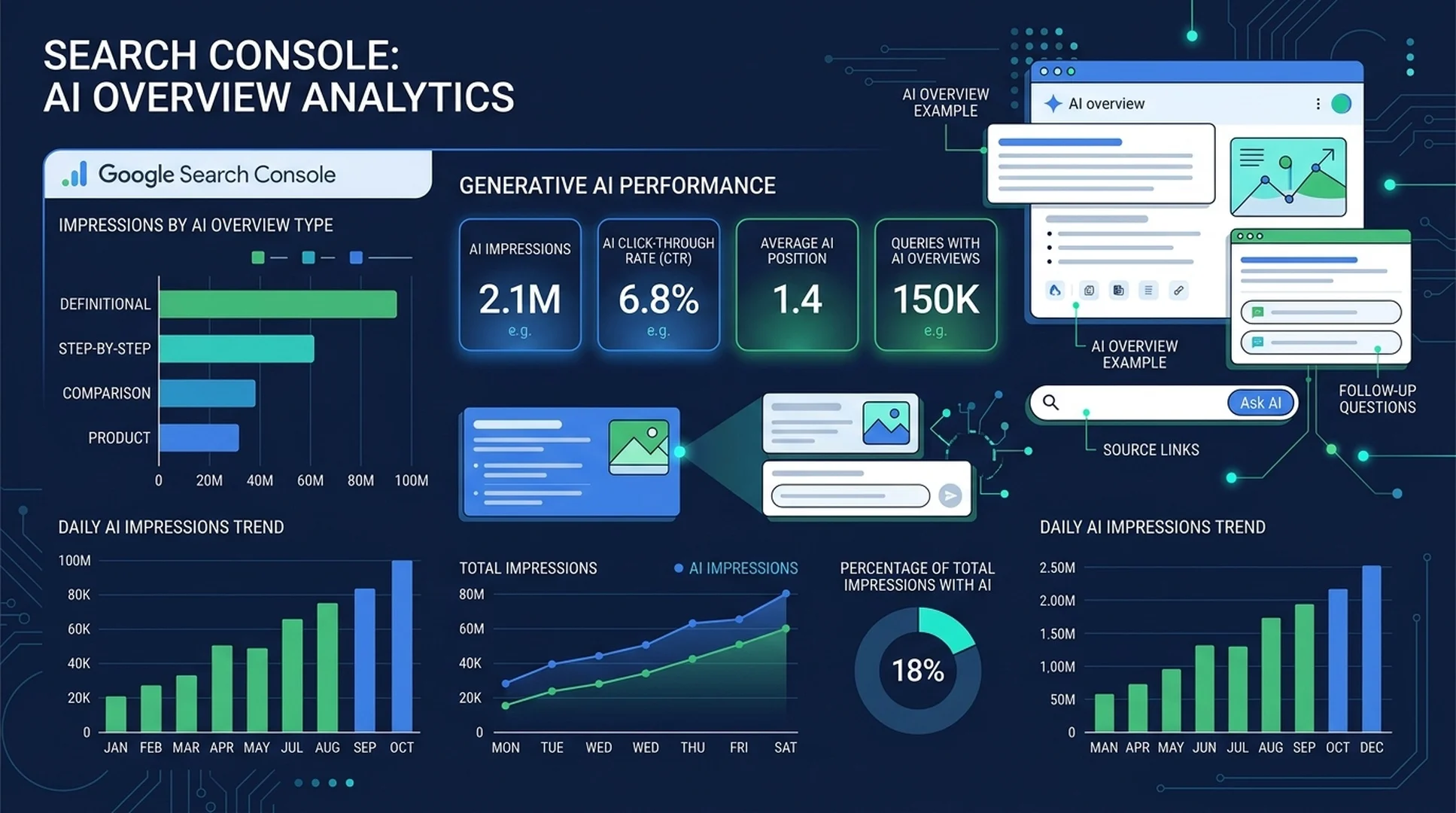
The generative AI performance report lives as an expandable tab beneath the main Performance section in Search Console. It tracks five data dimensions:
- Impressions: how often URLs from a site appeared inside generative AI features on Search and Discover.
- Pages: which specific URLs were surfaced within those AI features.
- Countries: visibility broken down by geography.
- Devices: which devices users were on when they saw the site in AI results (Search only).
- Dates: time-series data available at hourly, daily, weekly, and monthly intervals.
The report was announced on June 3, 2026, in a Google Search Central blog post authored by Hillel Maoz, Search Ecosystem Engineering Manager, and Moshe Samet, Product Manager Lead for Search Console. At launch, Google said the data was designed to help site owners understand their visibility within generative AI features, separate from the overall performance report that continues to track all search traffic.
Two metrics are notably absent. The report does not include click data, meaning site owners cannot see whether impressions in AI Overviews or AI Mode led to actual visits. It also lacks query-level data, so publishers cannot see which prompts or searches triggered their content's appearance in generative results.
Google said in its June announcement that it was collecting feedback on what additional metrics would be most useful. The company noted it is continuing to work with website owners to understand what insights would best inform their strategies, including the possibility of adding more metrics over time.
The report covers AI Overviews (the AI-generated summaries that appear at the top of search results), AI Mode (Google's conversational search experience), and generative AI features within Discover. This means the data captures visibility across Google's three main AI-powered surfaces, not just one product.
Why this matters for SEO and AI visibility
For the first time, publishers have a native tool that separates AI-driven impressions from traditional organic search impressions. Before this report, the only way to estimate AI Overview visibility was through third-party rank trackers or manual spot-checking. The Search Console data provides a ground-truth baseline, even if it is incomplete.
The absence of click data creates a gap. Site owners can see that a page appeared in AI Overviews 5,000 times last month, but they cannot tell whether any of those impressions converted to traffic. This mirrors the early days of Discover reporting, where Google also launched impressions-only data before eventually adding click metrics. If history repeats, click data may arrive in a future update.
The lack of query data is a more significant limitation. Without knowing which prompts surfaced their content, publishers cannot optimize for specific AI-driven queries the way they optimize for traditional search terms. This makes the report more of a monitoring tool than an optimization tool at this stage. Teams can track whether their AI visibility is growing or shrinking over time, but they cannot yet connect that visibility to specific user intents.
For GEO practitioners, the Pages dimension is the most immediately useful. It reveals which URLs Google's AI systems are selecting as sources, which provides direct feedback on whether a site's content structure and authority signals are working in the AI search context.
What to watch next
Google has signaled openness to expanding the report's metrics. The most anticipated additions would be click data and query-level breakdowns, either of which would transform the report from a visibility monitor into a practical optimization resource.
Site owners who do not yet see the report should verify that their pages are actually appearing in generative AI features. If a site has zero impressions in AI Overviews or AI Mode, the report will not display. This itself is a signal: sites missing entirely from generative results may need to reassess their content strategy for AI search visibility.
The broader trend is clear. As AI-driven search experiences capture a growing share of queries, Google is building the measurement infrastructure to match. The generative AI performance report is the first piece of that infrastructure. More tools and data points are likely to follow as the market matures and publishers demand greater transparency into how AI search affects their traffic.
Sources
- Google Search Central Blog, "Introducing Search Generative AI performance reports in Search Console," June 3, 2026. https://developers.google.com/search/blog/2026/06/gen-ai-performance-reports
- John Mueller, Reddit discussion on generative AI report rollout, August 2026.
Author: Owen Hartwell, Google AI Overview Tracker Across 40+ Verticals. Owen writes about Google's AI search features, SERP shifts, and what they mean for site owners navigating the transition from traditional search to generative AI experiences.