Do not start with websites. Start with a reason someone would link.
When people are new to link building, they often begin in the least useful place: searching for "free backlink sites" and submitting a company to a long list of directories nobody reads. The link count may go up. Useful mentions usually do not.
There is a better starting point. Find the sites that already perform well around the topics you want to own. Look at the articles, communities, publications, and partners that cite them. You may not be able to earn every one of those links, but the pattern tells you something important: what kind of resource, relationship, or information people in your market are willing to reference.
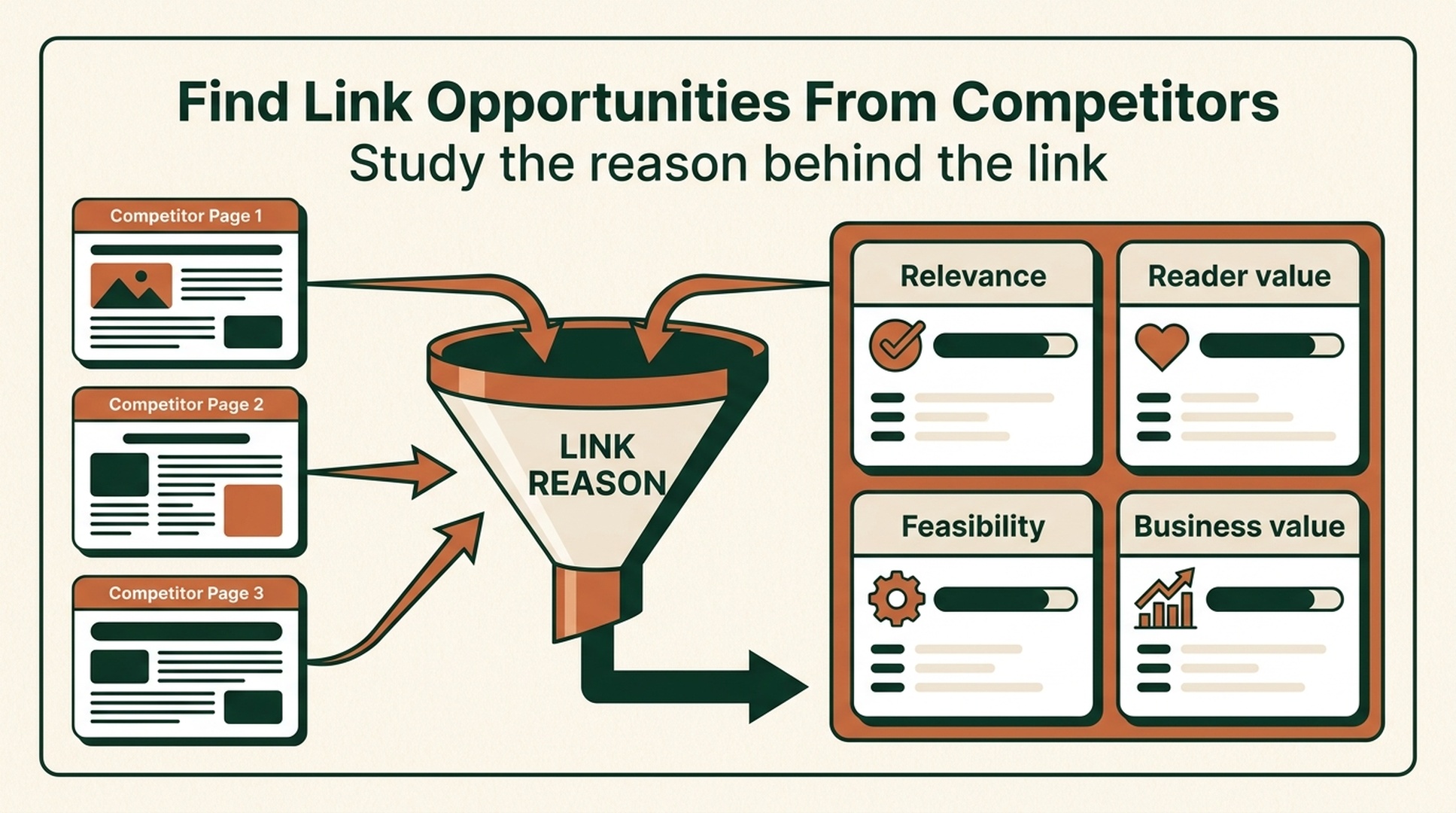
The aim is not to copy a competitor's backlink profile. It is to copy the reason behind a link.
Maybe a competitor appears in an industry tool roundup because it solves a clear job. Maybe it is listed on a partner page because it has a real integration. Maybe a research article cites it because it published original data. Asking for a link without that underlying reason rarely works. Building an equally useful, or better, reason gives you a credible way in.
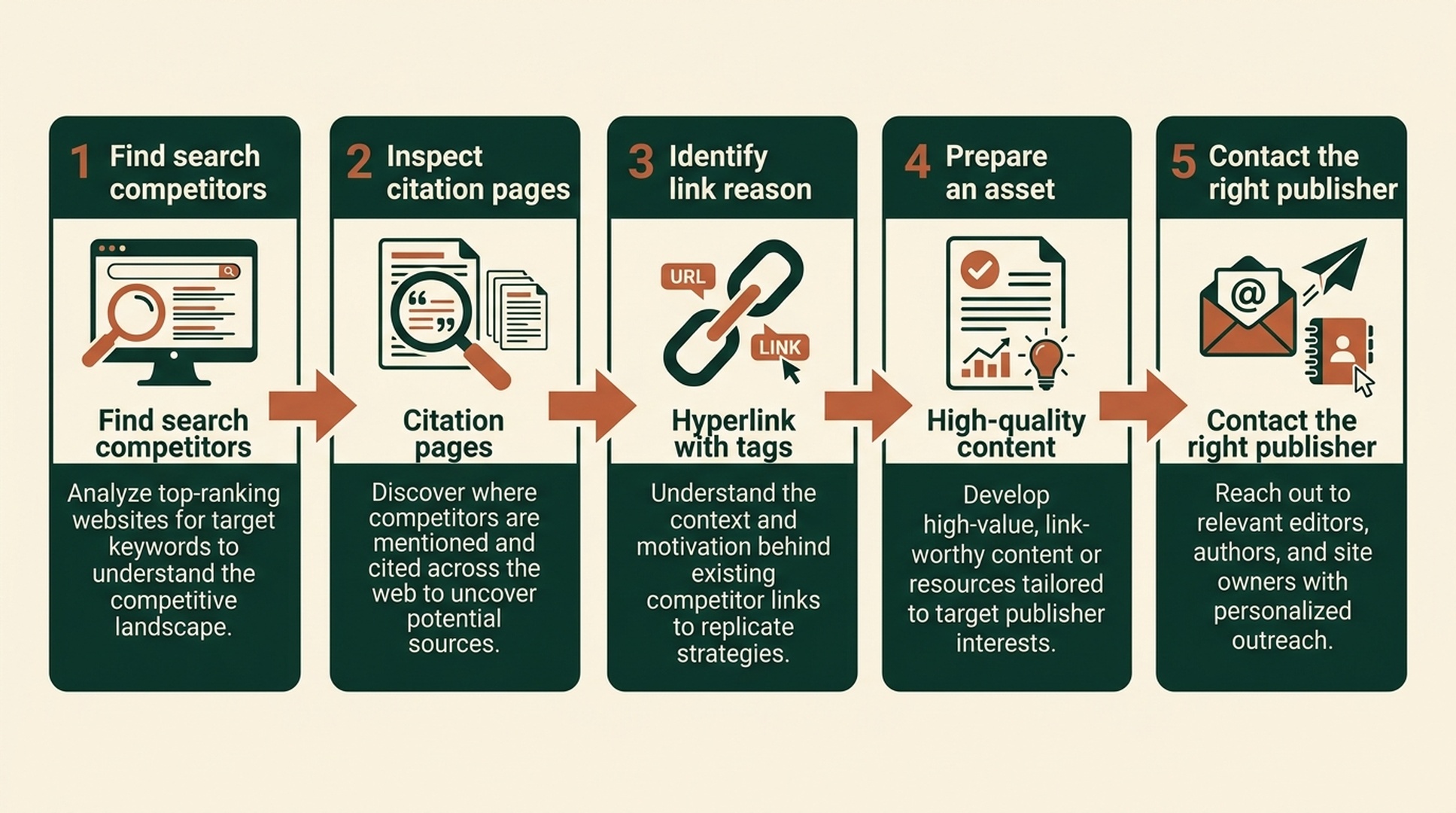
A competitor mention must be translated into a link reason and a useful asset before outreach begins.
Find search competitors, not only business competitors
For this exercise, a competitor does not have to sell the same product as you. The more useful group is often your search competitors: sites that appear repeatedly for the questions, topics, and product terms your potential customers use.
Imagine you sell project management software. Your search competitors might include:
- Other project management products.
- An industry publication with a "best project management tools" guide.
- A consultancy that publishes templates, frameworks, and benchmark reports.
- A lightweight tool that people often recommend in Reddit threads, product communities, or podcasts.
Three to five sites are enough for a first pass. Choose them because they cover a topic where you want visibility, or because they already appear in places your future customers read.
If you already have a keyword or content-competitor list, put those sites into one spreadsheet or analysis tool before you begin. The tool can reduce the time spent collecting and comparing signals. A person still has to answer the more important question: would this mention matter to our customer?
Turn each competitor link into one of six link reasons
Do not add every domain that links to a competitor to an outreach list. First ask why the publisher linked to them. These six reasons appear often, and each leads to a different practical next step.
Where the competitor appears | Why the publisher linked to them | What you need to prepare | A sensible next action |
|---|---|---|---|
Industry resource page or tool directory | Readers need a usable product or service | A clear product page, use cases, and accurate pricing or free-plan details | Apply for inclusion and explain the specific use case you cover |
Partner or integration page | The companies have a real relationship | An integration page, joint case study, or implementation guide | Build the relationship or integration first, then request the listing |
Expert article, roundtable, or interview | The editor needs a credible point of view or example | A named subject-matter expert, a specific opinion, and a verifiable example | Offer a useful contribution that fits the article's topic |
Data, statistics, or research article | The writer needs a primary source | A small survey, aggregated data, or a report with a transparent method | Publish a citeable chart and contact writers using outdated data |
Tutorial, template, or resource roundup | Readers need help completing a task | A template, calculator, checklist, or example file | Make the asset genuinely useful, then suggest it to relevant authors |
Event, association, or community page | Your brand participated, sponsored, or contributed | A talk, case study, recording, or community contribution | Take part only in communities that genuinely overlap with your customers |
This is also why many generic link-building services disappoint. Their whole plan is often to place a link somewhere. The opportunities above require a good reason for that placement.
A 30-minute competitor-link exercise
You do not need a massive analysis for your first run. Pick one important customer problem and work through this short exercise.
1. Write down who you want to be found by
Do not write "everyone who needs SEO." Make it more concrete:
- A 20-to-100-person SaaS team comparing customer-support software.
- A Shopify store owner who wants to add product reviews.
- A European startup choosing a compliance tool.
This determines which links are worth pursuing. A high-traffic site with the wrong audience is often less useful than a small, focused industry resource page.
2. Find three competitor pages that address that problem
Choose three pages from search results that closely match the question you want to cover. They can be product pages, tutorials, research reports, or free tools. Record the page topic, not just the brand.
For example, if a competitor earns many mentions for a customer-churn calculator, the real lesson may be that an embeddable, reusable calculator attracts references. The lesson is not simply the competitor's name.
3. Record the context around every citation
For each source page you find, record four things:
What to record | The question to ask |
|---|---|
Source page | Is it an article, directory, partner page, podcast page, or community discussion? |
Text around the link | Is the competitor presented as a tool, data source, case example, or expert voice? |
Audience and topic | Are the readers potential customers for you? |
Repeatable condition | Do you already have the matching resource, or must you build a page, template, or relationship first? |
It is easy to make poor choices when you only look at domain metrics. A high-authority publication on an unrelated page may be less useful than a practical tutorial in a focused community.
4. Split opportunities into "ready now" and "build first"
This is the step that keeps an outreach list honest. Do not label every opportunity as "ready for outreach."
Ready-now opportunities can include relevant directories for products or services you already offer, events where you have already contributed, resource pages that closely fit your existing material, and genuine unlinked brand mentions.
Build-first opportunities may require original data, a template, an integration page, a more complete tutorial, or a real partner relationship. They will not produce a link tomorrow. They are often the opportunities worth investing in.
5. Make the request fit the page
Outreach often fails because the request does not match the purpose of the page, not because the email lacks persuasive language.
If the page is a tool list, explain which reader need your product covers. If it cites old statistics, offer newer data and describe the method. If it is a partner page, make the partnership real first. "Please give us a dofollow link" is not a useful subject line or a useful request. An editor wants to know whether the page improves for readers.
Here is a plain version of a resource-page outreach email:
Hi [Name],
I was reading your [page name] and noticed the resources you list for readers who need to [reader task]. We recently published [resource name], which helps them [specific outcome] and includes [template / data source / free feature].
If you think it would make the page more useful, you are welcome to review it here: [link]. No need to reply if it is not a fit.
Thanks, [Name]
Short is usually better. Careful prospect selection and a useful resource do more work than polishing the same cold-email template for hours.
Use a light scoring card before you chase an impressive-looking domain
When the list gets longer, score each opportunity. Keep it simple: 0, 1, or 2 points in each category, for a total of 8.
Criterion | 0 points | 1 point | 2 points |
|---|---|---|---|
Topic relevance | Unrelated to your business | Some overlap | Readers are your target customers |
Link reason | The link would feel forced | There is limited supporting value | Your content or product clearly fills a page-level gap |
Feasibility | No contact and no sign the page is maintained | An author or editor is identifiable | A clear submission path, relationship, or real prior contact exists |
Business value | Only adds to a link count | Could bring a little relevant traffic | Could drive customers, credible mentions, or sustained referral traffic |
Start with opportunities scoring six or more. Put anything below five on a watch list, even if the site has a big name.
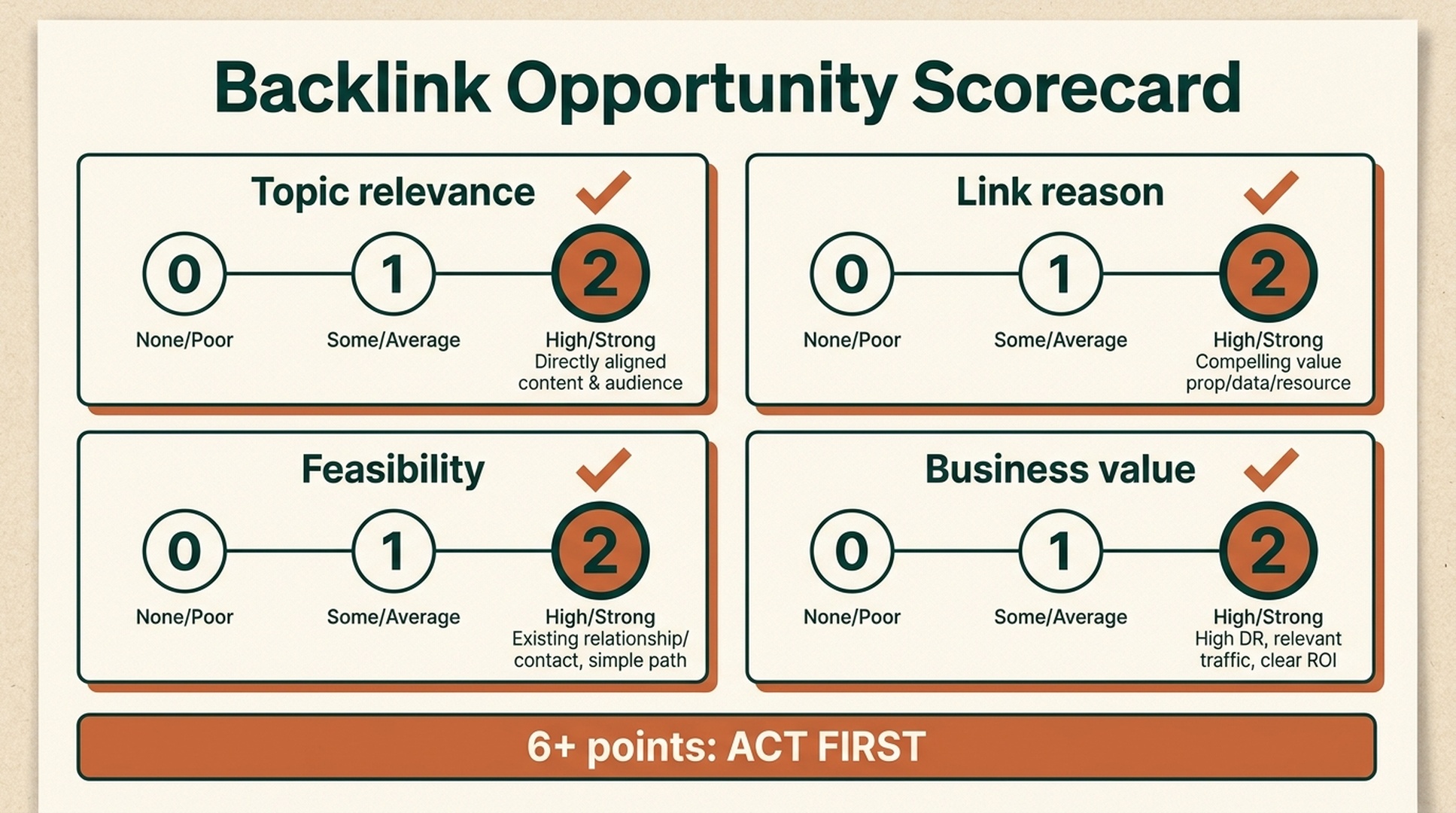
Relevance and a genuine link reason matter more than one authority number.
Links you should usually leave alone
You do not need every link a competitor has. Be cautious when:
- The page has no connection to your customers and only looks attractive because of a high domain metric.
- The site is full of paid posts, gambling, adult content, or unrelated outbound links.
- Someone promises a large volume of links quickly but cannot name the pages where they will appear.
- The arrangement requires identical commercial anchor text in a reciprocal exchange.
- You have to write a thin guest post solely to get one link.
Links remain part of search visibility, but low-quality placements do not replace useful content, a clear site structure, a good product, or real reputation. The same is true for AI search. A brand naturally mentioned on relevant industry pages has a more credible external footprint than one scattered across spam directories.
A one-week starting plan
If you do not want this to become a spreadsheet that never ends, begin with this pace:
Day | Work | Output |
|---|---|---|
Monday | Pick one customer question and three search competitors | A focused topic and competitor list |
Tuesday | Find 15 to 20 pages that mention or link to those competitors | An initial source list |
Wednesday | Write the reason behind each link and score it | A short list of high-priority opportunities |
Thursday | Improve the asset you most often lack: a template, case, statistic, or explanatory page | One citeable resource |
Friday | Send five personal, high-fit messages | An outreach log and follow-up date |
Five messages in a week may not sound like much. It forces you to choose carefully, though. Over time, that is more sustainable than sending one generic email to 500 unrelated sites.
Make link research a way to understand your market
Competitor link research does more than identify potential backlinks. It reveals where customers learn, what editors choose to cite, which resources a market lacks, and where your brand is currently absent.
You can begin manually. When you need to compare several competitors, topics, and content opportunities consistently, Auspia's SEO tools can help organize the research and priorities. A tool can reduce collection and sorting time. It cannot replace the hard part: making something readers and publishers genuinely want to recommend.
FAQ
How many competitor backlinks should I research?
You do not need to study a competitor's entire backlink profile. Start with 15 to 20 sources that are closely related to one important topic. That is usually enough to see recurring link types and resource gaps.
Can I contact sites that already link to a competitor?
Yes, if you have a legitimate addition to offer. If the page lists similar products, explain why yours fits the reader's use case. If it cites data, offer stronger or more current evidence. "You linked to my competitor, so link to us too" is not a reason for an editor to update a page.
Are links from small websites worth pursuing?
They can be. A smaller, highly relevant site may send more qualified referral visitors and create real recognition in an industry. Put audience fit, page topic, and reader value ahead of a single authority metric.
Can I use this method without a research budget?
Yes. A template that solves a specific task, a clear checklist, an honest case breakdown, or a genuinely useful free tool can all be citeable. Start with an asset you can maintain well.
How long does link building take to affect results?
There is no fixed timetable. Publishers need to update pages, search systems need to recrawl them, and rankings can move for several reasons. In the near term, watch for relevant mentions, referral traffic, and whether those sources create steady industry exposure.
Author: Olivia Stone, SERP Intelligence Researcher across 25,000 queries at Auspia. She writes about search competition, content and citation opportunities, and how growth teams turn search signals into usable priorities.