The number next to each site is the least useful thing on the list
A backlink list like this one circulates every few weeks, and it always arrives in the same shape: a platform name, a DR score, and an implied promise that higher is better.
Starter Story (DR 76), Niche Pursuits (DR 74), DevTo (DR 91), Hashnode (DR 83), Pinterest (DR 97), Flickr (DR 94), Vimeo (DR 96), YouTube (DR 99), Substack (DR 94), SaaSHub (DR 81), and the rest of the set.
The scores are roughly right. The problem is what founders do with them. A DR 99 site is a strong domain. That does not make the link you get from it strong. YouTube at DR 99 will hand your startup a page on a subdomain you do not control, with a link that may or may not pass anything, competing against millions of other channels for the same crawl budget. Starter Story at DR 76 will hand you a page on a domain with real editorial standards and a small, specific audience of people who are already looking for startup stories.
One of those is usually worth more to a company that launched six months ago. Usually it is not the one with the bigger number.
Below, the 18 sources are sorted by what they actually deliver, followed by a way to check the link before you spend a week on it. The AI-assisted startup backlink workflow covers the submission mechanics in more detail.
Sort the list by what you get, not by domain strength
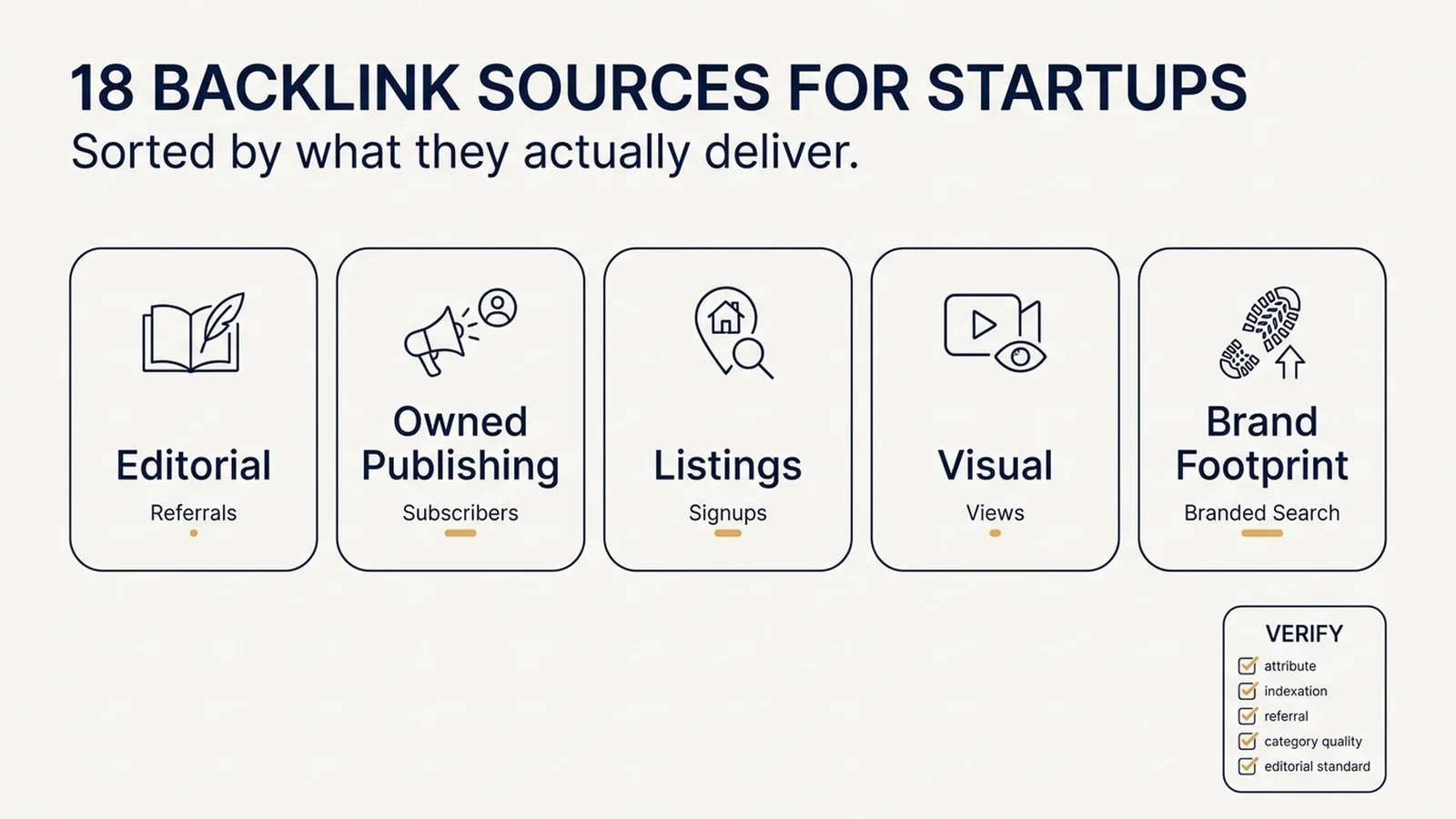
Every source here falls into one of five buckets. The bucket matters more than the score, because the bucket tells you what to measure afterward.
What you get | Sources | What to measure |
|---|---|---|
Editorial placement | Starter Story, Niche Pursuits | Referral sessions, branded search lift, whether the piece gets cited elsewhere |
Owned publishing surface | DevTo, Hashnode, Substack | Subscriber growth, repeat readers, whether the content ranks on its own |
Structured product listing | SaaSHub, and the smaller directories in the same family | Qualified referral traffic, trial signups, category-page visibility |
Visual and video discovery | Pinterest, Flickr, Vimeo, YouTube | Views, saves, watch time, assisted conversions |
Brand footprint | The remaining profile and community sites | Branded search, entity recognition in AI answers |
A startup rarely needs all five in the same month. Pick the two buckets that match where your buyers already spend attention, and treat the rest as a research pool.
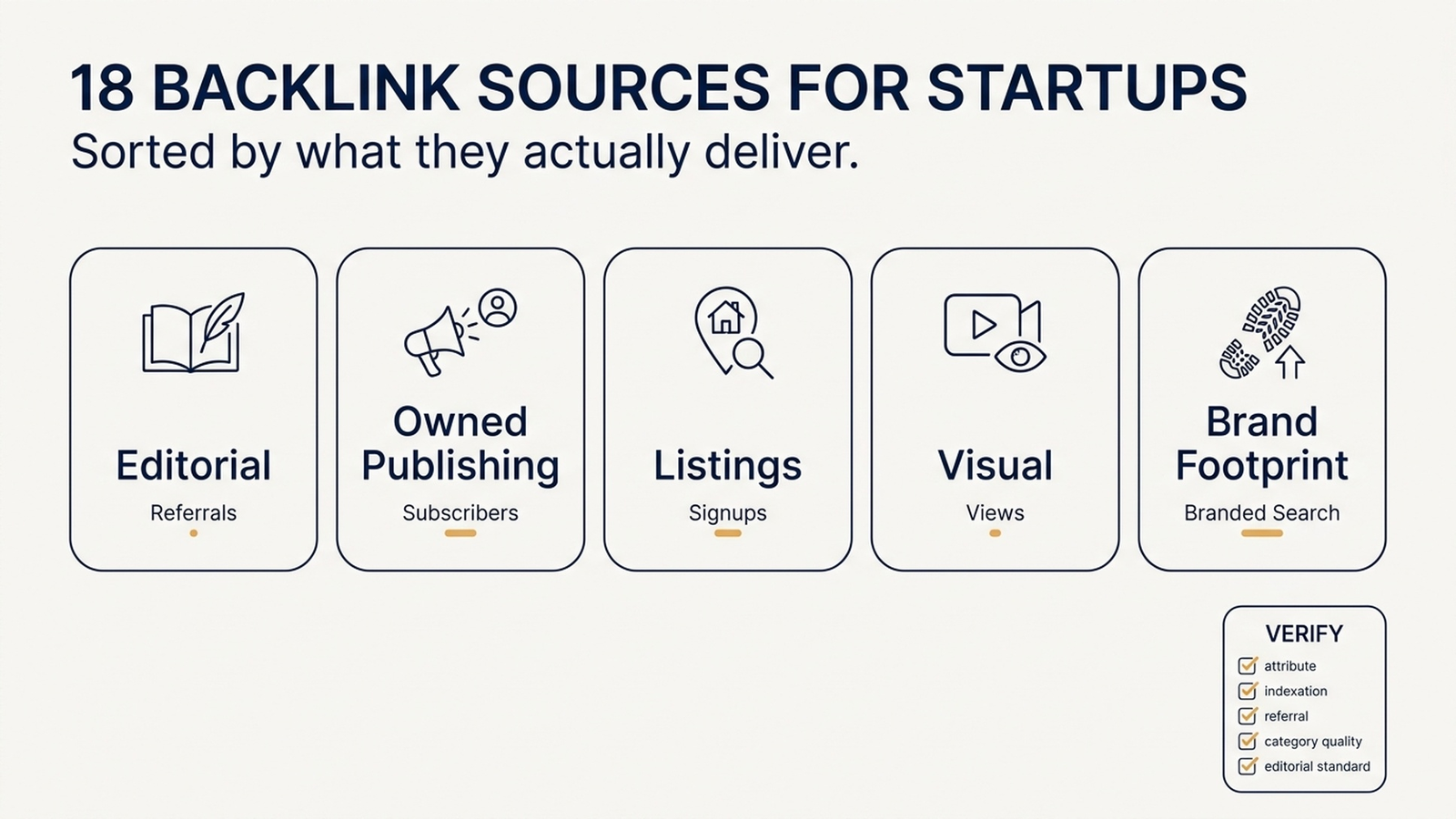
Caption: Five buckets, five different success metrics. Sorting the list this way stops you from judging a Substack newsletter by the same standard as a Product Hunt launch.
Editorial placements: Starter Story and Niche Pursuits
These two are the only sources on the list that require someone else to decide your story is worth publishing.
Starter Story publishes founder interviews and business breakdowns. The audience is other founders, indie operators, and people researching how a specific type of company got started. If your startup has a story with a real decision in it, a pivot, a distribution experiment, a number that surprised you, this is one of the better places to tell it. If you have a product page and no story, you will not get in, and pitching anyway burns the relationship.
Niche Pursuits covers niche site building, content businesses, and online income projects. It is a better fit for a content-led or SEO-led product than for a deep infrastructure tool. The audience is practitioners who will actually try what you describe, which makes it a good source of early, opinionated users.
What both give you is a link inside an editorial context, on a page that has a reason to exist without you. That is the version of a backlink that tends to survive algorithm updates.
What they do not give you is volume. Expect one placement to take weeks of pitching, and expect most pitches to be declined. The right way to approach them is to read the last twenty pieces each one published and pitch something that fits the pattern rather than something that fits your launch calendar.
Owned publishing surfaces: DevTo, Hashnode, Substack
These three let you publish without asking permission. That is the appeal, and also the trap.
DevTo and Hashnode are developer publishing platforms. Both will host your technical writing and both will give you a profile that links back to your site. The value comes from writing something a developer would read on its own merits: a migration writeup, a benchmark, a post-mortem, a library comparison. Cross-posting a marketing announcement there gets you a page nobody reads and a profile nobody clicks.
Substack is a newsletter platform first. It gives you a publication page, an archive, and an email list you keep. For a startup, the useful version is a founder or engineering newsletter with a narrow, specific angle, not a second company blog. The list is the asset. The backlink is a side effect.
One caveat on all three: links from user-generated content platforms are frequently marked ugc or nofollow, and profiles with no engagement are treated as low-value. The link is real. The ranking signal is not something you can count on. What you can count on is the referral traffic and the fact that a well-read post on DevTo or a growing Substack gives search engines and AI systems another consistent description of what your company does.
Structured listings: SaaSHub and its neighbors
SaaSHub is a software directory with comparison pages, alternatives pages, and category listings. Directories in this family are the most misunderstood sources on the list, because they look like a form to fill in and behave like a small SEO project.
The good ones rank for "X alternatives" and "X vs Y" queries, which means your listing can appear in front of people who are already comparing tools. That is genuinely useful traffic, and it is often the most qualified traffic any source on this list sends you.
The bad ones are auto-generated pages with no editorial oversight, no traffic, and a link that exists only to be sold. Submitting to those is the behavior Google's spam policies describe as a link scheme, and the cleanup cost later is higher than the benefit now.
A quick filter before you submit to any directory: search for the directory's own name. If it does not rank for its own brand, it will not rank for your category. Then check whether the category page you would appear on has real listings with real descriptions, or a wall of thin entries.
Visual and video discovery: Pinterest, Flickr, Vimeo, YouTube
These four are on the list because they are large, well-crawled domains. That is the whole reason. Treat them as discovery channels that happen to be owned by strong domains, not as link sources.
YouTube is the one most startups should take seriously. A product walkthrough, a setup tutorial, or a recorded teardown of a real problem can bring in viewers for years. Links in video descriptions are usually nofollow, so the SEO value is limited, but YouTube videos surface in Google results and increasingly get pulled into AI answers. A well-titled tutorial is a visibility asset independent of the link attribute.
Vimeo works for the same reason at smaller scale, with a different audience and a cleaner embed experience. If you already produce video, mirroring it there costs almost nothing.
Pinterest is worth the effort only if your product has a visual or template-shaped output. Infographics, checklists, comparison cards, and before-and-after diagrams do well. A B2B API tool does not.
Flickr is the weakest fit on the list for most startups. It is a photo community, and the link value is minimal. Unless you have a genuine photography or image-library angle, skip it and spend the hour somewhere else.
Brand footprint: the remaining profile and community sources
The rest of the list exists to make your company easier to find and easier to describe consistently. That has become more valuable as AI answer engines pull from multiple sources to build a picture of a brand.
The practical job here is consistency. Same company name, same one-line description, same category language, same URL, everywhere. A profile that says you are an "AI-powered growth platform" on one site and a "SEO automation tool" on another gives an answer engine two competing facts and no way to choose.
This is also where the risk lives. Community platforms like Reddit and Quora punish drive-by promotion quickly and permanently. The rule that works: participate where you have something useful to say, and only link when the link saves the reader time. If a page would not deserve to exist without the backlink, do not create it.
Check the link before you invest the week
Here is the part most lists skip. Before you commit real time to a source, verify what you will actually get.
Check | How to do it | What it tells you |
|---|---|---|
Link attribute | Publish a test page or inspect an existing user profile's link | Whether you get a followed link, |
Indexation | Search | Whether the platform even lets your page into the index |
Referral reality | Check your analytics for sessions from the domain after 30 days | Whether real people click, which is the only guaranteed benefit |
Category page quality | Open the page you would be listed on | Whether you are joining a curated list or a thin directory |
Editorial standard | Read the last ten published pieces | Whether your submission has a realistic chance |
Run this on two or three sources before you scale to the full list. The results are usually surprising enough to change your priority order, and they take an afternoon rather than a month.
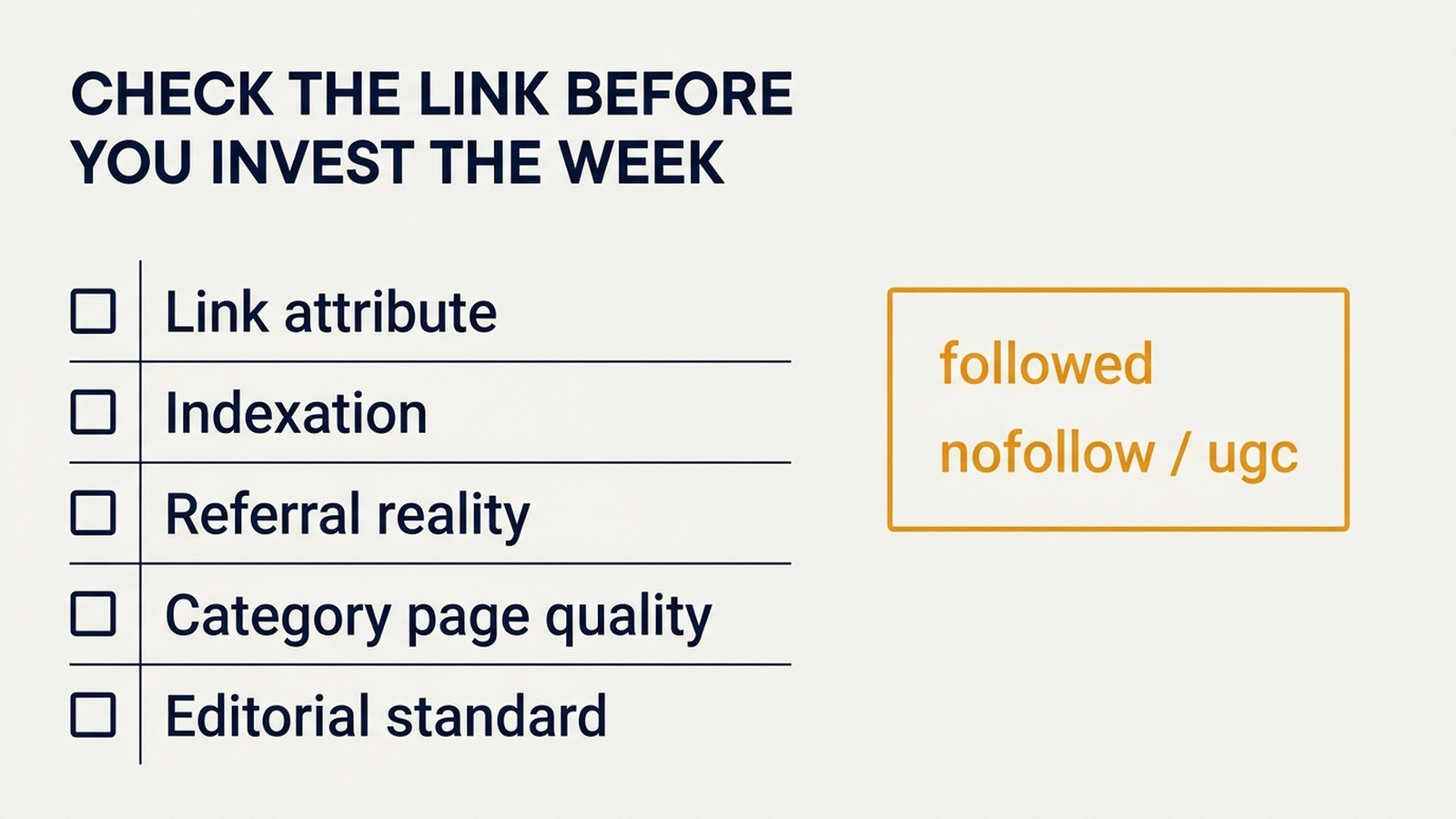
Caption: Five checks, run on two or three sources before you scale. The attribute check is the one that changes your priority order.
What to do with the list this week
Do not work the list top to bottom. Do this instead:
- Pick the two buckets that match your buyers. Most early startups should start with one editorial placement and one structured listing.
- Write down the specific asset each source needs. A founder story for Starter Story, a technical writeup for DevTo, a comparison-ready product description for SaaSHub. These are three different pieces of work.
- Verify the link type on one source before producing content for the others.
- Set a 30-day review. If a source has produced no referral sessions and no branded search movement, archive it and move to the next.
The list is a menu. It is not a checklist. Eighteen sources worked carefully will beat eighteen sources submitted in a weekend, and the second approach is the one that creates cleanup work six months later.
FAQ
Are high-DR backlink sources always better for startups?
No. DR describes the strength of the domain, not the value of the link you get from it. A DR 99 platform can give you a nofollow link on a page with no traffic, while a DR 76 editorial placement can send you qualified readers for years. Match the source to your audience and your content, then measure what actually arrives.
Which sources on this list give followed links?
It varies by platform and changes without notice. DevTo, Hashnode, Substack, and the directory sites generally mark user links as ugc or nofollow, though some allow followed links in specific contexts. Editorial placements usually include followed links inside the article. The only reliable way to know is to check a live example on the platform before you invest time.
How long before a backlink from these sources shows any effect?
Referral traffic can appear within days of publishing. Any effect on rankings or AI visibility typically takes weeks to months, and it is difficult to attribute to a single link. Track referral sessions, branded search volume, and whether your company description starts appearing consistently across sources.
Should a startup submit to every directory in the same family as SaaSHub?
No. Directory quality varies enormously. Check whether the directory ranks for its own brand name, whether its category pages have real listings, and whether it sends any traffic. Submitting to dozens of thin directories is the pattern Google's spam policies describe as a link scheme, and removing those listings later is slow.
Is it worth publishing on DevTo and Hashnode if the links are nofollow?
Yes, if you publish something developers would read without the link. The referral traffic, the profile, and the additional consistent description of your product all have value. If the only reason you are posting is the link attribute, the effort is better spent elsewhere.
Author: Hannah Pierce, 12-Year B2B SEO Growth Practitioner at Auspia. Hannah writes about startup SEO, buyer-focused content, and practical search workflows for small growth teams.