How to Make Product Data AI-Shopping Ready in 2026
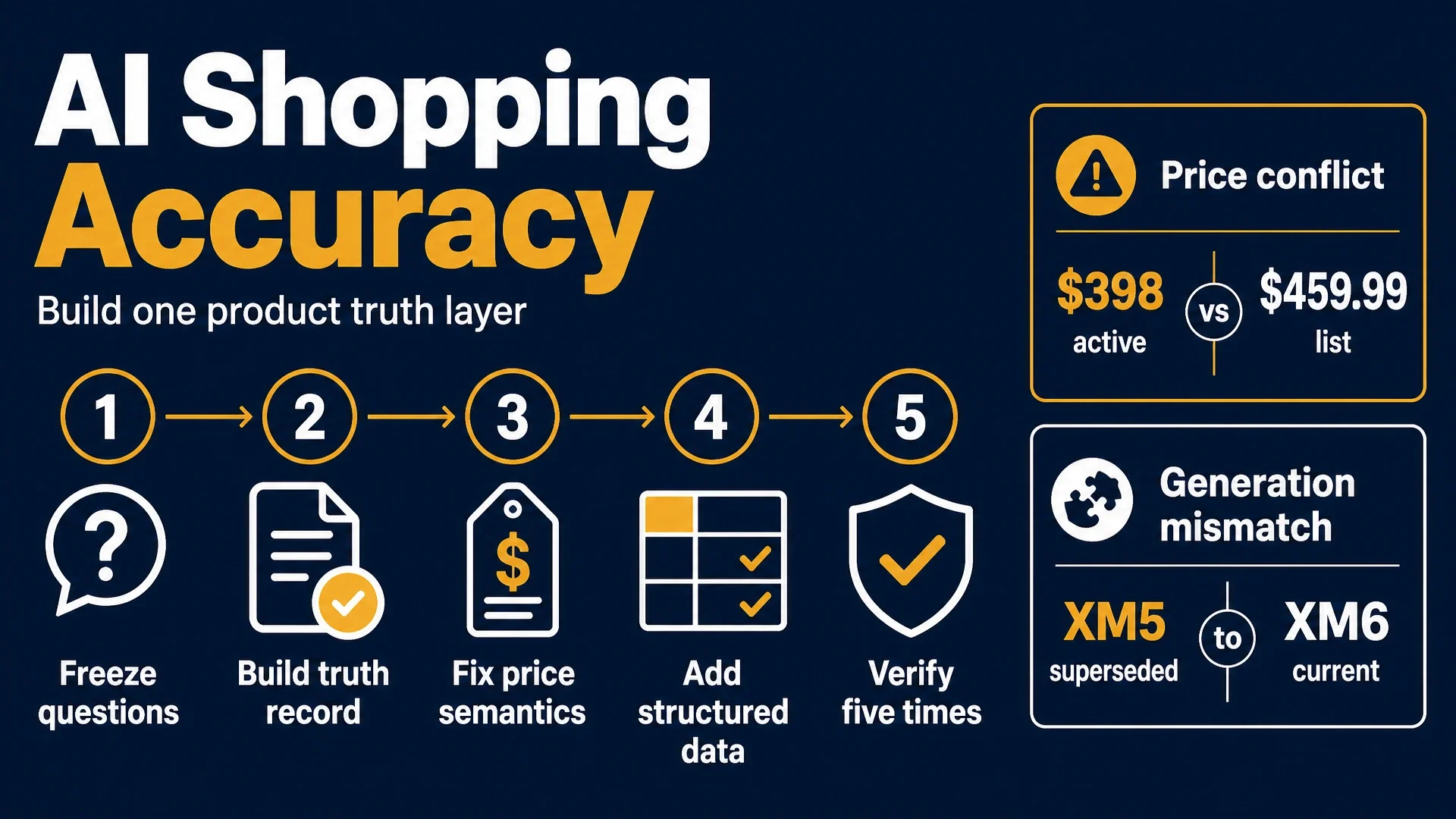
Product.ai asked ChatGPT, Gemini, Claude, and Perplexity the same 220 shopping questions five times each. Of the 217 question groups it could fully score, 187 (86%) produced a confirmed factual conflict: a contradicted price, a superseded model presented as current, or a spec the engines could not agree on. Comparison questions were the worst, conflicting 97% of the time. Even plain spec lookups conflicted on 75%.
The tempting conclusion is that AI shopping does not work. The more useful conclusion is narrower. AI shopping fails when the product truth behind an answer is fragmented, ambiguous, stale, or split across a price tag, a feed, a marketplace listing, and a support page that all disagree.
The models are often not inventing numbers. They are choosing the wrong line from a messy source. This workflow is about cleaning up the source.
What you will finish with
This is a team runbook for ecommerce SEO, product content, catalog, and growth teams. You will finish with a 20-SKU product truth workflow: one canonical record per SKU, explicit price and generation semantics, machine-readable product data, and a five-repeat verification loop across the four major AI engines.
Prerequisites
- Access to your product pages, catalog or feed, and price source of truth
- Ability to edit structured data or file a developer ticket
- A prompt set you can run repeatedly
- 2 to 3 hours for setup, plus 1 to 2 hours per SKU cluster
Definition of done
Five repeated prompts per SKU and query return no unresolved factual conflict on price, generation, availability, or core spec. Every fact traces to one canonical source with a named owner.
AI shopping accuracy is not a prompt problem. It is a product-information governance problem.
Freeze the 20 questions that can cost you a sale
Start with questions, not pages. Pull the 20 highest-risk shopping questions your buyers actually ask, then lock the list before you test anything.
Weight the list toward the question types the study found most fragile: head-to-head comparisons, open recommendations, price questions, and core spec lookups. If you sell electronics, include the model-succession questions. If you sell skincare or supplements, include the size, concentration, and serving questions. Every category in the study conflicted on at least 79% of questions, so no category is safe.
Expected output: a locked list of 20 questions, each mapped to one SKU or one head-to-head pair.
Quality check: every question names a specific product, generation, or comparison. "What is the best laptop?" is too vague to verify. "Is the 13-inch MacBook Air M4 still $1,099?" is checkable.
Recovery path: if you cannot narrow to 20, sort by revenue at risk and pick the top 20 by margin and return rate.
Build one product truth record per SKU
For each SKU in scope, create a single record that every team and every system reads from. This is the product truth layer. It is not a copy deck and it is not a feed export. It is the canonical answer to "what is true about this product today."
At minimum, capture:
- SKU and parent product group
- Generation, model year, and predecessor
- Current selling price and currency
- List or strikethrough price
- Availability and fulfillment notes
- Core specs with units
- Source URL for each fact
- Owner and last-verified date
Expected output: one row per SKU with every field filled or explicitly marked unknown.
Quality check: two people reading the record should reach the same answer about price, generation, and availability without opening a second tool.
Recovery path: if a field has no owner, assign one before you continue. An unowned fact will drift within a quarter.
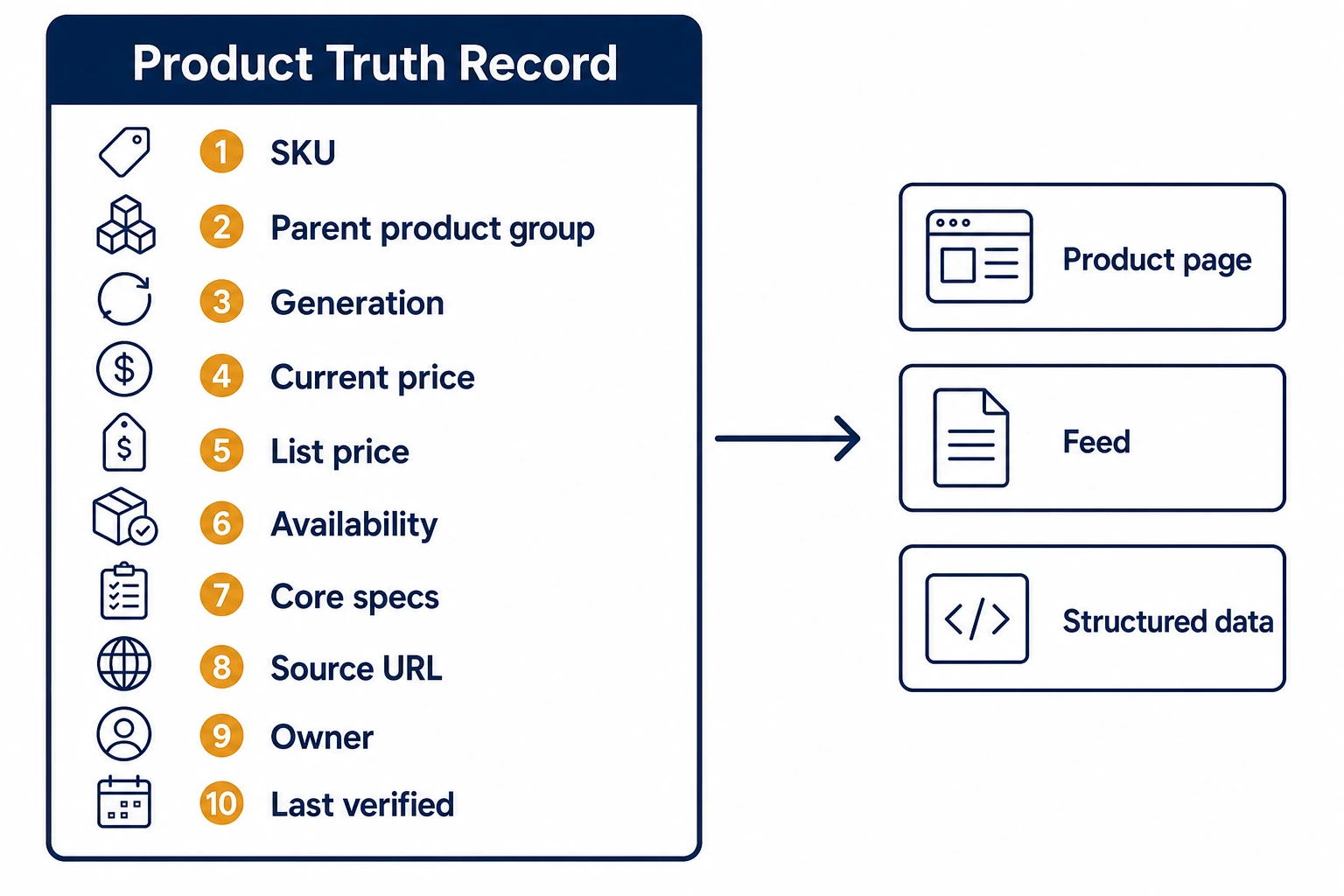
One record per SKU. Every downstream page, feed, and AI answer should resolve to this row.
Separate selling price, list price, and conditional price
The price layer of the study is the clearest warning. Of 913 verifiable price answers, 85% were exactly right. The 15% that missed were off by a median of $300, and one in ten missed by $500 or more. There was almost no middle ground.
The ambiguity starts on the page. Sony's WH-1000XM6 shows a $398 current selling price and a $459.99 list price. Engines picked different lines and presented each as "the price." Bose's QuietComfort Ultra battery spec splits between the original at 24 hours and the second generation at 30 hours, and answers often dropped the generation entirely.
Fix the semantics before you fix the copy:
- Active price: the number a shopper pays today
- Strikethrough price: the higher regular price the active price is discounted from
- Member price: the price for a loyalty tier, never the default
- Conditional price: trade-in, bundle, or financing, never the headline number
Expected output: a price table per SKU with each price type labeled and dated.
Quality check: the active price on the product page, in the feed, and in structured data match exactly, including currency.
Recovery path: if a price changes faster than your feed updates, add a priceValidUntil value and a last-updated timestamp so stale numbers are visibly stale.
Make generation and variant differences impossible to miss
Stale products were a headline failure in the study. Gemini's free tier named the Sony WH-1000XM5 as a current pick in all five runs on a headphone question, even though the XM6 had been the flagship for over a year. Every stale price in the study was the 13-inch MacBook Air quoted at $1,099, a price Apple retired months earlier after years at that number. Eight of those thirteen stale quotes came from ChatGPT.
The pattern is not yesterday's price change. It is the number that stayed the same for years. Live search catches fresh changes. Habit catches nothing.
Put the generation in the product name, the title tag, the H1, the breadcrumb, and the structured data. For variants, use ProductGroup with variesBy, hasVariant, and productGroupID so engines can tell a color or size variant from a different generation. Give each variant its own URL, image, price, and availability.
Expected output: a naming convention that makes the generation readable in a single glance.
Quality check: search your own site for the old model name. If it still appears as a current recommendation, fix that page.
Recovery path: if you cannot rename legacy URLs, add a visible "replaced by" note and a link to the current model.
Publish product facts in the page and in structured data
Google's own guidance is clear that structured data is not a special AI ranking lever and that no special schema is required for generative AI search. It is still the cleanest way to make product facts unambiguous for merchant listings and rich results. Treat it as clarity infrastructure, not a citation guarantee.
For each product page:
- Keep one product or variant per page
- Put
Productstructured data in the initial HTML, not only in client-side JavaScript - Include active price, currency, availability, condition, and
priceValidUntil - Add shipping and return policy details where you have them
- Use distinct URLs per currency for international stores
Google notes that JavaScript-generated product markup can make shopping crawls less frequent and less reliable, which matters most for fast-changing price and availability.
Expected output: valid Product or ProductGroup markup that matches the visible page.
Quality check: run the page through Google's Rich Results Test and confirm the price and availability in the markup match what a shopper sees.
Recovery path: if the markup is generated client-side, move the critical fields into server-rendered HTML or a feed that updates on the same cadence as your price source.
Give comparison and recommendation content a verifiable source
Comparison questions conflicted 97% of the time, the highest rate in the study. That is not surprising. A comparison asks an engine to combine several facts and then render a verdict. Every fact it pulls has a chance to be wrong, and the verdict amplifies the error.
If you publish comparison or "best X" content, make the source of each claim explicit. Link the spec to the product page, date the price, and state the generation you are comparing. Avoid tables that mix a current model with a discontinued one without saying so.
Expected output: comparison pages where every factual claim traces to a dated source.
Quality check: remove any claim you cannot verify against a seller page or official spec sheet within 24 hours.
Recovery path: if a comparison is out of date, either refresh it or add a visible last-reviewed date and a note about what changed.
Run the five-repeat verification
One answer proves nothing. The study found that even the steadiest engine configuration contradicted its own prior answer on at least 13% of questions, and Gemini's free tier did so on 29%. You need repetition to separate a real pattern from a fluke.
For each SKU and query:
- Ask the same question five times across ChatGPT, Gemini, Claude, and Perplexity.
- Record the product named, the generation, the price, the availability, and the core spec.
- Compare every answer against your product truth record.
- Flag any conflict that appears in at least two of five runs.
- Fix the source, not the prompt.
Expected output: a conflict log with the engine, the claim, the canonical value, and the gap.
Quality check: no unresolved conflict on price, generation, availability, or core spec after the fix.
Recovery path: if an engine keeps quoting a stale number, check whether an old page, marketplace listing, or third-party article still carries it. The engine may be reading a source you do not control.
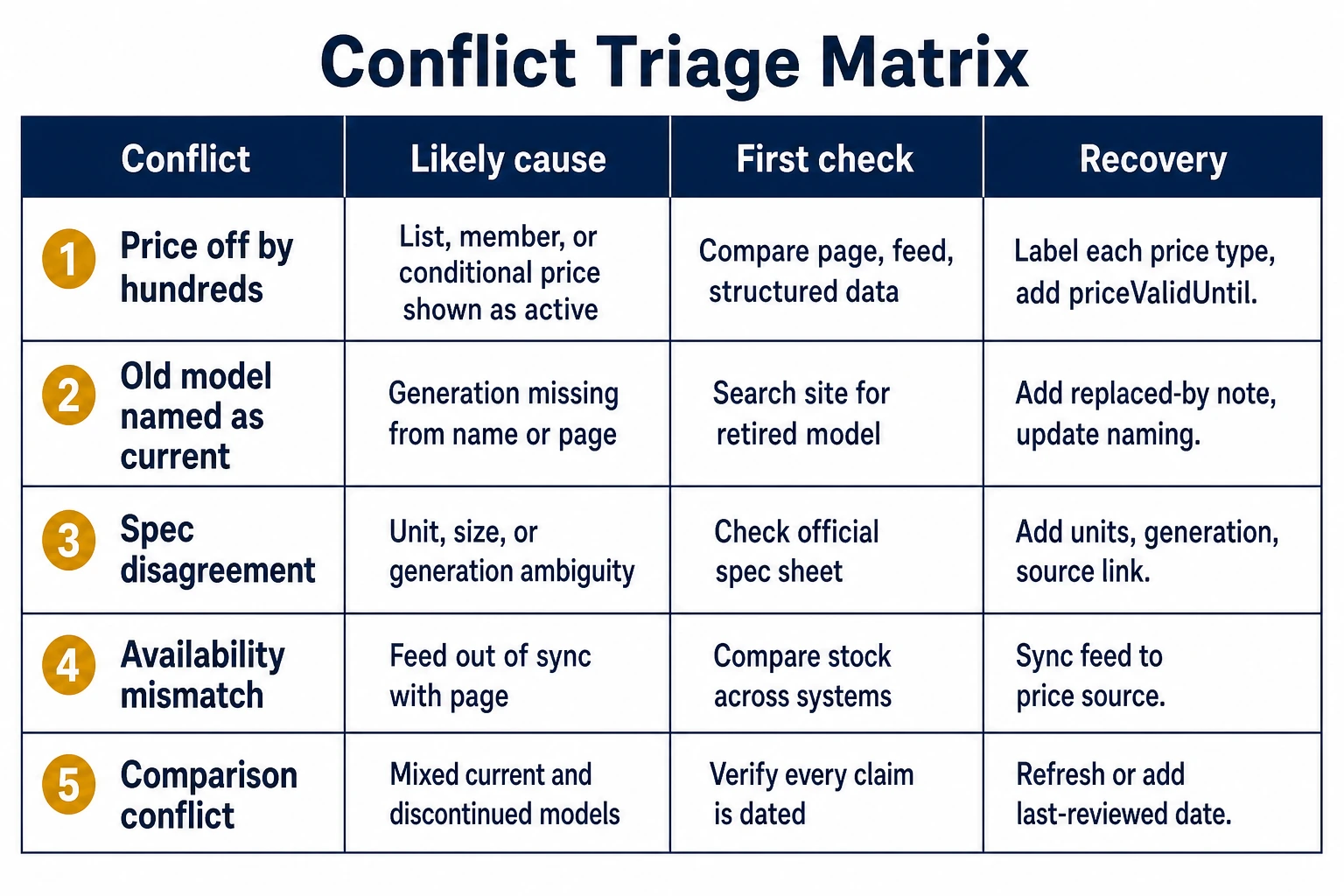
Triage by conflict type. Most errors trace back to an ambiguous or stale source, not a model failure.
Handle the three likely failures
Conflict | Likely cause | First check | Recovery |
|---|---|---|---|
Price off by hundreds | List price, member price, or conditional price presented as active | Compare page, feed, and structured data | Label each price type and add |
Old model named as current | Generation missing from name or page | Search site for the retired model | Add "replaced by" note and update naming |
Spec disagreement | Unit, size, or generation ambiguity | Check the spec against the official sheet | Add units, generation, and a source link |
Verify the finished result
Before you call the workflow done, confirm:
- Every SKU in scope has one product truth record with a named owner
- Active price, list price, and conditional prices are labeled separately
- Generation and variant differences are visible in the name and markup
ProductorProductGroupstructured data matches the visible page- Five repeated prompts per SKU show no unresolved factual conflict
- Every fact traces to one canonical source
If you want a fast read on how your brand currently appears across AI answer surfaces, run the AI Search Visibility Checker as a starting baseline before you fix the catalog.
Keep the catalog from drifting
Accuracy decays. Prices change, models get superseded, and feeds fall out of sync with pages. Set a review cadence that matches how fast your catalog moves.
- Weekly: price and availability for high-velocity SKUs
- Monthly: generation and spec checks for the full 20-SKU set
- Quarterly: re-run the five-repeat verification and refresh comparison content
Assign one owner per category. When a conflict appears, log it, fix the source, and re-test. The goal is not a perfect first run. It is a catalog that stays verifiable as it changes.
FAQ
Does structured data make AI engines recommend my products?
No. Google states that structured data is not required for generative AI search and there is no special schema for it. Structured data improves clarity and eligibility for merchant listings and rich results. It does not guarantee citations or recommendations.
Do I need an llms.txt file for this?
No. Google's guidance says Google Search does not use llms.txt or special AI markup files. The work that matters is making product facts accurate and unambiguous on the page, in the feed, and in structured data.
Why did the study say 85% of price answers were wrong?
It did not. Of 913 verifiable price answers, 85% were exactly right. The 15% that missed were off by a median of $300. The often-repeated "85% wrong" framing reverses the finding.
How many prompts do I need to run?
At least five repeats per question. The study found self-contradiction rates between 13% and 29% depending on the engine, so a single answer cannot tell you whether a conflict is real.
Does paying for a higher AI tier fix accuracy?
Not reliably. In the study, Gemini's costly-error rate barely moved between free (56%) and paid (54%). Claude improved sharply from 44% to 21%. Paying is not a substitute for clean product data.
Author: Eva Laurent, Ecommerce Search Strategist for 10k+ Product Pages at Auspia. Eva writes about product discovery, catalog data, and ecommerce search workflows.