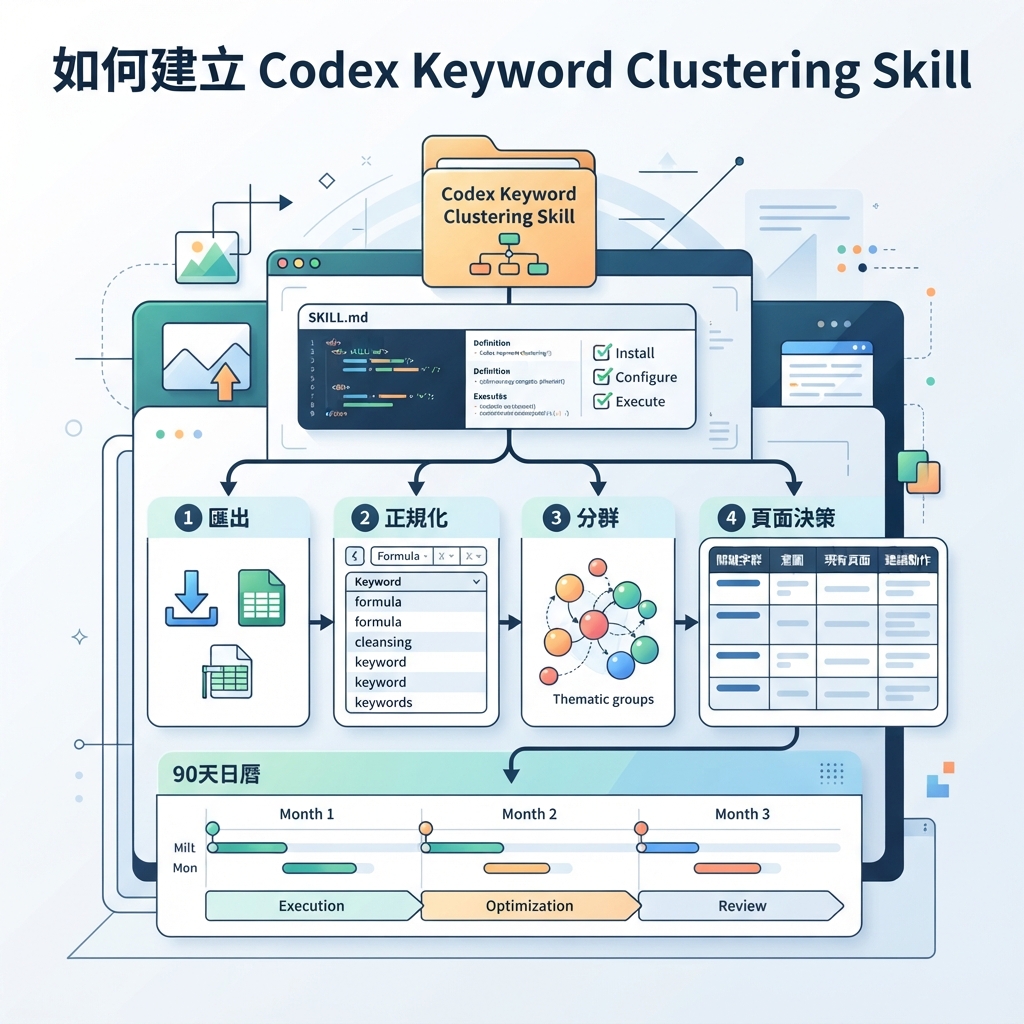
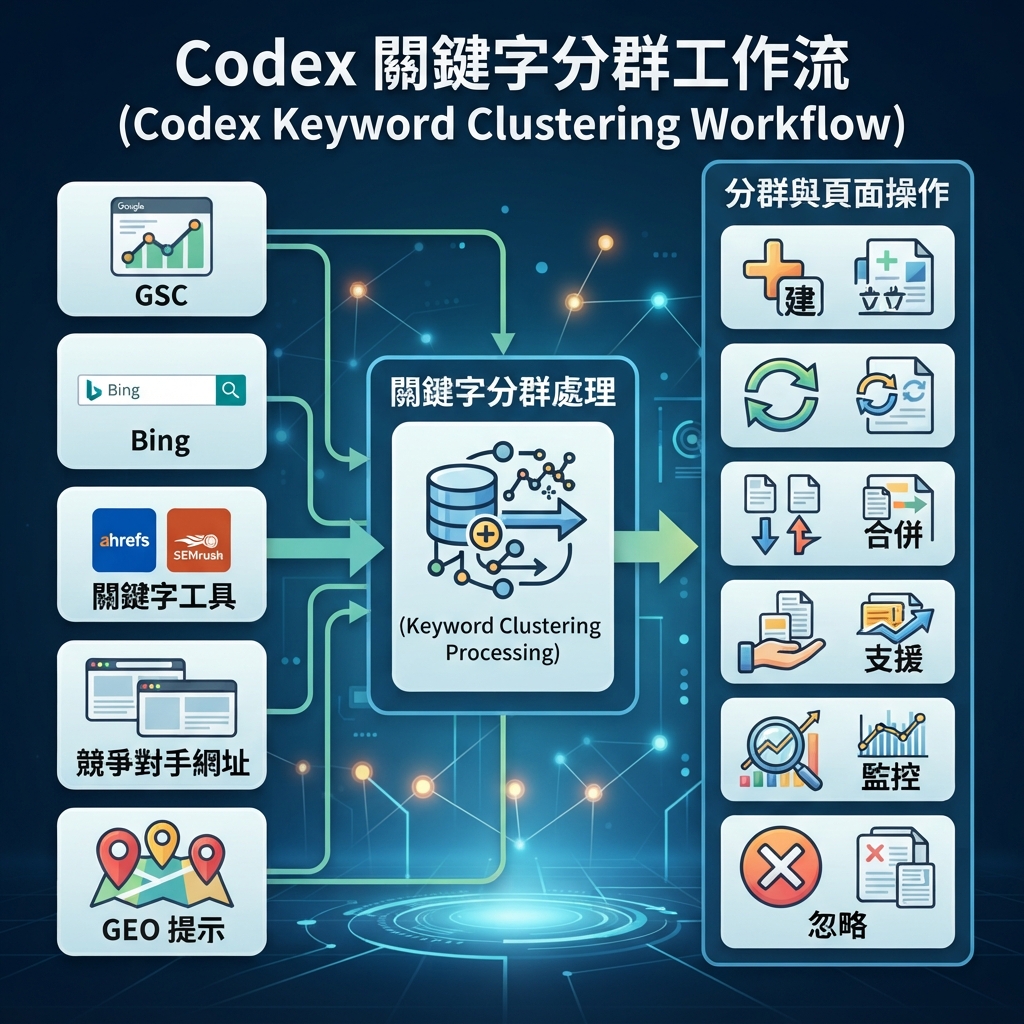
Codex Skill package for keyword clustering:instructions、scripts、exports、clusters 與 page decisions。
為什麼這應該做成 Codex Skill
Keyword clustering 不是一次性的 prompt。你每個月都會重新跑它,並帶入新的 GSC exports、Bing queries、keyword tool data、competitor URLs 與 GEO prompts。這讓它很適合做成 Codex Skill:一個包含 instructions、expected inputs、optional scripts 與一致 output format 的 reusable workflow。
目標不是產出一串 article titles。真正目標是一張 decision table:create、refresh、merge、support、monitor 或 ignore。
Codex Skills 是 reusable workflow packages,所以 keyword clustering 應該被打包,而不是每次貼一個超長 prompt。
Skill folder shape
一個實用的 project-local skill 可以長這樣:
.codex/skills/keyword-cluster-planner/
  SKILL.md
  references/
    clustering-rules.md
    page-action-rules.md
  scripts/
    normalize_keywords.py
    detect_cannibalization.py
如果你還不想維護 scripts,可以先只從 SKILL.md 開始。等 workflow 證明可重複後,再加入 scripts。
SKILL.md starter
---
name: keyword-cluster-planner
description: Turn SEO query exports, keyword data, competitor URLs, and GEO prompts into intent clusters and page actions.
---

# Keyword Cluster Planner

Inputs:
- GSC query export
- Bing query export
- keyword tool export
- existing URL inventory
- competitor URL notes
- GEO prompt map

Rules:
- Preserve source labels.
- Do not invent volume or difficulty.
- Cluster by reader job, not shared words.
- Assign one page action per cluster.
- Flag cannibalization before recommending new pages.

Output:
- normalized keyword table
- intent clusters
- page action table
- 90-day content calendar
- rejected cluster log
這份 starter 的重點,是讓 Codex 知道它不能編造 volume 或 difficulty,也不能因為字詞相同就硬分在一起。
Normalize the inputs
在 clustering 前,先要求 Codex clean data:
Use the keyword-cluster-planner skill.
Normalize these exports into seo/keyword-planning/normalized-keywords.csv.
Keep source labels, market, current URL, query, volume, difficulty, CPC, intent guess, and notes.
Remove duplicates only after preserving source frequency.
這一步會避免同一個 query 在不同 sources 裡被錯誤合併,也讓後續 decisions 能追溯來源。
Cluster by reader job
較弱的分組方式 | 較好的 Codex instruction |
|---|---|
只看相同字詞 | 依 reader 想完成的 job 分組 |
只看高 volume | 同時評估 business fit 與 effort |
一個 keyword 等於一篇文章 | 把每個 cluster 對應到 existing 或 new page |
GEO prompts 另外處理 | 把 prompt opportunities 附到 page decisions 上 |
對新手來說,最容易犯的錯是「一個 keyword 一篇文章」。Codex 應該先看 reader job,再決定 existing page 是否能 refresh,或是否真的需要 new page。
Page action table
Cluster | Existing URL | Search signal | GEO signal | Action | Reason |
|---|---|---|---|---|---|
Set up SEO agent |
| GSC impressions | setup prompts | refresh | existing page can answer better |
AI citation monitoring | none | medium demand | high GEO value | create | no page covers daily checks |
Codex skill packaging |
| low volume | strong fit | support | link from operator guide |
Action 欄位很重要。不是每個 cluster 都值得 create。很多時候,refresh、merge 或 support 比新文章更有效。
90-day calendar output
Build a 90-day content calendar from the approved page-action table.
Rules:
- no duplicate pages for the same intent
- max 2 new pages per week
- mix refreshes and new posts
- include owner, evidence, and approval gate
- keep rejected clusters in a log
這個 calendar 應該反映 production capacity。若團隊一週只能好好處理兩篇,就不要讓 Codex 排出二十篇。
Quality gate
接受 calendar 前,要求 Codex 做一次 review:
Review this keyword calendar for cannibalization, weak evidence, missing existing URLs, and overproduction.
Mark every risky item and recommend whether to keep, merge, monitor, or reject.
這一步會把 keyword clustering 從「看起來很滿的內容表」變成可執行、可審核的 page decision system。
FAQ
Codex 應該自己收集 keyword metrics 嗎?
請用 Codex normalize 與 interpret data。Metrics 應該來自 trusted exports 或 APIs。
這個 Skill 應該發布文章嗎?
不應該。它應該產出 clusters、briefs 與 calendar decisions。Publishing 應放在另一個 approval gate 後面。
第一次應該包含多少 clusters?
從 12 到 30 個有用 clusters 開始。如果團隊無法好好 publish 或 refresh,更多 clusters 不會帶來幫助。
Codex SEO/GEO learning path
這篇文章是 Codex SEO/GEO operator series 的一部分。如果你要從零建立 workflow,建議照這個順序讀:
- 如何在 2026 年用 Codex 做自動化 GEO
- 如何用 Codex 做自動化 SEO
- 如何用 AGENTS.md 建立 Codex SEO Workspace
- 如何用 MCP 把 Codex 接上 SEO Data
- 2026 年最佳 Codex GEO Skill
- 如何建立 Codex Keyword Clustering Skill
- 如何用 Codex Subagents 做 SERP、內容與技術 SEO
- 如何用 Codex 修 Technical SEO 且不破壞 Production
- 如何用 Codex Automations 跑每日 SEO/GEO Monitoring
- Codex SEO/GEO Quality Gates:Diff、Evidence、Tests 與 Human Approval
下一步
Sources and notes
請以 OpenAI 官方 Codex documentation 作為 current syntax 與 product behavior 的準確來源:
- Codex CLI: https://developers.openai.com/codex/cli
- AGENTS.md: https://developers.openai.com/codex/guides/agents-md
- Codex Skills: https://developers.openai.com/codex/skills
- Codex MCP: https://developers.openai.com/codex/mcp
- Codex subagents: https://developers.openai.com/codex/subagents
- Codex configuration: https://developers.openai.com/codex/config-reference
Author: Camille Rhodes, Auspia 300+ AI Content Workflows 架構師。Camille 撰寫 AI-assisted content systems、automation 與 growth teams 的 editorial quality control。