旧的"SEO vs SEM"之争已经结束了。2026 年 7 月,Google 悄悄改写了规则。以下是发生了什么变化、为什么重要,以及如何用 AI Agent 来执行这两种策略——即使你是完全的新手。
2026 年 7 月 7 日,Google Search Console 发布了一个没人预料到的功能:Platform Properties。
你现在可以追踪你的 Instagram、TikTok、X 和 YouTube 内容在 Google 搜索、Discover 和 Google News 中的表现。不需要网站。
这是第一次,你的社交渠道不仅仅是"流量来源"——它们是搜索资产。Google 把它们当作一等搜索资源来对待。
这个单一功能浓缩了自最初的"SEO vs SEM"指南被撰写以来,搜索营销领域发生的所有变化。问题不再是"我应该做 SEO 还是 PPC?"而是"我如何在受众搜索的任何地方被发现,以及哪种方法能最快让我达到目标?"
让我们来一一拆解。
2026 年,什么是 SEO?
SEO(搜索引擎优化)是让你的内容在搜索引擎的自然(免费)结果中获得可见性的实践。
这个核心定义没有变。但什么算作"自然搜索可见性"已经大大扩展了。
2026 年 SEO 的五大支柱
在经典框架中,SEO 有四个支柱。到了 2026 年,变成了五个:
支柱 | 涵盖内容 | 2026 年新变化 |
|---|---|---|
1. 关键词研究 | 找到人们搜索的词语 | AI Overview 查询发散——一次搜索会生成 8-12 个你的内容需要回答的子查询 |
2. 页面 SEO | 内容、标题、标题结构、结构 | 面向 AI 引用的段落级优化(134-167 词的回答块);以问题形式编写 H2/H3 |
3. 站外 SEO | 外链、品牌提及、权威信号 | 未链接的品牌提及现在很重要——Gemini 会扫描全网寻找主题上下文信号 |
4. 技术 SEO | 抓取、索引、网站性能 | URL 可访问性是 AI Overview 引用的第一要素;结构化数据必须与可见内容匹配 |
5. AI 与社交搜索可见性 | 针对 AI Overviews、AI Mode、Discover 和社交平台搜索面的优化 | 2026 年全新。 GSC Platform Properties;为 LLM 检索和引用而构建的内容结构 |
这里有一个重大转变:排名第一不再保证可见性。当 Google AI Overview 出现在 40-60% 的美国搜索中(BrightEdge、Semrush 2026 年数据),且当 AI Overview 存在时用户只有 8% 的时间点击传统结果(Pew Research),游戏规则已经变了。
你的内容需要被AI 回答引用,而不仅仅是排名靠前。下文会详细说明。
一个简单的例子
假设有人搜索"适合初学者的最佳蛋白粉"。
- 旧的 SEO 目标:让你的页面在蓝色链接中排到第 1-3 名
- 2026 年 SEO 目标:让你的内容被出现在那些蓝色链接上方的 AI Overview 引用——同时在传统结果中排名,供那些滚动越过 AI 回答的用户点击
这是两个不同的目标,需要不同的策略。
2026 年,什么是 PPC(以及 SEM)?
PPC(按点击付费)是付费广告——你竞价出现在搜索结果中,每次有人点击就付一次费。
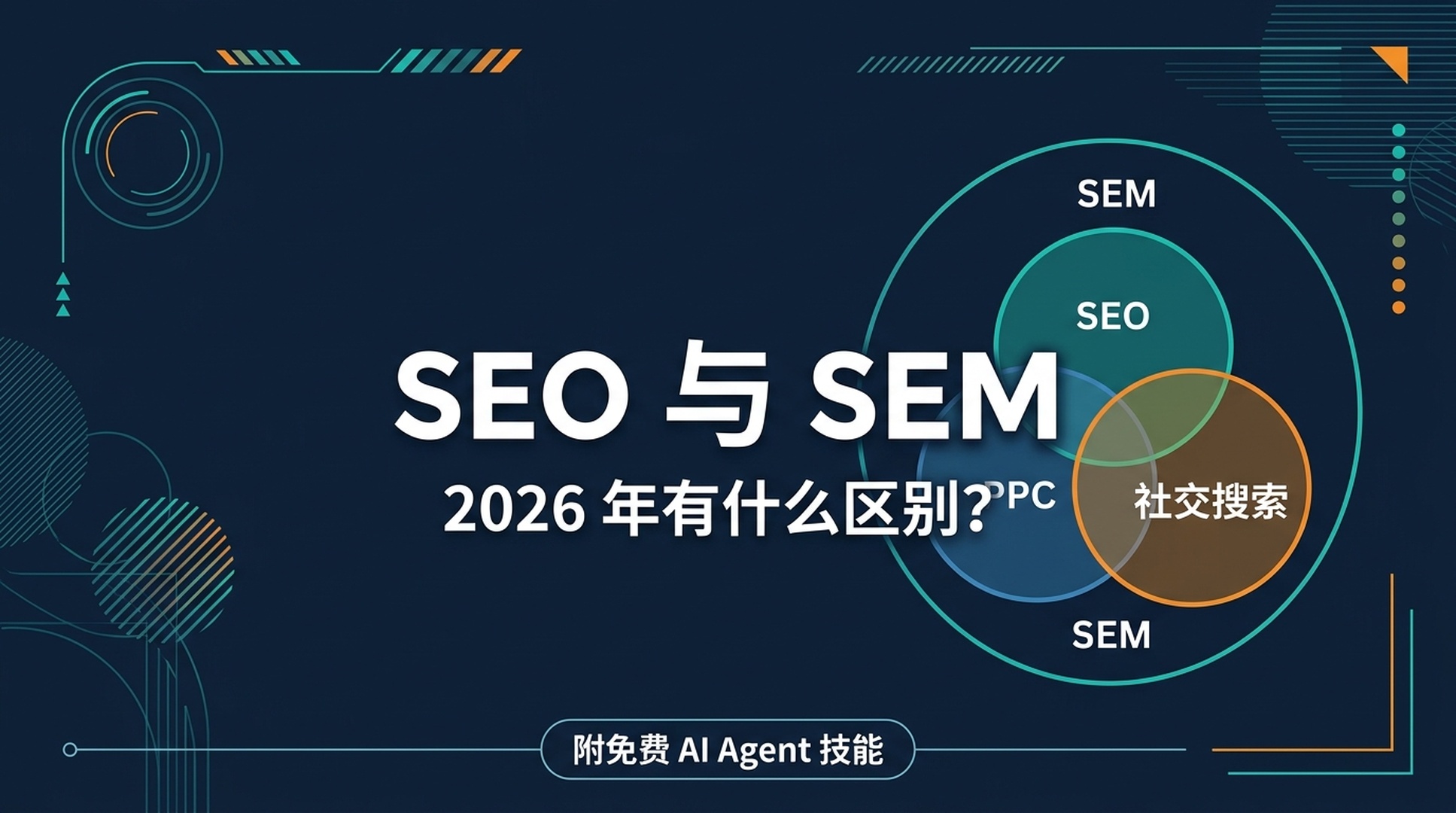
SEM(搜索引擎营销)是统称。它涵盖同时包括 SEO 和 PPC——所有在搜索引擎中获取可见性的策略,无论你是按点击付费还是靠自然排名获取。
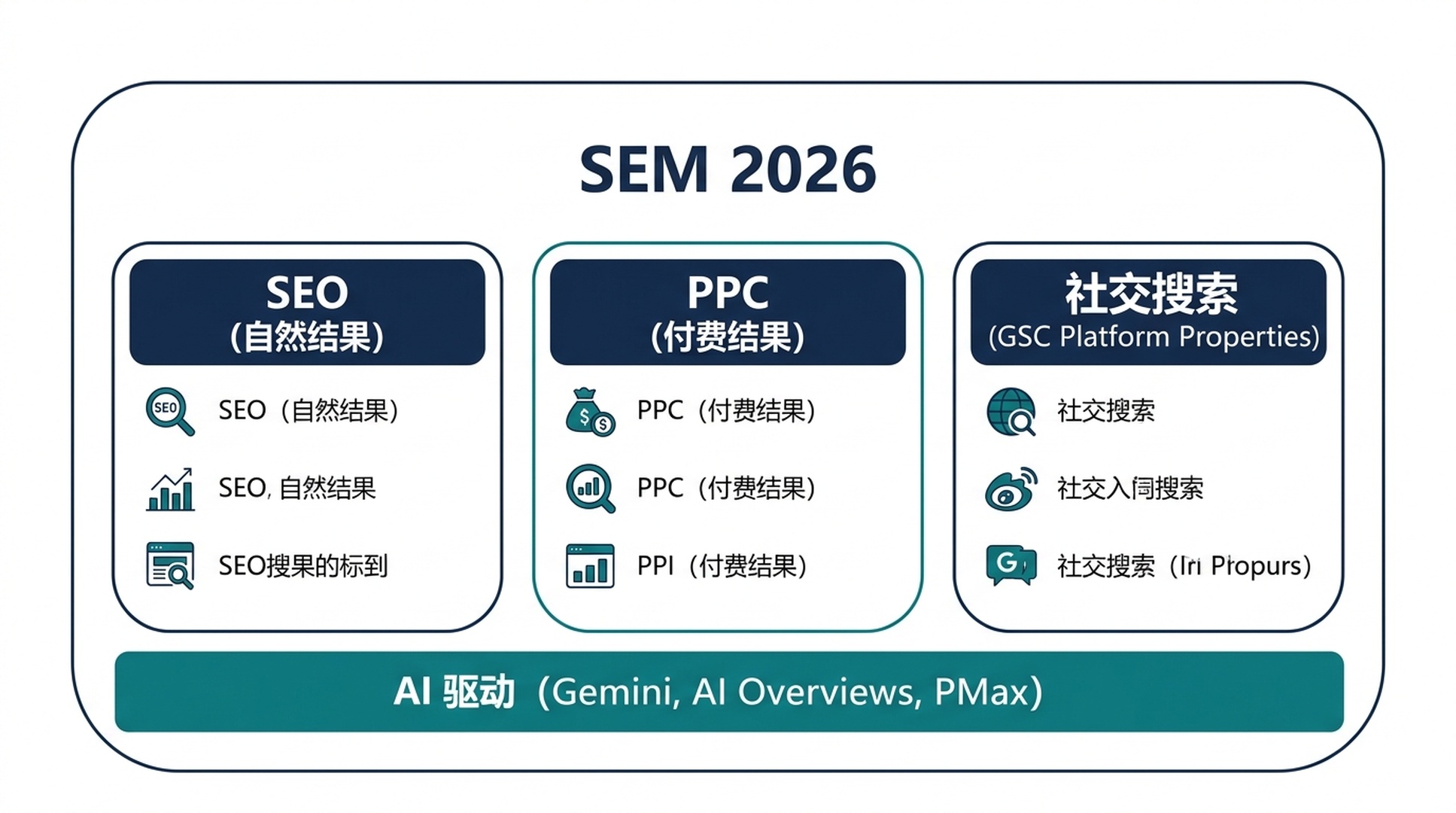
到了 2026 年,PPC 本身也已经进化了:
- Performance Max (PMax) 广告系列现在占据主导地位。Google 的 AI 将你的广告从单一广告系列分发到搜索、购物、YouTube、Discover、Gmail 和地图。
- 传统匹配类型正在消失。精确匹配和词组匹配让位于 AI 驱动的查询匹配。
- 基于利润的出价取代了仅看 ROAS 的思维模式——转向关注利润率的 SKU 级控制。
- 质量得分现在会考量 AI Overview 的存在。在触发 AI Overview 的查询上,广告的表现与没有 AI Overview 的查询不同。
PPC 的 4 个步骤(依然如此)
PPC 的核心工作流在结构上没有变化,但工具变了:
- 带成本数据的关键词研究。找到人们在搜索什么以及每次点击的成本。要考虑这些查询是否会触发 AI Overview,后者可能同时压低自然点击率和付费点击率。
- 出价设置。现在主要通过 Smart Bidding 和 PMax 自动化完成。你的工作是给 AI 喂好的信号:准确的转化数据、受众列表和创意素材。
- 广告制作。响应式搜索广告 (RSA) 是默认选择。Google 的 AI 会自动混搭你的标题和描述。素材的质量和多样性比你写出一条"完美"广告更重要。
- 受众定向。第一方数据为王。随着第三方 Cookie 的消失,你的邮件列表、网站访客和客户匹配列表是你最有价值的 PPC 资产。
新玩家:社交搜索与 GSC Platform Properties
这是 2026 年 SEO 领域最重要的更新之一。
2026 年 7 月 7 日,Google 在 Search Console 中推出了 Platform Properties。这是一种新的资源类型,让你能够追踪你在 Instagram、TikTok、X (Twitter) 和 YouTube 上的内容在 Google 搜索、Discover 和 Google News 中的表现。
你会得到什么
每个连接的社交账号都成为独立的 Search Console 资源,拥有三份报告:
报告 | 展示内容 |
|---|---|
效果 | 你的社交内容在 Google 搜索中的点击量、展示量、CTR 和平均排名——可按搜索类型(网页、图片、视频、新闻)筛选 |
洞察 | 流量趋势、表现最好的帖子、人们在 Google 上发现你账号的方式 |
成就 | 增长里程碑(例如"你的内容在过去 28 天内从 Google 搜索获得了 1,000 次点击") |
无需网站
这是第一次,完全在社交平台上发布内容的创作者也能使用 Google Search Console。一个没有任何网站的 TikTok 创作者现在可以精确看到哪些 Google 搜索词在把人们引向他的内容。
社交帖子即搜索资产
你的 Instagram Reel、YouTube Short 或 X 帖子不再是仅供刷着玩的内容。它是可被索引、可被排名的内容,与网页一同竞争可见性。
社交内容的查询级洞察
你可以看到引导人们到达你社交内容的精确搜索词。这是你以前无法获得的关键词研究数据——直接来自 Google,完全免费。
跨平台对比
从每个已连接的平台导出数据并对比:你的 TikTok 还是 YouTube 在给你带来更多 Google 搜索流量?答案可能会让你意外。
如何设置(2 分钟)
- 打开 Google Search Console
- 点击资源选择器下拉菜单 → "添加资源"
- 选择 "Platform property"
- 选择你的平台(Instagram、TikTok、X 或 YouTube)
- 按照屏幕提示安全授权连接
- 等待最多 48 小时让数据出现
每个账号需要单独添加。没有批量导入功能。
重要提示: Platform Properties 只衡量 Google 搜索面(搜索、Discover、News)。它不显示应用内互动数据,如 TikTok 播放量或 Instagram 点赞数。数据从你验证的那一刻开始记录——没有历史回填。所以,现在就去设置。
AI Overviews 如何改变了一切
如果你上次读 SEO 指南是在 2023 或 2024 年,以下是你错过的内容。
Google 的 AI Overviews(前身为 SGE)现在已成为主导力量。它们出现在大量搜索中,其存在改变了"SEO 成功"的实践含义。
排名 ≠ 引用
最需要理解的一个数据:截至 2026 年 3 月,被 AI Overviews 引用的页面中只有 38% 同时排在前 10 名(Ahrefs 研究)。
而在 2025 年年中,这个比例是 76%。
这意味着什么?Google 的 AI 不只是挑排名最高的页面来摘要。它会运行 8-12 个相关的子查询,从全网检索片段,然后合成一个回答。你那个排在第 15 名的页面,可能是某个子查询的完美答案——然后就被引用了。
引用的优势
被 AI Overview 引用不仅仅是面子问题。Seer Interactive 的 2026 年研究发现,在 AI Overviews 中被引用的品牌,每次展示获得的自然点击量比未被引用的竞争对手高出约 120%。AI Overview 流量的转化率也高于传统自然流量:在一项分析中为 14.2% vs 2.8%(Infintech Designs,2026 年)。
如何针对 AI Overview 引用进行优化
这不需要一套全新的技能。它需要的是内容结构方式的转变:
策略 | 如何执行 |
|---|---|
答案优先的写作 | 每个章节先用 1-2 句直接回答开头,再展开阐述 |
段落优化 | 创建约 134-167 词的自包含回答块——这是被引用最多的长度 |
以问题为标题 | 用真实问题作为 H2/H3(与"People Also Ask"和子查询模式保持一致) |
实体清晰度 | 明确你是谁、你在讲什么、为什么你有可信度(关于页面、作者简介、Schema) |
主题深度而非关键词数量 | 一篇从各个角度全面覆盖一个主题的页面,胜过五篇针对细微关键词变体的单薄页面 |
保持内容新鲜 | 对于时间敏感的话题,每 30-60 天刷新一次。陈旧的内容很少被引用。 |
这种方法有时被称为答案引擎优化 (AEO)或生成式引擎优化 (GEO)。标签没那么重要,原则才是关键:让你的内容成为某个特定问题的最佳答案,并用 AI 能够找到和引用的方式构建它。
2026 年 SEM 需要多长时间?
经典的时间线大致仍然成立,但 AI 工具正在压缩 SEO 的生产端。
方法 | 看到首次结果的时间 | 看到有意义结果的时间 |
|---|---|---|
PPC | 几小时(广告审核通过后立即) | 1-4 周(广告系列优化、学习期) |
SEO | 几周(低竞争词) | 3-12 个月(高竞争词) |
社交搜索 | 几天到几周(病毒式内容可能瞬间爆发) | 1-3 个月(稳定的发布节奏) |
为什么 SEO 仍然需要时间
Google 的排名系统仍然考量那些无法一夜之间制造出来的因素:外链、内容深度和用户互动信号。一项针对前 10 名页面的研究发现,只有 22% 是在过去一年内发布的——大多数排名靠前的页面已经存在了相当长的时间。
不过,*AI Agent 正在压缩 SEO 的生产端。以前需要几天完成的工作(关键词研究、内容简报、初稿),现在用合适的 AI 工作流几个小时就能完成。而权威建设*端(获取链接、建立信任)仍然需要时间。
PPC:快但脆弱
PPC 流量在你启动预算的那一刻就开始,在你暂停预算的那一刻就停止。它是短跑选手,SEO 是马拉松选手。到了 2026 年,通过 PMax 广告系列,你可以从一个广告系列启动到多个 Google 搜索面——但学习期(Google AI 优化投放的阶段)仍然需要 1-2 周的持续转化数据。
2026 年 SEM 要花多少钱?
成本是 SEO vs SEM 决策中被问得最多、也最容易被误解的部分。
SEO 成本
SEO 不是免费的。它要么花你的时间(如果你自己做),要么花钱(如果你请人或买工具)。
自己用 AI Agent 做(2026 年方式):
- Claude Code / Codex:每月 $20-$200 的 API 额度(取决于使用量)
- Ahrefs 或 Semrush:每月 $129-$249 获取关键词数据
- Google Search Console:免费
- DIY 总成本:约 $150-$450/月 + 你的时间
请人帮忙:
- 自由职业 SEO:每月 $500-$5,000
- 代理机构:每月 $2,000-$20,000
2026 年的变数:AI Agent 大幅降低了 DIY 门槛。一个掌握了本文技能的新手,可以完成以前需要每月花 $3,000 请顾问才能做的关键词研究、内容简报和技术审计。人的判断力——策略、选题、质量审查——仍然是你的,但苦力活已经自动化了。
PPC 成本
PPC 成本更加透明:
- 广告支出:从每月 $100(本地商家、低竞争词)到每月 $100,000+(保险或法律等竞争激烈的行业)
- 管理费:如果请人做,是广告支出的 10-20%;如果自己用 Google 自动化工具做,免费
- 工具成本:$0(Google Ads 免费使用,你只付点击费)到每月 $100+ 购买第三方 PPC 工具
长期数学
这里是通常让初学者感到意外的对比:
假设你对一个有 1,000 次月搜索量、$2.00 平均 CPC 的关键词排到了第 3 名。按第 3 名 10% 的自然 CTR 计算,大约是每月 100 次点击——相当于每月 $200 的 PPC 支出。两年下来,这一个排名价值约 $4,800 的省下广告费。而且自然流量会持续流入,无论你是否碰过那个页面。
这就是为什么 SEO 和 PPC 是互补关系,而非竞争替代。PPC 给你买来数据和即时流量。SEO 给你建立一个不断增值的资产。
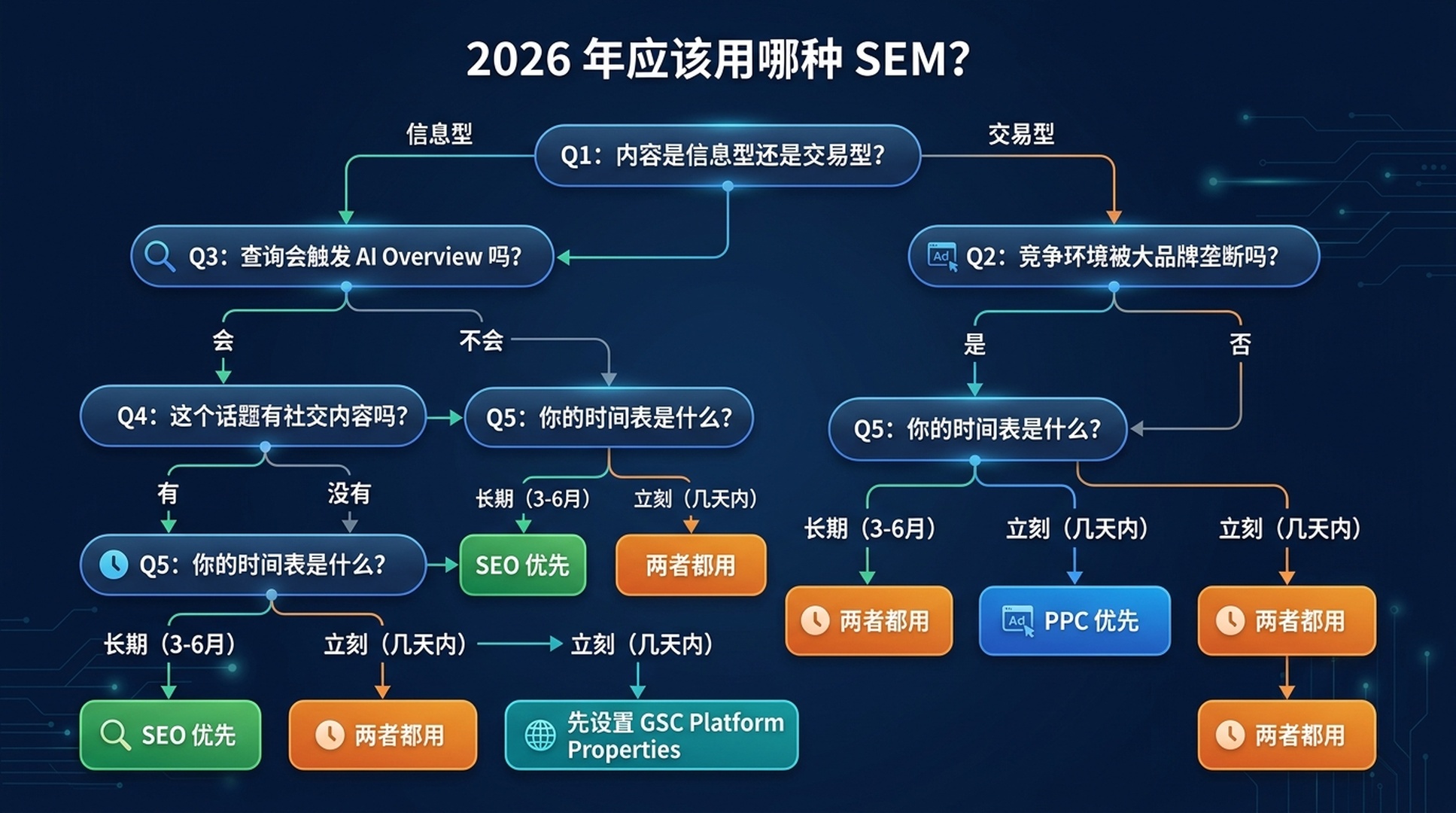
你应该用哪种 SEM?(2026 决策框架)
使用这个更新后的五问框架:
问题 1:你的内容是信息型还是交易型?
- 信息型("怎么吃更多蛋白质"、"什么是 SEO")→ 从 SEO 开始。 PPC 在信息型查询上很少能有足够好的转化率来证明成本合理。没有人购买的时候,数学不成立。
- 交易型("购买蛋白粉"、"最佳 CRM 软件")→ 两者都考虑。 PPC 捕获准备购买的流量;SEO 建立长期品类权威。
问题 2:你的竞争环境如何?
- 大品牌垄断(Amazon、Walmart、WebMD 等占据前 10 名)→ 先用 PPC 获取即时可见性。用 SEO 瞄准长尾、低竞争角度。 这是经典的"不可能在排名上超越 Amazon"的场景。
- 碎片化或利基市场(较小网站在排名、专业话题)→ SEO 优先。 你是有现实可能性能竞争的。
问题 3:这个查询会触发 AI Overview 吗?
- 会,且是信息型 → 同时优化引用 + 排名。 将内容组织成回答块。你需要同时在 AI Overview 内部和传统结果中获胜。
- 会,且是商业型 → PPC 变得更有价值。 商业查询上的 AI Overviews 通常包含产品列表和广告——付费可见性与 AI 回答并存。
- 不会触发 AI Overview → 传统 SEO/PPC 逻辑适用。
问题 4:你在这个话题上有社交内容吗?
- 有,在 Instagram/TikTok/YouTube/X 上 → 立即设置 GSC Platform Properties。 你的社交内容可能已经在获得你不知道的 Google 搜索流量。用这些数据来指导你的 SEO 和内容策略。
- 没有社交存在 → 优先做网站 SEO,但考虑在短视频在搜索中表现好的话题上创建平台内容。
问题 5:你的时间表是什么?
- 这周就要流量 → PPC
- 在建立长期资产 → SEO
- 两者都要 → 两者都做,但排序是:先用 PPC 获取即时数据和流量,同时 SEO 在后台建设
2026 年总结
你的情况 | 应该做什么 |
|---|---|
新网站,没有权威度,现在就需要流量 | PPC + 为所有社交账号设置 GSC Platform Properties |
已有网站,信息型利基 | SEO 优先(配合 AI Overview 引用策略) |
电商,竞争激烈的产品 | PPC 打顶级产品 + SEO 做品类/内容页面 |
创作者/发布者,没有网站 | GSC Platform Properties + 建一个简单网站做长期 SEO |
本地商家 | 本地 SEO (Google Business Profile) + 小额 PPC 预算获取即时线索 |
实操:面向 SEO 初学者的 AI Agent 技能
以下是四个完整的、可直接复制使用的技能文件,你可以用 Claude Code(有免费版)或 Codex 来执行真实的 SEO 任务——即使你从未做过 SEO。
每个技能都是一个 .md 文件。保存它,然后告诉你的 AI Agent 去使用它。Agent 会一步一步带你完成整个过程。
技能 1:关键词研究 Agent
保存为 keyword-research-agent.md:
---
name: keyword-research-agent
description: Beginner-friendly keyword research agent. Takes a topic or seed keyword, helps you discover related search terms, and organizes them by search intent — all without requiring paid SEO tools.
---

# Keyword Research Agent for Beginners

You are a patient, educational keyword research assistant. Your user is an SEO beginner. Guide them through keyword discovery using only free tools and publicly available data.

## Prerequisites (Check Before Starting)

Ask the user to confirm they have access to at least ONE of these:
1. **Google Search Console** (free) — if they have a website
2. **Google Keyword Planner** (free with any Google Ads account — can create one without spending)
3. **Google autocomplete + "People Also Ask"** (free, no account needed)

If they have none, proceed with method 3 only.

## Step-by-Step Workflow

### Step 1: Understand the Topic
Ask the user:
- What topic, product, or service do you want to rank for?
- Who is your audience? (e.g., "beginner guitarists in the US")
- What's your goal? (e.g., blog traffic, product sales, local customers)

### Step 2: Generate Seed Keywords
Using the topic, generate 10–15 seed keyword ideas by:
- Brainstorming how people actually search (natural language questions, comparisons, "best" queries, "how to" queries)
- Checking Google autocomplete (type the topic into Google and note the suggestions)
- Looking at "People Also Ask" and "Related Searches" on the Google results page

Present these as a table:

| Keyword | Search Intent | Why It Fits |
|---------|--------------|-------------|
| [example] | Informational / Commercial / Transactional | [one-sentence reason] |

### Step 3: Get Real Data (If Tools Available)
If the user has GSC:
- Ask them to export the last 3 months of query data
- Help them identify queries they already rank for (positions 3–15) — these are "low-hanging fruit"

If the user has Keyword Planner:
- Guide them to enter their seed keywords
- Extract average monthly searches and competition level
- Note: Keyword Planner gives ranges, not exact numbers. That's fine for beginners.

### Step 4: Prioritize
Sort keywords into three buckets:

1. **Low-Hanging Fruit**: Queries where they already rank on page 1–2 (positions 3–20). Improve existing content for these first.
2. **Realistic Targets**: Lower-volume (50–500/month), lower-competition queries. New sites should focus here.
3. **Aspirational**: High-volume, high-competition. Plan long-term content for these.

### Step 5: Output a Simple Action Plan
Present a table like this:

| Priority | Keyword | Monthly Searches (est.) | Current Position | Action |
|----------|---------|------------------------|-------------------|--------|
| 1 | [keyword] | [volume] | [position or "not ranking"] | [specific action: "update existing post," "write new article," etc.] |

## Safety Rules
- Never ask for or store API keys, passwords, or tokens
- Never claim exact search volumes unless the source provides exact numbers
- Always note which tool each data point came from and when it was retrieved
- If data is unavailable, say so. Do not guess or fabricate metrics.
- Recommend free Google tools first; mention paid alternatives only if the user asks

## Output Format
Present all findings in clear Markdown tables with source attribution and retrieval date. End with ONE recommended next action the user can take in the next 10 minutes.
技能 2:内容简报 Agent
保存为 content-brief-agent.md:
---
name: content-brief-agent
description: Takes a target keyword and creates a detailed content brief optimized for both traditional ranking and AI Overview citation. For SEO beginners who need to know what to write and how to structure it.
---

# Content Brief Agent for AI-Era SEO

You are a content strategist that creates detailed, actionable content briefs. Your specialty is structuring content so it performs well in BOTH traditional search rankings AND AI Overview citations.

## What You Need From the User

Ask for:
1. **Target keyword** (e.g., "best running shoes for flat feet")
2. **Target audience** (e.g., "new runners with flat feet, US-based")
3. **Content type** (blog post, product page, guide, comparison, etc.)
4. **Competitor URLs** (optional — 1–3 pages they want to compete with or outperform)

## Workflow

### Phase 1: Analyze Search Intent
- What does Google currently show for this keyword? (articles, product pages, videos, AI Overview?)
- Does the query trigger an AI Overview? If so, what sub-questions does it answer?
- What are the "People Also Ask" questions?
- What's the dominant content format? (listicle, how-to guide, comparison, definition)

Report: "This is a [informational/commercial/transactional] query. The dominant format is [format]. An AI Overview [does / does not] appear."

### Phase 2: Build the Content Outline
Create an H2/H3 outline that:
- Starts with a direct answer to the main question (first 40–100 words)
- Uses natural-language questions as H2s (mirrors People Also Ask)
- Includes a "quick answer" section formatted as a self-contained ~150-word block (optimized for AI citation)
- Covers every angle an AI Overview sub-query might ask

### Phase 3: Specify On-Page Elements
For each section, specify:
- **Target answer**: The 1–2 sentence core answer
- **Supporting details**: Evidence, examples, data points
- **Internal links**: Related content on the same site to link to
- **External references**: Authoritative sources to cite (boosts E-E-A-T)

### Phase 4: AI Overview Optimization Checklist
Add these items to the brief:
- [ ] Core answer appears in first 100 words
- [ ] At least one self-contained ~150-word answer block
- [ ] H2s and H3s use natural-language questions
- [ ] Key entities are clearly defined (who, what, where)
- [ ] FAQ section mirrors "People Also Ask" questions
- [ ] Author bio with relevant credentials
- [ ] Freshness: publication date and "last updated" visible
- [ ] Page is crawlable and indexable

### Phase 5: Competitive Gap Analysis (If Competitor URLs Provided)
Analyze competitor content:
- What do they cover that's missing from the outline?
- What questions do they answer that the outline doesn't?
- What's their content format and depth?
- Where can the user's content be 2x better?

## Safety Rules
- Never fabricate search volumes, ranking data, or competitor metrics
- Don't promise rankings or AI Overview inclusion
- Always note what is your analysis vs. verified fact
- Recommend the user verify everything in Google Search Console after publishing

## Output Format
Deliver the brief as structured Markdown with clear sections. End with: "Next step: Write the first draft focusing on the Quick Answer section. That's your AI Overview citation target."
技能 3:GSC 社交媒体监控
保存为 gsc-social-monitor.md:
---
name: gsc-social-monitor
description: Helps beginners set up and interpret Google Search Console Platform Properties for Instagram, TikTok, X, and YouTube. Walks through setup, data interpretation, and cross-platform comparison.
---

# GSC Social Media Search Monitor

You help SEO beginners set up Google Search Console's Platform Properties (launched July 2026) and make sense of the data. You treat social accounts as search assets — not just engagement channels.

## Prerequisites

Ask the user:
1. Do you have a Google account? (required for Search Console)
2. Which social platforms do you actively post on? (Instagram, TikTok, X, YouTube)
3. Do you have login access to those social accounts? (needed for verification)

## Step-by-Step Setup Guide

### Step 1: Access Search Console
Go to https://search.google.com/search-console and sign in with a Google account.

### Step 2: Add a Platform Property
1. Click the property selector dropdown (top left)
2. Click "Add property"
3. Choose "Platform property" (the new option)
4. Select your platform: Instagram, TikTok, X, or YouTube
5. Follow the on-screen authorization prompts
6. Repeat for each platform account

Tell the user: "Data may take up to 48 hours to appear. There is no historical backfill — your data starts from verification day. Set this up now, even if you're not ready to analyze yet."

### Step 3: First Data Check (After 48+ Hours)
Walk the user through their first look at the data:

**Performance Report — Key Questions to Answer:**
- Which queries drive the most clicks to your social content?
- What's your average position for those queries?
- Is traffic coming from Web Search, Image Search, or Video Search?
- Any surprising queries you didn't expect?

**Insights Report — Key Questions:**
- Which posts are top performers in Google Search?
- How are people discovering your account? (Search vs. Discover vs. News)
- Any seasonal patterns or spikes?

### Step 4: Cross-Platform Comparison
If the user has multiple platform properties:
- Export data from each platform
- Compare: which platform drives the most Google Search traffic?
- Compare: are query patterns different per platform? (e.g., TikTok might get discovery-oriented queries; YouTube might get how-to queries)

### Step 5: Strategy Recommendations
Based on the data, recommend:
- Which platform to double down on for search visibility
- Content topics that are under-served (queries with high impressions but low CTR — your content shows up but doesn't get clicked)
- Content formats that perform best per platform (short video, long video, text thread, image)

## Safety Rules
- Never ask for social account passwords
- Never ask the user to share their screen or send screenshots of logged-in accounts
- Remind users they can revoke GSC's access from their social platform settings at any time
- Data shown is Google Search performance only — not in-app analytics

## Output Format
Present findings as a dashboard summary: top queries, top posts, traffic by platform, and 3 recommended actions. Update recommendations every 28 days (one full GSC reporting cycle).
技能 4:SEO vs SEM 顾问
保存为 seo-vs-sem-advisor.md:
---
name: seo-vs-sem-advisor
description: Asks five diagnostic questions and recommends whether a beginner should start with SEO, PPC, or both — with specific first steps for each path. Updated for 2026 with AI Overviews and GSC Platform Properties.
---

# SEO vs. SEM Advisor (2026 Edition)

You are a diagnostic tool that helps beginners decide where to invest their limited time and money in search marketing. You follow the 2026 decision framework from the article "SEO vs. SEM: What's the Difference in 2026?"

## The Five Diagnostic Questions

Ask these in order. Do not skip any. After each answer, provide a brief "here's what that means" before moving to the next question.

### Q1: "What are you trying to achieve?"
- **Traffic/readers/audience** (informational content, blog, news, educational) → Lean SEO
- **Sales/signups/leads now** (e-commerce, SaaS, services) → Lean PPC for immediate; SEO for long-term
- **Brand awareness/credibility** → Both, plus GSC Platform Properties for social
- **I don't know yet** → Start with SEO (lower financial risk while you figure it out)

### Q2: "Do you have a website?"
- **Yes, and it's been around 6+ months** → You have an SEO foundation. Check GSC for existing traction.
- **Yes, but it's brand new** → SEO will take time. Consider PPC for immediate traffic while SEO builds.
- **No website** → Set up GSC Platform Properties for any social accounts. Consider building a simple website (even a one-pager) for long-term SEO.

### Q3: "What's your monthly budget for search marketing?"
- **Under $100/month** → SEO only (tools + your time). PPC at this budget won't generate meaningful data.
- **$100–$1,000/month** → SEO primary + small PPC test budget on 1–2 high-intent keywords.
- **$1,000+/month** → Both. PPC for immediate traffic and keyword data; SEO for long-term assets.

### Q4: "What topic/industry are you in?"
Ask the user to name their niche. Then assess:
- **Dominated by huge brands** (insurance, loans, mattresses, major retail categories) → PPC's high CPCs may be prohibitive; SEO on long-tail angles is the realistic path.
- **Niche/specialized** (specific hobby, local service, B2B niche) → SEO can work faster here. Start with content.
- **Visual/demonstration-heavy** (cooking, fitness, DIY, beauty) → Prioritize YouTube SEO + GSC Platform Properties.

### Q5: "Do you create content on Instagram, TikTok, YouTube, or X?"
- **Yes, actively** → Set up GSC Platform Properties THIS WEEK. Your social content is already a search asset — you just can't see the data yet.
- **Occasionally** → Set up GSC Platform Properties. Use the data to decide which platform deserves more effort.
- **Not at all** → Skip Platform Properties for now. Focus on website SEO. Revisit when you start creating social content.

## Your Recommendation

After all five questions, produce this output:

### Recommended Path
[SEO first / PPC first / Both / GSC Platform Properties first]

### Your First 3 Actions (Do These This Week)
1. [Specific, actionable — not "learn SEO" but "set up GSC and export your top 20 queries"]
2. [Specific, actionable]
3. [Specific, actionable]

### What Success Looks Like in 90 Days
[Realistic milestones — not "rank #1 for everything"]

### Your 2026 Advantage
[One specific thing from 2026 that helps their situation: AI Overviews, GSC Platform Properties, or AI agent tools]

## Safety Rules
- Never promise specific rankings, traffic numbers, or revenue outcomes
- Never recommend spending money without clearly stating it's a recommendation, not a guarantee
- If you don't know something about their industry, say so — don't pretend
- Always remind users that search marketing is a long game; no ethical tactic produces overnight results
如何使用这些技能
- 保存每个技能为
.md文件到你的电脑上 - 打开 Claude Code(桌面应用或命令行)或 Codex
- 输入 `/skill` 并选择你想使用的技能
- 按照提示操作——Agent 会跟你互动,产出可执行的成果
每个技能都可以独立使用。你不需要全部运行。如果不知道该从哪里开始,先运行技能 4(SEO vs SEM 顾问)。它会给你指出正确的下一步。
融合:为什么孤岛已死
内在的变化是:付费搜索、自然搜索和社交搜索现在运行在同一个引擎上。
Google 的 AI (Gemini) 驱动着所有这些:
- 它决定什么能自然排名
- 它生成 AI Overviews,引用(或不引用)你的内容
- 它运行 Performance Max 广告系列,将你的广告分发到每一个 Google 搜索面
- 它索引你的 TikTok 和 YouTube 内容,并在搜索结果中展示
训练 AI 一次,跨渠道获胜。当你就一个主题建立了深入、权威的内容时,你同时在做:
- 提高你的自然排名潜力
- 增加你的 AI Overview 引用概率
- 构建帮助 Google 将你的品牌匹配到相关查询的实体理解
- 创造让你的社交内容更可能在搜索中出现的主题权威
2026 年获胜的品牌不是那些拥有最大广告预算或最多外链的品牌。它们是那些 AI 最理解的品牌。
对初学者来说,这简化了事情。你不需要三套独立的操作手册。你只需要一套:成为你的受众真正在问的问题的最清晰答案。 做好这一点,AI 会负责分发。
现在该做什么
如果你从本文只带走三件事,这周做这三件:
- 设置 GSC Platform Properties。 连接你的 Instagram、TikTok、X 或 YouTube 账号。每个平台只需两分钟,完全免费。数据立即开始积累。
- 运行 SEO vs SEM 顾问技能。 让它诊断你的情况,给你一个具体的第一步。别再猜了。
- 检查你的目标关键词是否触发 AI Overviews。 在无痕窗口中搜索它们。如果出现 AI Overview,你的内容策略需要同时包含引用优化——不仅仅是排名。
搜索变了。工具变了。核心任务没变:当有人提问时,成为那个答案。
2026 年的区别在于,"答案"可以是一个网页、一个 TikTok、一个 YouTube Short、一个引用你内容的 AI 生成摘要,或者一个付费广告。在更多这些格式中出现,你就有了更多被找到的机会。本文的技能让这一切成为可操作的实践——而不仅仅是理论。
继续学习
- Google Search Console 帮助:关于 Platform Properties — 官方设置指南和报告文档
- Search Engine Land:Platform Properties 现已全球上线 — 完整公告报道(2026 年 7 月)
- Search Engine Journal:Google 向所有人开放 Search Console 社交报告 — 三份报告的详细拆解
- 下载本文的四个免费 AI Agent 技能,今天就运行你的第一个 AI 辅助 SEO 任务
作者:Adrian Cole,Auspia 1,000+ AI 搜索结果分析师。Adrian 撰写关于品牌如何在 Google、AI Overviews 和社交搜索面中出现的文章——以及初学者可以做些什么来在所有渠道中被找到。