役に立つ出力はキーワードリストではない
キーワードリストはコンテンツ戦略ではありません。あくまで素材です。本当に役に立つ出力は、どのトピックにページを作るべきか、どのページを先に更新すべきか、各ページがどの検索意図に応えるのか、どの GEO プロンプトに答えるべきか、そしてそれらのページ同士をどうリンクさせるのかを示す計画です。
ここで Hermes が役立つのは、キーワード計画には小さな判断がたくさんあるからです。重複を整理し、似たクエリをグループ化し、意図をラベル付けし、ページタイプを選び、カニバリゼーションを避け、内部リンクを割り当て、すべてをカレンダーに落とし込む必要があります。スプレッドシートは計画を保存できますが、Hermes はその計画を作る手助けができます。
初心者にとって最も安全な流れは次の通りです。
Raw keywords -> Clean list -> Topic clusters -> Intent labels -> Page types -> GEO prompts -> Internal links -> 90-day calendar -> Human approval
キーワードリストからページを公開するよう Hermes に頼んではいけません。人間がレビューできるコンテンツ運用計画を作らせます。
クラスタリング前に必要なもの
小さなデータセットから始められます。完璧なキーワードデータが揃うまで待つ必要はありません。
入力 | 初心者向けの形 | 後で目指す形 |
|---|---|---|
シードキーワード | 商品、顧客、競合から集めた 20〜100 語 | SEO ツール、GSC、有料検索、商談、サイト内検索からのエクスポート |
Web サイト文脈 | ブランド、商品、読者、対象市場 | ICP、ポジショニング、ファネル、競合リスト、CV 目標まで整理 |
既存ページ | URL リストまたは sitemap エクスポート | 流入、CV、文字数、最終更新日を含むコンテンツ棚卸し |
GEO プロンプト | 明らかな AI 検索質問 10〜30 件 | 購買ジャーニー、課題、比較、推薦意図別のプロンプトライブラリ |
承認ルール | レビューなしで公開しない | 各ページの担当者、期限、リスクレベル、CMS ワークフロー |
ファイルを Hermes プロジェクトに入れます。
/hermes-seo-agent
  /context
    brand.md
    website.md
    audience.md
  /data
    seed-keywords.csv
    existing-pages.csv
    gsc-performance-last-28-days.csv
  /reports
  /briefs
  /calendar
  /prompts
SEO ツールのエクスポートがまだない場合は、簡単な seed-keywords.csv を作ります。
keyword,source,notes
seo dashboard,product,core product category
seo reporting template,sales call,customers ask for templates
google search console ga4,blog idea,common integration topic
ai search visibility checker,product,tool page topic
generative engine optimization,category,education topic
Step 1:キーワードリストを整理する
入力が散らかっていると、カレンダーも散らかります。クラスタリングの前に、まず Hermes にリストを整理させます。
prompts/keyword-cleaning-prompt.md を作成します。
You are helping build an SEO/GEO content plan.

Read:
- /context/brand.md
- /context/website.md
- /data/seed-keywords.csv

Clean the keyword list.

Return:
1. Removed duplicates
2. Removed irrelevant keywords
3. Keywords that are too broad for this site
4. Keywords that may be high-risk or off-brand
5. Clean keyword list

For each removed keyword, explain why.
Do not create new article ideas yet.
良い整理結果は次のようになります。
| Keyword | Decision | Reason |
|---|---|---|
| seo | Remove | Too broad for a beginner content plan. Use as category context only. |
| free analytics software | Keep with caution | Relevant, but may attract low-intent users. |
| enterprise data warehouse | Remove | Outside the product scope. |
この手順は、人気がありそうなキーワードすべてでコンテンツを作ってしまう初心者の問題を防ぎます。
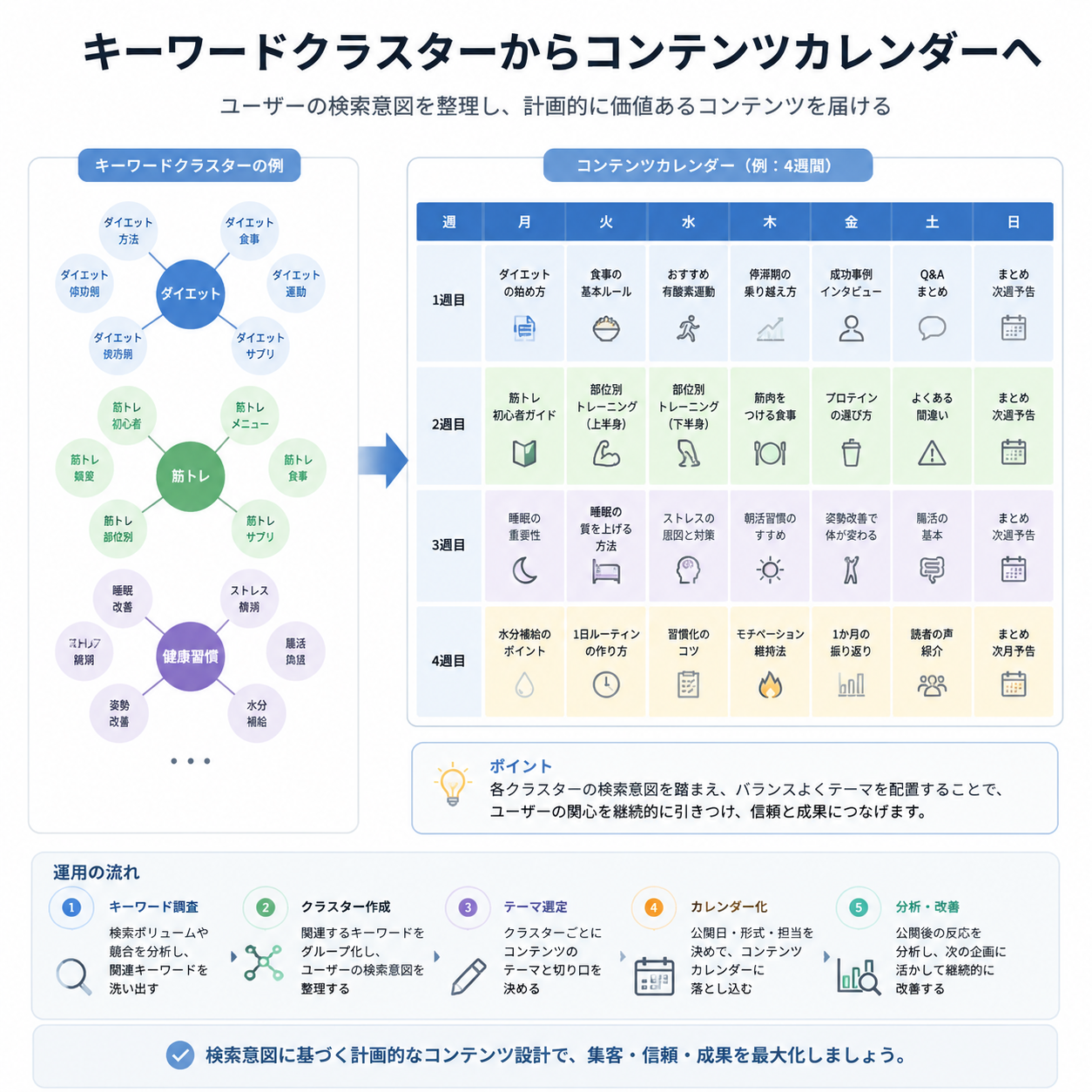
Step 2:トピッククラスターを作る
次に、整理済みリストを Hermes にグループ化させます。
Cluster the cleaned keyword list into topic groups.

For each cluster, return:
1. Cluster name
2. Primary keyword
3. Supporting keywords
4. Search intent
5. Funnel stage
6. Existing page match, if any
7. New page needed: yes/no
8. Cannibalization risk
9. Business relevance score from 1-5

Do not recommend a new page if an existing page can be updated instead.
次のクラスターテーブルを使います。
| Cluster | Primary keyword | Supporting keywords | Intent | Funnel stage | Existing page | New page? | Cannibalization risk | Business relevance |
|---|---|---|---|---|---|---|---|---|
意図ラベルはシンプルで構いません。
意図 | 意味 | 例 |
|---|---|---|
Definition | 概念を理解したい | what is GEO |
How-to | 手順を知りたい | how to connect GSC to GA4 |
Template | 再利用できる素材が欲しい | SEO report template |
Comparison | 選択肢を比較している | GSC vs GA4 |
Problem | 症状や課題がある | impressions but no clicks |
Buyer | ツールやベンダーを評価している | best AI search visibility tools |
Hermes が 80 キーワードから 40 クラスターを作るなら、細かく分けすぎです。同じ読者と意図に応えるクラスターを統合するよう依頼します。
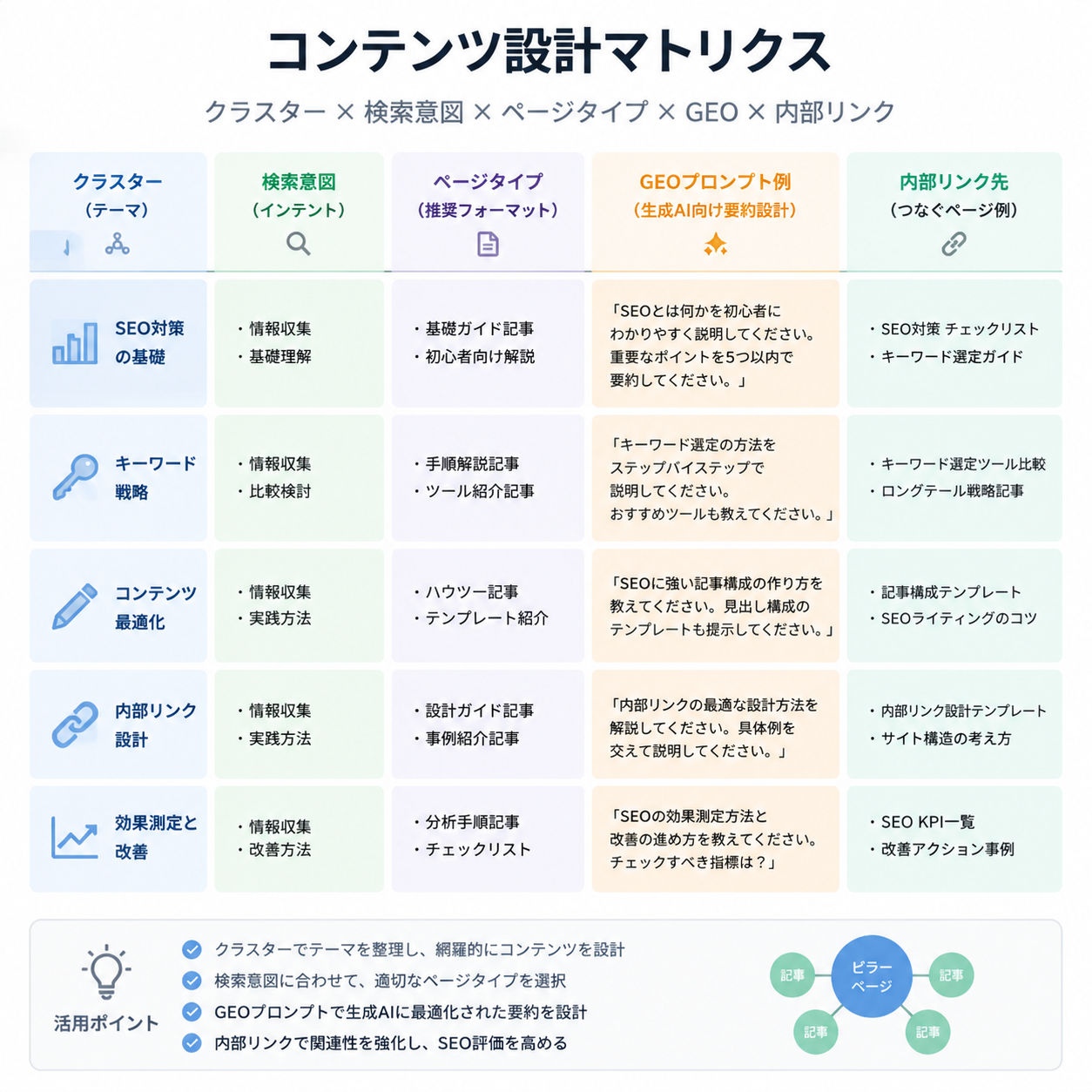
Step 3:クラスターをページタイプに対応づける
クラスターは必ずしもブログ記事を必要としません。ツールページ、用語集ページ、比較ページ、テンプレートページ、プロダクトページ、既存ページのリフレッシュが適している場合もあります。
次のプロンプトを使います。
Map each keyword cluster to a page type.

Allowed page types:
- Hub guide
- Supporting article
- Tool page
- Template page
- Comparison page
- Use case page
- Glossary page
- FAQ section
- Existing page refresh
- Do not create page

For each choice, explain:
1. Why this page type fits the intent
2. Whether it should be new or refreshed
3. Which page it should link to
4. Which page should link back to it
5. What approval is needed
判断ロジックは次の通りです。
検索意図 | 適したページタイプ | 理由 |
|---|---|---|
広いカテゴリ教育 | Hub guide | 中心トピックページになれます。 |
具体的な How-to | Supporting article | 狭いタスクを解決し、ハブへリンクできます。 |
再利用できる素材 | Template page | 読者はコピーまたはダウンロードできるものを求めています。 |
ツール評価 | Tool page または Comparison page | 読者は購買に近い状態です。 |
基本定義 | Glossary または FAQ section | 長い単独記事は不要な場合があります。 |
既存トピックでデータが弱い | Refresh | 重複ページを作るより更新のほうが安全です。 |
Step 4:GEO プロンプト角度を追加する
次に GEO レイヤーを追加します。キーワードは、人が検索窓に入力するものです。プロンプトは、人が AI アシスタントに尋ねる可能性のある質問です。
各クラスターについて、Hermes にプロンプト角度を作らせます。
For each keyword cluster, generate GEO prompt angles.

Create prompts in these categories:
1. Definition prompt
2. How-to prompt
3. Comparison prompt
4. Recommendation prompt
5. Problem-solving prompt
6. Buyer decision prompt, if relevant

For each prompt, map:
- Target page
- Missing evidence
- Entities to define
- Answer block needed
- Table or checklist needed
出力例:
| Cluster | GEO prompt | Target page | Missing evidence | Answer block needed |
|---|---|---|---|---|
| GSC + GA4 reporting | How do I connect Google Search Console data with GA4 landing page reports? | /blog/gsc-ga4-seo-reporting | Example workflow, field list | Step-by-step setup summary |
| AI search visibility | What tool can check whether my brand appears in AI search answers? | /tools/ai-search-visibility-checker | Product use case, prompt examples | Short tool explanation + use cases |
これはコンテンツ構造に影響します。記事はキーワードを狙うだけでは不十分です。AI システムが要約しそうな質問にも答える必要があります。
Step 5:カレンダー作成前にカニバリゼーションを確認する
重複を確認する前に新規ページを予定してはいけません。
次のプロンプトを使います。
Review the proposed clusters and page types for cannibalization risk.

Find:
1. Clusters that target the same intent.
2. Proposed pages that should be merged.
3. Existing pages that should be refreshed instead of replaced.
4. Keywords that should be secondary sections, not standalone pages.
5. Internal link relationships that clarify hierarchy.

Return a cannibalization risk table with recommended fixes.
カニバリゼーション表:
| Cluster A | Cluster B | Risk | Recommended fix | Final page decision |
|---|---|---|---|---|
例:
Cluster A | Cluster B | Risk | Recommended fix | Final page decision |
|---|---|---|---|---|
GA4 SEO report | GSC GA4 dashboard | High | Merge into one guide with dashboard section | One how-to article |
GEO definition | Generative engine optimization | High | Use one glossary/hub page | One hub guide |
Low CTR pages | Improve CTR in GSC | Medium | Keep one diagnosis article, add examples | One supporting article |
これは時間を節約します。誰かがページを書き始める前にアイデアを統合するほうが簡単です。
Step 6:各コンテンツ機会をスコアリングする
90 日カレンダーは検索ボリュームだけで並べるべきではありません。価値と実行しやすさでスコアリングします。
次のスコアモデルを使います。
スコア要素 | 範囲 | 確認すること |
|---|---|---|
Search demand | 1〜5 | キーワードツール、GSC、顧客の言葉に根拠があるか |
Business relevance | 1〜5 | 商品、サービス、リード品質、CV につながるか |
GEO potential | 1〜5 | AI 検索プロンプトに明確に答えられるページか |
Existing authority | 1〜5 | 関連ページやリンクがすでにあるか |
Effort | 1〜5 | 執筆、設計、検証、構築がどれくらい難しいか。5 は難しいという意味です。 |
Risk | 1〜5 | コンプライアンス、ブランド、技術、カニバリゼーションのリスクがあるか。5 は高リスクです。 |
優先度の式:
Search demand + Business relevance + GEO potential + Existing authority - Effort - Risk
プロンプト:
Score each approved content opportunity.

Use these factors:
- Search demand: 1-5
- Business relevance: 1-5
- GEO potential: 1-5
- Existing authority: 1-5
- Effort: 1-5
- Risk: 1-5

Calculate priority score:
Search demand + Business relevance + GEO potential + Existing authority - Effort - Risk

Return a sorted table.
If data is missing, use "unknown" and explain the assumption.
Hermes に仮定を隠させてはいけません。検索ボリュームが不明なら、正確なふりをせず unknown と書くべきです。
Step 7:90 日カレンダーを作る
ここまで来たらカレンダーを作れます。多くのチームにとって、90 日は 90 本の記事を意味しません。新規ページ、リフレッシュ、テンプレート、技術改善を現実的に組み合わせることを意味します。
小さなチームなら、週に 2〜3 件のコンテンツアクションから始めます。
週 | コンテンツアクション | ページタイプ | 目的 |
|---|---|---|---|
Week 1 | 表示回数の多い既存ページをリフレッシュ | Refresh | CTR と回答の明確さを改善する |
Week 1 | 承認済みブリーフを 1 本作る | Brief | 翌週の記事を準備する |
Week 2 | サポート記事を 1 本公開 | Supporting article | 狭い How-to 意図をカバーする |
Week 2 | ハブページから内部リンクを追加 | Internal link update | トピッククラスターを強化する |
Hermes へのプロンプト:
Create a 90-day SEO/GEO content calendar from the approved opportunity list.

Rules:
- Do not schedule more than 3 content actions per week for a small team.
- Mix new pages, refreshes, briefs, internal links, and QA tasks.
- Put high-business-relevance topics earlier.
- Put refreshes before duplicate new pages.
- Include approval checkpoints.
- Include the target internal link for each page.
- Include the GEO prompt angle for each page.

Return a weekly calendar table.
カレンダーテンプレート:
| Week | Action | Cluster | Page type | Target URL | Primary keyword | GEO prompt angle | Internal link target | Owner | Approval gate |
|---|---|---|---|---|---|---|---|---|---|
Step 8:最初の 2 週間分だけブリーフを作る
Hermes に 90 日分すべてのブリーフを書かせてはいけません。市場は変わります。検索結果も変わります。チームも最初の数ページから学びます。
最初の 2 週間分だけブリーフを依頼します。
Create content briefs for the first two weeks of the approved 90-day calendar.

For each brief, include:
1. Working title
2. Target reader
3. Search intent
4. GEO prompt intent
5. Page type
6. Primary keyword
7. Supporting questions
8. Entities to explain
9. Required sources or evidence
10. Recommended structure
11. Internal links
12. CTA or conversion path
13. Quality gate
14. Approval needed

Do not write full drafts yet.
これでシステムの柔軟性を保てます。90 日カレンダーは計画ツールであり、公開の牢獄ではありません。
Step 9:人間の承認ゲートを追加する
下書きに進む前に、カレンダーをレビューします。
次の承認チェックリストを使います。
# 90-day content calendar approval checklist

- [ ] Each page has a clear search intent.
- [ ] Each page has a GEO prompt angle.
- [ ] No two pages target the same intent.
- [ ] Existing pages are refreshed before duplicate pages are created.
- [ ] High-business-relevance topics appear early enough.
- [ ] Each new page has an internal link target.
- [ ] Each page has a realistic owner.
- [ ] No high-risk claims are scheduled without source requirements.
- [ ] Publishing pace is realistic for the team.
- [ ] The first two weeks have briefs, not only titles.
Hermes へのプロンプト:
Review the 90-day calendar against the approval checklist.

Return:
1. Pass/fail for each item.
2. Pages that should be merged.
3. Pages that should be delayed.
4. Missing internal links.
5. Missing evidence.
6. A revised calendar if needed.
人間のレビュー担当者が同意して初めて、カレンダーは承認済みになります。
初心者向け例:小さな B2B SaaS カレンダーの一部
SaaS 分析会社の小さな例です。
Week | Action | Cluster | Page type | Primary keyword | GEO prompt angle | Internal link target | Approval |
|---|---|---|---|---|---|---|---|
1 | Refresh | SEO レポートダッシュボード | 既存ページリフレッシュ | seo dashboard template | SEO ダッシュボードには何を含めるべきか | /product | Editor |
1 | Brief | GSC + GA4 レポート | How-to article | google search console ga4 | GSC データを GA4 とどう接続するか | /blog/seo-dashboard-template | SEO lead |
2 | Draft | GSC + GA4 レポート | How-to article | google search console ga4 | GSC データを GA4 とどう接続するか | /product/integrations | Editor |
2 | Internal links | 分析テンプレート | Internal link update | seo report template | コンテンツと登録をつなげるレポートテンプレートはどれか | /blog/seo-dashboard-template | SEO lead |
3 | Brief | AI 検索での可視性 | Tool page support | ai search visibility checker | 自社ブランドが AI 回答に出ているかをどう確認するか | /tools/ai-search-visibility-checker | Marketing lead |
組み合わせに注目してください。新規記事だけではありません。リフレッシュ、ブリーフ、下書き、内部リンク作業が含まれています。
よくある失敗
失敗 | なぜ悪いか | より良い方法 |
|---|---|---|
キーワードごとに 1 ページ作る | 意図重複と薄いページを生みます | まず意図でクラスター化する |
ボリュームだけで並べる | CV やブランド適合を無視します | 需要、関連性、GEO 可能性、工数、リスクでスコアリングする |
既存ページを確認しない | カニバリゼーションが起きます | 先にリフレッシュまたは統合する |
内部リンク計画がない | ページが孤立した資産として公開されます | 下書き前にハブとサポートリンクを割り当てる |
GEO プロンプト角度がない | 検索では拾われても回答抽出に弱くなります | プロンプト質問、回答ブロック、表、エンティティを追加する |
90 本分のブリーフを一気に書く | 優先順位が変わると時間を無駄にします | 最初の 2 週間分だけブリーフ化する |
Auspia の見解
Hermes はキーワードクラスタリングに向いています。この作業は 1 回の創造的な飛躍ではなく、小さな判断の連続だからです。整理、グループ化、ラベル付け、対応づけ、スコアリング、スケジュール化、承認。ルールが明確なら、まさに Agent が支援しやすい仕事です。
本当の成果は、見た目の良いスプレッドシートではありません。本当の成果は、ランダムなページが減ることです。計画された各ページには、存在する理由、検索意図、GEO プロンプト角度、内部リンク上の役割、人間の承認ゲートが必要です。
キーワードがこれらのチェックを通れないなら、まだページにするべきではない可能性が高いです。
FAQ
Hermes は単独でキーワード調査できますか?
Hermes はキーワードの整理、拡張、分類を手伝えますが、データは必要です。商品、顧客の質問、GSC、SEO ツール、有料検索、商談、競合調査からシードキーワードを用意してください。
すべてのキーワードクラスターを新規記事にすべきですか?
いいえ。一部のクラスターは既存ページ内のセクションにすべきです。一部は古いコンテンツのリフレッシュです。一部はツールページ、テンプレート、用語集、比較ページになります。却下すべきものもあります。
90 日コンテンツカレンダーには何ページ含めるべきですか?
小さなチームなら、8〜20 件の意味あるコンテンツアクションで十分な場合があります。コンテンツアクションには、新規記事、リフレッシュ、ブリーフ、内部リンク更新、テンプレート、QA タスクが含まれます。記事数だけで計画を測らないでください。
これは GEO にどう役立ちますか?
各クラスターを AI 検索プロンプト、エンティティ、回答ブロック、表、根拠要件に対応づけます。その結果、コンテンツが AI システムに理解・要約されやすくなります。
キーワードカニバリゼーションを避けるには?
スケジュール前に、Hermes にクラスターを検索意図、既存ページとの一致、対象 URL で比較させます。同じ読者ニーズに応えるクラスターは統合します。
カレンダー作成後、Hermes にすべての下書きを書かせるべきですか?
いいえ。まずブリーフを作り、承認済みページだけを下書きに進めます。これによりワークフローを制御でき、低品質な大量公開を防げます。
Hermes SEO/GEO シリーズを続けて読む
- 最初に読む:Hermes SEO/GEO オペレーターガイド
- 前のガイド:Hermes を GSC、Bing Webmaster、GA4 につないでデータを監視する方法
- 次のガイド:SEO キーワードから GEO プロンプトマップを作る方法
- 関連ガイド:SEO キーワードから GEO プロンプトマップを作る方法、Hermes で内部リンクとサイト構造を設計する方法
Author: David Sinclair, Auspia の 500 以上のトピッククラスターを横断するトピカルオーソリティ戦略家。David はトピッククラスター、権威性構築、カバレッジ計画、オーガニック成長チーム向けの実践的なコンテンツシステムについて執筆しています。