Decide what one low-click page deserves next
A page with low clicks is not automatically bad. Its title may promise the wrong thing. The opening may miss the visitor's question. It may overlap with another page. Its facts may be old. Or it may simply be too new, too lightly measured, or aimed at a narrow decision. Changing every weak-looking page creates noise and destroys the history you need to learn.
This workshop gives Codex one page, one completed comparison period, and the page's original purpose. It returns a Refresh Decision you can inspect before anyone edits, redirects, deletes, or publishes anything.
Your finished result: one decision marked KEEP, REFRESH, CONSOLIDATE, REDIRECT PROPOSAL, or LEAVE ALONE; an evidence-backed change sheet when a change is justified; and a before/after measurement note.
Use this when: an existing page has disappointing clicks, a stale answer, or confusing overlap with another URL. Allow 45-60 minutes. Bring the live URL or draft, its Traffic Mission, Fact Pack, the original release note, and a completed Search Console or analytics export. Do not use public estimates as your performance data. You also need someone who can approve a redirect, deletion, or production edit if the decision reaches that point.
Choose a page with enough history to inspect
Start with one URL, not a list of twenty. For Northstar Books, choose /before-self-assessment-bookkeeping-checklist: it has existed for a complete comparison period, receives impressions for preparation questions, but visitors do not often reach the discovery-call link. The original mission was: "Help a freelance designer gather records before deciding whether monthly bookkeeping support is a fit."
Make a refresh input note like this:
refresh-input.md
URL: /before-self-assessment-bookkeeping-checklist
Original mission: help a freelance designer gather records before deciding
whether monthly bookkeeping support fits.
Release date and change: 2026-05-01; initial checklist page.
Completed comparison periods: 2026-06-01 to 2026-06-28 vs 2026-05-01 to 2026-05-28.
Evidence attached: GSC page export, current page copy, Fact Pack, internal-link
inventory, customer feedback dated 2026-06-20.
Observed issue: search terms suggest people also want remote-service fit; the
page opening does not explain the boundary.
Known competing/related URLs: /monthly-bookkeeping-for-designers.
Do not change: service exclusions, tax advice boundary, existing URL without owner approval.
The phrase observed issue is not a claim that it caused low clicks. It is a question for the decision. If the page went live last week, write insufficient time and schedule a review date instead of forcing a refresh.
Give Codex the full decision prompt
Attach the input note and the listed files, then copy this prompt exactly.
Read [refresh-input.md], [current page URL or copy], [traffic-mission.md],
[fact-pack.md], [release note], [completed GSC/analytics export], and
[internal-link inventory]. Create refresh-decision.md.

Choose exactly one: KEEP, REFRESH, CONSOLIDATE, REDIRECT PROPOSAL, or LEAVE
ALONE. Then provide:
1. evidence supporting the decision and unknowns that prevent a stronger claim;
2. the visitor question this page must answer now;
3. whether the original mission remains correct;
4. specific title, opening, proof, section, CTA, and internal-link changes to
   test, if REFRESH is justified;
5. URLs with possible overlap and a pair-by-pair explanation;
6. technical or historical risks, including canonical/redirect considerations;
7. a before-state, implementation boundary, review date, and rollback plan.

Do not edit, publish, delete, redirect, change a canonical, submit a URL,
change measurement settings, or claim that a metric movement was caused by a
single page element. Mark missing facts NEEDS OWNER FACT.
Read the decision before you read the proposed copy
The decision must lead. A strong Northstar Books answer might say:
Decision: REFRESH.
Reason: the original preparation mission remains distinct from the monthly
service page. Completed page data and dated feedback show an unresolved remote-
fit question. The current opening gives a checklist but does not state what the
service can and cannot help with.
Boundary: retain the current URL and tax-return exclusion. Add a short,
fact-backed "Is remote bookkeeping a fit?" decision block that links to the
separate service-fit page. Do not merge with /monthly-bookkeeping-for-designers;
that page explains service scope after the reader identifies the need.
It separates the two page jobs. The checklist helps someone prepare. The service page helps someone evaluate ongoing help. That is evidence of a useful internal link, not a reason to clone copy.
Use this table to reject the wrong action
Decision | Choose it when | Next safe move |
|---|---|---|
Keep | The page is accurate and no evidence identifies a reader problem | Record why and set a later review date |
Refresh | The mission is still distinct, but answer, proof, title, path, or CTA is weak | Prepare a narrow approved change sheet |
Consolidate | Two pages genuinely serve the same reader decision and proof need | Make a merge plan; preserve history before changing URLs |
Redirect proposal | The old page is obsolete and a clear equivalent destination exists | Obtain technical/owner approval and test the redirect plan |
Leave alone | Evidence is too thin, time period incomplete, or a key fact is unconfirmed | Collect one missing fact or wait for a completed period |
Never choose redirect because Codex calls a page thin. A redirect changes a visitor route and can affect historical signals. It needs a valid destination, technical review, and owner approval. Similarly, a consolidation is not copying two pages together; it needs a chosen surviving URL, mapping of useful content, internal-link updates, measurement preservation, and a rollback plan.
Test page overlap before you merge anything
For each possibly overlapping URL, write the two questions side by side:
URL | Visitor question | Primary proof | Next action |
|---|---|---|---|
Checklist page | What records should I gather before I seek help? | Onboarding checklist | Check readiness or read service fit |
Monthly-service page | What ongoing bookkeeping help is included for a designer? | Service scope and exclusions | Request a discovery call |
If those rows differ, the pages deserve different roles and a contextual link. If the question, proof, and action are all the same, a consolidation review is reasonable. If Codex cannot identify distinct rows, do not accept a confident merge recommendation. Use this recovery prompt:
Show the page roles in a comparison table: visitor question, opening answer,
proof, next action, and unique section. If three or more fields are the same,
propose a consolidation plan. If they differ, explain the internal links that
make both pages useful. Do not recommend a redirect without a mapped destination
and an owner-approved technical review.
Turn a REFRESH decision into a constrained change sheet
Once the human approves the decision, do not ask Codex for a wholesale rewrite. Ask for the smallest change that tests the identified problem.
Using the approved refresh-decision.md, current page, Fact Pack, and Topic
System Map, prepare refresh-change-sheet.md. Include:
- exact sections to add, remove, or revise and why;
- before/after title and opening; use only confirmed facts;
- each claim with Fact Pack source;
- internal links to add, remove, or change with anchor context;
- URL, canonical, indexing, redirect, and analytics boundaries;
- pre-release checks, owner approvals, and rollback trigger;
- the completed comparison period and date for the next review.

Do not edit the CMS/repository, publish, redirect, delete, add schema, submit
URLs, or change analytics. Stop where owner input is required.
For the checklist, an appropriate sheet might add a 90-word remote-fit decision block supported by the service scope, one contextual link, and a clearer title. It would not add unrelated city pages, rewrite every paragraph, or claim the service is suitable for every designer.
Good and bad refreshes
Good: revise the opening to answer the actual preparation question, state a documented service boundary, link to the service-fit page after the reader has received the checklist, and save the before-state.
Bad: change the publication date, insert keywords in every heading, delete the URL, and call it an SEO refresh. That makes it impossible to tell what was improved for a visitor and can introduce risk without evidence.
Release like a controlled experiment, not a bulk update
Before the owner changes the page, save these four items in a release folder:
refresh-[page-slug]/
  before-page-copy-or-screenshot.md
  refresh-decision.md
  approved-change-sheet.md
  measurement-note.md
Then run the Publishing Gate against the actual proposed change. Have the CMS or code owner approve publication; have a developer approve technical routing; and record the release date. After release, check that the URL loads, the approved title/opening/link are present, the destination works, and the page has the intended canonical/indexing state. Do not celebrate or reverse it because of one day's movement. Wait for the comparison period named in the change sheet.
At the review date, feed the new evidence back into your Weekly Growth Loop. Codex should compare periods, list what changed, identify unknowns, and select only one next action. It must not claim the refresh caused an outcome without adequate evidence.
Troubleshooting
No original mission or release note exists. Reconstruct one from the page, Fact Pack, and owner memory, but label assumptions. Save it before proposing a change so future reviews have a baseline.
The page has impressions but no useful query data. Use page feedback, internal-link context, and content accuracy to decide whether to wait or make a small reader-first improvement. Do not invent a keyword intent.
A critical claim is outdated. Stop the refresh and correct the fact first with the public fact correction workflow. An appealing title cannot compensate for an inaccurate page.
The desired change needs a redirect or canonical change. Turn the result into a technical proposal with a mapping table, impacted links, owner, test, and rollback. Do not apply it in a content editing session.
Completion check and next lesson
- [ ] I chose one page with a completed comparison period or a clear wait condition.
- [ ] My Refresh Decision names evidence, unknowns, and exactly one outcome.
- [ ] I checked possible overlap by visitor question, proof, and next action.
- [ ] Any live change has a narrow approval sheet, before-state, and rollback boundary.
- [ ] I scheduled a later evidence review rather than guessing about causation.
Now collect the lessons from these decisions into a capacity-based operating plan: Build Your 90-Day Plan to Scale From First Wins Toward 1,000,000 Organic Visits.
Author: Elise Morgan, 15-Year Editorial SEO Strategist at Auspia. Elise writes about evidence-led content refreshes and meaningful editorial improvements.
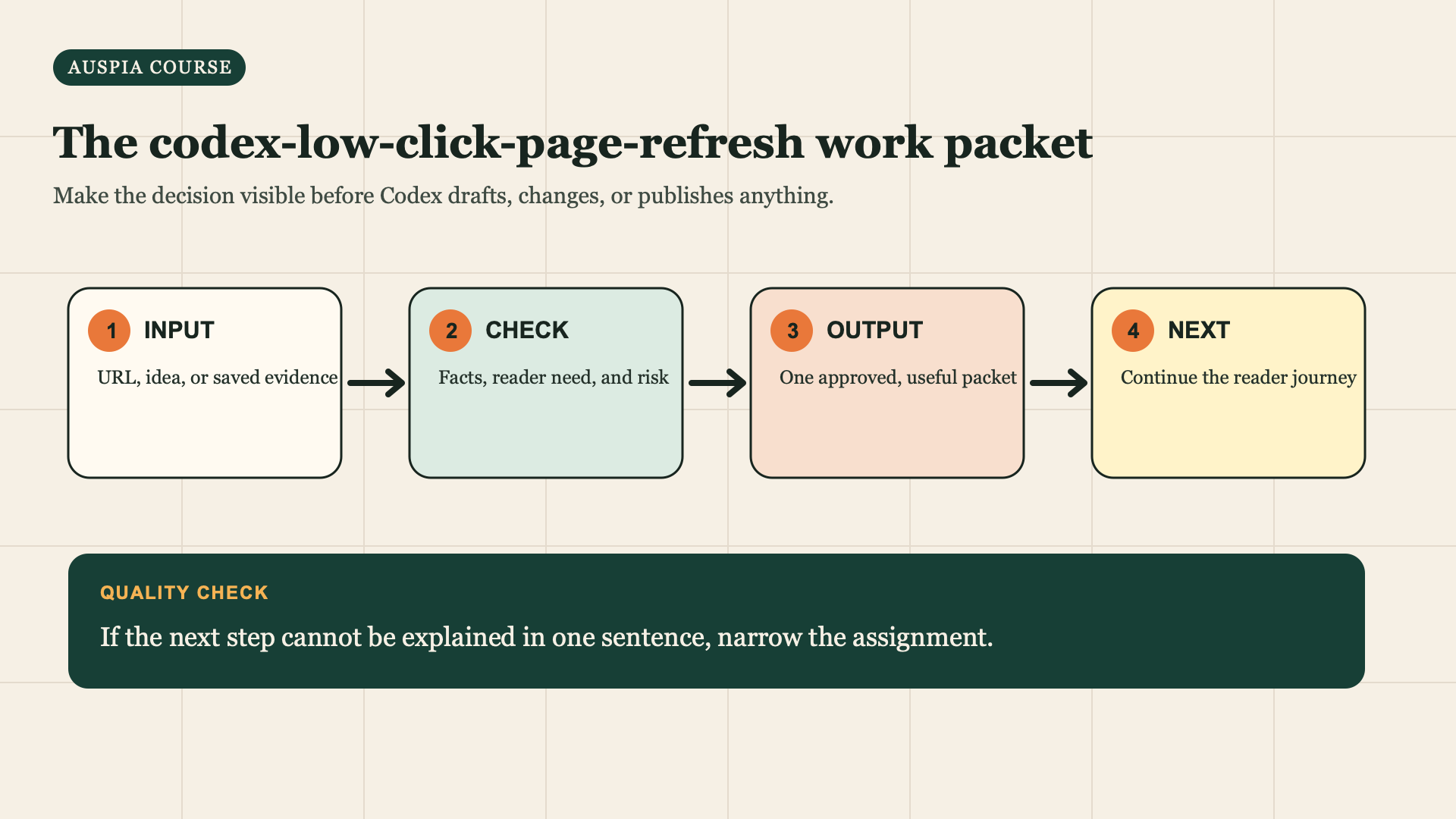
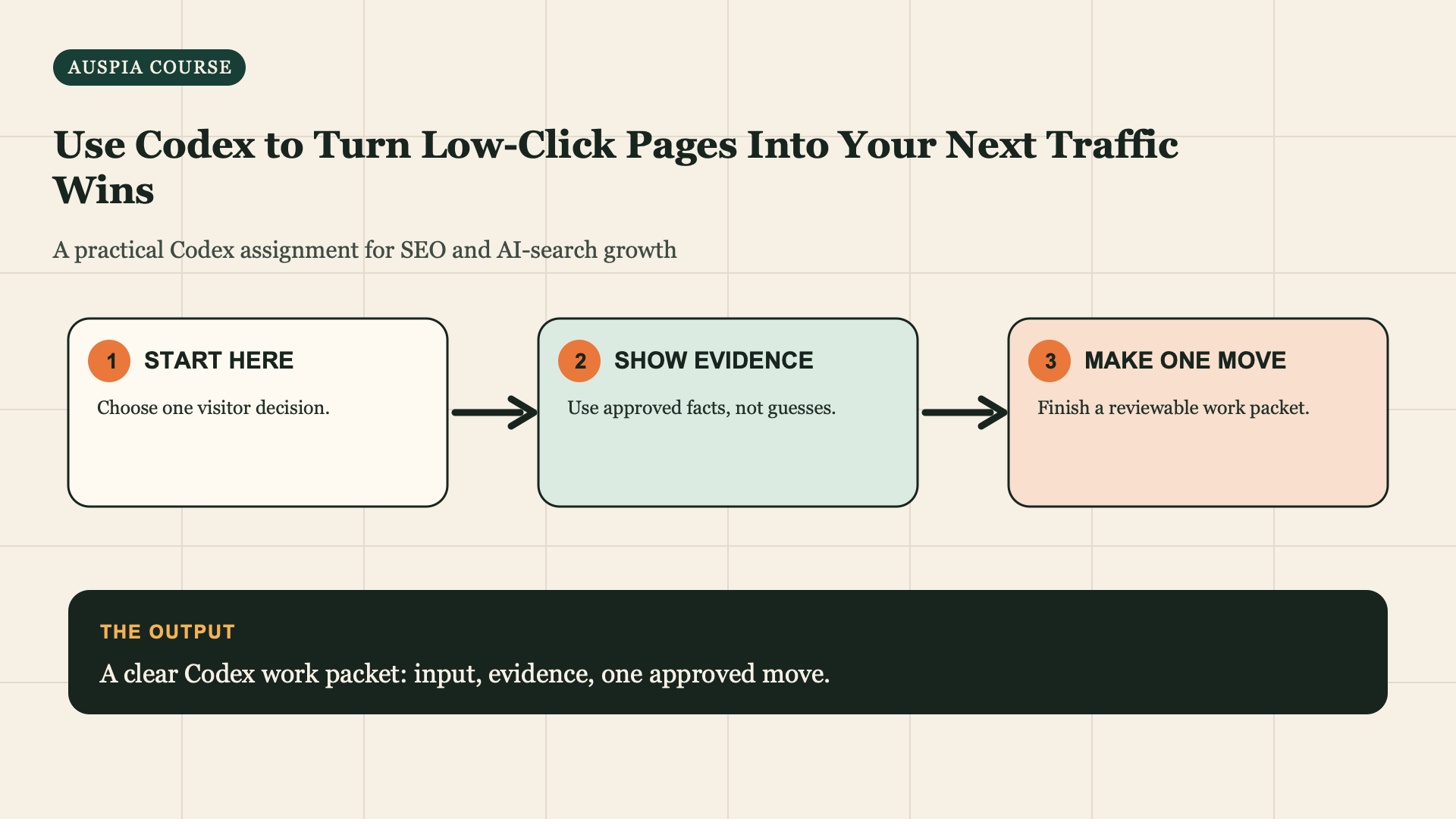
Use this sequence for the assignment: start with a real input, check the evidence, prepare one reviewable output, then choose the reader next step.