When a strong local brand is hard to find in an AI answer
A customer considering permanent makeup has questions long before booking an appointment.
Will the result look natural? What happens if it fades unevenly? How much does a touch-up cost? Who performs the treatment?
A few years ago, she might have asked a friend, searched Google for a nearby studio, checked reviews, and opened several websites. Today, she may also put those questions to an AI assistant and use its answer to decide which businesses deserve a closer look.
For a beauty chain, that creates a visibility problem.
A brand may have experienced practitioners, loyal customers, and locations across dozens of cities. Yet an AI answer might omit it, describe its services inaccurately, or cite a third-party page with outdated information.
The underlying business has not changed. The way a customer first encounters it may have.
This article examines an anonymized beauty-chain example described by its service team: a permanent makeup brand operating across more than 90 cities. We use it to explore a practical question for multi-location businesses:
How do you make a real-world reputation easier for AI search tools and potential customers to discover and verify?
The answer starts with the brand’s own information, then extends to local listings, independent sources, and a measurement process. None of these guarantees a recommendation. Together, they give customers and search systems better material to work with.
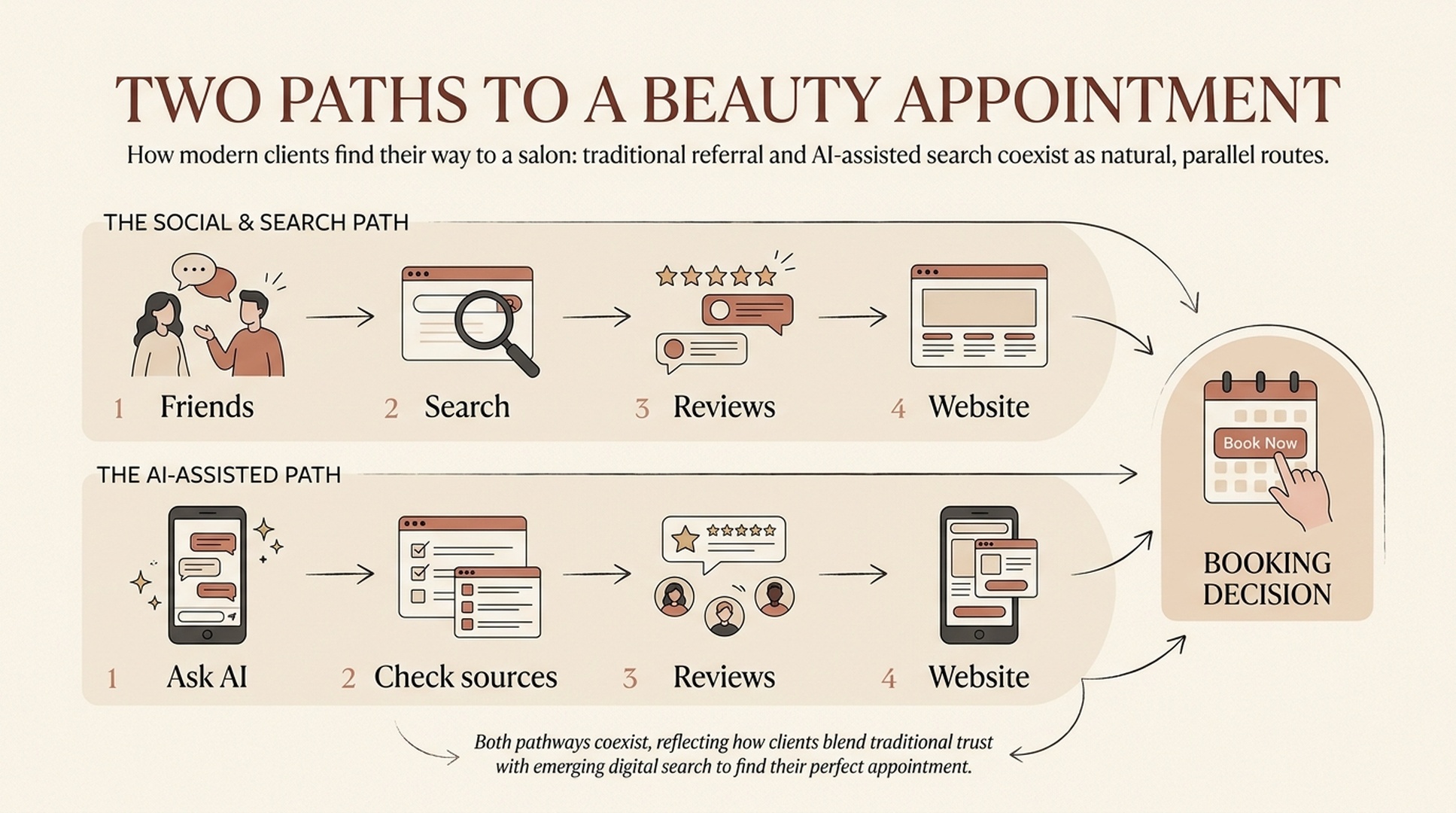
Customers may combine referrals, search, reviews, and AI-assisted discovery.
Why beauty chains face a particular visibility challenge
A beauty appointment is local, personal, and difficult to evaluate in advance.
Someone choosing a permanent makeup provider is not simply comparing opening hours. They may be weighing practitioner experience, hygiene, aftercare, pricing, and the possibility of an unsatisfactory result. A reassuring answer needs more than a slogan.
For chains, the challenge multiplies across locations.
A customer in Austin might ask, “Where can I get natural-looking brow treatments near me?” Another in Seattle might ask about touch-up policies. A third may already know the brand but want to understand whether a particular location offers the same service.
These are related questions, but they do not all have the same answer.
Customer question | Information the brand needs to make accessible |
|---|---|
“Does this brand operate in my city?” | An accurate location page, address, and contact details |
“What does the treatment involve?” | A clear service description and realistic expectations |
“What will it cost?” | Pricing or an explanation of what determines the final quote |
“Who will perform it?” | Relevant practitioner qualifications and local availability |
“What happens afterward?” | Aftercare guidance and the applicable touch-up policy |
A national homepage cannot answer all of these questions well. Nor can a set of nearly identical city pages with the location name swapped out.
The opportunity is to connect the brand’s overall standards with useful, accurate information about each real location.
The starting point: a good reputation without a clear information trail
The source case describes a long-established beauty chain with a substantial offline footprint and strong customer loyalty. Its service team believed the brand was less visible in AI answers than its offline presence would suggest.
That diagnosis is plausible, but the available case material does not include a reproducible baseline: we do not know the exact prompts, platforms, locations, test dates, or frequency of brand mentions. We also cannot independently verify the business’s customer and retention figures.
Those gaps matter. An AI answer can change with the wording of a question, the user’s location, the product used, and the sources available at the time.
Still, the case points to a common operational problem: important brand facts are often scattered across a homepage, location listings, social profiles, reviews, and old media coverage. Some are missing. Others disagree.
A customer can usually investigate those inconsistencies. An AI-generated answer may instead reproduce one version, omit the detail, or present an incomplete summary.
The work, then, is not to find a secret phrase that makes an assistant recommend the brand. It is to build a reliable information trail and test whether that trail is being found.
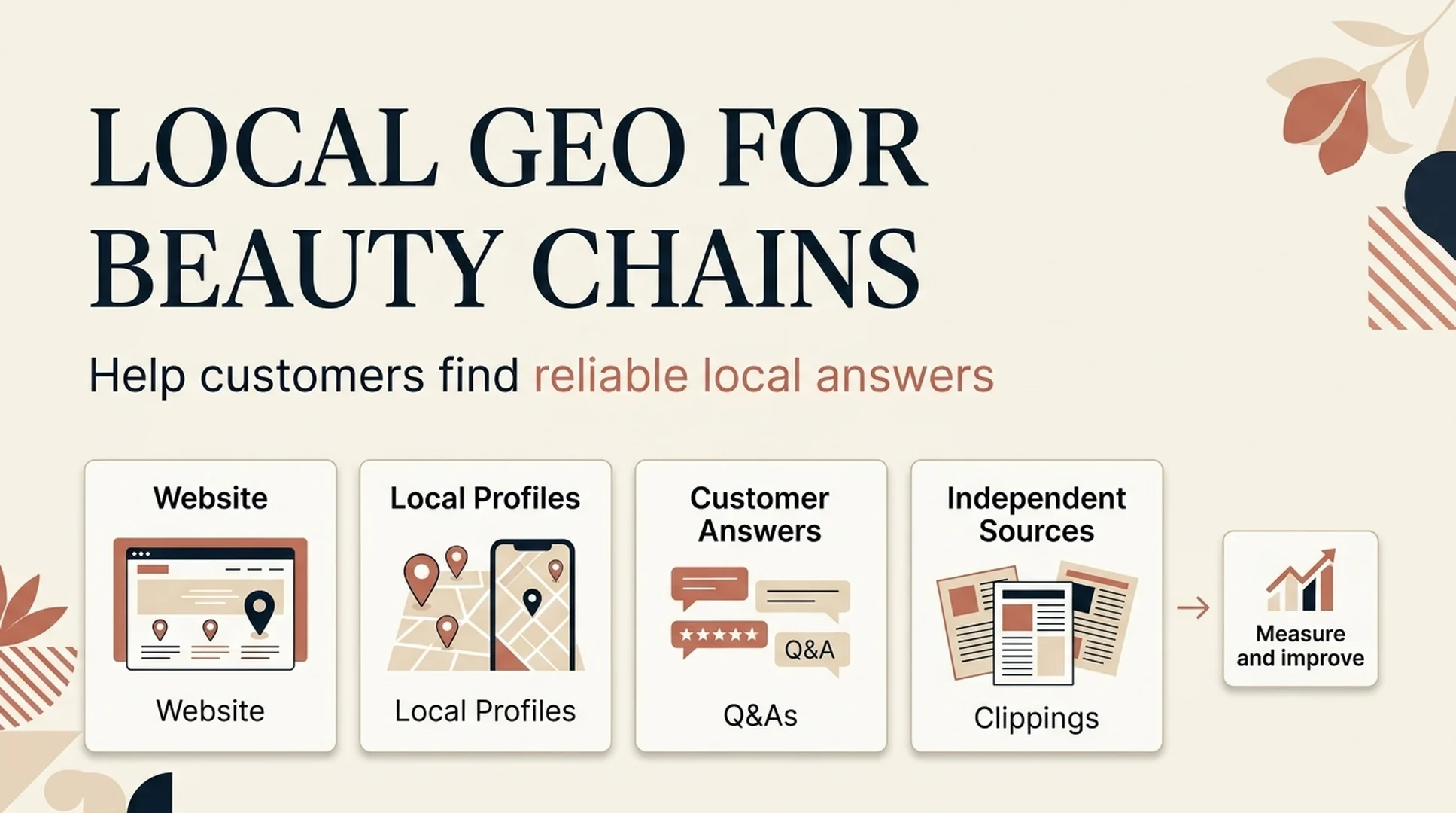
Four layers of a local GEO foundation
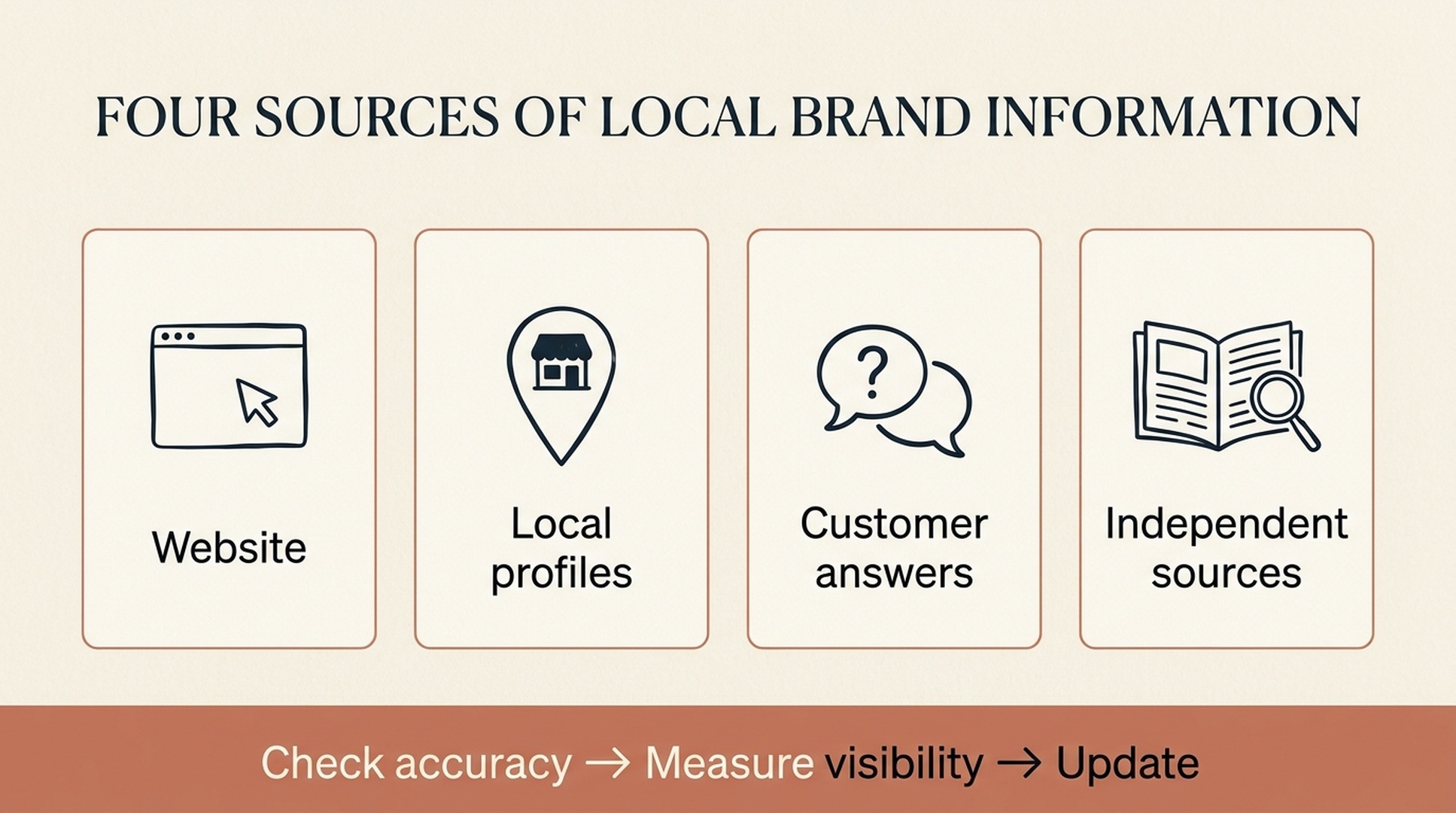
Four sources to review and maintain as local business information changes.
1. Make the website a dependable source of brand facts
The website is the part of the information trail a business controls most directly. It should explain what the brand offers and make it easy to find details for each location.
For a beauty chain, that usually means reviewing:
- Service descriptions, treatment processes, and aftercare.
- Location addresses, opening hours, and booking links.
- Practitioner qualifications and any claims the business can substantiate.
- Pricing information, including what may vary by location.
- Touch-up, cancellation, and complaint-resolution policies.
The important detail is not just whether these facts appear somewhere. It is whether a customer can find them in readable text and whether the relevant location page reflects the service actually offered there.
Consider a generic claim:
“Our experienced artists provide premium service nationwide.”
A more useful version would explain what “experienced” means, how a customer can check the practitioner at a particular location, and where local policies may differ. Any specific credential or guarantee should be published only after the business has verified it.
Google’s guidance for its AI search features emphasizes ordinary search fundamentals, including accessible text, internal links, and up-to-date business information. Google also says there is no special structured-data markup required to appear in AI Overviews or AI Mode. Google Search Central
Clear pages help customers regardless of whether an AI tool cites them. A citation is a possible outcome, not an entitlement.
2. Repair the local profiles customers already use
For a chain, the official website is only one part of the customer journey. People also check map listings, review platforms, and local directories.
A location audit should compare each listing against the business’s own records:
- Is the location open and eligible for the listing?
- Are its name, address, phone number, and hours accurate?
- Are the listed services actually available there?
- Does the booking link lead to the correct location?
- Is someone responsible for responding to changes and customer feedback?
For Google Business Profiles, Google says local results depend primarily on relevance, distance, and prominence. Complete and accurate business information can help Google understand a listing, but a business cannot pay Google for a better local ranking. These factors describe Google’s local results; they should not be treated as a universal formula for every AI assistant. Google Business Profile Help
For chains with many locations, the unglamorous work of correcting closed branches and inconsistent phone numbers may be more valuable than publishing another generic article.
3. Answer the questions customers ask before they book
The source case emphasizes educational content and customer concerns. That is a useful direction, provided the answers are accurate and reviewed by qualified people where appropriate.
Start with questions that appear in consultations, support conversations, and reviews:
- How is the final treatment price determined?
- Is a consultation required before booking?
- What should a customer ask a practitioner about aftercare?
- What does the touch-up policy cover?
- What happens if a customer needs to reschedule?
A strong answer gives a reader enough detail to make a decision. It also makes the limits clear.
For example, instead of promising that a result will never change color, explain what factors can affect appearance over time, what the business’s aftercare guidance covers, and when a customer should contact the practitioner. Health-related claims should be reviewed by an appropriately qualified professional and supported by reliable sources.
The same principle applies to testimonials. Real customer experiences can help readers understand a service, but they should not be presented as proof that everyone will have the same result. Obtain permission where needed and follow the rules for reviews and endorsements.
4. Earn credible coverage without confusing advertising with independence
Customers often look beyond a brand’s own website before choosing a provider. Independent reviews, relevant local publications, professional associations, and other credible sources can add context.
The distinction between independent coverage and paid promotion matters.
A sponsored article may reach a relevant audience and explain the brand’s position. It is not independent verification simply because it appears on another website, and buying coverage does not guarantee that an AI tool will cite or recommend the business.
The better question is: What can an outside reader verify?
For instance, a publication might independently report on a new location, interview practitioners about a treatment, or examine how a business handles customer concerns. A brand can also make useful information available to journalists and industry publications without trying to dictate the conclusion.
In the United States, the FTC provides guidance on truthful endorsements and disclosure of material relationships. Requirements elsewhere may differ. FTC: Endorsements, Influencers, and Reviews
A practical way to prioritize cities and questions
A chain does not need to create hundreds of new pages on day one. Start with locations where the business has a real presence and enough information to produce something useful.
A simple prioritization matrix can help:
Priority | Example question | Useful next action |
|---|---|---|
Existing location with incomplete information | “Does the downtown location offer brow treatments?” | Correct the location page and relevant listings |
Recurring trust concern | “What is included in a touch-up?” | Publish the verified policy and link to it from service pages |
Important market with inconsistent details | “What are the hours for the Seattle studio?” | Reconcile website, map profile, and booking system |
No local operation | “Do you have a location in Denver?” | Answer accurately; do not create a page implying a location exists |
The goal is not to publish a page for every variation of every prompt. It is to make sure that when a real customer has a local question, there is a useful, current answer somewhere they can reach.
A location page earns its place when it contains information specific to that location: the actual address, services, staff details where appropriate, policies that apply there, and a clear next step. If the only difference is the city name, the page probably needs more work.
What the case can—and cannot—tell us about results
The source describes the work as a foundation for stronger AI visibility. It also attributes the brand’s existing scale and customer loyalty to years of service and reputation building.
That separation is the right starting point.
A GEO project may improve the availability and consistency of information. It may also coincide with more AI mentions, website visits, or bookings. But a case study needs evidence before it can claim that the project caused those outcomes.
For the example described here, the available material does not provide:
- A dated, repeatable baseline of AI answers.
- A matching set of follow-up tests.
- Platform-by-platform citation or mention counts.
- Referral, inquiry, or booking data tied to the work.
- A comparison that separates GEO activity from other marketing and business changes.
The source also gives different cumulative customer totals in different sections. Those figures should be reconciled before publication as factual claims.
Without those records, the defensible conclusion is narrower: the case illustrates a multi-layer approach to organizing brand information and local trust signals. It does not establish how much AI visibility or revenue the work produced.
How to measure whether the foundation is helping
A useful measurement program begins before the fixes.
Choose a manageable set of real buyer questions across a sample of locations. Include generic category questions, branded questions, and questions about policies or safety. Record the platform, date, location setting, exact wording, answer, brand mention, and any cited sources.
For example:
Test question | What to record |
|---|---|
“What should I look for in a permanent makeup provider in Austin?” | Whether the brand appears and which sources are cited |
“Does [brand] offer touch-ups in Seattle?” | Whether the answer is accurate and links to the applicable policy |
“What questions should I ask before booking brow treatment?” | Whether the answer reflects useful decision criteria |
Repeat the same tests after meaningful changes, using the same conditions where possible. Review several responses rather than relying on a single screenshot.
Track outcomes in separate layers:
- Information quality: Are location pages and listings accurate and current?
- Observed visibility: In the sampled answers, is the brand mentioned or cited? Are descriptions accurate?
- Business outcomes: Are there measurable visits, inquiries, or bookings associated with identifiable referral sources?
The second layer is a sample, not a complete view of everything customers see. The third is harder still: a customer may read an AI answer, search for the brand later, and book through another channel. Ask how customers found the business when appropriate, but avoid presenting self-reported attribution as a precise causal measurement.
A tool such as Auspia’s AI Search Visibility Checker can support an initial review; keep the prompts and observations so the team can repeat the exercise consistently.
Three decisions for multi-location brands
First, test before you publish. Pick a handful of important cities and customer questions. The initial sample will show whether the issue is absence, inaccurate information, a missing citation, or something else entirely.
Second, fix the facts closest to the customer. A correct booking link, current address, and clear treatment policy can help someone make a decision today. They also give search systems better information to discover.
Third, assign an owner for every location. A location page becomes outdated when nobody is responsible for it. Decide who updates hours, services, staff details, and policies, and when those details are reviewed.
The aim is not to make every AI answer say the same thing. It is to make sure that when customers investigate the brand, they can find evidence that reflects the business as it actually operates.
FAQ
Does a beauty chain need a separate page for every city?
Create pages for real locations or service areas when they can offer useful, accurate information. A large collection of near-identical pages with only city names changed is unlikely to help customers make a decision.
Will consistent brand information guarantee an AI recommendation?
No. Consistency makes facts easier to verify, but AI answers vary by platform, prompt, location, and available sources. There is no guaranteed formula for inclusion.
Are paid articles the same as independent endorsements?
No. Paid placements are advertising or sponsored content and should be identified appropriately. Independent coverage comes from an outlet exercising its own editorial judgment.
How often should a chain check its AI visibility?
Choose a cadence the team can sustain, such as monthly or quarterly, and repeat a stable set of questions. Run additional checks after significant changes, such as a location opening, closure, or policy update.
Author: Maya Ellison, 12-Year GEO Strategy Researcher at Auspia. She writes about AI search visibility, brand clarity, and practical GEO programs for growth teams.