One traffic mission beats one hundred keywords
Every useful SEO or GEO page begins with a mission. Not a topic. Not a keyword. A mission answers: who is this page helping, what are they trying to decide, what proof will help them, and what should happen next?
Today you will turn your Growth Start Card, Recovery Card, Opportunity Card, or AI Answer Gap Card into a one-page Traffic Mission. This is the document Codex will use to research questions, choose a page, and draft without drifting into generic content.
Definition of done: You have one mission that names a person, a decision, an evidence requirement, a page goal, and one visitor action. You can reject any keyword or article idea that does not help that mission.
Allow 30 minutes. Bring one of the starting cards from Lessons 1-5 and a rough owner statement. You do not need keyword volume, a CMS, or a content calendar. This lesson creates the filter that makes those later inputs useful.
Fill in the five blanks yourself first
Write one rough answer for each blank. Plain language is better than marketing copy.
Person: [who needs help]
Decision: [what they need to solve or choose]
Proof: [what facts, process, examples, policies, or experience you can show]
Page goal: [guide, comparison, service page, product page, tool, checklist]
Visitor action: [signup, demo, purchase, booking, contact, next guide]
Example:
Person: freelance designers in Bristol
Decision: choose bookkeeping help before a self-assessment deadline
Proof: actual service scope, deadline process, local/remote eligibility
Page goal: decision guide linked to the bookkeeping service page
Visitor action: book a discovery call
If you cannot name proof, stop there. Do not make a page claim you cannot support. Lesson 7 will help you build the Fact Pack.
Turn the five blanks into a real visitor moment
The word person is not a demographic label. "Small businesses" is too wide. The person needs to be recognizable at a moment where they must decide something. For the bookkeeping example, the fuller sentence is:
Person and moment: A sole-trader designer in Bristol who has fallen behind on
records and needs to decide whether monthly bookkeeping help is appropriate
before a self-assessment deadline.
That gives Codex a boundary. It should not now propose pages for limited companies, corporate tax, payroll teams, or bookkeeping software reviews unless you deliberately choose a different mission.
Use this quick test before you send the prompt:
Field | Weak input | Strong enough input |
|---|---|---|
Person | Small business owner | Sole-trader designer with overdue records |
Decision | Need bookkeeping help | Decide what records to prepare before asking for monthly help |
Proof | We are experts | Confirmed scope, process, qualification, and exclusions |
Page goal | Blog post | Decision guide connected to a service-fit page |
Action | Contact us | Book a discovery call after checking service fit |
If your own five blanks look like the left column, make them narrower before asking Codex to polish them. Codex cannot recover the reader's real moment from a vague brief.
Ask Codex to make the mission precise
You are my Traffic Mission editor.

Read my starting card:
[paste Growth Start Card, Recovery Card, Opportunity Card, or AI Answer Gap Card]

My rough five blanks:
[paste Person, Decision, Proof, Page goal, Visitor action]

Create a one-page Traffic Mission with these sections:
1. PERSON AND MOMENT: who they are and when this decision matters.
2. DECISION QUESTION: one question the page must answer.
3. PAGE PROMISE: a direct, honest answer the page can make.
4. PROOF NEEDED: confirmed facts versus NEEDS OWNER FACT.
5. PAGE ROLE: what page type best serves this mission and what existing page it
   must connect to.
6. VISITOR ACTION: one useful next step.
7. EXCLUSIONS: three adjacent topics this page must not try to cover.

Do not research keywords, invent proof, write a full article, or change my
site. Ask no more than three questions if the mission cannot be made specific.
Save the output in a format future prompts can use
Ask Codex to return the mission in this exact shape and save it as traffic-mission.md:
PERSON AND MOMENT
Sole-trader designers in Bristol who are preparing overdue records before a
self-assessment deadline.

DECISION QUESTION
What records do I need to prepare, and when does monthly bookkeeping help fit?

PAGE PROMISE
This page explains the records a sole-trader designer can prepare before a
discovery call, what monthly bookkeeping covers, and what it does not cover.

PROOF NEEDED
CONFIRMED: onboarding checklist; monthly service scope; qualification.
NEEDS OWNER FACT: exact service area; response time after a call request.

PAGE ROLE AND CONNECTION
Decision guide that links to /bookkeeping-for-designers after the reader
understands the service boundary.

VISITOR ACTION
Book a discovery call if the stated scope fits.

EXCLUSIONS
Tax-return filing advice; accounting software comparisons; payroll setup.
The exclusions are useful, not restrictive. They protect the first page from becoming a generic guide that tries to answer every financial question. When a future keyword or customer question does not fit, save it for a later mission instead of forcing it into this page.
Test the mission with the "one page" question
Read the mission and ask: could one page honestly help this person make this decision? If the answer is no, it is too broad.
Too broad | Focused enough for one page |
|---|---|
Help small businesses with bookkeeping | Help a freelance designer prepare bookkeeping records before self-assessment |
Help teams choose project software | Help a five-person design studio compare project tools with client approval steps |
Sell running shoes | Help new runners choose stable shoes for rainy city runs |
The mission does not lock you into one keyword. It gives later keyword research a filter. If a phrase does not match the person, decision, proof, and action, it is not your next page.
Test it against three tempting distractions
Take any three ideas that sound useful and run them through the mission:
Idea | Keep, reject, or park? | Reason |
|---|---|---|
| Keep | It helps the named person make the named decision and can use the available proof |
| Park | It may be useful later, but it requires a fair product-comparison method and does not lead naturally to this service-fit action |
| Reject | Different customer, decision, proof, and likely service boundary |
If Codex tells you all three should become pages, use this correction prompt:
Use the Traffic Mission as a strict filter. Label each idea KEEP, PARK, or
REJECT. For each label, cite the person, decision, proof, and visitor action.
Do not keep an idea merely because it may have search demand.
Hand the mission to the next lesson without losing the boundary
Before moving on, ask Codex for a short evidence request. This is not the Fact Pack itself; it is the list of facts you need to collect to make the mission real:
Read traffic-mission.md. Create an Evidence Request List with no more than ten
items. For each item, state the claim or page section it supports, the owner or
source likely to have it, and whether the page can proceed without it. Do not
invent a fact, write a page, contact anyone, or change files.
For example, a service scope is a blocking fact; a customer quote may be a nice-to-have fact. This distinction prevents you from waiting for a perfect research folder before beginning useful work.
If the mission still feels vague
Return to the starting card and ask one owner question, not ten: "What moment makes this visitor seek help now?" A deadline, a failed setup, an eligibility question, a purchase constraint, or an urgent local need often gives the mission its shape. If there is no such moment, you are not ready to choose a first traffic page yet. Keep the mission as a draft and collect customer language in Lesson 8.
Before leaving this lesson, read the mission aloud once. If it sounds like a department goal rather than something a person would recognize, rewrite the person-and-moment line. "Grow local SEO" is a department goal. "Help a designer decide whether their records are ready for monthly bookkeeping" is a page mission.
Use the mission when someone asks for "more SEO work"
The first practical use of this file is saying no to an attractive distraction. When an owner, colleague, or tool suggests a new topic, give Codex the mission and ask for a decision rather than a draft:
Read traffic-mission.md and this proposed task: [idea, URL, keyword, or audit
finding]. Return KEEP, PARK, or REJECT. Show the named person, decision, proof,
and visitor action that support the label. If it is PARK, state the exact new
evidence that would make it eligible. Do not write a page, change a website, or
estimate traffic.
Save the response beside the mission. A PARK result is valuable because it protects the next page from becoming a dumping ground for every adjacent idea. When the owner later supplies the required proof or a new customer question, you can reopen the decision without starting the course over.
Course map
Next: Teach Codex the Facts It Can and Cannot Use About Your Business. The Fact Pack makes the proof section real before you ask Codex to research or write.
Completion check
- [ ] One person and one decision are named.
- [ ] The page promise is honest and narrow enough for one page.
- [ ] Required proof is separated from missing facts.
- [ ] The mission has one visitor action and three exclusions.
- [ ] I saved
traffic-mission.mdwith a person-and-moment sentence, not a broad audience label. - [ ] I used the mission to reject or park at least two tempting but off-mission ideas.
- [ ] I have an Evidence Request List ready for the Fact Pack.
Author: Simon Vale, 11-Year Search Intent Researcher at Auspia. Simon writes about translating customer decisions into pages that deserve search traffic.
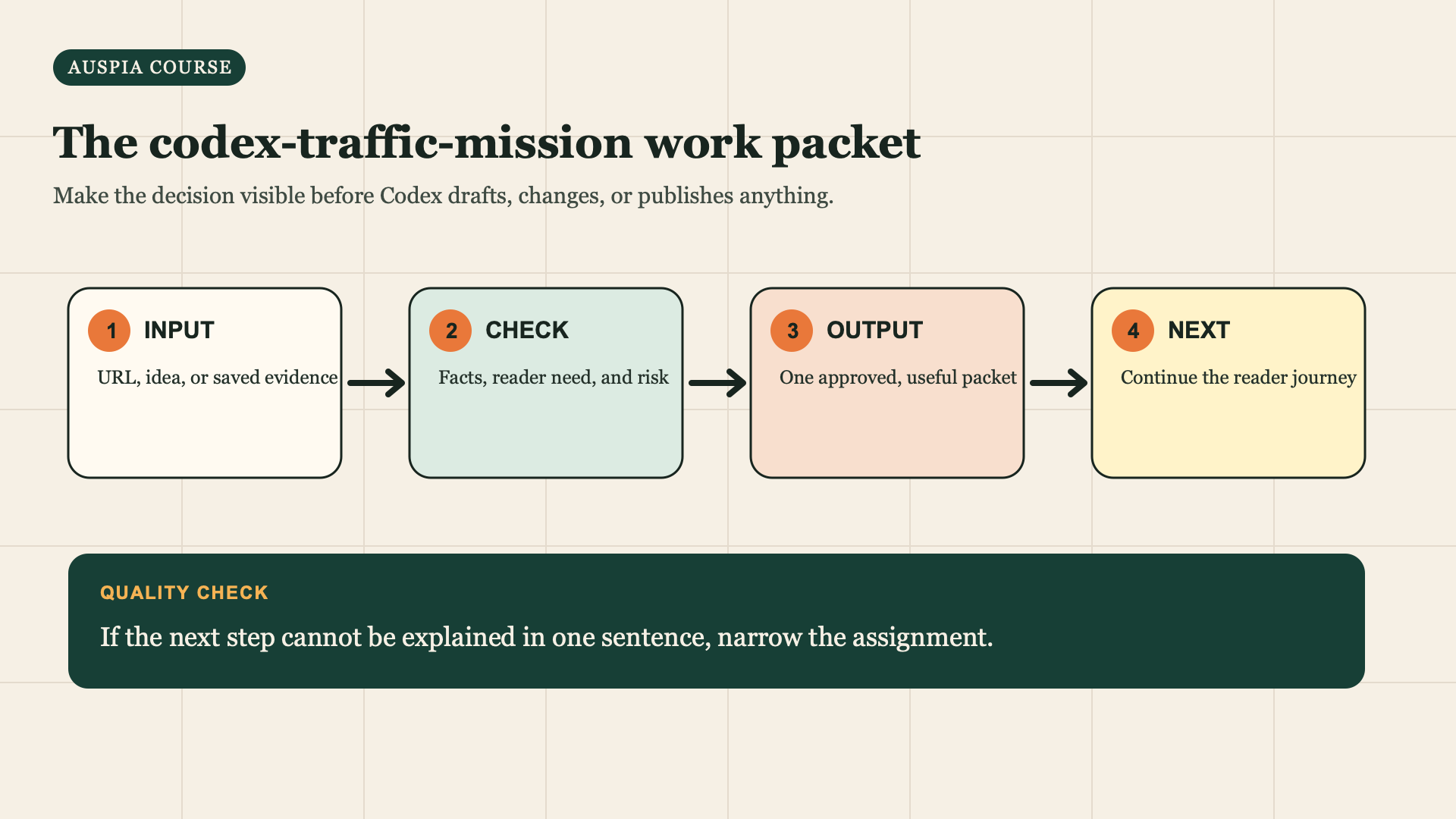
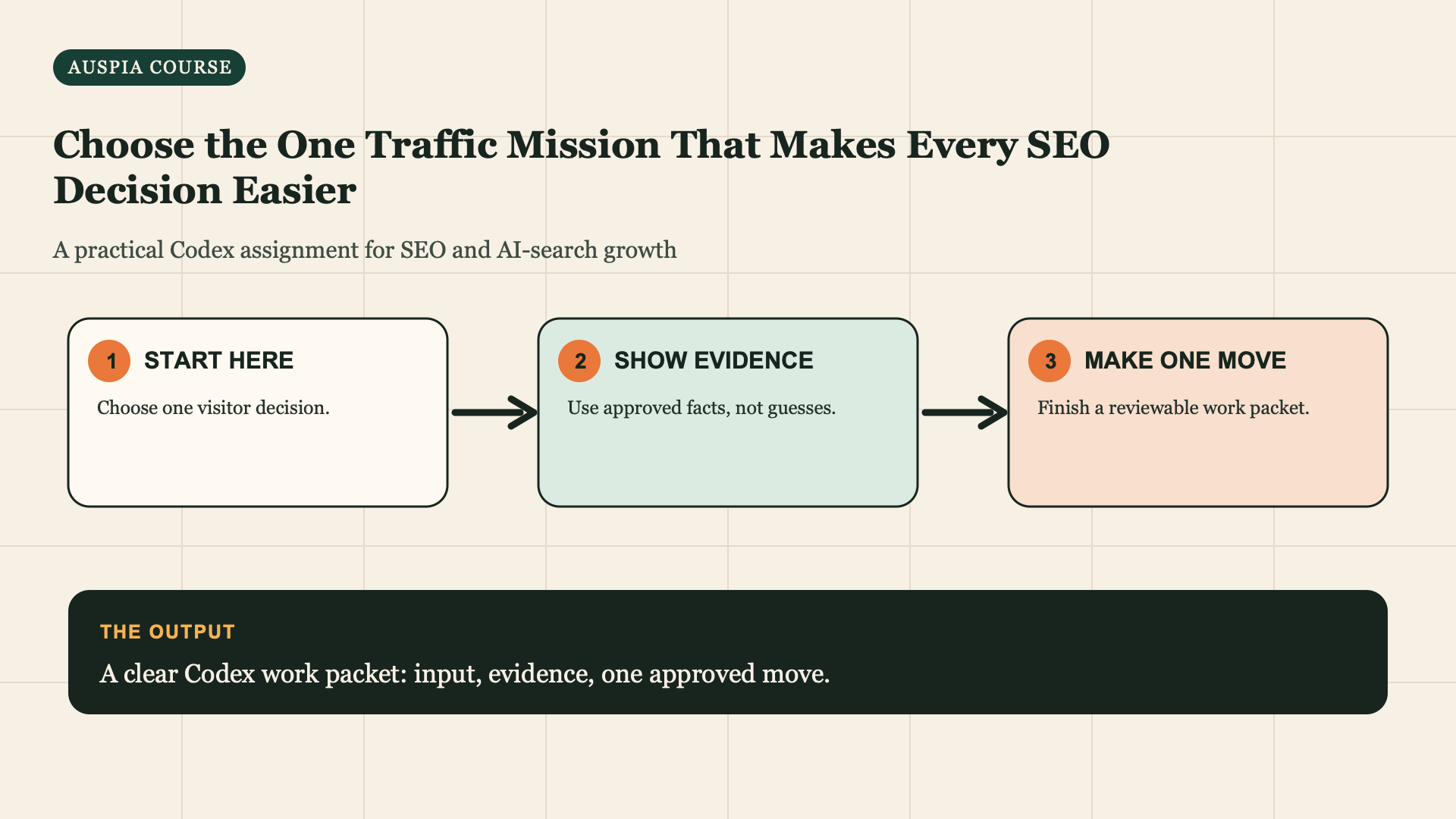
Use this sequence for the assignment: start with a real input, check the evidence, prepare one reviewable output, then choose the reader next step.