Build the site people will search for, not just the site you want to launch
If you have no website yet, your advantage is that nothing is messy. You can give every first page a job before you publish it.
In this lesson, Codex turns your Growth Start Card into a First Site Blueprint. It is a one-page plan with five to seven pages: the pages that explain your offer, prove it, help a visitor decide, and give search engines a useful first topic to understand.
Definition of done: You have a page map, one primary visitor action, one first traffic-page idea, and a short list of facts you must supply. You do not have a generic 50-page blog plan.
Allow 45 minutes. Bring a three-to-five-line owner brief, your Growth Start Card, and one decision a visitor should be able to make. You do not need a domain, a CMS, analytics access, or a developer for this lesson.
This lesson is for a new service, SaaS product, ecommerce idea, or content site. If you already have a site, return to the course map and use the route that matches your current traffic state.
Start with the smallest useful site
Do not begin with "blog," "resources," or a pile of category pages. Begin with pages that help a real visitor answer basic questions.
Page job | What the page must answer | Example for a bookkeeping service |
|---|---|---|
Home | Who is this for and what outcome do they get? | Bookkeeping help for freelance designers |
Offer or service | What is included, who fits, and what happens next? | Monthly bookkeeping and deadline support |
Proof | Why should a visitor trust the offer? | Qualifications, process, permitted examples, policies |
Contact or conversion | How does the visitor take the next step? | Book a discovery call |
First traffic page | What specific problem could a new visitor search? | Bookkeeping checklist before self-assessment for designers |
An ecommerce version may use home, collection, product, shipping/returns, and a buyer guide. A SaaS version may use home, product/use case, pricing or trial, security/docs, and a workflow guide. Codex will adapt the labels, but it must not invent features, prices, stock, service areas, or customer outcomes.
Give Codex your idea and your Growth Start Card
Prepare a five-line owner brief first
Do this before opening Codex. It should take five minutes, and it prevents the most common beginner mistake: asking an AI to choose your business for you.
Here is a complete example for a fictional bookkeeping service. It is not a copywriting exercise. Short, blunt answers are better than polished ones.
Offer: Monthly bookkeeping and deadline preparation for sole-trader designers.
Audience: Freelance designers in Bristol who are behind on financial records.
Visitor action: Book a 20-minute discovery call.
Service boundary: We do not file personal tax returns or offer legal advice.
Proof I own: A documented onboarding checklist, service terms, and the founder's
bookkeeping qualification. I do not yet have approved client case studies.
Save this in the same folder as growth-start-card.md as owner-brief.md. You will use it again for the Fact Pack and first traffic page. If you do not know an answer, write UNKNOWN. Do not replace an unknown with a plausible marketing claim.
Quality check: You can point to a real document, policy, product screen, or owner statement for every sentence marked as proof. If you cannot, move it to UNKNOWN.
If you are an ecommerce store: replace service boundary with shipping, returns, product compatibility, and stock boundaries. If you are SaaS, list the workflow, required integration, and any plan limitation. The exercise is the same: give Codex facts that set an honest boundary.
Copy this prompt. Save the result as first-site-blueprint.md beside your growth-start-card.md.
You are building an SEO-first site blueprint for a beginner.

Read my Growth Start Card:
[paste it or provide its local file path]

Here are facts I confirm:
- Offer: [what I sell or publish]
- Audience: [specific people]
- Visitor action: [demo / purchase / booking / signup]
- Market or location: [market, country, city, or online]
- Facts I can prove: [three facts, links, screenshots, policies, or say unknown]

Create a First Site Blueprint with exactly these sections:
1. ONE-SENTENCE SITE PROMISE.
2. ESSENTIAL PAGE MAP: 5 to 7 pages only; state each page's visitor job,
   required proof, and next link or action.
3. FIRST TRAFFIC PAGE: one specific search problem, why it fits this site,
   and facts needed before writing it.
4. WHAT NOT TO PUBLISH YET: three tempting pages that would be premature.
5. OWNER QUESTIONS: no more than five missing facts.

Do not write page copy, choose a CMS, buy a domain, create code, publish, or
invent business details. If a claim is not supplied, mark it NEEDS OWNER FACT.
What a useful blueprint actually looks like
For the bookkeeping brief, a good output is not a long list of keyword pages. It looks more like this:
Page | Visitor job | Proof required | Next action |
|---|---|---|---|
| Help a designer decide whether the service fits their records and deadline situation | Scope, exclusions, onboarding process | Book a discovery call |
| Show what happens from first call to monthly handoff | Verified onboarding checklist | Read service page or book |
| Help a behind-on-records designer prepare before asking for help | Checklist steps, scope boundary, deadline caveat | See the service fit page |
| Make the next step clear | Response expectation confirmed by owner | Send enquiry or book |
The first traffic page solves a narrow question a new visitor could search: "What bookkeeping records should a freelance designer prepare before a self- assessment deadline?" It is not "Bookkeeping advice" and it is not "Best accounting software." The former is too broad to make a useful first page; the latter may demand comparisons you cannot substantiate.
Bad output: Home, About, Services, Blog, Contact, 20 keyword articles.
Why it fails: there is no visitor decision, no proof request, and no route from a helpful article to the actual offer.
If Codex produces that sort of list, paste this correction:
This is a menu, not a site plan. Rewrite it as five to seven pages with one
visitor decision per page. For every page, name the proof we must provide and
the next helpful action. Keep unknown facts visible. Do not add blog categories
or keyword lists.
Review the blueprint like an owner
The blueprint passes when every page has a visitor job. About us, Blog, and Features are not jobs by themselves. Ask Codex to rewrite weak labels.
Weak page | Better page job |
|---|---|
Blog | Help a freelancer decide what records to prepare before tax season |
Features | Show how the product solves one specific workflow |
About | Prove who provides the service and what expertise is visible |
Also check the first traffic page. It must be narrower than your whole market and close enough to your real offer that you can add useful evidence. If Codex suggests Best bookkeeping software, say: Choose a problem we can answer with our own expertise and service facts, not a broad affiliate-style list.
Run the two-minute overlap test
Put the blueprint in front of you and ask these questions page by page:
- Would a visitor know why this page exists after reading its first sentence?
- Does it answer a different decision from every other page?
- Can you name the proof it needs before writing begins?
- Does it lead to one useful next page or action?
If two pages answer the same decision, merge them in the plan. For example, Bookkeeping for freelancers and Monthly bookkeeping service are often one page at this stage. A small site earns clarity by having fewer, stronger pages.
If a page has no proof, do not delete the problem. Add it to an owner question: What exact response time can we promise after a discovery-call form? That is more useful than allowing Codex to write "fast response" without evidence.
Ask Codex for a build packet, not a live website
Only after you approve the page map should Codex translate it into work your developer, CMS editor, or future self can review. Use this prompt for the first page only:
Read owner-brief.md and first-site-blueprint.md. Prepare a build packet for
only [approved page]. Include:

1. The visitor decision and page promise.
2. A section-by-section outline, with the question each section answers.
3. Facts required in each section, marked CONFIRMED or NEEDS OWNER FACT.
4. Existing pages this page should link to and why.
5. One conversion action and the exact information it needs from the owner.
6. A CMS-neutral acceptance checklist for mobile, links, headings, and forms.

Do not write claims that are marked NEEDS OWNER FACT. Do not create files,
choose a CMS, publish, connect a domain, or change a live website.
The expected result is a reviewable document, not a finished page. The moment Codex writes a sentence such as "trusted by Bristol designers" without a source, mark it NEEDS OWNER FACT and have it remove the claim.
When the plan feels too big
Beginners often stop here because six pages sound like six projects. Do not build all of them at once. Your first production sequence is deliberately small: make the offer page credible, make one traffic page useful, and connect them. A contact page or booking route can be simple if it honestly explains what happens next.
If you have no developer or CMS yet, complete the blueprint and build packet anyway. These documents let you choose a platform later without losing the important work: the reader decision, proof boundary, and page relationship.
Your first publish order
Build or prepare pages in this order:
- The offer page and conversion path.
- The proof and policy information that makes the offer believable.
- The first traffic page.
- The internal links between them.
This order keeps the traffic page connected to something useful. A visitor should not land on a helpful article and then discover there is no clear service, product, author, or next action.
Course map
You entered through the new-site route. Next, go to Choose the One Traffic Mission That Makes Every SEO Decision Easier. It turns the promising first traffic page into a precise page mission before you research or draft it.
For other starting states, return to Find Your First Growth Move.
Completion check
- [ ] I have five to seven pages with a specific visitor job.
- [ ] I selected one first traffic page, not a generic blog category.
- [ ] Every important claim is either supported or marked
NEEDS OWNER FACT. - [ ] Codex did not build, publish, or invent any part of the site.
- [ ] I saved
first-site-blueprint.md. - [ ] I saved a five-line
owner-brief.mdwith unknowns left visible. - [ ] I can explain the distinct visitor decision for every planned page.
- [ ] I have a build packet for one approved page, not an instruction to launch a whole site.
Author: Clara Bennett, 10-Year Content Strategy Practitioner at Auspia. Clara writes about small site structures that turn customer problems into useful content systems.
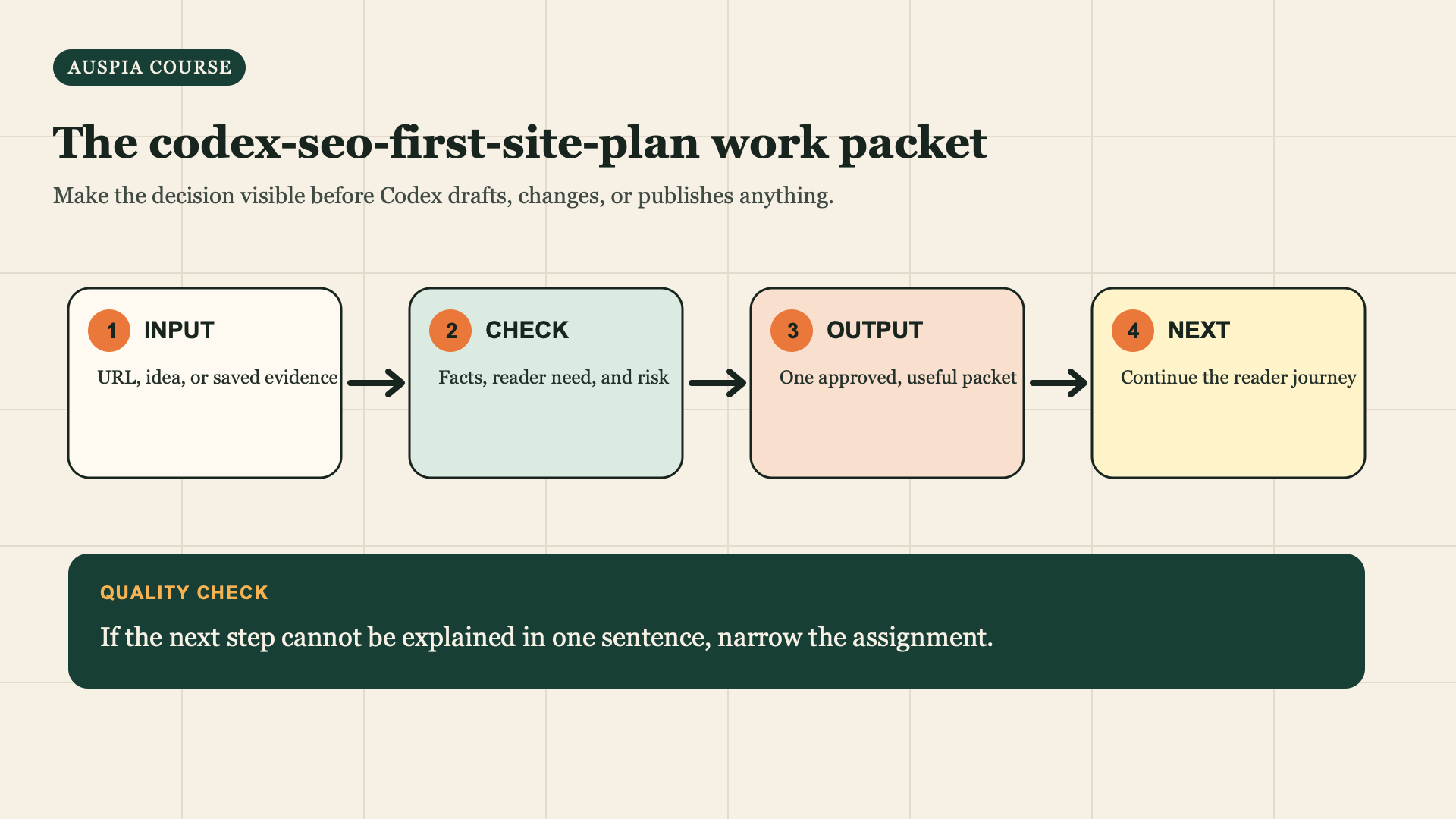
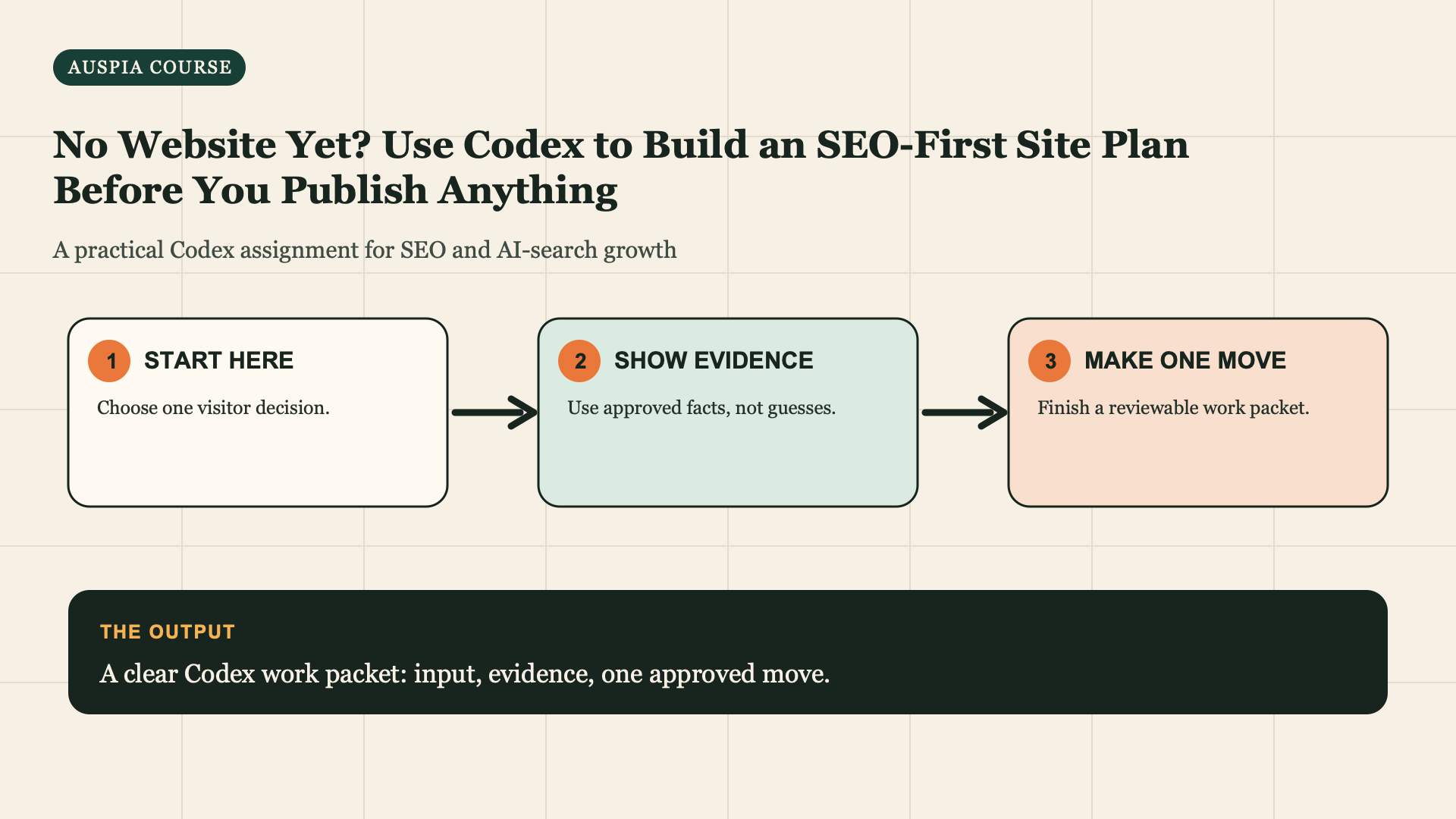
Use this sequence for the assignment: start with a real input, check the evidence, prepare one reviewable output, then choose the reader next step.