Your next traffic win is usually hiding in a page you already own
When growth stalls, teams often publish a new article because it feels productive. The faster win is often a page that already has impressions, a useful topic, and one missing answer, weak title, outdated detail, or poor next step.
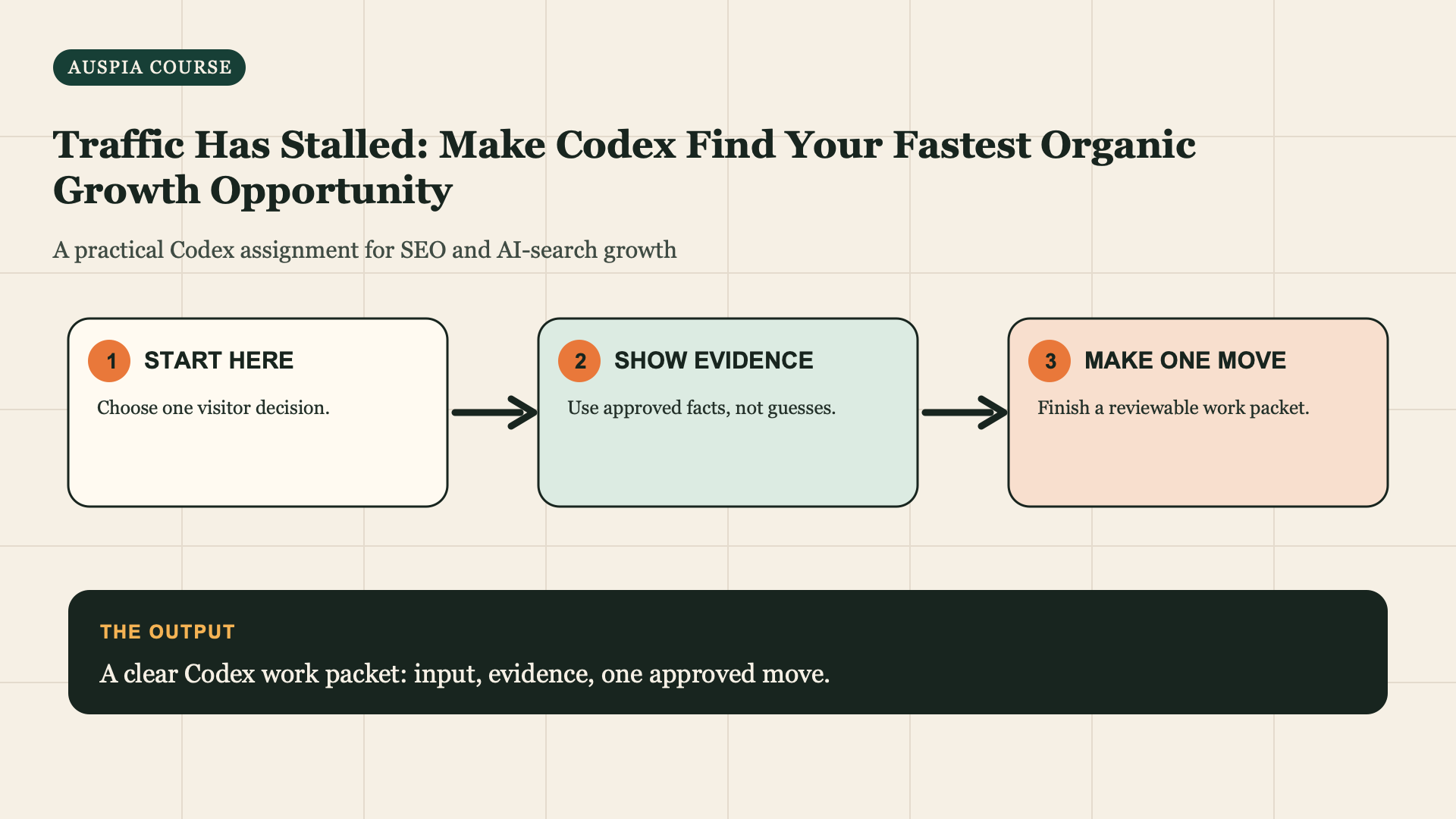
This lesson makes Codex create a Growth Opportunity Card. It chooses one page, one visitor job, one gap, and one change worth testing. It does not turn every impression into a content task.
Definition of done: You have one opportunity card with evidence, a visitor action, and a proposed page improvement. You know why it is a better bet than your other options.
Allow 45 minutes. The best input is one completed 28-day Search Console export plus a page URL. You can still complete the exercise with a public page and a documented customer problem, but performance claims must remain unknown.
Bring a small slice of evidence
Export enough data to choose, not enough to drown in
If you have access to Google Search Console, open Performance, choose Search results, and use one completed 28-day period. Export two small tables:
- Pages: URL, clicks, impressions, CTR, and average position.
- Queries: query, clicks, impressions, CTR, and average position.
Save them as pages-28d.csv and queries-28d.csv. If you use another analytics platform, export its equivalent page-and-query evidence. Do not mix today's partial data with a completed period; the comparison becomes noisy.
The lesson still works without an export. In that case, choose a page that a customer or sales call has shown is confusing, and label performance numbers as unknown. You are choosing a useful change, not pretending to run a data analysis you do not have.
Here is a fictional SaaS example:
Page: /shopify-returns-automation
Query: shopify returns automation setup
28-day export: 420 impressions, 12 clicks, 2.9% CTR, average position 11.8
Visible page: product claims and a demo CTA, but no setup steps, compatibility
requirements, or explanation of what happens after installation.
Conversion: Start a trial.
Quality check: The row belongs to the actual page you plan to improve. Do not match a query from one page to a different page just because the wording is convenient.
Export the last complete 28 days or month from Search Console if you can. The export can be a page table, query table, or both. Add one page URL you suspect is underperforming. If you have no export, provide the page and explain what has stalled; Codex must label traffic facts as unknown.
You are my organic-growth opportunity analyst.

Read my Growth Start Card and Traffic Mission:
[local paths or pasted text]

Public site or page: [URL]
Search Console or analytics export, if available: [local path or NONE]
Business conversion: [what a qualified visitor should do]

Use only the supplied evidence and public pages. Do not log in, call APIs,
change my site, publish, or estimate missing metrics.

Create one Growth Opportunity Card:
1. PAGE TO BET ON.
2. EVIDENCE: exact export rows or visible page evidence.
3. VISITOR JOB: what this searcher is trying to decide or complete.
4. THE GAP: one missing answer, mismatched format, weak promise, stale fact,
   unclear CTA, or internal-link problem.
5. THE NEXT CHANGE: one approval-ready change and the expected visitor action.
6. WHY NOT THE OTHER OPTIONS: reject two alternatives briefly.
7. MEASURE AFTERWARD: which comparable data to save after the change.
Read the opportunity card as a bet, not a promise
For the SaaS example, a good card looks like this:
PAGE TO BET ON
/shopify-returns-automation

EVIDENCE
The supplied page/query rows show 420 impressions for setup-oriented demand.
The public page promotes the product but does not show a setup path or limits.

VISITOR JOB
Decide whether this returns tool can be configured for the store before
starting a trial.

THE GAP
The page is a product pitch where the searcher needs an implementation answer.

NEXT CHANGE
Add an approved setup-and-fit section: prerequisites, supported store setup,
steps after installation, and an honest trial CTA.

MEASURE AFTERWARD
Save the same page/query rows after a completed comparison period. Record the
release date and the exact sections added.
This is specific enough to work on. It does not say "improve the title" just because CTR is lower than you would like. A title change could be the next test, but only after you decide whether the page actually satisfies the query.
Use a four-question filter before approving the bet
Question | A yes means | A no means |
|---|---|---|
Does the evidence point to one page and one visitor question? | You can inspect a real opportunity | Narrow the evidence or stop guessing |
Can you add first-party facts or a clearer explanation? | The page can become materially better | Do not pad it with generic text |
Is the action smaller than a whole-site redesign? | You can learn from one release | Split the work into a smaller change |
Is there a relevant next action? | The traffic can lead somewhere useful | Repair the conversion path first |
If the answer is no to the first two questions, choose another page or collect better evidence. Do not turn a weak opportunity into a new content calendar.
What makes an opportunity worth taking
Use this simple filter. A page does not need huge traffic to be worth improving.
Signal | Strong opportunity | Weak opportunity |
|---|---|---|
Demand evidence | Existing impressions, recurring customer question, or clear query/page match | A keyword tool suggestion with no page purpose |
Page fit | You can add true information the visitor needs | The topic is unrelated to your offer or expertise |
Change | One visible improvement is possible | The recommendation is only |
Conversion | The page can lead to a useful next action | There is no relevant next step |
Example: a SaaS integration page receives impressions for "[tool] integration setup" but only lists product marketing copy. The gap is a real setup path, compatibility limits, and a next step. A complete rewrite of the home page is not the first experiment.
Turn the card into a controlled improvement
When you approve the card, use this follow-up:
Turn the approved Growth Opportunity Card into a page-improvement brief.
Include: the exact visitor question, verified facts required, current-page
sections to keep, proposed new sections, one CTA, internal links to consider,
and a before/after measurement note. Mark every unsupported claim NEEDS OWNER
FACT. Do not edit or publish the page.
The shared course then makes this discipline repeatable. Lesson 6 records the traffic mission; Lesson 7 builds the Fact Pack that keeps the next page or refresh grounded.
Ask for a page diff only after owner facts are ready
The improvement brief tells you what the page needs. It does not yet give Codex permission to write unsupported setup instructions or product claims. First make a short evidence list:
CONFIRMED: Shopify store connection is required.
CONFIRMED: The app supports [approved return route].
NEEDS OWNER FACT: Which plan includes automated labels?
NEEDS OWNER FACT: What exact onboarding support is offered?
Then use this change-sheet prompt:
Read the approved Growth Opportunity Card and this fact list. Produce a
reviewable change sheet for [URL or local page file]. Show:

1. The existing section that fails the visitor question.
2. The exact new or revised section, using CONFIRMED facts only.
3. Every NEEDS OWNER FACT left as a visible note, not page copy.
4. One title or meta-description option only if it matches the finished page.
5. One contextual internal link and why a reader needs it.
6. A release note with the before state, date, and comparison period.

Do not edit source files, publish, change redirects, or alter tracking.
When Codex returns the sheet, read it like a product owner. Reject broad claims such as "automate returns in minutes" unless you have a defined, approved source. Reject a comparison section that names competitors without a current, verifiable comparison. The point of a fast win is not faster prose; it is a better answer on a page that already has a reason to exist.
If the page has impressions but no obvious gap
This happens. It may be too early to change the page. Save the opportunity as watch, do not edit yet, collect customer questions or sales-call notes, and compare again after a full period. A disciplined non-change is better than rewriting a page simply because a chart made you nervous.
Troubleshoot the three common dead ends
"Every page has low traffic." Start with the page closest to a commercial or support decision that you can genuinely improve. A page with only a few impressions can still be the right first test if it has a clear audience and you have proof to add.
"Codex chose an unrelated query." Reply with the original Traffic Mission and say: Reject every query that does not help this person make this decision. Choose the closest page/query pair from the supplied rows only. Relevance comes before volume.
"The output asks for a complete rewrite." Require the model to name the one section that is currently missing, unclear, stale, or disconnected. A whole-page rewrite is justified only when the page serves the wrong visitor question entirely. Otherwise, preserve useful sections so you can learn which change mattered.
Save the approved card, evidence export, and final change sheet in organic-growth/opportunities/[page-slug]/. That small record is what lets Lesson 19 later decide whether to refresh, consolidate, or leave the page alone.
The first opportunity is complete when the next person can open that folder and understand the page, evidence, proposed change, and review date without having to reconstruct your reasoning from a dashboard.
Course map
Next: Choose the One Traffic Mission That Makes Every SEO Decision Easier.
If the selected page needs a refresh after the weekly loop is running, bookmark Turn Low-Click Pages Into Traffic Wins.
Completion check
- [ ] The card chooses one page and one change.
- [ ] Metrics are copied from supplied evidence or marked unknown.
- [ ] The page has a named visitor job and conversion action.
- [ ] I rejected two distracting alternatives.
- [ ] I saved matching page and query evidence, or clearly labelled it unknown.
- [ ] I can explain the specific new information the visitor will get after the change.
- [ ] The approved next action is a reviewable change sheet, not an automatic edit.
Author: Leo Harrington, SEO Analytics Translator for 500+ Executive Reports at Auspia. Leo writes about turning confusing search data into one clear editorial decision.
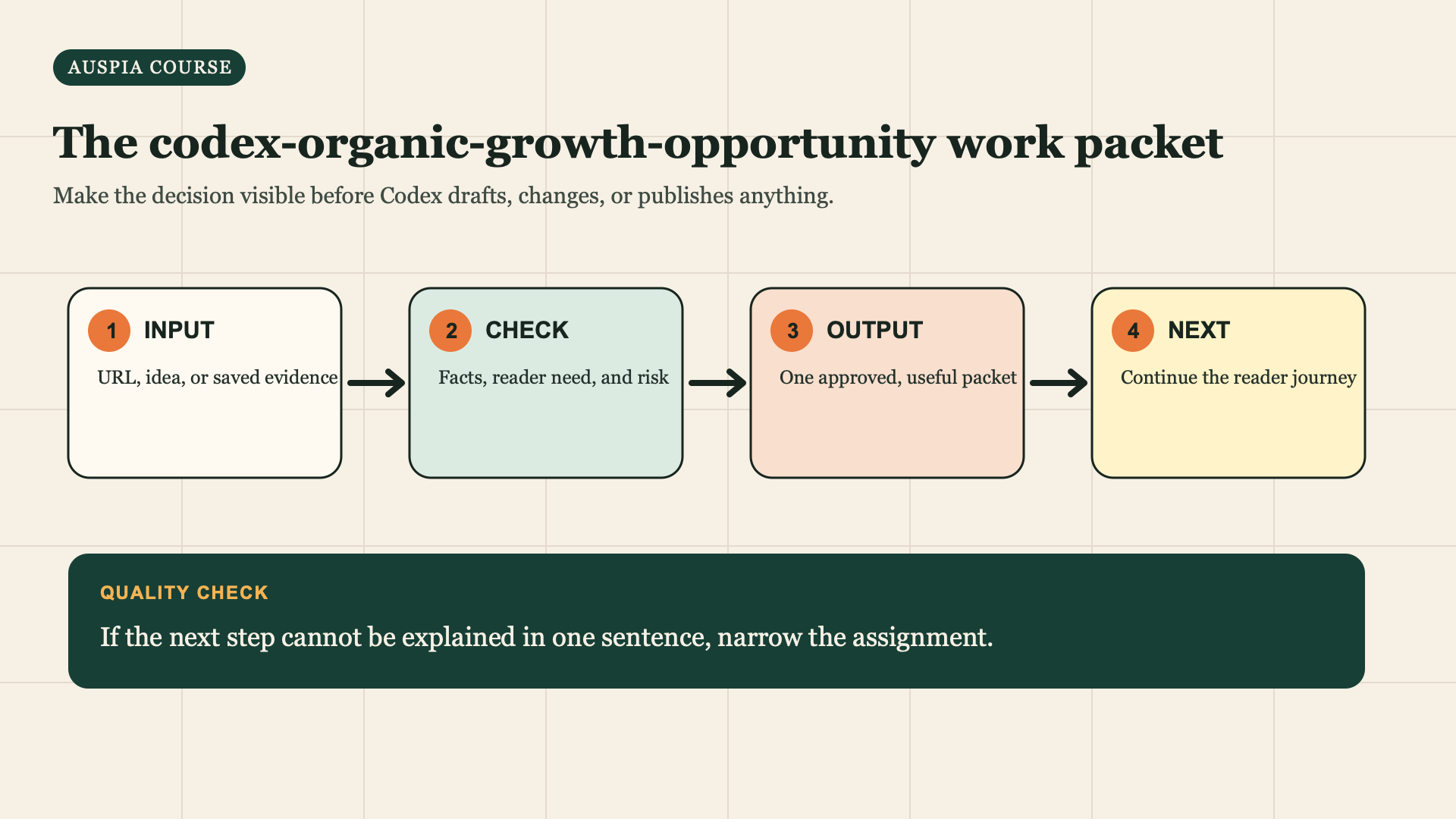
Use this sequence for the assignment: start with a real input, check the evidence, prepare one reviewable output, then choose the reader next step.