Direct answer
GEO is not a mysterious replacement for SEO. For most content teams, it is a stricter version of the basics: make pages crawlable, indexable, readable, and worth citing with evidence, original experience, and clear structure.
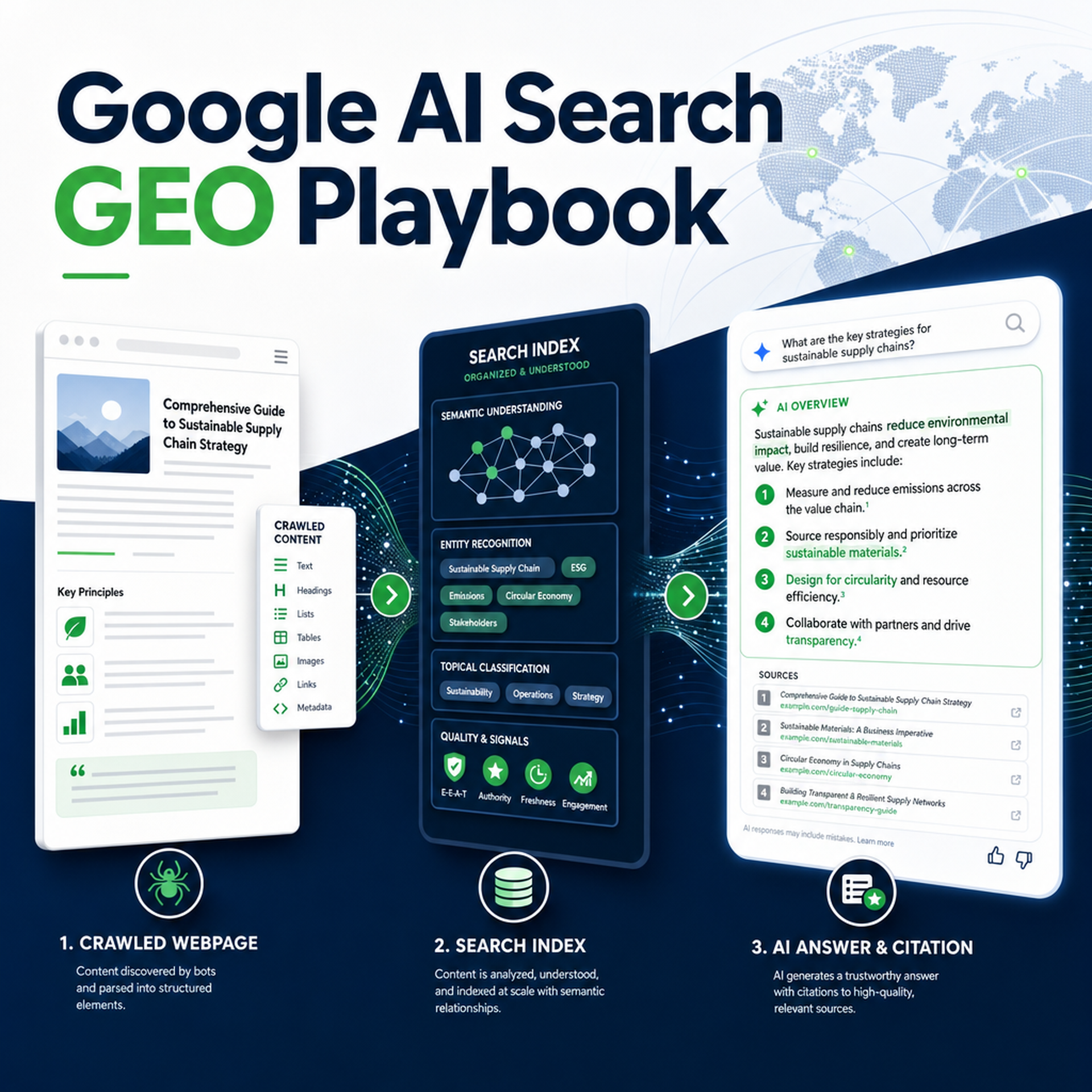
Google's guidance for AI features makes the boundary clear: there is no special AI SEO tag or hidden shortcut for AI Overviews or AI Mode. The same fundamentals still matter. The difference is that AI search systems can expand a user's question, retrieve multiple supporting sources, and synthesize an answer. That puts more pressure on content depth, evidence, and machine-readable clarity.
For global SaaS, B2B, and content teams, the practical playbook comes down to seven actions:
- Make sure search systems can crawl and index the page.
- Remove content that an offline AI model could write by itself.
- Track AI citations, not only traditional rankings.
- Add an evidence layer to every important article.
- Consolidate thin posts into stronger topic hubs.
- Manage crawler access for AI search and AI training separately.
- Use baseline structured data without chasing fake AI-only schema.
1. Make the page crawlable before you optimize for citations
Many teams start GEO by asking, "How do we get ChatGPT, Google AI Overviews, or Perplexity to cite us?"
A better first question is simpler:
Can search and AI retrieval systems actually see this page?
Google's documentation says that to be eligible as a supporting link in AI Overviews or AI Mode, a page must be indexed by Google Search and eligible to show a snippet. If a page cannot be crawled, indexed, or summarized, advanced GEO tactics do not matter.
This is not a local-market issue. It applies to any website trying to earn visibility in AI-assisted discovery.
What to do:
- Return HTTP 200 for important pages.
- Avoid accidental
noindextags on articles, guides, and landing pages. - Keep the main article text available in crawlable HTML.
- For React, Next.js, Astro, or other JavaScript-heavy stacks, use SSR, SSG, or pre-rendering for content pages.
- Use real links with
<a href="...">, not JavaScript-only navigation. - Check indexing, impressions, and crawl issues in Google Search Console.
- If Bing, Copilot, or ChatGPT Search matter in your market, also review Bing Webmaster Tools.
- Make sure CDN rules, WAF settings, login walls, and robots rules are not blocking important content.
Auspia perspective: the first layer of GEO is not "writing for AI." It is making sure machines can read what you already published.

AI search citation starts with crawlability and indexing before a page can become a supporting source.
2. Remove content that AI can already write without you
AI search does not need another generic explanation. It needs sources that add verifiable, differentiated information.
If an article is just a broad summary like "10 ways to improve productivity," "what is SEO," or "how to write better blog titles," an AI system may not need to cite it. The model can often generate a similar answer without visiting your page.
Pages that are more useful as sources usually contain at least one of these elements:
- A real test process.
- First-party data.
- A product comparison with criteria.
- A specific failure or recovery story.
- A reproducible workflow.
- Expert judgment with context.
- Dates, sample sizes, trade-offs, and constraints.
Before publishing, ask one test question:
If an AI model had no web access, could it produce 80% of this article?
If the answer is yes, the article needs more original value.
How to improve it:
- Replace abstract claims with specific scenarios.
- Replace generic advice with a decision process.
- Replace adjectives with numbers.
- Replace "best practices" with conditions and exceptions.
- Add examples that only a practitioner, customer, product team, or analyst could provide.
Weak version:
AI search is changing SEO, so companies should invest in GEO.
Stronger version:
We tested 30 buyer-intent questions across AI Overviews, Perplexity, and ChatGPT Search. The pages that were easiest to cite had concise definitions, source links, and examples that answered adjacent follow-up questions.
Auspia perspective: in AI search, the risk is not publishing too little. It is publishing too much content that AI does not need to attribute to anyone.
3. Track AI citations, not only rankings
Traditional SEO teams track rankings, impressions, clicks, and conversions. GEO needs another layer: whether AI systems mention, cite, or absorb your content.
Google's AI search experiences can use query fan-out, where the system issues multiple related searches around a user's original question. That means AI visibility may not map perfectly to a single keyword ranking.
AI visibility patterns
Scenario | Traditional SEO signal | AI search signal | What to do |
|---|---|---|---|
High ranking, no citation | Strong | Weak | Add evidence, definitions, examples, and source clarity |
Mid ranking, cited often | Medium | Strong | Expand the cited page into a stronger topic hub |
Brand mentioned, no URL | Mixed | Medium | Strengthen entity consistency and attribution signals |
No ranking, no citation | Weak | Weak | Fix crawlability, indexing, quality, and topic coverage |
What to do:
- Build a library of 20-50 AI search prompts that match your buyer questions.
- Test them monthly across Google AI experiences, Perplexity, ChatGPT Search, and any platform your audience uses.
- Record whether your brand appears.
- Record whether your URL is cited.
- Record which competitor pages are cited.
- Save answer screenshots or exports when possible.
- Compare AI visibility against Search Console and analytics data.
Do not test only once. AI answers can vary by region, time, query wording, and platform.
Auspia perspective: content teams now need two visibility dashboards. One shows keyword performance. The other shows AI citations, brand mentions, and source inclusion.
4. Add an evidence layer to every strategic article
Early GEO research repeatedly points in the same direction: citations, statistics, source clarity, and authoritative references can improve how useful a page is to generative engines. The original GEO research found that optimization methods such as adding citations, quotations, and statistics can improve visibility in generative answers, with some methods producing gains around 40% in tested conditions.
The lesson is not to stuff every article with random data. The lesson is to make your claims easier to verify.
A simple evidence layer looks like this:
Each strategic article should include:
- 3 specific numbers
- 1 authoritative source or direct quote
- 1 original example, case, or reproducible workflow
- 1 limitation or condition
- 1 clear last-reviewed or updated date when freshness matters
Weak version:
Structured content helps AI understand your page.
Stronger version:
Google says there is no special markup required for AI features, but it still recommends making pages crawlable, indexable, and eligible for snippets. That means structured, visible, consistent content remains part of the foundation, even if there is no AI-only schema shortcut.
What to do:
- Link to original sources, not only summaries of sources.
- Use numbers to explain why a recommendation matters.
- Add examples to show how a recommendation works.
- Add limitations to show when the advice does not apply.
- Update old posts when platform behavior or documentation changes.
- Avoid vague source language like "experts say" or "many people believe."
Auspia perspective: AI systems are more likely to use content that looks verifiable, specific, and hard to replace.
5. Consolidate thin posts into stronger topic hubs
A common old SEO pattern was one keyword, one post. Then one long-tail variation, another post. That can create a large library of thin, overlapping pages.
AI search creates pressure in the opposite direction. When a user asks one question, the system may expand it into related sub-questions before generating an answer.
For example, a query like "how to optimize content for AI search" may require answers to several adjacent questions:
- How is AI search different from traditional search?
- What makes content easier to cite?
- Does technical SEO still matter?
- Do teams need schema?
- How should AI citations be measured?
- How should old articles be refreshed?
- Do different AI platforms choose sources differently?
If those answers are scattered across ten shallow posts, none of them may be strong enough to become a preferred source. A well-structured topic hub can be more useful because it answers the main question and the follow-up questions together.
What to do:
- Audit 5-10 thin posts in the same topic cluster.
- Decide whether they should be merged into one authoritative guide.
- Use 301 redirects from retired posts to the new hub.
- Cover definitions, context, steps, examples, mistakes, FAQs, and tools.
- Use a table of contents and descriptive headings.
- Link from the hub to narrower cases, templates, or product workflows.
Auspia perspective: GEO does not reward endless variations of the same post. It rewards pages that can resolve a whole cluster of related questions.

A topic hub can answer the main query and related follow-up questions better than many overlapping thin posts.
6. Manage AI crawler access intentionally
Many websites only think about Googlebot in robots.txt. AI search has made crawler policy more complicated.
Separate two goals:
- Search and citation discovery. These systems help determine whether your content can be retrieved, cited, or used as a supporting source in an answer.
- Model training or model improvement. These controls can affect whether content is used for training or improvement by certain providers.
Different platforms use different crawlers and policies, and the rules change. Do not blindly copy a robots.txt template from the internet. Start with your own policy.
AI crawler policy matrix
Goal | Safer strategy |
|---|---|
You want AI search citations | Do not accidentally block relevant search or retrieval crawlers |
You do not want training use | Review each provider's training crawler controls |
You want Google Search visibility | Do not block Googlebot from important pages |
You want to control snippets | Use official snippet, preview, or noindex controls where appropriate |
You have paywalled content | Pair access control with paywall markup and clear indexing policy |
What to do:
- Audit
robots.txt. - Check CDN and WAF logs for blocked crawlers.
- Separate search retrieval policy from training policy.
- Use URL inspection for important pages.
- Document which crawlers your organization allows or blocks.
- Revisit the policy quarterly because AI search behavior is still changing.
Auspia perspective: AI visibility is not only a content problem. One mistaken crawler rule can make your best content invisible to the systems you want to reach.
7. Use baseline structured data, but ignore fake AI-only schema
Google's guidance is easy to misunderstand. It says you do not need special schema or a new AI-specific text file to appear in AI features.
That does not mean structured data is useless. It means there is no magic AI-only tag that guarantees inclusion.
The right approach is to use normal structured data accurately and keep it consistent with what readers can see on the page.
Structured data by page type
Page type | Useful structured data |
|---|---|
Blog article | Article or BlogPosting |
Step-by-step guide | HowTo, when the steps are visible on the page |
FAQ page | FAQPage, when the questions and answers are visible |
Category or hub page | BreadcrumbList |
Product page | Product or SoftwareApplication |
Case study | Article + Organization + BreadcrumbList |
What to do:
- Add Article or BlogPosting schema to article pages.
- Add BreadcrumbList where navigation hierarchy matters.
- Mark up FAQ only when the FAQ is visible to readers.
- Keep structured data consistent with page content.
- Validate with Google's Rich Results Test.
- Avoid tools that promise "AI schema" as a shortcut to AI citations.
Auspia perspective: structured data reduces machine interpretation cost. It is not a GEO shortcut, but it is part of a clean technical foundation.
Summary: the 7 actions in one view
Action | Problem it solves | Priority | Owner |
|---|---|---|---|
Crawl and index checks | AI systems cannot see the page | High | SEO / Engineering |
Remove generic content | AI has no reason to cite you | High | Content |
Track AI citations | Rankings miss AI visibility | High | SEO / Growth |
Add an evidence layer | Claims are hard to verify | High | Content / Research |
Build topic hubs | Thin posts split authority | Medium-high | SEO / Content |
Manage AI crawler policy | Crawlers are blocked by mistake | Medium-high | Engineering |
Add baseline schema | Machines need clearer context | Medium | SEO / Engineering |
FAQ
Does GEO replace SEO?
No. GEO builds on SEO, AEO, content quality, and technical accessibility. Google's AI feature guidance still points back to fundamentals such as crawlability, indexability, snippet eligibility, and visible page content.
Can smaller websites earn AI citations?
Yes, but not with generic content. Smaller websites have a better chance when they focus on narrow expertise, original examples, clear data, and pages that answer a complete cluster of related questions.
Do we need llms.txt for Google AI features?
Google says you do not need a new AI-specific text file to appear in its AI features. Other AI platforms may treat publisher signals differently, so teams can evaluate llms.txt as a supplemental policy file, not as a substitute for indexing, quality, and crawler access.
Does schema guarantee inclusion in AI answers?
No. Schema does not guarantee AI visibility. It helps machines understand content when it is accurate and consistent with the visible page.
How do we know whether AI systems cite us?
Create a fixed prompt library, test it regularly across relevant AI search platforms, and record brand mentions, URL citations, cited competitors, and answer language. Compare those results with traditional SEO metrics.
Auspia perspective
GEO is not about chasing a new acronym. It is about making content cite-worthy.
A page built for AI search needs four qualities:
- Search systems can discover it.
- Machines can understand its structure.
- Readers can verify its claims.
- Competitors cannot easily replace it with generic text.
If your article only changes the title, keyword, and paragraph order, AI does not need it. If it provides evidence, experience, examples, judgment, and clean structure, AI has a reason to use it as a source.
Sources
- Google Search Central: AI features and your website — https://developers.google.com/search/docs/appearance/ai-features
- GEO: Generative Engine Optimization — https://arxiv.org/abs/2311.09735
- From Citation Selection to Citation Absorption — https://arxiv.org/abs/2604.25707