Short answer
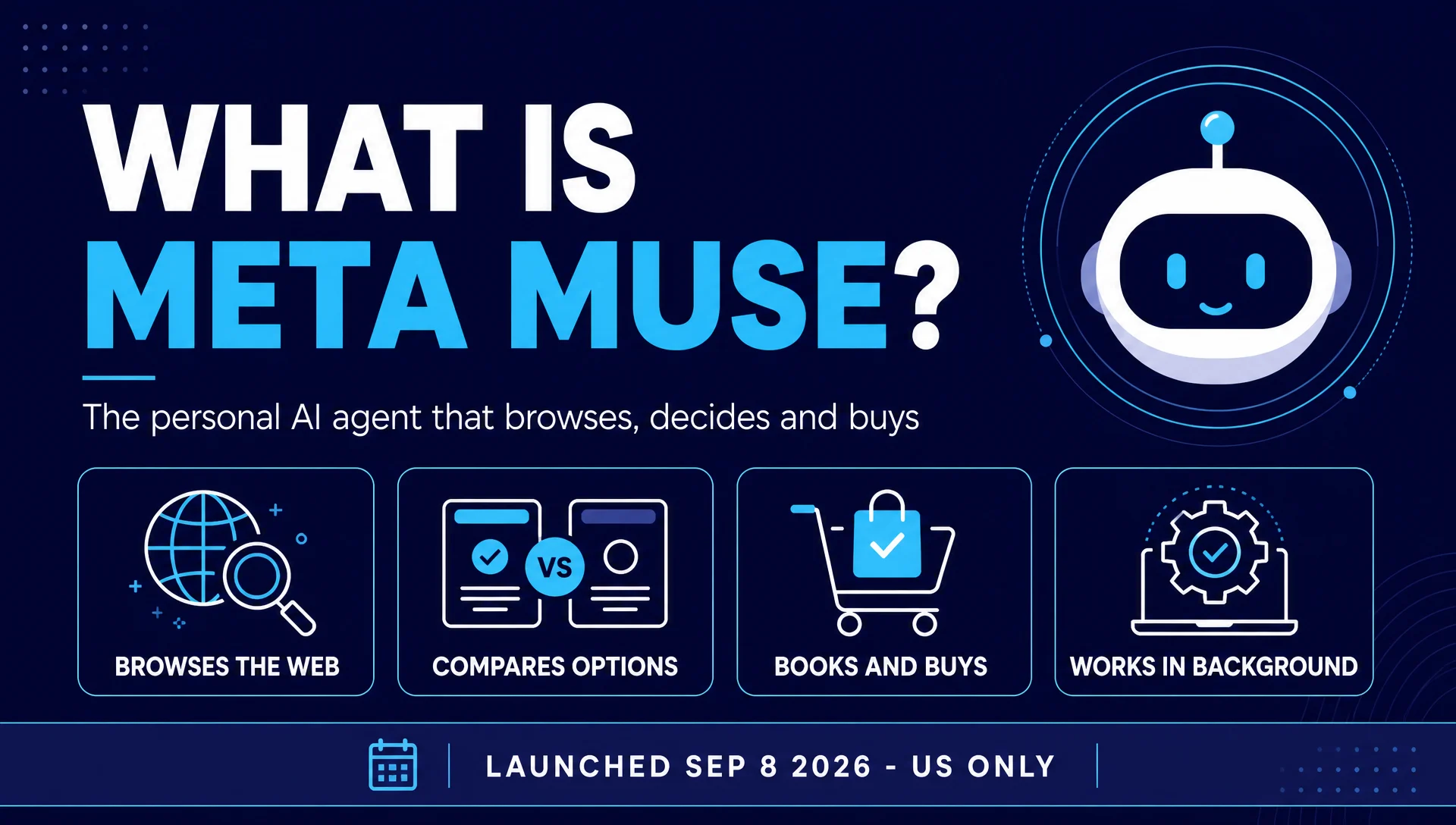
Meta Muse is a personal AI agent that Meta launched on September 8, 2026, in the United States. Unlike a chatbot that answers questions, Muse acts. It opens a browser, fills out forms, compares options, books travel, and completes purchases on a user's behalf, then keeps working in the background after the app is closed.
For anyone who works on search visibility, the important part is not the chat. It is that Muse researches the open web and then decides what to recommend. That makes it a discovery surface, not just an assistant. If an agent can find, understand, and buy from you, you are in the running. If it cannot, you are not in the conversation at all.
This article covers what Muse is, what it actually does, who it partners with, and what it changes for SEO and generative engine optimization. It is the starting point for the rest of our Meta Muse coverage.
What Muse actually is
Meta calls Muse "the world's first personal AI agent built for everyone." That is marketing, but the underlying product is genuinely different from the assistants most people have used.
Three things separate it from a chatbot:
It runs its own browser. Muse does not just read a page you paste in. It navigates websites the way a person would, which means it encounters your site the way a person would, minus the patience.
It acts, not just answers. Sending email, filling forms, booking travel, negotiating a bill, and checking out are all in scope. Meta says it asks for approval before sensitive actions like a purchase.
It works in the background. You can close the app and Muse continues, notifying you only when it needs a decision.
It runs in an isolated per-user virtual machine, which Meta calls the Muse Secure VM, with a separate agent called Sentinel gating outbound actions. Meta says Muse cannot see your passwords or payment methods, and that credentials go into secure storage the agent can use without reading the values.
What it does, concretely
The capability list is long, so here is the practical version, grouped by what it means for a business.
Muse can | What it means for a brand |
|---|---|
Research products across the open web | Your site is a candidate source, not just your marketplace listing |
Compare options against stated constraints | Attributes and specs matter more than brand storytelling |
Book travel and reservations | Aggregators and direct sites compete for the agent's attention |
Complete checkout with approval | Being recommendable is worthless if the agent cannot pay |
Fill forms and send email | Your contact and intake flows need to be machine-completable |
Turn a saved Reel into a grocery list | Social content feeds agent tasks, not just discovery |
Meta's own product page lists tasks like workout analysis, scheduling, grocery shopping, trip bookings, gift ideas, and budgeting. It also shows the approval flow for purchases, where the user reviews and confirms before Muse completes a transaction.
Who Muse works with
This is where the story gets interesting, because the partner list is not uniform.
Open to Muse: Shopify (catalog search plus Shop Pay checkout), PayPal (checkout across its merchant network), Expedia (travel booking), Instacart (grocery orders), and Stripe Link (one-click checkout across more than a million merchants).
Closed to Muse: Amazon. On September 20, 2026, Amazon began blocking Muse at checkout with a popup stating that continued access by an unauthorized AI agent violates its Conditions of Use. Amazon's stated reasons were that Meta never disclosed the access, that the agent did not identify itself as automated, and that it appeared to capture customer credentials.
That split is the single most useful thing to understand about Muse. It shows that agent access is a platform decision, not a technical accident. We covered the full breakdown in Amazon Blocked Muse, Shopify Embraced It.
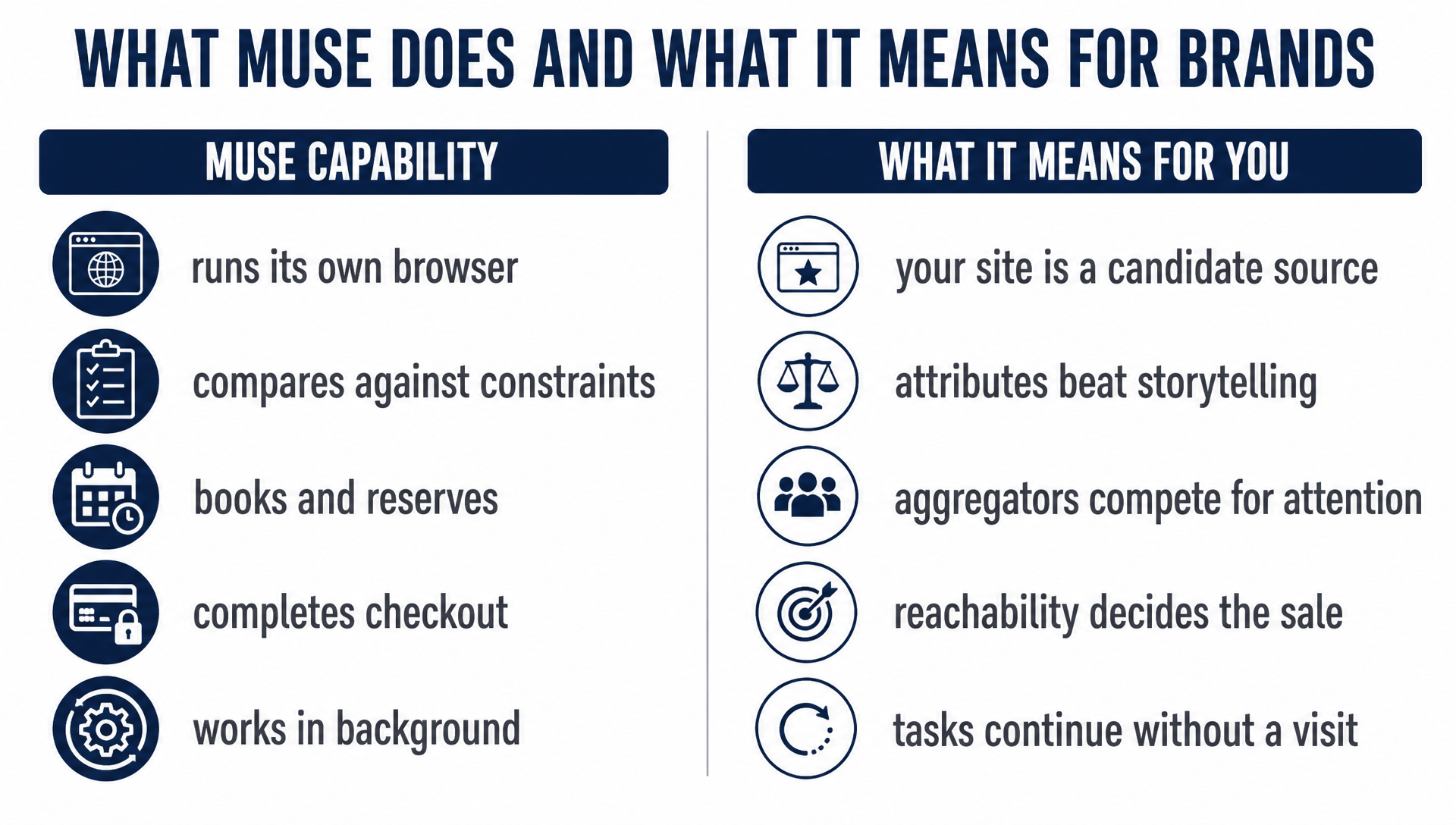
Muse's capabilities map directly to brand requirements. Every capability on the left creates a job on the right.
Why this matters for SEO and GEO
Traditional SEO asks whether a page ranks for a query. GEO asks whether a brand appears in a generated answer. Muse adds a third question: can an agent act on what it found?
That third question changes the work in three ways.
Discovery moves from keywords to intent. A Muse prompt looks like "find me a waterproof carry-on under $250 that fits under an airline seat," not "best carry-on 2026." The agent filters against explicit constraints, so a product that clearly states its dimensions, materials, and use case has an advantage over one that describes itself in mood language.
Machine readability becomes a purchase requirement. An agent that cannot extract your price, stock, and variants will surface your product and then fail at checkout. That is worse than never appearing, because it wastes the interaction.
Third-party evidence carries more weight. Agents cross-check claims. If your product's stated advantages are not corroborated by reviews, comparisons, or editorial coverage anywhere outside your own site, the agent has less reason to trust them.
None of this replaces SEO. Clean titles, real content, and fast pages still matter. It adds a layer on top.
A simple example
Imagine a buyer tells Muse: "Find me a birthday gift for a 10-year-old who likes art, under $50, that can arrive by Friday."
A brand that wins this interaction will have:
- A product description that names the age range, the interest, and the price clearly
- Stock and shipping speed the agent can verify
- Reviews or coverage that confirm it is a good gift for that age
- A checkout the agent can complete
A brand that loses will have a beautiful product page with a poetic description, the price buried in a theme default, and no agent-capable payment method. The product might be better. The agent will never know.
How to apply it on your site
You do not need to rebuild anything. Start with the parts an agent reads first.
- Rewrite titles so the product type comes first. "Merino Wool Crew Socks, 3-Pack, Unisex" beats "ACME Signature Series."
- Fill in structured fields. Product type, attributes, variants, price, and availability should exist as data, not only as prose.
- Add Product schema so an agent can parse the page without guessing.
- Check your robots.txt. If you blocked broadly to stop scrapers, you may also be blocking the agents that would send you buyers.
- Enable an agent-capable payment method. Stripe Link or PayPal is the fastest path for most stores.
If you sell on Shopify, much of the data plumbing is handled by Shopify Catalog. If you are on WooCommerce, BigCommerce, or a custom storefront, you own all of it. We wrote a separate workflow for that: How to Get Your Products Recommended by Meta Muse Without Shopify.
Mistakes that weaken the result
Optimizing for a ranking formula that does not exist. Meta has not published how Muse selects products. Shopify says ranking factors vary by platform and may include data quality, relevance, availability, pricing, and engagement. Anyone guaranteeing a Muse placement is guessing.
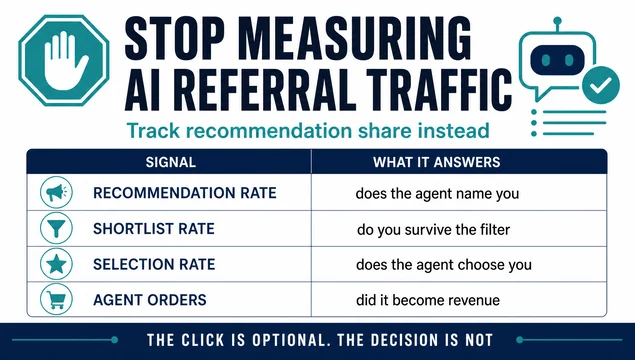
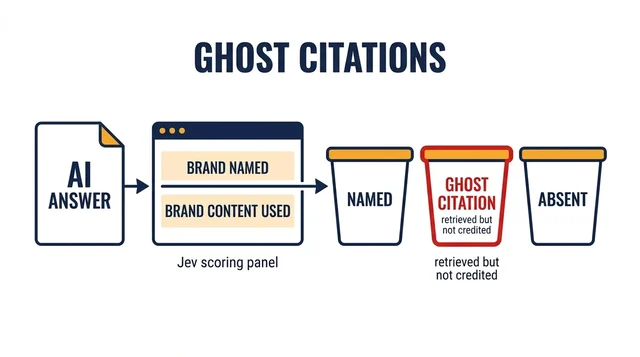
Confusing a mention with a sale. Being cited in an AI answer and being purchasable through an agent are different achievements. Track both.
Assuming access is permanent. Shopify, PayPal, and Expedia can change terms. Amazon already closed its door. Treat every open channel as open today, not open forever.
Writing for the agent and forgetting the human. Over-stuffed titles that read like spec sheets hurt conversion on the human path, which still carries most of your revenue.
Quick checklist
- [ ] Titles lead with product type, not brand
- [ ] Product type and category fields are filled
- [ ] Descriptions contain at least five concrete attributes
- [ ] Variants exist as purchasable options with their own stock
- [ ] Product schema is present and matches the visible page
- [ ] robots.txt does not block buyer-sending agents
- [ ] At least one agent-capable payment method is live
- [ ] Agent-originated orders are logged, even at zero
FAQ
Is Muse free? There is a free tier with a usage limit. Meta's product page states that if you reach the free limit you can upgrade to a paid subscription or wait for it to refresh. Paid tiers are reported at $20/month for Power and $100/month for Maximum.
Where is Muse available? The United States at launch, for users 18 and over, on iOS, Android, web, and WhatsApp. Meta has said AI glasses support is planned.
Does Muse replace Google for shopping? Not yet, and probably not soon. It adds a discovery layer alongside search, social, and marketplaces. The practical question is whether you are reachable in that layer, not whether it replaces the others.
Can I pay to rank higher in Muse? There is no published paid placement for Muse recommendations. Treat any offer to guarantee placement as unverified.
Is Muse safe to let shop with my card? That is a consumer decision, not a brand one. Meta says Muse cannot see your card details and uses a one-time card number for checkout, and it asks for approval before purchases. A security researcher did find and report a macOS vulnerability in September 2026, which Meta patched quickly.
What should I do first? Check whether an agent can complete a purchase from you at all. That is a one-hour question with a binary answer, and it determines whether the rest of the work can pay off.
Auspia's view
Muse is the clearest signal yet that AI visibility is splitting into two jobs. The first is being understood: clean data, real content, corroborating evidence. The second is being reachable: an agent that can actually complete the transaction.
Most brands are working hard on the first and have never checked the second. The ones that check both will be the ones that show up when a buyer hands the decision to an agent.
Author: Adrian Cole, Analyst of 1,000+ AI Search Results at Auspia. Adrian writes about how brands appear in ChatGPT, Perplexity, Gemini, Google AI Overviews, and agent-driven answer surfaces.