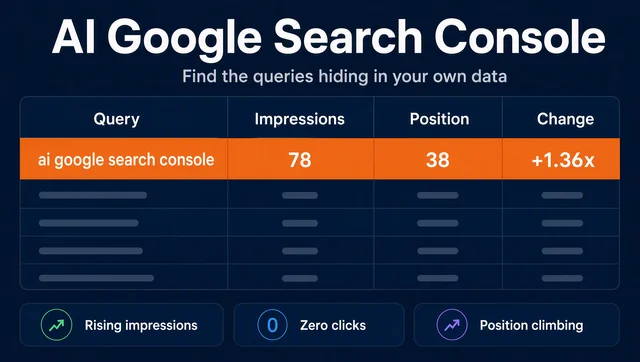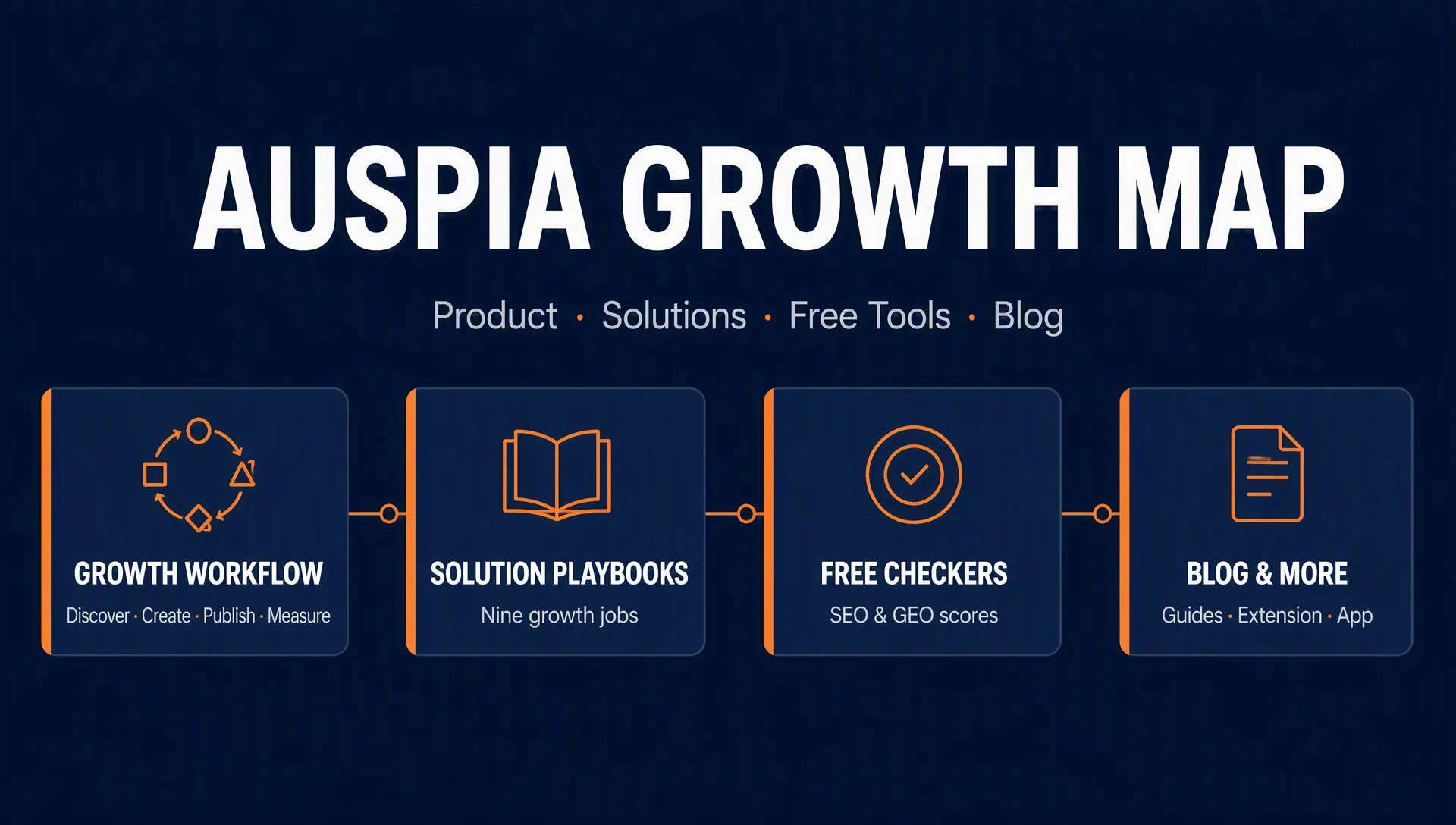
Watch the 90-second walkthrough above. The video tours the whole site with narration and subtitles — the five-step growth workflow, the nine solution playbooks, the free checkers, and how each page links to the next. Read on for the same map in detail, or jump to the section you came for.
What Auspia is in one paragraph
Auspia is a growth platform for SEO, GEO, and AI search visibility with three layers: a single five-step workflow that carries an opportunity from discovery to published, maintained content; nine solution playbooks that cover the specific jobs that block traffic growth; and a stack of free checkers that score any public URL before you commit to changes. The map below walks through all of it — every page in the navigation, grouped by what it does, so you can open what fits your next week. Start at the Auspia homepage if you are entirely new, then follow the groups in order.
At a glance:
- Product — one workflow: discover, ground, create, publish, measure.
- Solutions — nine playbooks for the jobs that matter most.
- Tools — free checkers for scores, audits, and crawler access.
- Resources — the blog, the extensions, and the app.
The growth workflow: discover, ground, create, publish, measure
The product pages follow the order of the work itself. You never skip from a raw keyword to a published page — each step hands off a reviewable artifact to the next.
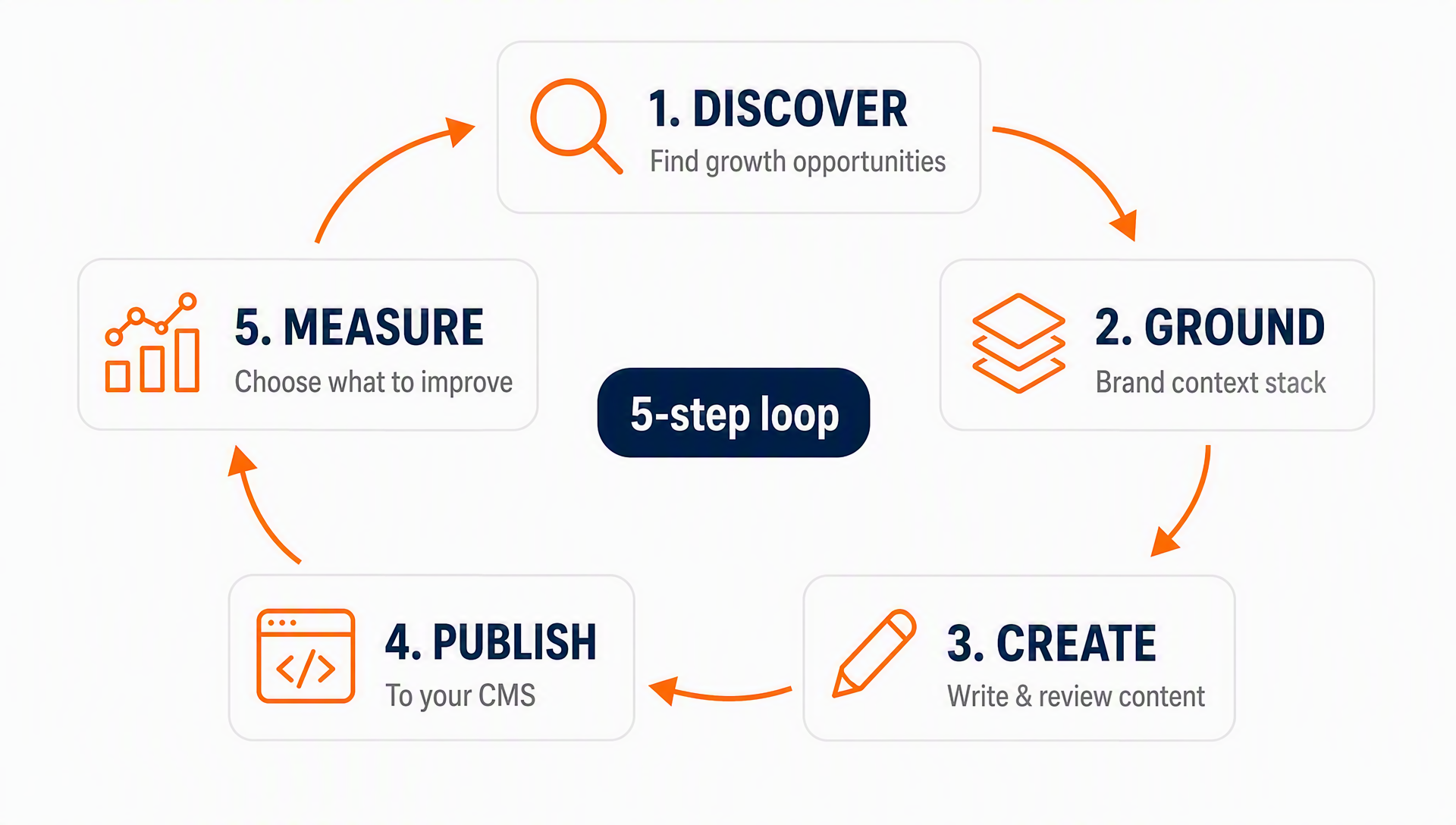
- Auspia Growth Workflow: Discover, Create, Publish, Improve — the whole loop on one page: how opportunities become content and how published work feeds the next decision.
- Find SEO Growth Opportunities — use keyword, competitor, and site signals to choose the next reviewable opportunity instead of chasing volume.
- Give AI Content Real Brand Context — build a Context Stack of product information, competitor context, and crawl findings so every AI-assisted draft is grounded before it is drafted.
- Create and Review SEO Content — create, edit, preview, review, and organize content from a defined growth opportunity, with the review gate before anything ships.
- Publish Reviewed Content to Your CMS — publish reviewed content to a verified CMS target and connect eligible post-publish workflows.
- Measure SEO Content and Choose What to Improve — bring traffic, visitor, page, event, content, and search signals together to choose the next improvement, not just the next article.
The loop only works when each handoff is explicit: an opportunity becomes a grounded brief, the brief becomes a reviewed draft, the draft becomes a published page, and the published page becomes evidence for the next decision. Content operations is the playbook for making that loop repeatable.
Nine solution playbooks, one per growth job
The solutions pages define a problem precisely, then give you the workflow and tools that solve it. Choose the one that matches the bottleneck you are looking at.
- SEO Automation and AI Search Growth Solutions — the full index of solutions; start here if you are not sure which job to take first.
- Build a Repeatable Traffic Growth System — a connected system for deciding, creating, publishing, and learning from SEO and AI search growth work.
- SEO Automation With Human Review — automate repeatable handoffs while keeping strategy, factual review, editorial approval, and release ownership human-led.
- Find the SEO Work Worth Doing Next — turn keyword demand, existing-page gaps, competitor movement, and changing search behavior into clear actions.
- Content Operations for Useful, Maintained Public Pages — a reliable lifecycle from a useful idea through review, publishing, and maintenance.
- Competitive Growth Monitoring for Deliberate SEO Action — turn recurring competitor changes into context and deliberate action instead of reactive copying.
- Make AI Search Visibility Work Actionable — turn broad questions about AI search visibility into reviewable improvements to public information, clarity, evidence, and access.
- GEO for Clear, Evidence-Backed Public Information — improve public pages as clear, accessible, evidence-backed source material for people and AI search systems.
- Make Your Website Usable in Agent-Assisted Work — prepare public product, documentation, and support information for customers researching, comparing, and implementing with AI agents.
A few of these are adjacent: SEO automation is about the handoff process, opportunity intelligence is about picking the work, and competitive monitoring feeds both. Most teams pick one per quarter and run it with the free checkers first.
Free checkers: score any page without an account
The tools hub links all the free checkers. Each one takes a public URL or pasted text and returns a score plus the specific things to fix.
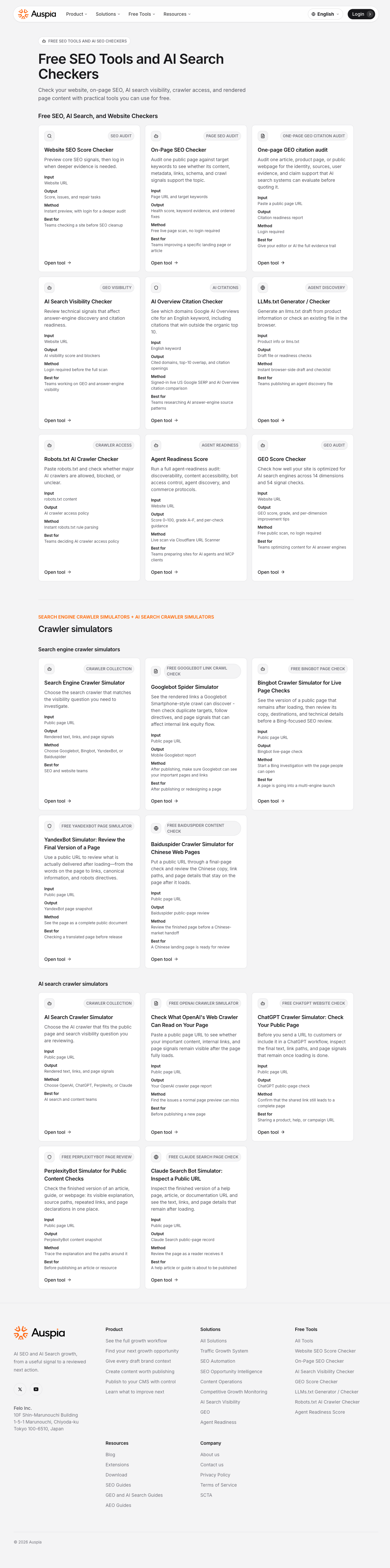
- Free Website SEO Score Checker — a site-level score with priority issues, plus the option to run a full Auspia audit when you are ready.
- Free On-Page SEO Checker & Page Audit — keyword coverage, title tags, headings, links, schema, and crawl health for any public URL, with clear fixes and no login.
- AI Search Visibility Checker — the technical signals that affect AI answer-engine discovery, content readability, and citation readiness.
- GEO Score Checker — Free Generative Engine Optimization Audit — 54 signals across 14 dimensions, compressed into one GEO score: how ready your page is to be understood and cited by generative engines.
- LLMs.txt Generator / Checker — generate a clean llms.txt draft from product information or check an existing one for AI agent readability, canonical links, and citation guidance.
- Robots.txt AI Crawler Checker — paste your robots.txt and see whether OAI-SearchBot, GPTBot, ClaudeBot, Google-Extended, PerplexityBot, and other AI crawler tokens are allowed, blocked, or unclear.
- Agent Readiness Score Checker — Free AEO Audit Tool — 18 AI agent standards including MCP, A2A, OAuth, and robots.txt, scored for free.
The useful sequence is: run the on-page audit on the page you care about, check crawler access and llms.txt if agents matter, then use the GEO score to see where the page stands for generative engines. Everything is public; nothing needs an account.
Where the growth thinking lives — and how to take Auspia with you
- Auspia Blog: SEO, GEO, AEO & AI Search Growth Guides — daily insights on SEO, GEO, AEO, and AI search: field experience, tool workflows, and growth experiments turned into practical guidance.
- SEO guides — technical SEO, keyword research, link building, and content planning explainers.
- GEO and AI search guides — citations, AI overviews, brand visibility in answer engines, and GEO measurement.
- AEO guides — answer engines, extractable content, FAQs, and agent-facing information.
- SEO Chrome Extension & AI Search Visibility — the SEO Inspector extension for page-level SEO and AI search signals while you browse.
- Download SEO App for Growth Insights — Auspia on iOS: check growth data, follow ongoing work, and keep decisions moving on the go.
Which page should you open first?
If you want to... | Open this page |
|---|---|
Check one URL fast | |
See your visibility for AI searches | |
Understand why your site is where it is | |
Confirm agents can actually read your site | Robots.txt AI Crawler Checker and LLMs.txt Generator / Checker |
Get one number for generative engine readiness | |
Start a repeatable growth program | |
Learn as you grow | The blog |
FAQ
Are the Auspia checkers really free?
Yes. The score checkers, the on-page audit, the GEO score, the robots.txt checker, and the llms.txt generator all run on any public URL without an account.
What is the difference between an SEO score and a GEO score?
The website SEO score measures quality and priority issues across a site — titles, headings, links, schema, crawl health. The GEO score measures how ready public information is for generative engines: 54 signals across 14 dimensions such as clarity, evidence, and access. One optimizes classic search; the other optimizes for AI answers and agent users.
Does Auspia replace my CMS?
No. The workflow publishes reviewed content into a verified CMS target of yours. The product owns the decision-and-review loop; your CMS stays your publishing system.
Where should a new user start?
Run the on-page audit and the GEO score on your most important page, then read the traffic growth system playbook to see how the fix becomes part of an ongoing loop.
Author: Caleb Brooks, SaaS SEO Strategist for 100+ Product-Led Pages at Auspia. Caleb writes about product-led SEO, growth workflows, and how the pieces of a growth system fit together.