Most AI agent launches in 2026 have been variations on the same idea: a chat window that can call tools. Grok Bot, which SpaceXAI shipped on August 12, 2026, is built on a different premise. Each Bot runs on a persistent cloud computer with its own browser, filesystem, and terminal, and every Bot on your account shares that machine's login state. That single architectural choice is what makes it interesting for SEO and GEO work, and it is also what makes it dangerous to hand over carelessly.
This is a capability assessment, not a news brief. I looked at the official product pages and documentation, then at how practitioners are actually using it for search work in the first six weeks after launch. The goal is to answer one question clearly: for a growth team doing SEO and GEO, which jobs does Grok Bot genuinely make easier, and which jobs should stay with a different tool?
The short answer
Grok Bot is a strong fit for logged-in, multi-surface, recurring visibility work. This is the kind of job where you need to open Google Search Console, check how ChatGPT answers a buyer question, look at a competitor's pricing page, and repeat that on a schedule. It is a weak fit for anything that needs a guaranteed deterministic result, a hard audit trail, or a change you cannot undo.
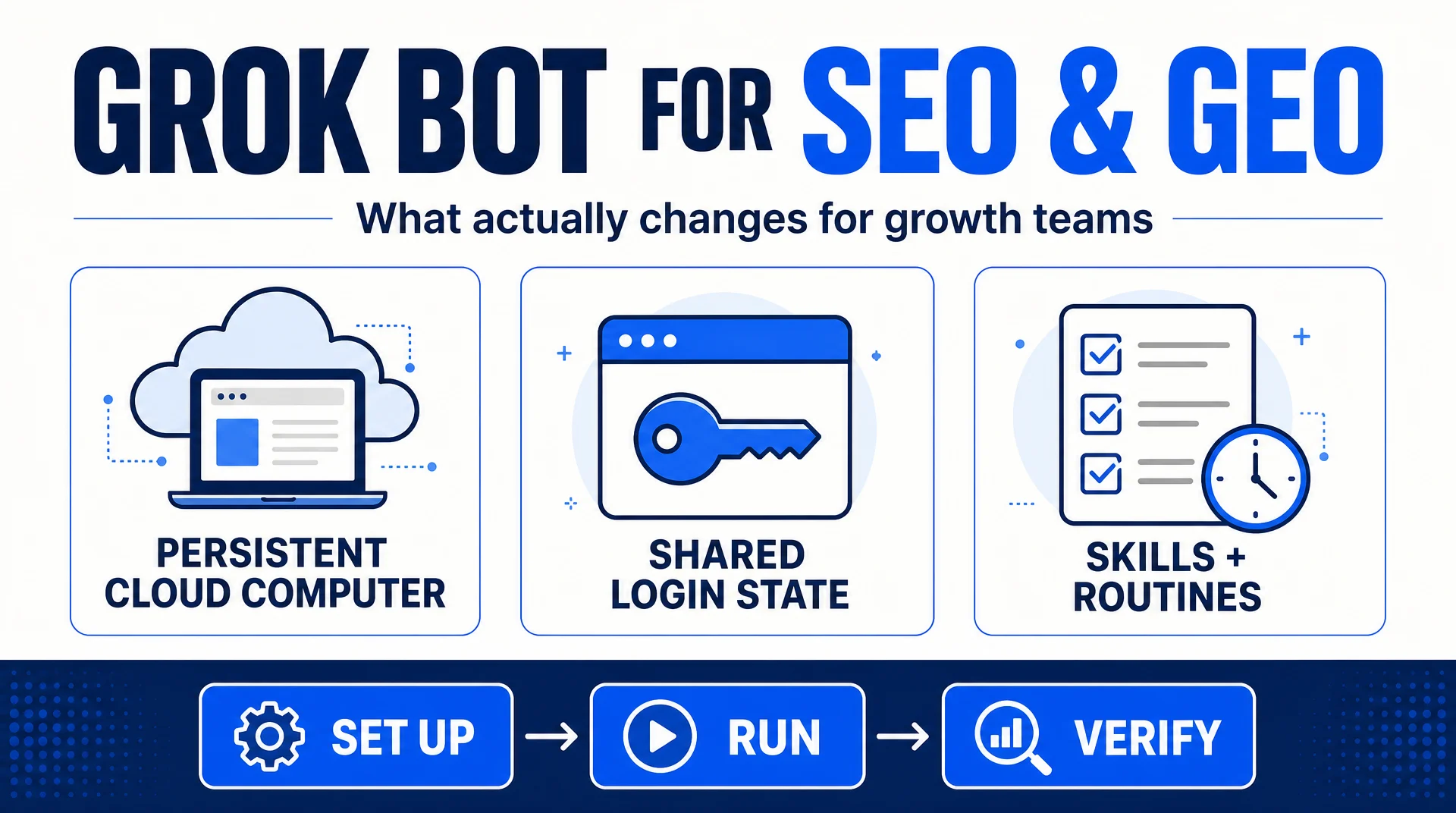
Three properties drive that conclusion:
Property | What it means | Why it matters for SEO/GEO |
|---|---|---|
Persistent cloud computer | Each Bot has a browser, filesystem, and terminal that keep running when your laptop is closed | Recurring checks actually run on schedule instead of only when you are at your desk |
Shared login state | Every Bot on your account shares one cloud machine, so sessions and files carry across Bots | You log into Search Console, GA4, or an AI platform once; the Bot can then work inside it |
Skills and routines | A skill is a saved procedure; a routine runs it on a schedule or an event | A weekly GEO prompt check becomes a saved asset, not a prompt you retype |
Everything below is a consequence of those three properties.
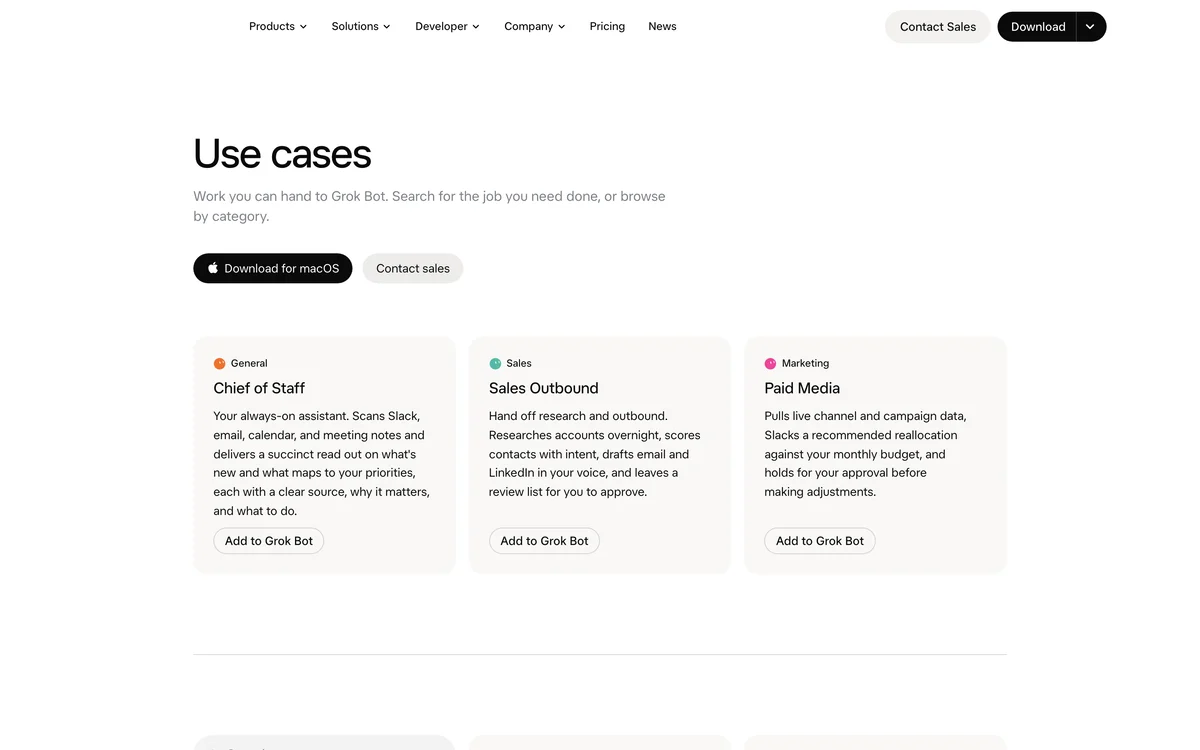
The Grok Bot landing page positions the product around finished work rather than chat. Source: x.ai/bot, captured September 23, 2026.
Where the persistent computer changes the job
The official documentation is explicit that a Bot works on a persistent cloud computer rather than inside a chat window. In practice that means a task can keep running after you close the app, and the Bot comes back to you only when it needs approval or hits a step that requires a human.
For SEO and GEO, that changes three specific jobs.
Recurring visibility checks become real. A weekly check of how four AI answer surfaces describe your brand is a boring, repetitive task that humans skip. A routine that runs it every Monday and writes the result to a file does not skip. The Grok Bot guides page lists marketing workflows that research competitors, draft positioning, and open pull requests, which is a fair signal of the intended shape of the work.
Logged-in surfaces stop being a barrier. This is the part most agent tools cannot do well. Search Console, GA4, and several AI answer surfaces all require a session. Because the Bots share one cloud machine, a single login carries across every Bot you run. You are not re-authenticating for each task.
Multi-step research stops being a copy-paste relay. A task like "pull this week's underperforming pages from Search Console, check which ones are cited in AI answers, and draft a refresh list" crosses two or three tools. On a persistent machine with a shared filesystem, the intermediate files stay put between steps.
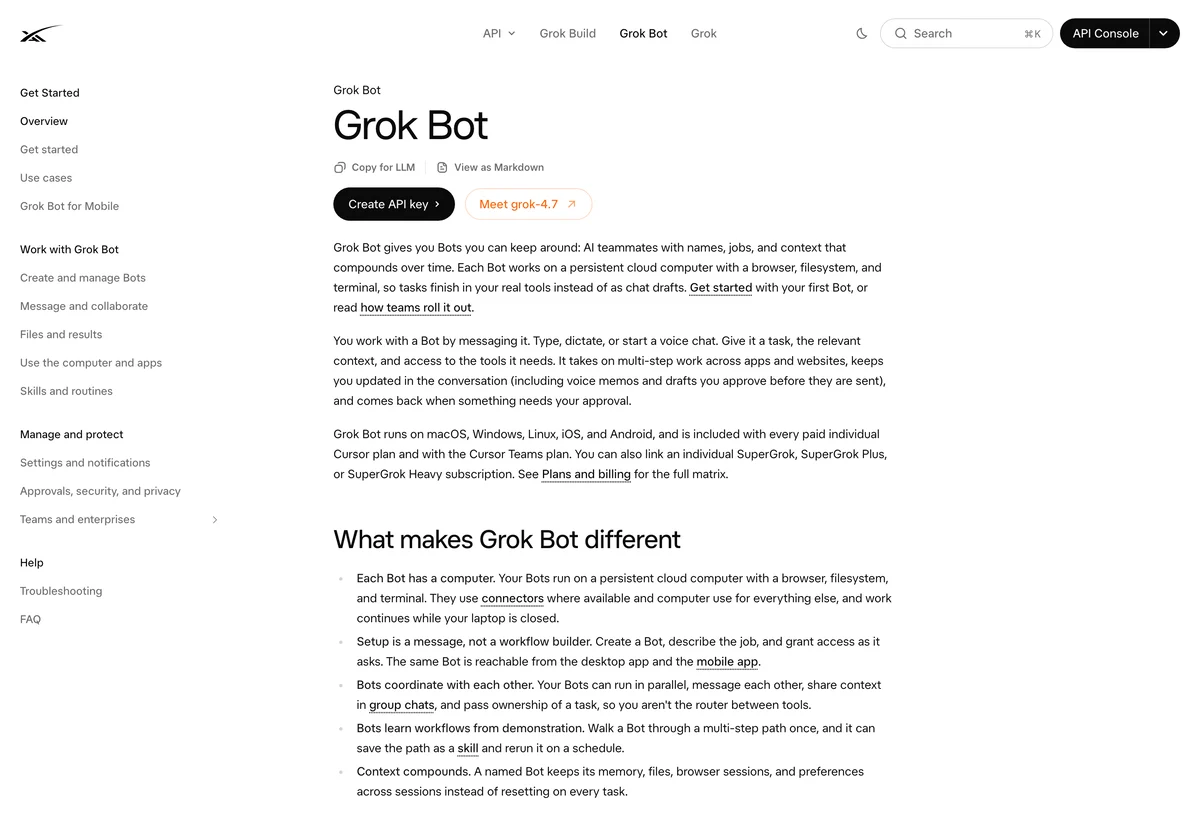
The official documentation describes each Bot as having its own browser, filesystem, and terminal on a persistent machine. Source: docs.x.ai/grok-bot/overview, captured September 23, 2026.
Where it does not change anything
A lot of the launch coverage implied that Grok Bot replaces an SEO stack. It does not, and the practitioners closest to the tool are the ones saying so.
It does not replace your data sources. Grok Bot reads Search Console, GA4, or a rank tracker. It does not become them. If your measurement is wrong at the source, the Bot will confidently summarize wrong numbers faster.
It does not guarantee a repeatable output. Agent runs vary. A prompt that produced a clean schema audit on Monday can produce a slightly different structure on Tuesday. That is fine for research and drafting, and unacceptable for anything you publish without review.
It does not make irreversible changes safe. The product has an auto-review switch that can ask you before an action runs, and the documentation describes approval flows. Treat that as a safety net, not a substitute for your own gate. Publishing, sending, spending, and deploying should stay behind human approval no matter what the tool offers.
One practitioner on X reported the honest version of this in the first week: Grok 4.7 "got stuck 3 times on a simple LLM SEO optimisation task" on the Cursor cloud runtime. Reliability is improving, but you should plan for a Bot that occasionally stalls and needs a nudge.
What practitioners are actually doing with it
The most-shared Grok Bot SEO post in the launch window came from an account selling a growth service, so read it with that in mind. It laid out five prompts: extract your business and competitors, generate Google Business Profile posts, find competitor content gaps, run a schema audit that outputs JSON-LD, and list high-intent local keywords. The structure is sound. The "outrank your local business in 60 days" framing is not something the tool guarantees.
More useful are the quieter reports. One user pointed a fresh SEO Bot at a single site and reported that it was "already pulling the homepage and running the audit" without setup ceremony. Another described running eight Bots as a small team. A third described the most advanced pattern: a front-door agent that routes work and owns the irreversible gate, with Codex, Claude Code, and Gemini running as workers underneath it. That last pattern is the one worth studying, because it treats Grok Bot as a coordinator rather than a replacement.
The most detailed public framework came from a marketing platform that published seven Bot roles (Google Ads, Meta Ads, creative, SEO, GEO, tracking, and operations) plus eighteen operating notes. Two ideas from that framework are worth keeping regardless of the vendor's commercial interest:
- One Bot, one job. Each Bot has its own memory. Mixing SEO and paid ads in one Bot muddies both.
- Skills carry thresholds, exceptions, and proof rules. A skill file is not a prompt. It is a short operating document that says when to act, when not to, and how to verify.
That second idea is the most transferable thing to come out of the launch, and it is the subject of a separate article in this series.
The honest limits
Limit | What it looks like in practice | What to do |
|---|---|---|
Variable output | Structure and depth shift between runs | Review anything that leaves your team |
Occasional stalls | A run hangs on a heavy task | Keep tasks small; check in on long routines |
Cost at scale | Per-seat pricing plus weekly quotas, then on-demand | Start with one seat and one recurring job |
Access risk | A shared machine holds live sessions | Use a dedicated account, never a personal one |
No native SEO data | It reads your tools, it is not a rank tracker | Keep your measurement stack authoritative |
The access risk deserves emphasis. Because all Bots share one cloud machine, anything on that machine is reachable by every Bot you run. Isolation between users is strict, but isolation between your own Bots is not. If you would not give a contractor the login, do not put it on the shared machine.
How this fits an existing SEO and GEO stack
If you already run an agentic SEO setup, Grok Bot is best understood as the logged-in layer. It is the part that can sit inside a session and look at what a real user sees.
A practical division of labor looks like this:
- Your data stack (Search Console, GA4, a rank tracker, an AI visibility tool) stays the source of truth.
- Grok Bot handles the logged-in, multi-surface, recurring checks that no API exposes cleanly.
- A code agent (Codex, Claude Code) handles repository changes, because those need diffs, review, and rollback.
- A human owns anything irreversible.
That is the same four-layer model we laid out in our agentic SEO guide, with Grok Bot filling the layer that needs a live session.
What to do this week
- Pick one recurring job. A weekly check of how AI answers describe your brand is the best first candidate.
- Create a dedicated account for the shared machine. Do not attach personal logins.
- Write the job as a skill, with a threshold, an exception list, and a proof rule.
- Run it read-only for two weeks before you let it change anything.
- Verify the output against your own data at least once, so you know the Bot is reading the right source.
If you want a starting point for step three, the skills and routines framework in this series gives you a fill-in template.
FAQ
Is Grok Bot free? It is included with paid Cursor plans and can be linked to SuperGrok subscriptions. There is a weekly usage allowance, and usage beyond it can move to on-demand billing depending on your settings. Check current pricing on the official product page before you commit a team.
Can Grok Bot replace an SEO tool? No. It reads your tools and works inside them. It does not provide ranking data, backlink indexes, or crawl infrastructure of its own.
Is it safe to log into Search Console with it? Use a dedicated account with scoped access rather than an owner account. Because Bots share one machine, treat every credential on that machine as available to every Bot you run.
Does it work for GEO, not just SEO? It is arguably a better fit for GEO, because AI answer surfaces are logged-in, visual, and change often. Those are exactly the conditions where a persistent browser helps.
What is the single biggest mistake teams make? Letting a Bot take an irreversible action before anyone has verified that it reads the right data. Run read-only first.
Author: Jasper Quinn, AI Search Product Researcher Tracking 60+ Feature Changes at Auspia. Jasper writes about AI search product updates, agent behavior, and how new tools change the day-to-day work of SEO and GEO teams.