Do not publish another article until you know why the current site is invisible
A no-traffic site does not always need more content. It may need a clearer offer page, a crawlable page, a real answer to a real problem, internal links, or simply enough time and measurement to see what exists.
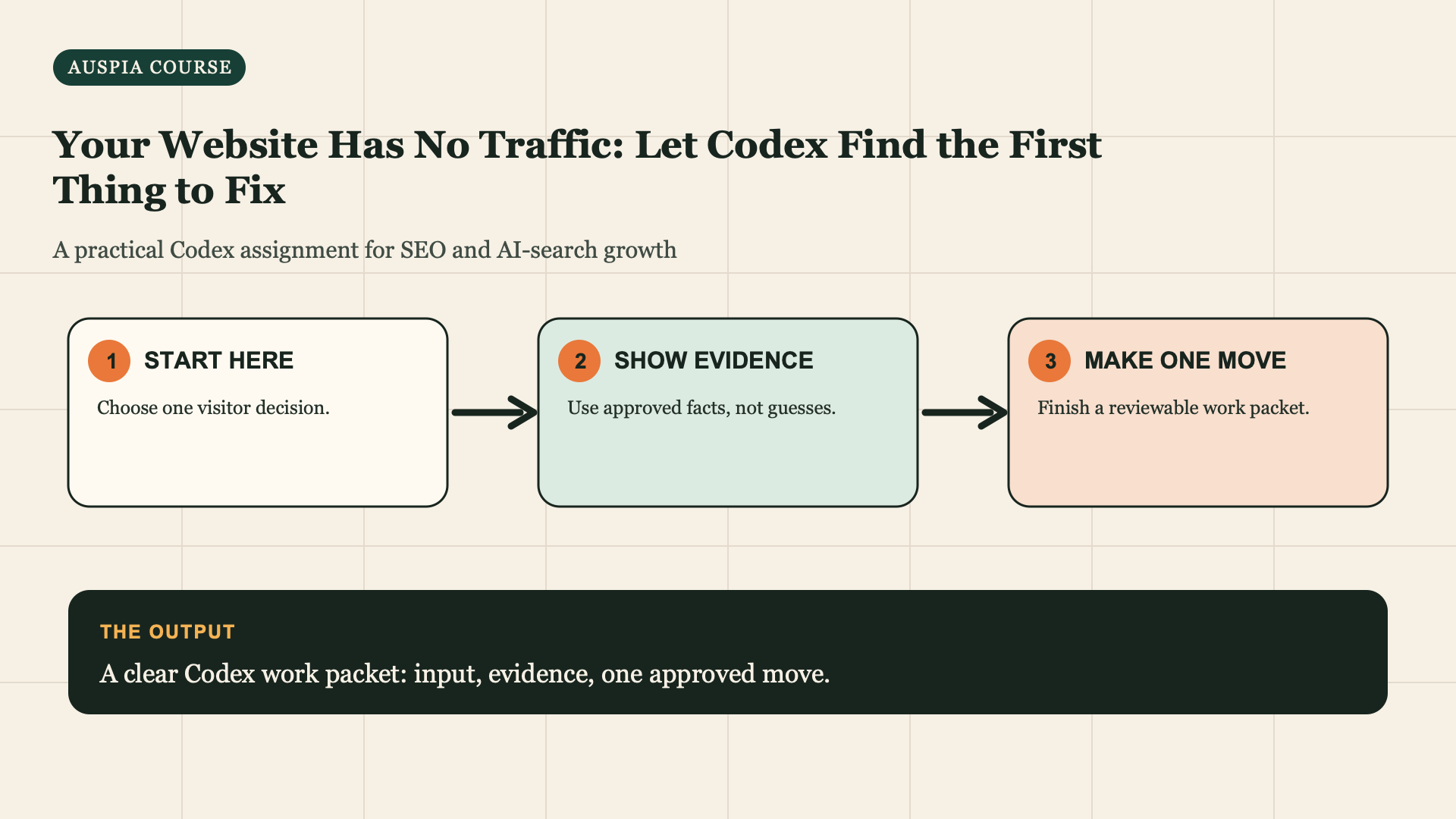
This lesson gives Codex one job: create a Traffic Recovery Card. It identifies the first problem worth fixing and shows the evidence behind that choice. It does not produce a giant audit, touch production, or pretend it knows your rankings without data.
Definition of done: You have one named page or site issue, evidence that supports it, a repair brief, and a next route to the shared Traffic Mission lesson.
Allow 30 to 45 minutes. Bring a public homepage URL, one page you care about, and a one-sentence description of the visitor action. A Search Console export helps but is optional; do not wait for perfect analytics to start.
Give Codex the minimum evidence it needs
Make a small evidence folder, not a giant audit
You do not need to buy an SEO tool or grant access to an account for this lesson. Make a folder named traffic-recovery and add only what you can see or export safely:
traffic-recovery/
  growth-start-card.md
  homepage-notes.md
  important-page-url.txt
  gsc-pages-last-28-days.csv        (optional)
  gsc-queries-last-28-days.csv      (optional)
  owner-brief.md
For homepage-notes.md, paste the visible heading, the first paragraph, the main offer, and the call to action. Do not copy private analytics, customer lists, passwords, or anything you would not want in a writing project.
Here is the running example used in this lesson:
Site: example-bookkeeping.co.uk
Important page: /bookkeeping-for-designers
Visible heading: Calm bookkeeping for creative people
Visible CTA: Get in touch
Owner statement: We offer monthly bookkeeping and a discovery call. We do not
file tax returns. We can work remotely across the UK.
GSC export: none yet
This is enough to find a first visible problem. It is not enough to claim that Google has not indexed the site, that the page ranks poorly, or that visitors bounce. Those must stay in the unknown column.
Quality check: Your folder contains a URL and one business boundary. If it contains a dozen reports but no clear visitor action, stop and write the owner statement first.
If you have Search Console: export one completed date range, not today's partial numbers. Add the page and query exports as evidence. If you do not have it, finish the lesson anyway; later you can return with better data.
Provide your public home-page URL and, if possible, one page you care about. If you have Google Search Console exports, attach them, but do not delay this lesson to configure analytics.
You are my no-traffic website diagnostician.

Read my Growth Start Card:
[paste it or provide local path]

Public site: [URL]
Important page, if any: [URL or NONE]
Optional evidence I own: [GSC export path, crawl report path, or NONE]
What I sell or want visitors to do: [one sentence]

Inspect public pages and the local evidence I supplied only. Do not log in,
request credentials, edit files, submit URLs, modify robots.txt, publish,
deploy, or create content.

Create a Traffic Recovery Card with:
1. WHAT IS VISIBLE: up to five facts with URL evidence.
2. WHAT IS UNKNOWN: traffic, indexing, rankings, or setup facts you cannot verify.
3. FIRST RECOVERY PRIORITY: choose only one of PAGE CLARITY, TECHNICAL
   FINDABILITY, CONTENT GAP, INTERNAL CONNECTION, or TRUST/FACT GAP.
4. THE PAGE OR ASSET TO FIX FIRST and why it has priority.
5. A SMALL REPAIR BRIEF: goal, required owner facts, proposed change, and a
   check to run after approval.
6. WHAT NOT TO DO YET: three actions that would waste effort.

Use plain English. Do not call anything broken unless evidence supports it.
Read the card before you let Codex recommend a fix
A useful recovery card separates three things that beginners often mix up:
What Codex says | What it means | What you do next |
|---|---|---|
| It is on the supplied public page or export | Check the cited URL or row yourself |
| It needs owner access, data, or a crawl check | Collect it later; do not let Codex guess |
| The first small repair most likely to clarify the next move | Approve a narrow repair brief |
For the bookkeeping example, the recovery card might say:
VISIBLE: The main service page says "Calm bookkeeping for creative people"
but does not name the type of creative worker, the service boundary, what
happens after contact, or a specific decision it helps with.

UNKNOWN: Search impressions, index status, rankings, pricing, and form
completion rate.

FIRST RECOVERY PRIORITY: PAGE CLARITY.

FIRST REPAIR: Improve /bookkeeping-for-designers so a freelance designer can
tell whether monthly bookkeeping fits their situation and what a discovery
call covers.
That is a good first result. It does not promise traffic. It gives you a page you can make more useful before creating five articles around an unclear offer.
Reject the two diagnoses that waste the most time
The first bad diagnosis is a generic list: fix technical SEO, add schema, write ten blogs, get backlinks. It is not a diagnosis because it has no evidence, no sequence, and no single page to improve.
The second is a confident technical claim without a test: Google cannot crawl your website. A public page loading in a browser does not prove crawlability; neither does the absence of traffic data prove a crawl problem.
Use this repair prompt whenever either happens:
Your diagnosis makes a claim I cannot verify. Rebuild the Traffic Recovery
Card using only a visible URL element or a supplied export row as evidence.
Keep all crawl, indexing, traffic, and ranking conclusions in UNKNOWN unless
the evidence proves them. Choose one priority and one page or asset only.
How to choose between the five priorities
Priority | Choose it when | First repair usually looks like |
|---|---|---|
Page clarity | Visitors cannot tell who the page is for or what it solves | Rewrite one offer/service page around a concrete decision |
Technical findability | Public evidence or supplied reports show a crawl/index/canonical problem | Produce a narrow technical repair brief for review |
Content gap | The offer is clear but no page addresses a searchable customer problem | Plan one first traffic page |
Internal connection | Good pages exist but they do not lead to each other or the offer | Add contextual routes from support content to key pages |
Trust/fact gap | Critical facts, proof, policies, author/service details are absent or conflict | Build the missing fact/proof block before promotion |
The point is not to diagnose the whole site today. A local plumber with no visible service area may need a trust/fact repair before a keyword list. A SaaS site with good product pages but no use-case explanation may need one content gap page. Codex must pick one.
Reject a bad diagnosis
Bad: Your SEO is poor. Add more keywords and backlinks.
Good: The service page names a service but does not identify the homeowner situation it solves, the service area, or a booking path. Improve this page before writing articles because it is the page a qualified visitor must trust.
If Codex gives you a long checklist, reply: Reduce this to one recovery priority and one repair brief. Show the page evidence that makes it first.
Approve the repair brief, not a surprise edit
Before any change, make Codex turn the card into a short approval request:
Using the approved Traffic Recovery Card, prepare a repair plan for only
[page or issue]. Show the exact proposed copy, file diff, or configuration
change; the evidence it relies on; how to test it; and how to roll it back.
Do not make the change until I approve the plan.
You may discover that the repair is content, technical, or trust-related. That is useful. The next shared lesson stops the work from drifting by turning the recovery finding into one Traffic Mission.
What a repair brief should contain
For page clarity, the result should read like a small change request. It might ask to replace a vague opening with a statement of audience and service scope, add a short "what happens on a discovery call" section, link to a deadline checklist when it exists, and replace Get in touch with an honest action such as Check whether monthly bookkeeping fits your records.
For a technical findability priority, do not let Codex edit a configuration. The brief should identify the exact URL or file, the evidence source, the proposed change, the owner who must approve it, a test, and a rollback. For example, a supplied crawl report may show a page returning a 404. The brief can propose a redirect destination for review; it must not create the redirect.
For a trust/fact gap, the brief can request a confirmed service-area statement or updated policy. It cannot decide which legal, price, availability, or eligibility claim is true.
Before approving any change, answer these four questions in writing:
- What customer decision becomes easier after this change?
- What sentence, setting, or link will actually change?
- Which owner fact makes it safe to change?
- How will I check the visible page after publishing?
If you cannot answer question two, the card is still advice, not a repair.
Save a before state
Take a browser screenshot or save the current page text before editing. Record the URL and date in traffic-recovery/release-note.md. This is not bureaucracy. When you later look at a metric or a customer question, you need to know what changed rather than relying on memory.
Course map
Next: Choose the One Traffic Mission That Makes Every SEO Decision Easier.
If your main issue is inaccurate AI answers rather than ordinary organic visibility, use Make Codex Show You What AI Search Gets Wrong About Your Business.
Completion check
- [ ] Codex named one priority rather than listing every SEO tactic.
- [ ] The card separates visible evidence from unknowns.
- [ ] I have one page or asset to repair first.
- [ ] No change happens without a reviewed repair plan.
- [ ] I saved the visible evidence and unknowns in
traffic-recovery/. - [ ] I can name the customer decision the first repair will improve.
- [ ] I saved a before state before asking anyone to make the repair.
Author: Julian Mercer, 14-Year Technical SEO Practitioner at Auspia. Julian writes about finding the smallest technical or page-level repair that unlocks the next growth step.
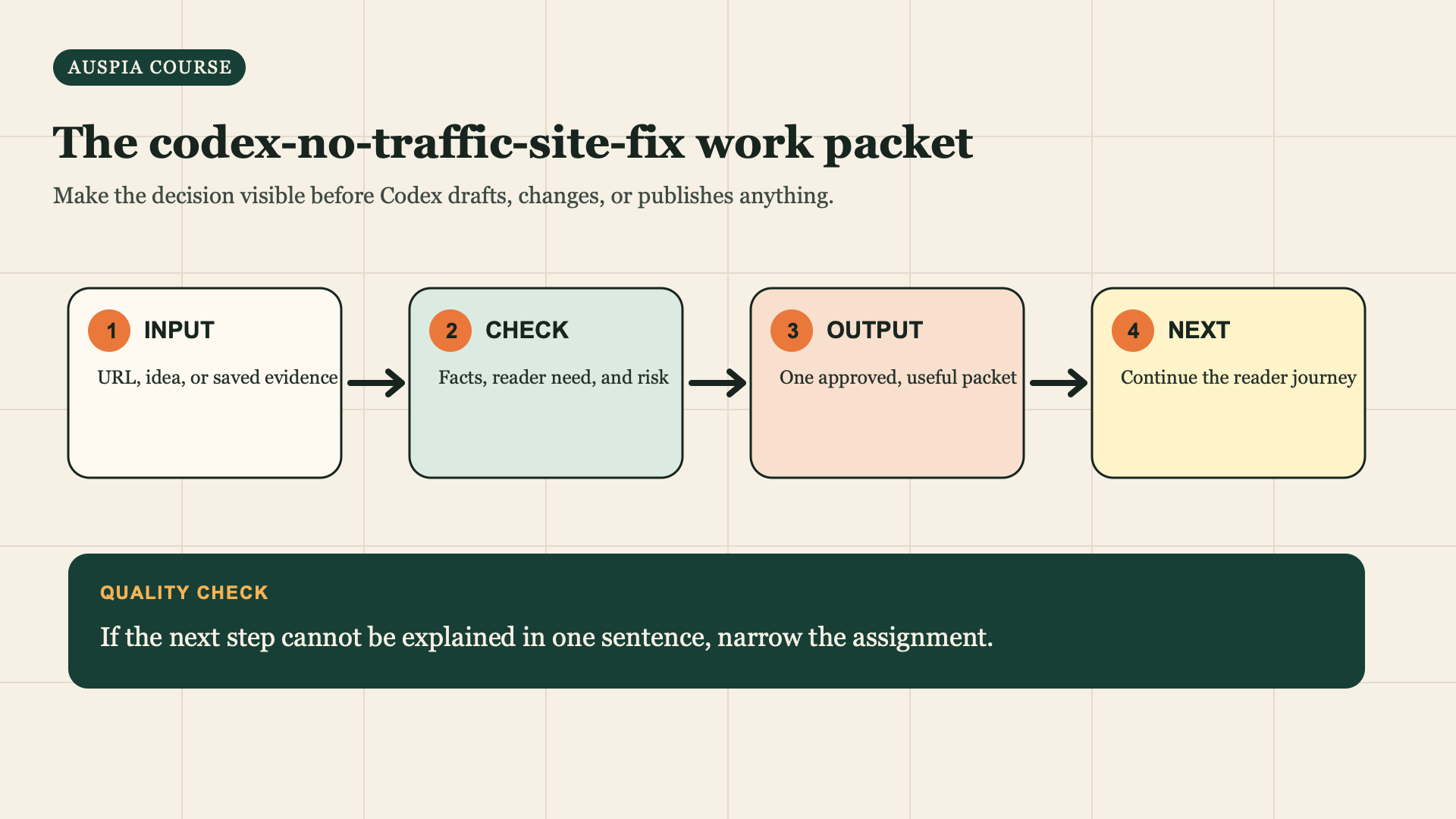
Use this sequence for the assignment: start with a real input, check the evidence, prepare one reviewable output, then choose the reader next step.