Build one reason a relevant person would reference you
Good pages need proof beyond their own wording. The useful way to earn that proof is not to ask strangers for backlinks. It is to make one small resource, explanation, or contribution that a relevant customer, partner, publisher, or community can honestly use.
In this lesson, Codex will turn material you already control into one Trust Opportunity Packet. It will not send email, make accounts, add listings, offer payment, or publish anything. You choose whether the packet is worth using.
Your finished result: one useful asset idea, a source-backed evidence packet, five target criteria, a tailored draft message or submission note, and a follow-up log. The asset must still be useful if nobody links to it.
Use this when: you have a site, a first page or small topic cluster, and some real knowledge, process, product detail, local knowledge, or customer help you can document. Allow 45-75 minutes. Bring your Fact Pack, Traffic Mission, a page list, and an owner who can approve public claims. You do not need an outreach tool or a list of websites.
Start with an asset, never a target list
Imagine a small bookkeeping service for freelance designers. Its useful starting asset is not "a backlink request." It is a short, accurate records-before-self-assessment checklist: what to gather, which items need checking, what the service can organize, and the fact that it does not file a personal tax return. A local creative-business group could share it because it helps its members. The service page can link to it because it sets honest expectations.
Write this small input file before opening Codex:
trust-input.md
Business: Northstar Books, monthly bookkeeping for UK freelance designers.
Reader: a designer with disorganised records before self-assessment.
Useful controlled material: onboarding checklist; approved service scope;
tax-return exclusion; discovery-call process.
Existing useful page: /before-self-assessment-bookkeeping-checklist
Possible audiences: freelance-design communities, accountant referral partners,
local creative-business programmes.
Not approved: customer names, outcome claims, tax advice, paid placements.
The input is deliberately modest. Do not write that you are "the leading" anything, paste a keyword list, or ask Codex to discover contacts by guessing. You are telling it what can be checked.
The asset-selection test
An asset earns attention because it reduces a real reader's work. Run each idea through this table before you prepare a message.
Question | Keep the idea when | Reject or change it when |
|---|---|---|
Useful alone | A visitor can complete a decision or task with it | It is only an advert wrapped in a PDF |
Specific to you | It uses a controlled process, evidence, or experience | A competitor can make the identical thing from generic web copy |
Safe to claim | Every material statement has an owner or source | It needs a testimonial, statistic, or legal claim you cannot prove |
Relevant audience | A real publisher or partner serves the same reader | The only reason to contact them is their domain metric |
Maintainable | You can update it when a controlled fact changes | It will quietly become wrong next month |
For the bookkeeping example, a generic article called "Why bookkeeping matters" fails the first two tests. The dated checklist passes if its inclusion and exclusion lines come from the Fact Pack. A "2026 tax deadlines" graphic fails unless the business has approved, current source material and someone owns the future update.
Ask Codex for three evidence-bound options
Copy this prompt and attach trust-input.md, the Fact Pack, and the relevant page or draft. Replace only the bracketed paths.
Read [trust-input.md], [fact-pack.md], [traffic-mission.md], and [page list or
topic map]. We need one trust opportunity that helps a real reader before it
helps our visibility.

Propose exactly three small owned assets. For each show:
1. the reader problem it solves;
2. the controlled facts or source files required;
3. a one-sentence useful result for the reader;
4. target types that would have a genuine reason to use it;
5. what makes it different from generic SEO content;
6. risks, missing owner facts, and update responsibility.

Score each idea 1-5 for usefulness, proof available, audience fit, and
maintenance. Recommend one only if it has no unsupported critical claim.
Then create trust-opportunity-packet.md for the recommended idea. Do not search
for private contacts, scrape sites, create accounts, submit forms, send email,
offer compensation, invent statistics, or publish a page.
What a reviewable answer looks like
A strong recommendation is concrete:
Asset: Freelance Designer Records-Preparation Checklist
Reader result: arrive at a bookkeeping discovery call knowing which records to
collect and which service boundary to confirm.
Evidence: onboarding-checklist-v3.pdf; service-scope-approved.md; terms.md.
Good target types: freelancer-resource libraries; design-business programmes;
accountant partners who do not provide monthly bookkeeping.
Missing fact: owner must approve whether the checklist applies outside the UK.
A weak answer says: "Create an ultimate guide and pitch high-authority blogs." It identifies neither a reader need nor proof. Ask Codex to repair it:
This proposal is a link tactic, not a useful asset. Remove domain-authority
language and generic guide ideas. Rebuild it around a specific reader task,
named controlled evidence, an audience who benefits, and a maintenance owner.
Mark every missing fact instead of filling it in.
Turn the winner into a Trust Opportunity Packet
Open the recommended packet and make sure it has these six parts. This is the artifact you approve, not an email blast.
Packet part | What you should see | Your quality check |
|---|---|---|
Asset promise | One narrow reader outcome | Could a reader explain why it exists in one sentence? |
Evidence register | Claim, exact source, status | Does every meaningful claim point to something you own? |
Public-page plan | Existing page or a new, useful page | Does it benefit your own visitor before any external mention? |
Target criteria | 3-5 types, not a scraped list | Would their audience actually need this resource? |
Tailored angle | Why this exact audience might care | Does it name their reader rather than praise their site? |
Follow-up log | date, owner, status, response, next step | Can you stop after a respectful follow-up? |
For example, the target criterion is not "sites with DR 60+." It is: "a freelance design organisation that already maintains practical business resources for UK members and does not present itself as a tax adviser." That criterion helps a human choose carefully and prevents irrelevant outreach.
Prepare the public asset before you mention it
Do not tell anyone about a resource that only exists as a sentence in a spreadsheet. First ask Codex for a change sheet or repository diff, using the normal Publishing Gate. Use this prompt after you approve the packet:
Using the approved Trust Opportunity Packet and [fact-pack.md], prepare a
reviewable change sheet for [existing URL] or a new-page brief. Include the
exact page purpose, outline, every factual claim with its source, internal
links, title suggestion, update owner, and release checks. Do not edit the CMS,
deploy, add structured data, submit URLs, or contact anyone. Stop at the
change sheet and flag missing owner facts.
If your page is in a repository, replace "change sheet" with "proposed diff" and require a file list. The human owner approves the copy, facts, and release. Only after the page is live and checked should you consider the tailored draft.
Review the message like it might be published publicly
The message should be short, honest, and easy to decline. It should say what you made, why it may be relevant to their audience, and where the evidence or resource can be reviewed. It must not pretend you are a customer, conceal a commercial relationship, promise a reciprocal link, or pressure a recipient.
Example of a safe shape:
Hello [name], we created a short records-preparation checklist for UK freelance
designers who are deciding whether monthly bookkeeping help fits their
situation. It includes the service boundary and a source-backed checklist.
Because your [resource area] helps designers run their business, I thought it
could be useful to review. If it is not a fit, no action is needed.
This is a draft for a person to send, not an instruction for Codex to send it. Before approving it, check each answer: Is the asset already public and useful? Does this recipient serve the exact reader? Is every claim in the message supported? Would you be comfortable seeing it on a public forum? If any answer is no, change the asset or do not send.
Record outcomes without turning them into a vanity score
In your log, no reply, not relevant, shared, requested change, and needs follow-up are all useful results. They reveal whether the asset, target fit, or claim needs work. Do not manufacture a positive outcome through paid placements, fake reviews, automated accounts, or mass templates. A small, well-matched resource that receives no mention can still improve your own page and teach you which proof your audience values.
If no one can verify a claim, add NEEDS OWNER FACT to the packet and do not publish that line. If no relevant audience exists, keep the resource for your site and move to a different trust opportunity later. The correct recovery is better evidence, not a bigger list.
Completion check and next lesson
- [ ] My asset solves one reader problem without requiring a link.
- [ ] Every important public claim has a controlled source or owner approval.
- [ ] I have target criteria, not a scraped database.
- [ ] Codex prepared a packet and draft; a human controls any send, account, or submission.
- [ ] The public page has passed the Publishing Gate.
Your next job is to stop collecting random ideas and use your evidence to pick one useful action each week: Build a Weekly Codex Growth Loop That Always Knows What to Do Next.
Author: Naomi Ellis, Brand Mention Analyst Across 20k+ Visibility Signals at Auspia. Naomi writes about earning relevant proof rather than collecting empty placements.
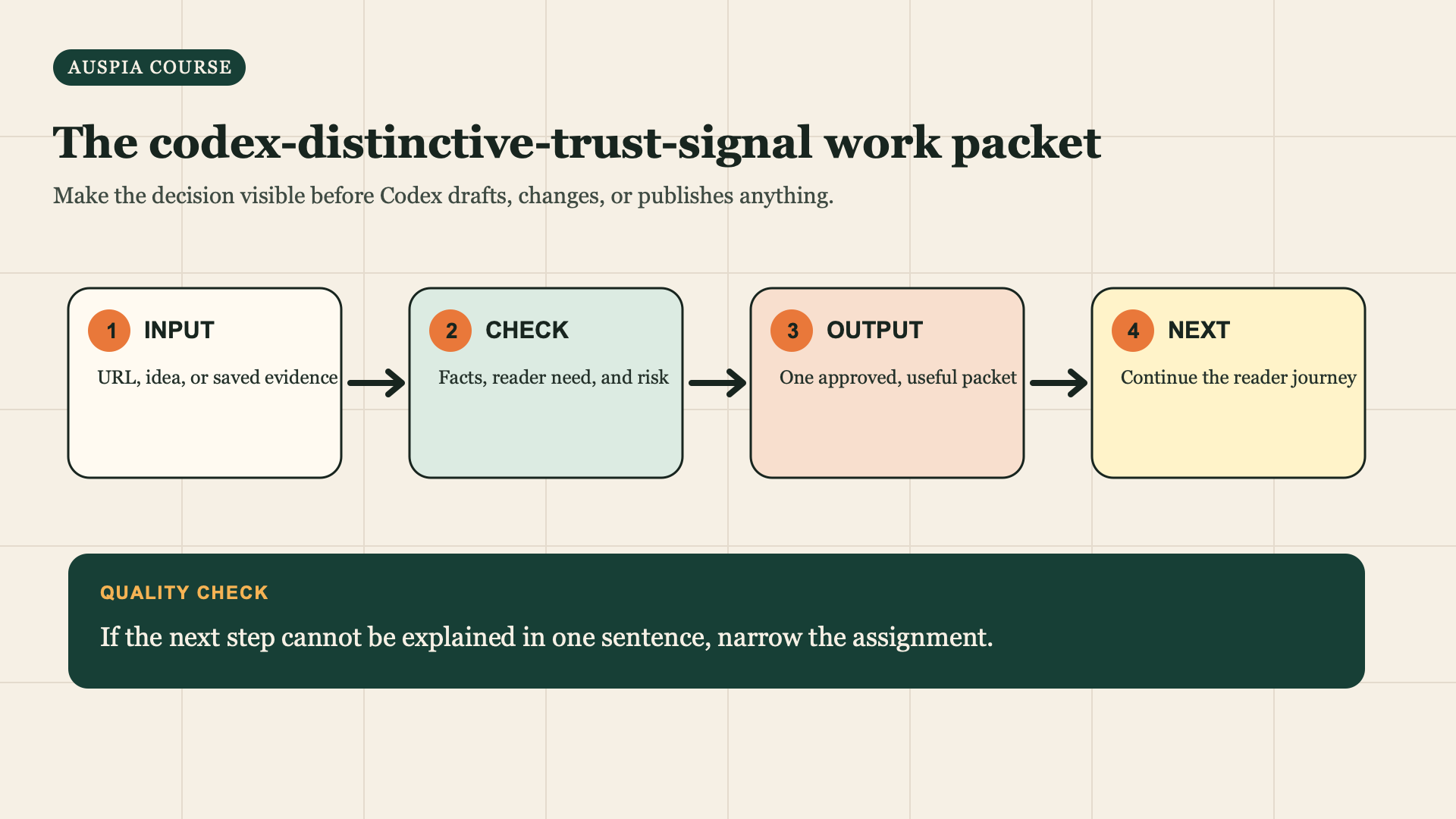
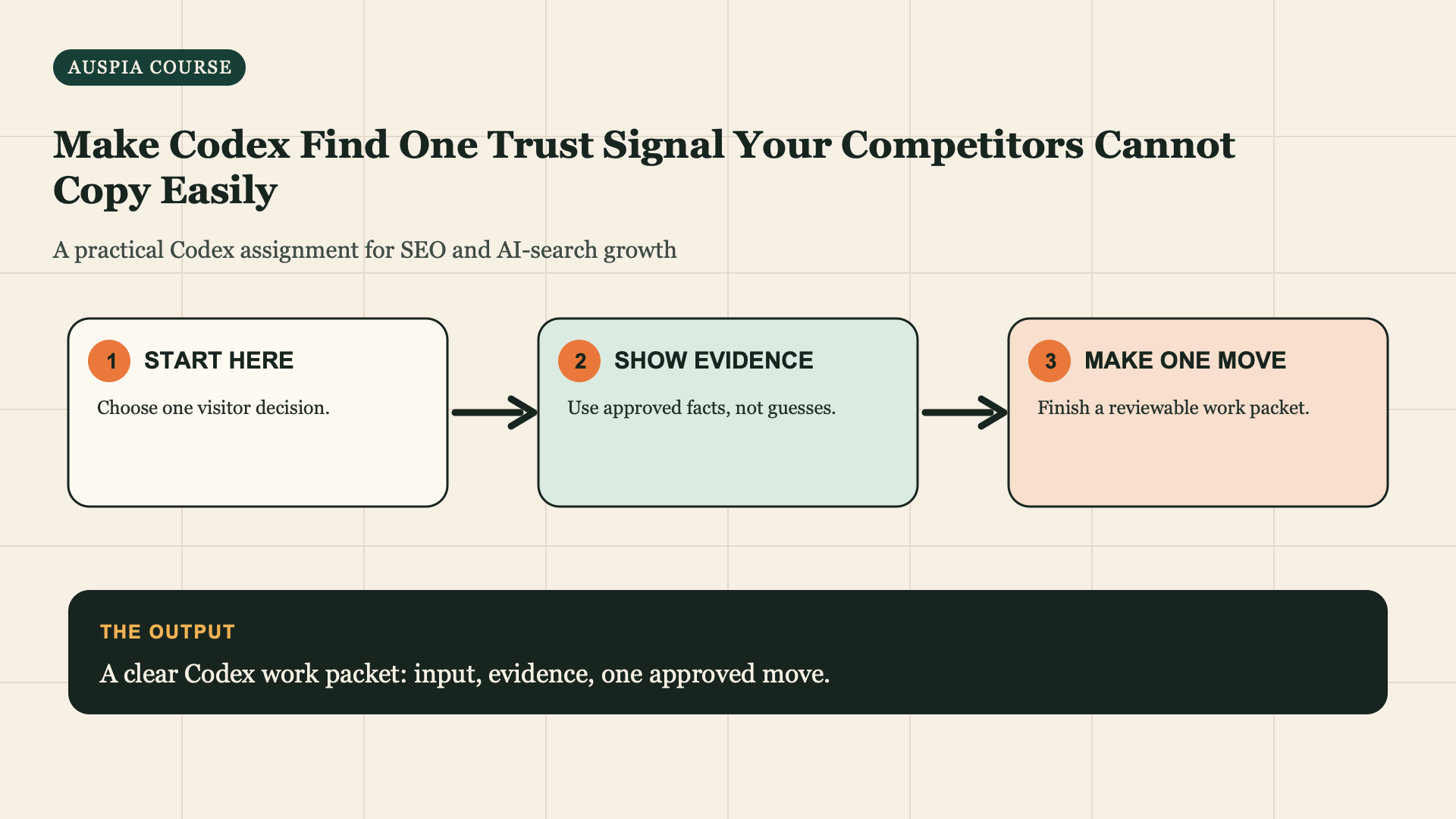
Use this sequence for the assignment: start with a real input, check the evidence, prepare one reviewable output, then choose the reader next step.