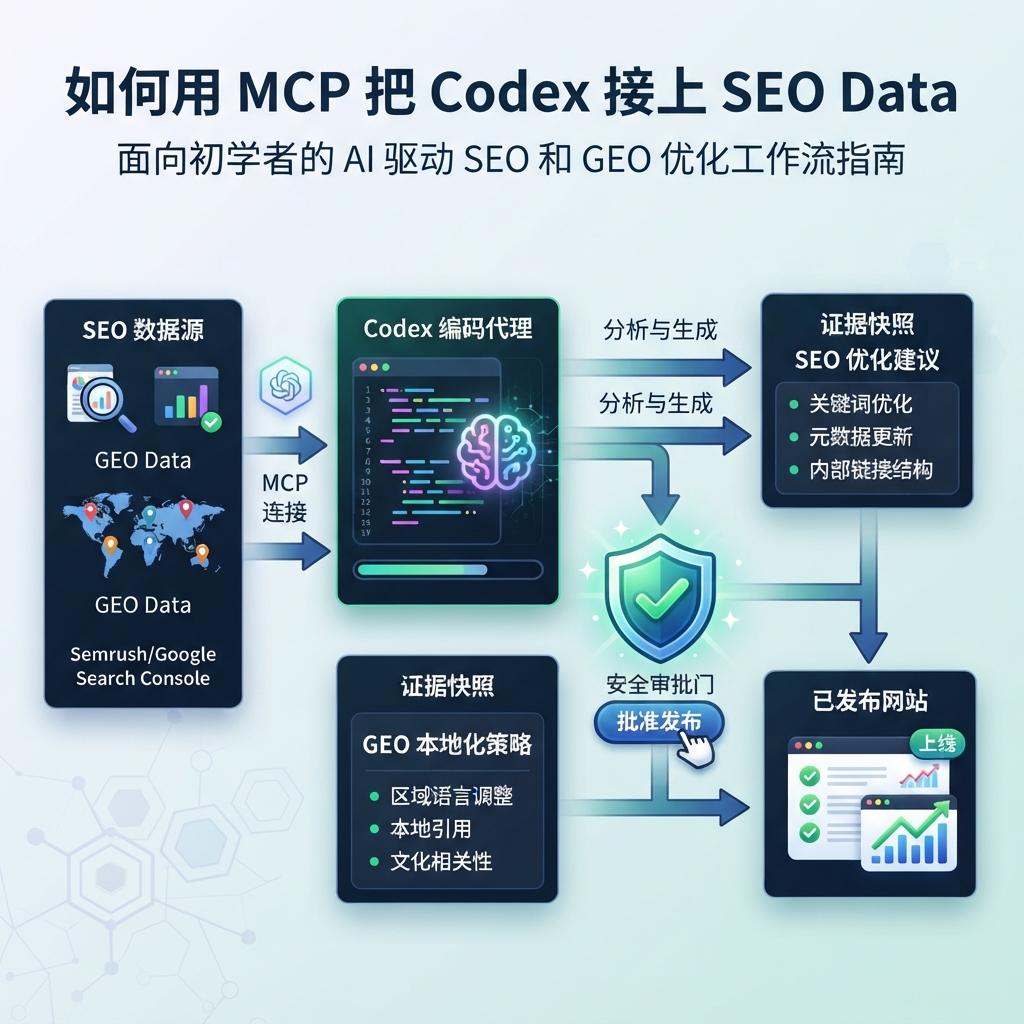
Codex MCP data loop:read-only connectors、normalized snapshots、evidence tables 与 action queue。
实用设定
Codex 不应该靠贴上的 screenshots 和记忆做 SEO decisions。它应该读 source data:GSC exports、Bing Webmaster data、GA4 landing-page reports、keyword exports、SERP API results,以及 GEO prompt observations。MCP 是把 Codex 接到 external tools 与 context 的方式之一,而且不用每次都 copy-paste。
对初学者最安全的 pattern 是 staged:
- 从 CSV exports 开始。
- 加入 read-only scripts。
- 为可重复 data access 加入 MCP connectors。
- 保持 write actions blocked。
Codex MCP documentation 展示了这个 workflow 使用的 connector layer,用于 read-only SEO/GEO data access。
选对 data path
Method | Best for | Pros | Watch out |
|---|---|---|---|
CSV export | First setup、小团队 | Easy、auditable、不需要 connector work | Manual refresh |
Local script | 可重复 API pulls | Versioned、testable | 需要 API handling |
MCP server | 持续 tool access | Codex 可以 query structured context | 必须 scope permissions |
Browser check | Rendered page evidence | 显示 users 与 crawlers 看到的内容 | 不适合 bulk analytics |
MCP 应用于可重复的 read access。不要给 daily monitor 权限去 publish、submit URLs、change account settings 或 edit production files。
先建立 source map
接线前,先建立 seo/data-map.md:
# SEO/GEO Data Map

| Source | Access method | File or tool | What it proves | Write access? |
| --- | --- | --- | --- | --- |
| Google Search Console | export/API | gsc-queries.csv | queries, impressions, CTR | no |
| Bing Webmaster Tools | export/API | bing-pages.csv | Bing clicks and crawl hints | no |
| GA4 | export/API | ga4-landing-pages.csv | engagement and conversion | no |
| SERP API | API | serp-snapshots.json | ranked URLs and SERP features | no |
| AI search API | API | geo-answer-snapshots.json | citations and brand mentions | no |
这份 data map 会让 Codex 知道每个 source 能证明什么,也能提醒它不要把不同 data types 混在一起。
要求 Codex 安全地设计 connector
Design a read-only SEO data connector plan for this workspace.
Use AGENTS.md and seo/data-map.md.
For each data source, specify:
- access method
- minimum required permission
- output file schema
- refresh cadence
- validation step
- risks
Do not write connector code until I approve the plan.
这段 prompt 的重点,是先要 plan,不要先写 connector code。尤其当牵涉 GSC、Bing、GA4 或付费 API keys 时,permission scope 应该先被写清楚。
分析前先 normalize
Raw API responses 很难比较。请 Codex 先写 normalized snapshot schema:
Field | Meaning |
|---|---|
| GSC、Bing、GA4、DataForSEO、SERP API、Felo Search、Perplexity |
| pull date |
| exact query or AI prompt |
| page you care about |
| clicks、impressions、position、citation、mention、rank |
| numeric or boolean value |
| result/citation URL when available |
| high、medium、low |
| raw response path |
Prompt:
Normalize these SEO and GEO exports into seo/snapshots/YYYY-MM-DD-normalized.csv.
Keep source labels visible. Do not merge GSC performance with AI citation observations.
Flag missing data and partial API responses in seo/data-quality-log.md.
Example analysis request
Using the normalized snapshot, identify SEO/GEO opportunities for the next seven days.
Group by page.
For each recommendation, include:
- source data
- affected URL
- whether this is SEO, GEO, conversion, or technical
- confidence
- action type: create, refresh, link, monitor, technical ticket, ignore
Do not write final copy or edit production files.
Report 应该包含什么
## SEO/GEO Data Opportunity Report

Date:
Sources used:
Sources missing:

## Page opportunities
| URL | Signal | Evidence | Interpretation | Recommended action | Approval |
| --- | --- | --- | --- | --- | --- |

## Data quality notes
- stale exports
- missing markets
- failed API calls
- low confidence observations

## Action queue candidates
这份 report 的重点,是把 recommendation 连回 evidence。没有 evidence 的建议,只能放进 observation,不能直接进入 action queue。
常见错误
- 把所有 APIs 当成可互换。GSC、Bing、GA4、SERP APIs 与 AI answer APIs 证明的是不同事情。
- 把 write permissions 给 read-only monitoring workflow。
- 把 AI answer citations 当成 classic rank positions 来比较。
- 因为一次 noisy data pull 就删除或 rewrite pages。
- Summary raw API responses,却没有保存原始资料。
FAQ
第一天就需要 MCP 吗?
不需要。CSV exports 足以建立第一个 workflow。当同一个 data pull 每周或每天重复时,MCP 才会变得有用。
Codex 可以直接连 GSC 和 Bing 吗?
Codex 可以使用你提供的 scripts、MCP servers 或 exported files。除非你有另一套 approval workflow,否则保持 read-only access。
AI search APIs 和 classic SERP APIs 应该合成一个 score 吗?
一开始不要。先分开保存,再在 decision memo 里比较 patterns。
Codex SEO/GEO learning path
这篇文章是 Codex SEO/GEO operator series 的一部分。如果你要从零建立 workflow,建议照这个顺序读:
- 如何在 2026 年用 Codex 做自动化 GEO
- 如何用 Codex 做自动化 SEO
- 如何用 AGENTS.md 建立 Codex SEO Workspace
- 如何用 MCP 把 Codex 接上 SEO Data
- 2026 年最佳 Codex GEO Skill
- 如何建立 Codex Keyword Clustering Skill
- 如何用 Codex Subagents 做 SERP、内容与技术 SEO
- 如何用 Codex 修 Technical SEO 且不破坏 Production
- 如何用 Codex Automations 跑每日 SEO/GEO Monitoring
- Codex SEO/GEO Quality Gates:Diff、Evidence、Tests 与 Human Approval
下一步
- 上一篇:如何用 AGENTS.md 建立 Codex SEO Workspace
- 下一篇:2026 年最佳 Codex GEO Skill
- 相关:如何用 Codex Automations 跑每日 SEO/GEO Monitoring
Sources and notes
请以 OpenAI 官方 Codex documentation 作为 current syntax 与 product behavior 的准确来源:
- Codex CLI: https://developers.openai.com/codex/cli
- AGENTS.md: https://developers.openai.com/codex/guides/agents-md
- Codex Skills: https://developers.openai.com/codex/skills
- Codex MCP: https://developers.openai.com/codex/mcp
- Codex subagents: https://developers.openai.com/codex/subagents
- Codex configuration: https://developers.openai.com/codex/config-reference
Author: Camille Rhodes, Auspia 300+ AI Content Workflows 架构师。Camille 撰写 AI-assisted content systems、automation 与 growth teams 的 editorial quality control。