リフレッシュのルール
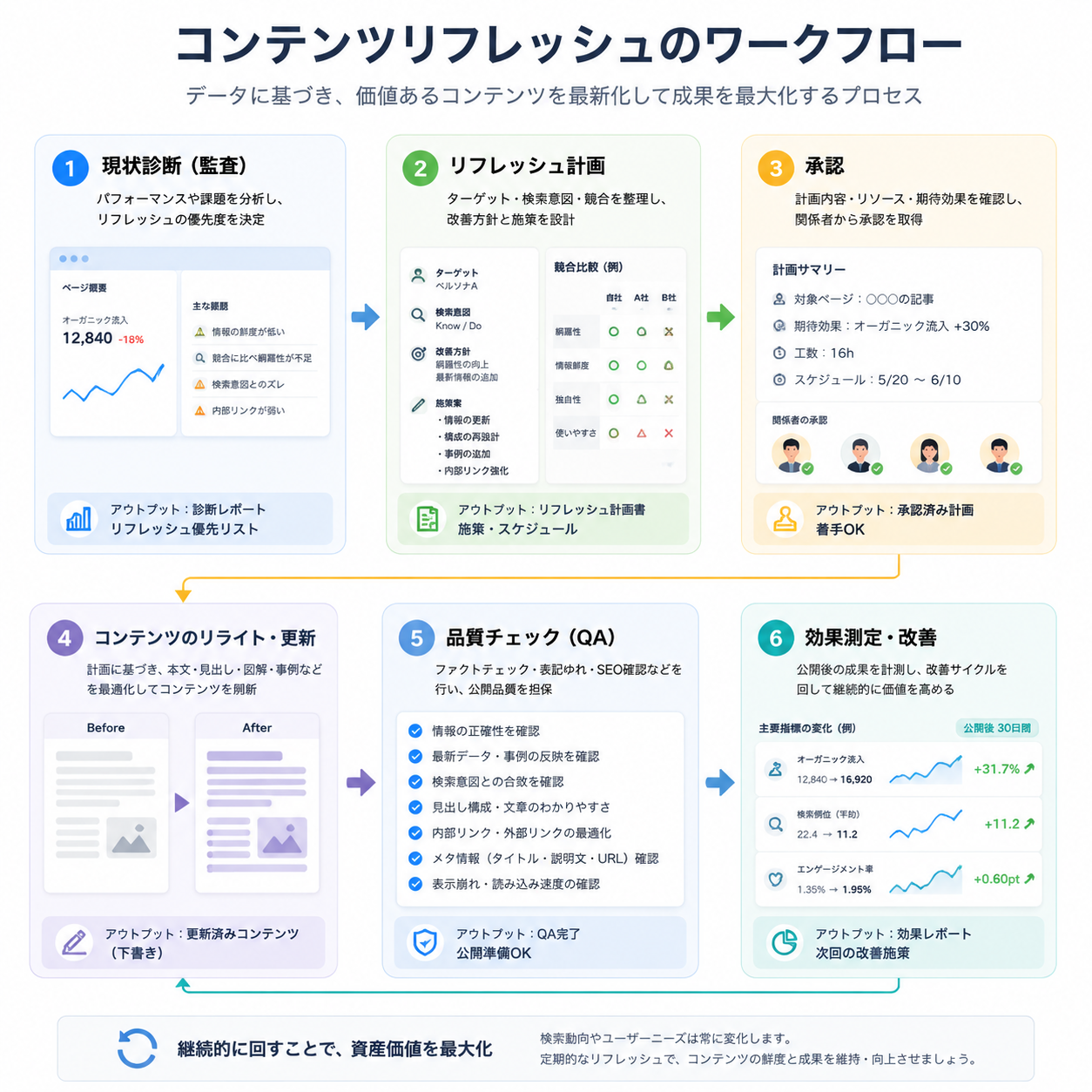
古い記事を最初に書き換えるよう Hermes に頼んではいけません。まず記事を診断させます。
良いコンテンツリフレッシュは根拠から始まります。Google Search Console の推移、GA4 の行動データ、クロールデータ、現在のページ構造、古くなった事実、不足している内部リンク、GEO プロンプトのギャップです。Hermes が何が壊れているかを理解すると、より良いタイトル、より明確な回答ブロック、新しい表、更新された根拠、強化された FAQ 回答、より良い内部リンク経路など、狙いを絞った更新を提案できます。
初心者向けのルールはシンプルです。先に診断し、次に書き換え、承認後にだけ公開します。
古い記事をリフレッシュすべきタイミング
すべての古いページに手を入れる必要はありません。Hermes を使って、リフレッシュが本当に意味を持つページを見つけます。
シグナル | 意味している可能性 | リフレッシュアクション |
|---|---|---|
表示回数が多く CTR が低い | ページは見えているがクリックを得られていない | title/meta をテストし、スニペットとの一致を改善する |
クリックが減っている | ページが古くなった、または意図が変わった可能性 | セクション、例、クエリカバー範囲を更新する |
掲載順位 4〜15 位 | 改善できる位置に近い | 意図一致と内部リンクを強化する |
オーガニック流入はあるがエンゲージメントが弱い | 訪問者は来ているが次の行動につながっていない | 導入、CTA、構造、ページの約束との一致を改善する |
AI プロンプトで競合が言及される | 自社ページに根拠や回答の明確さが足りない可能性 | 回答ブロック、証拠、比較、エンティティの明確化を追加する |
クロール問題やメタデータ不足 | 技術的問題がパフォーマンスを制限している可能性 | 承認後にメタデータまたは技術問題を修正する |
需要がなく、ビジネス関連性もなく、トピッククラスター内で有用な役割もないページは、むやみにリフレッシュしないでください。場合によっては、そのままにする、統合する、別のコンテンツ監査後に削除するほうが良いこともあります。
Step 1:リフレッシュ用ファイルを集める
ページごとに refresh フォルダを作ります。
/hermes-seo-agent
  /refresh
    /page-name
      current-article.md
      gsc-last-28-days.csv
      gsc-previous-28-days.csv
      ga4-landing-page.csv
      crawl-row.csv
      geo-prompt-gaps.csv
      refresh-plan.md
      qa-report.md
最低限のファイル:
ファイル | 内容 |
|---|---|
| 現在の記事本文またはエクスポートした Markdown |
| 直近期間のクエリ/ページデータ |
| 比較対象となる前期間のクエリ/ページデータ |
| 可能であればオーガニックセッション、エンゲージメント、キーイベント |
| ステータスコード、indexability、title、meta、canonical、文字数、inlinks |
| ページが不足、弱い、引用されない、不正確なプロンプト |
記事と GSC データだけしかない場合は、そこから始めて構いません。Hermes は不足分を missing として扱えます。
Step 2:書き換えではなく診断を依頼する
prompts/content-refresh-diagnosis.md を作成します。
You are diagnosing an old article for SEO and GEO refresh.

Read the files in /refresh/[page-name].

Do not rewrite the article yet.
Do not invent missing data.
If a file or metric is missing, write "missing".

Return:
1. Current page summary
2. Search performance diagnosis
3. Query changes from GSC
4. CTR issues
5. Ranking or impression shifts
6. GA4 engagement or conversion issues, if data exists
7. Crawl or metadata issues, if data exists
8. GEO prompt gaps
9. Sections to keep
10. Sections to update
11. Sections to remove or merge
12. New answer blocks needed
13. Internal links to add or review
14. Risk level
15. Approval needed before rewriting
有用な診断は、具体的な問題名を挙げます。弱い診断は「新鮮さのために記事を更新する」とだけ言います。その場合は根拠を求めてください。
例:
| Issue | Evidence | Likely cause | Action |
|---|---|---|---|
| CTR is low for "gsc ga4 dashboard" | 6,200 impressions, 1.1% CTR, position 5.8 | Title may promise a guide, but users likely want a template or dashboard example | Add template preview section and test a title with "dashboard template" |
| GEO prompt gap | Prompt "How do I connect GSC and GA4 for SEO reporting?" has no clear step list in article | Page explains concepts but not workflow | Add 6-step answer block |
Step 3:SEO 修正と GEO 修正を分ける
すべてを 1 つの曖昧なタスクに混ぜると、リフレッシュは失敗しやすくなります。Hermes に作業を分けさせます。
修正タイプ | 例 | 承認 |
|---|---|---|
SEO title/meta | 表示回数の多いクエリに合わせてタイトルを書き換える | 編集者または SEO 担当 |
検索意図セクション | 不足しているワークフロー、テンプレート、比較、例を追加する | 編集者 |
GEO 回答ブロック | 優先プロンプトへの直接回答を追加する | 編集者 |
根拠更新 | 最新データ、公式ソース、スクリーンショット、例を追加する | 編集者/ソースレビュー担当 |
内部リンク | ハブページからリフレッシュ記事へリンクする | SEO/編集 |
技術メタデータ | canonical、noindex、schema、クロール問題を修正する | 技術レビュー担当 |
プロンプト:
Split the refresh recommendations into SEO fixes and GEO fixes.

For each fix, include:
- Section affected
- Evidence
- Exact recommended change
- Expected SEO impact
- Expected GEO impact
- Risk level
- Approval owner

Do not combine unrelated fixes into one recommendation.
これにより更新内容をレビューしやすくなります。また、すでに機能しているページ部分を Hermes が書き換えてしまうことも防げます。
Step 4:リフレッシュ計画を作る
書き換える前に refresh-plan.md を作ります。
テンプレート:
# Content refresh plan

Page:
Current URL:
Primary goal:
Main SEO issue:
Main GEO issue:
Risk level:
Approval owner:

## Keep
| Section | Why keep it |
|---|---|

## Update
| Section | Problem | Change | Evidence |
|---|---|---|---|

## Add
| New section | Purpose | SEO role | GEO role |
|---|---|---|---|

## Remove or merge
| Section | Reason | Destination |
|---|---|---|

## Title/meta tests
| Current | Proposed | Reason |
|---|---|---|

## Internal links
| Source page | Target page | Anchor | Reason |
|---|---|---|---|

## Approval checklist
- [ ] Facts verified
- [ ] Sources checked
- [ ] No invented claims
- [ ] Technical changes reviewed
- [ ] Final draft approved
Hermes へのプロンプト:
Create refresh-plan.md for this page.

Use the diagnosis report.
Only recommend changes supported by evidence.
If a change is based on judgment rather than data, label it "editorial judgment".
Do not write the updated article yet.
この計画は、下書き前に承認されるべきです。
Step 5:GEO 回答ブロックを追加する
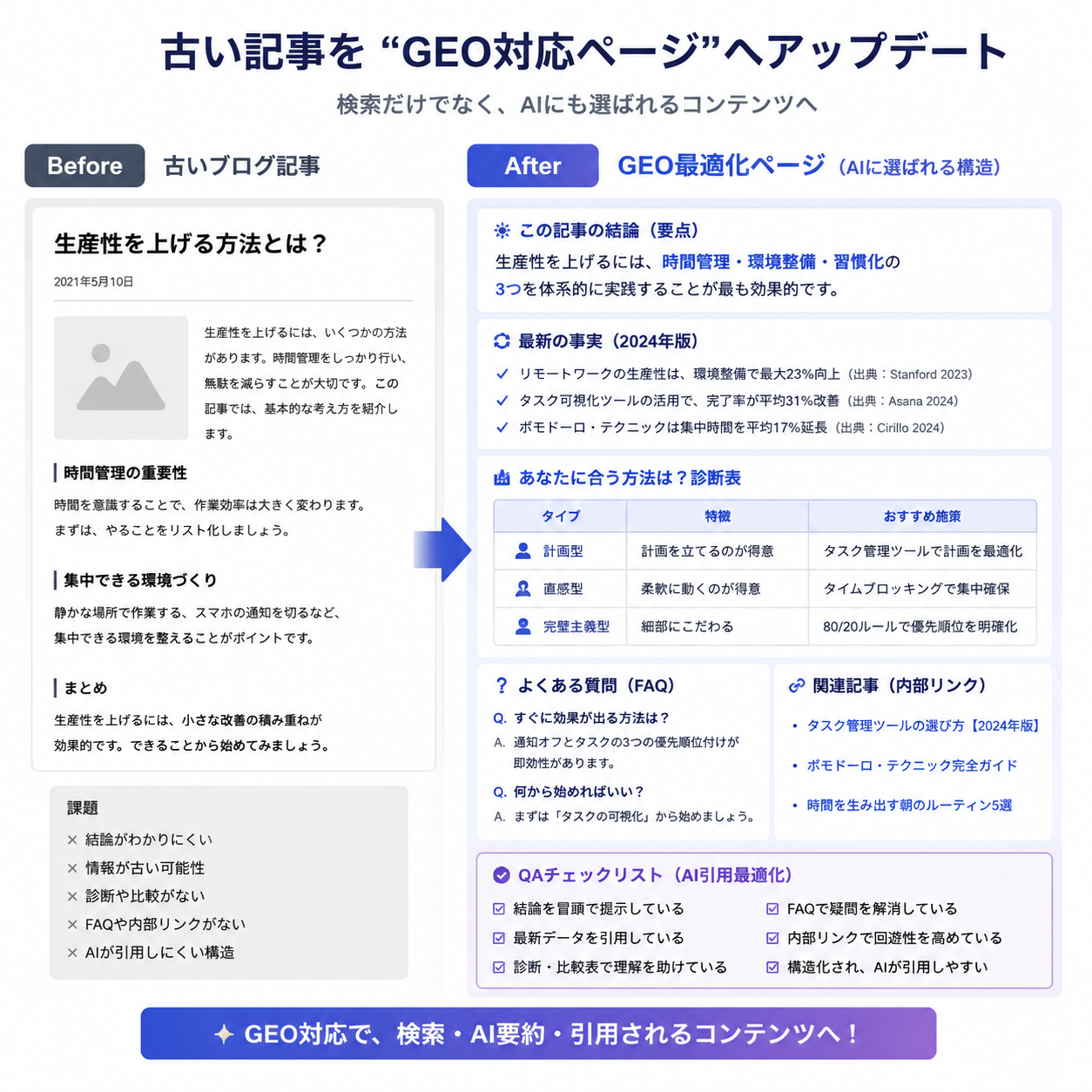
GEO 回答ブロックは、実際のプロンプトに短く直接答えるセクションです。まず読者の役に立つべきであり、AI に抽出されやすいことは副次的な効果です。
形式は次の通りです。
## Short answer

[Answer the prompt in 2-4 plain sentences. Name the topic, the problem, the recommended action, and one constraint.]
課題解決プロンプトには診断表を使います。
| Symptom | Likely cause | What to check | Fix |
|---|---|---|---|
比較プロンプトには判断表を使います。
| Situation | Choose this | Why |
|---|---|---|
Hermes へのプロンプト:
Create GEO answer blocks for the approved refresh plan.

For each answer block, include:
1. The prompt it answers
2. The recommended location in the article
3. The answer block text
4. Any supporting table or checklist
5. Evidence or source needed

Rules:
- Keep the answer direct.
- Do not add unsupported claims.
- Do not use vague language like "improve visibility" without explaining how.
- Make the answer useful to a human reader.
例:
## Short answer

If your page has high impressions but low clicks in Google Search Console, the page is visible but not persuasive enough in the search result. Check the top query, title tag, meta description, current snippet, and whether the page actually matches the user's intent. Start with a title/meta test before rewriting the whole article.
Step 6:title と meta description を慎重に更新する
title と meta の変更は CTR 改善に役立つことがありますが、過剰な約束をするとユーザーを誤解させます。Hermes には最終案ではなくテスト案を作らせます。
プロンプト:
Create title and meta description test options for this refreshed article.

Use the GSC query data and refresh plan.

Return:
1. Current title and meta, if available
2. Three title options
3. Three meta description options
4. Query or intent each option targets
5. Risk of overpromising
6. Recommended option

Do not stuff keywords.
Do not promise outcomes the article cannot deliver.
判断表:
選択肢 | 向いている場合 | リスク |
|---|---|---|
Query-led title | 1 つのクエリで表示回数が強い | ページを狭くしすぎる可能性 |
Benefit-led title | 記事が実務タスクを解決する | 広すぎると過剰約束になりやすい |
Template-led title | ユーザーが再利用素材を明確に求めている | 記事内に本物のテンプレートが必要 |
Comparison-led title | 検索意図が評価・比較である | 公平な比較表が必要 |
Step 7:内部リンクを更新する
古い記事は孤立しているためにパフォーマンスを落とすことがあります。Hermes には両方向を確認させます。
- どのページからリフレッシュ記事へリンクすべきか。
- リフレッシュ記事からどのページへリンクすべきか。
プロンプト:
Create an internal link update plan for this refreshed article.

Use:
- Existing page inventory
- Current article
- Refresh plan
- Target cluster

Return:
1. Source pages that should link to this article
2. Target pages this article should link to
3. Suggested anchor text
4. Reason the link helps the reader
5. SEO benefit
6. GEO benefit
7. Risk of irrelevance

Avoid repetitive anchor text.
Do not force links that do not fit the section.
内部リンク表:
| Source URL | Target URL | Anchor text | Reader reason | SEO role | GEO role | Approval |
|---|---|---|---|---|---|---|
リンクは自然に保ちます。悪い内部リンクは最適化ではなく、読者の邪魔です。
Step 8:変更セクションだけを下書きする
初心者は Hermes に記事全体の書き換えを頼みがちです。しかし、それは有用な部分を消してしまうことがあります。まずは変更対象セクションだけにします。
プロンプト:
Rewrite only the approved sections from refresh-plan.md.

Rules:
- Preserve sections marked "keep".
- Only edit sections marked "update" or "add".
- Keep the original useful examples unless they are outdated.
- Add answer blocks where approved.
- Add tables or checklists only where they improve clarity.
- Mark any claim that needs source verification.
- Return the updated sections, not the full article.
セクション編集が承認されたら、Hermes に全文を組み立てさせます。
Assemble the refreshed article using:
- Original sections marked keep
- Approved rewritten sections
- Approved new sections
- Approved internal links

Return the full Markdown draft and a change log.
変更ログは重要です。
## Change log
| Section | Change | Reason | Evidence |
|---|---|---|---|
Step 9:リフレッシュ QA ゲートを通す
qa/content-refresh-gate.md を作成します。
# Content refresh QA gate

## Data and diagnosis
- [ ] Refresh was based on GSC, GA4, crawl, or prompt gap evidence.
- [ ] Missing data was marked as missing.
- [ ] The plan was approved before rewriting.

## SEO
- [ ] Search intent is clearer than before.
- [ ] Title/meta options do not overpromise.
- [ ] Internal links are relevant.
- [ ] No cannibalization risk was introduced.

## GEO
- [ ] High-priority prompts have direct answer blocks.
- [ ] Entities are named clearly.
- [ ] Evidence, tables, or examples support important claims.
- [ ] FAQ questions are based on real prompts or queries.

## Safety
- [ ] No invented statistics.
- [ ] No fake citations.
- [ ] Outdated facts were updated or removed.
- [ ] Technical changes were approved by a technical reviewer.
- [ ] Final draft is approved before CMS update.
プロンプト:
Review the refreshed draft against qa/content-refresh-gate.md.

Return:
1. Pass/fail for each item
2. Specific sections that fail
3. Claims needing source verification
4. Overpromising title/meta risks
5. Internal link concerns
6. Whether the draft is safe to publish after human review
QA ゲートに落ちたら公開してはいけません。セクション単位の修正を依頼します。
Step 10:公開後に計測する
リフレッシュ作業にはフォローアップが必要です。公開前に計測メモを追加します。
# Post-refresh measurement plan

Page:
Publish date:
Baseline period:
Comparison period:
Primary SEO metric:
Secondary SEO metric:
Primary GEO prompt:
Secondary GEO prompts:
Conversion or engagement metric:
Next review date:
推奨チェック期間:
期間 | 確認すること |
|---|---|
7 日 | インデックス、レンダリング、壊れたリンク、明らかな計測問題 |
14〜28 日 | GSC の表示回数、クリック、CTR、クエリ構成 |
30〜60 日 | エンゲージメント、CV、内部リンク影響、プロンプト可視性 |
90 日 | 維持、拡張、統合、再リフレッシュの判断 |
Hermes へのプロンプト:
Create a post-refresh measurement plan for this page.

Use the baseline data from GSC, GA4, crawl, and prompt checks.

Return:
1. Metrics to watch
2. Baseline values if available
3. Review dates
4. Expected signals
5. What to do if performance improves
6. What to do if performance does not improve
即時の結果を期待しないでください。重要なのはフィードバックループを作ることです。
初心者向け例:低 CTR 記事をリフレッシュする
シナリオ:GSC and GA4 reporting に関する記事は表示回数が多いが CTR が弱い。
入力 | 根拠 |
|---|---|
GSC | クエリ |
GA4 | ページにはオーガニックセッションがあるがキーイベントが少ない |
GEO prompt check | プロンプト「GSC と GA4 を SEO レポートでどう接続するか」がこのページを引用しない |
Crawl | タイトルが一般的で、meta description がない |
Hermes の推奨:
修正 | 理由 |
|---|---|
短い回答ブロックを追加 | ページには直接的なワークフロー説明が必要 |
6 ステップのセットアップセクションを追加 | クエリは How-to 意図を示している |
診断表を追加 | 読者が GSC と GA4 の違いを理解しやすくなる |
「GSC + GA4 SEO reporting」を含む title をテスト | 表示回数の多いクエリにより一致する |
analytics template への CTA を追加 | GA4 では CV 経路が弱い |
SEO dashboard 記事から内部リンクを追加 | reporting クラスターを強化する |
これは狙いを絞ったリフレッシュです。全文書き換えではありません。
よくある失敗
失敗 | なぜ悪いか | より良い方法 |
|---|---|---|
最初に記事全体を書き換える | 有用な内容を消し、本当の問題を隠します | 書き換え前に診断する |
公開日だけ更新する | 価値がほとんど増えません | 事実、構造、例、回答を更新する |
GSC のクエリ変化を無視する | 変化した検索意図を見落とします | 直近期間と前期間を比較する |
根拠のない FAQ を追加する | 水増しになります | 実際のクエリとプロンプトギャップを使う |
タイトルで過剰に約束する | 一時的に CTR が上がっても信頼を損ないます | 実際のページ価値に合わせる |
QA なしで公開する | 捏造された主張や弱いリンクが残ります | リフレッシュゲートを通す |
Auspia の見解
コンテンツリフレッシュは Hermes の最初の用途として非常に向いています。入力が具体的だからです。既存記事、パフォーマンスデータ、プロンプトギャップ、目に見えるページ構造があります。Hermes はそれらを比較し、正確な修正案を提案できます。
有用なパターンは「これを良くして」ではありません。有用なパターンは、診断、計画、承認、変更セクションの書き換え、QA、公開、計測です。
このループを再現可能にすれば、古いコンテンツはバックログではなく、積み上がる資産になります。
FAQ
リフレッシュ時に Hermes に記事全文を書き換えさせるべきですか?
最初は避けてください。Hermes には記事を診断させ、リフレッシュ計画を作らせ、承認済みセクションだけを書き換えさせます。全文書き換えは有用な内容を消し、新しい誤りを入れる可能性があります。
コンテンツリフレッシュにはどのデータを使うべきですか?
現在の記事、GSC のクエリ/ページデータ、GA4 のランディングページ行動、クロールデータ、GEO プロンプトギャップから始めます。不足データがある場合、Hermes は推測せず missing と示すべきです。
GEO 回答ブロックとは何ですか?
GEO 回答ブロックは、実際の AI 検索プロンプトまたは読者の質問に対する短く直接的な回答です。通常はセクション冒頭付近に置き、表、チェックリスト、診断要約を含むこともあります。
古い記事はどれくらいの頻度でリフレッシュすべきですか?
重要ページは 3〜6 か月ごとに見直します。GSC でクリック、表示回数、CTR、クエリカバー範囲が大きく落ちた場合は、もっと早く見直します。年齢だけでなく根拠に基づいてリフレッシュしてください。
title 更新はパフォーマンスを悪化させることがありますか?
あります。title 変更がページ内容やクエリ意図と合わなくなると関連性が下がる可能性があります。title 変更はテストとして扱い、公開前にベースラインを記録してください。
リフレッシュが成功したかどうかはどう判断しますか?
公開後に GSC のクリック、表示回数、CTR、平均掲載順位、GA4 のエンゲージメント、CV、GEO プロンプト可視性を追跡します。初期の検索シグナルは 14〜28 日、より強い行動シグナルは 30〜60 日で見ます。
Hermes はリフレッシュ記事を自動公開できますか?
初心者ワークフローでは自動公開しないでください。Hermes はリフレッシュ下書きと QA レポートを準備できますが、CMS 更新前に人間が最終版を承認すべきです。
Hermes SEO/GEO シリーズを続けて読む
- 最初に読む:Hermes SEO/GEO オペレーターガイド
- 前のガイド:SEO キーワードから GEO プロンプトマップを作る方法
- 次のガイド:Hermes で内部リンクとサイト構造を設計する方法
- 関連ガイド:SEO キーワードから GEO プロンプトマップを作る方法、Hermes で週次 SEO/GEO モニタリングを行う方法
Author: Miles Carter, Auspia の 10,000 URL 以上を分析してきたコンテンツ劣化アナリスト。Miles は古い記事の更新、コンテンツ劣化、鮮度計画、根拠に基づくリフレッシュワークフローについて執筆しています。